











A wine can finish alcoholic fermentation and still be a long way from the bottle. It may need time, a different vessel, a carefully chosen blend or protection against an unwelcome change after sale. Wine maturation and finishing bring these decisions together. The aim is not to perform every possible treatment, but to make a stable wine whose development suits its intended use.
Article #8 · Part I: Wine Science, Viticulture, and Winemaking. This independent lesson follows Unit 1 LO1, criterion 3, in the 2022 Issue 2 WSET Level 3 specification. Explain vessels, oxygen, sulfur dioxide, lees, malolactic conversion, blending, clarification, stabilisation, packaging, closures and bottle development. Original TFE exercises are not official WSET material; no affiliation or endorsement is implied.
Maturation is purposeful change
Maturation is a period in which a wine develops under selected conditions before or after packaging. Some styles are intended to preserve youthful fruit and reach customers relatively quickly. Others benefit from a longer period in a vessel or bottle. Time alone is not a quality ingredient: a wine without suitable fruit, structure or condition can deteriorate rather than improve.
Think of the starting wine, the environment and the intended outcome. A fruit-led aromatic white may need protection and prompt preparation for bottling. A structured red may be given more time for its components and texture to develop. These are production choices, not rules that all whites must be young or every tannic red requires years in new oak.
Choose the vessel before assuming its effect
Stainless steel is relatively easy to clean, can support effective temperature control and adds no oak flavour. Concrete provides another non-oak environment, with thermal and oxygen behaviour influenced by construction and lining. Glass bottles offer a further maturation setting after packaging. The term “inert vessel” primarily distinguishes these from flavour-active wood; it should not imply that every example has identical physical performance.
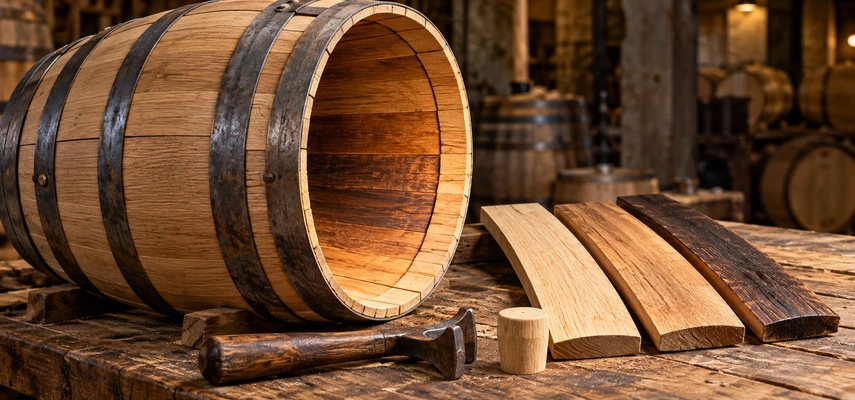
Oak can contribute extractable compounds and a particular maturation environment. Fermenting in oak and moving an already fermented wine into oak are different timings, with different interactions among wine, wood and microbes. An oak aroma does not prove which sequence was used. Nor does a tank-fermented wine necessarily remain completely free of oak influence if alternatives are used later.
The Bourgogne white-wine production guide illustrates fermentation and maturation choices alongside lees and blending. Read the operations as a set of adjustable decisions. The vessel participates in a process; it is not a complete description of the wine.
Newness, size and cooperage change oak influence
New oak generally has more readily extractable flavour compounds than wood that has already held several wines. Smaller vessels offer more wood surface relative to the volume they contain than larger vessels. These relationships help explain why a small new barrel and a large old cask need not give the same oak impression, even over the same length of time.
Oak species and origin influence composition, while seasoning and barrel production alter it further. Heating or toasting during cooperage changes the compounds available to the wine. Vanilla, spice, toast, smoke or coconut-like impressions can result, depending on the wood, treatment and wine. Avoid a rigid rule that every French barrel tastes elegant or every American barrel tastes like coconut.
The relevant variables include species, forest or source, seasoning, toast, newness, size, time and the particular wine. Wine Australia’s research on flavour compounds discusses oak-related composition and transformations. Those variables explain possibilities, not an automatic quality hierarchy based on country of origin.
Oak alternatives, such as chips or staves, can supply wood-derived compounds in another vessel. They may reduce some material or handling costs compared with a barrel programme, but do not recreate every aspect of barrel maturation. Compare the actual mechanisms and intended result. A barrel purchase is a cost, not proof that its contents are balanced.
Oxygen must be managed at each stage
Controlled exposure can contribute to desirable changes, particularly in some red-wine maturation programmes. Excessive or unwanted exposure can reduce fresh aromas, alter colour and lead to oxidative deterioration. Wine composition, vessel, temperature, transfers and time all influence the result. More oxygen is not the same thing as more maturity, and less oxygen is not a guarantee against every fault.
Racking and other transfers can introduce oxygen, so producers can choose protective handling where appropriate. Filling vessels correctly, monitoring condition and managing exposure help preserve the intended style. An old oak vessel can remain useful even when it contributes little fresh wood flavour. Wood flavour and oxygen management are related decisions, but not interchangeable explanations.
Sulfur dioxide supports protection, not neglect
Sulfur dioxide, often abbreviated SO2, has antioxidant and antimicrobial roles in winemaking. Its useful effect depends on wine composition and conditions, including pH and how much is in available rather than bound forms. A single addition is not permanent protection against every oxidation or microbial problem. Hygiene and controlled handling remain necessary.
The OIV’s SO2 practice review places it within a wider management system. The educational task is to explain its protective roles, not provide a universal dose or assert that every wine needs the same amount. Relevant permissions and limits must be checked for the actual production and market context.
Lees contact and malolactic conversion are distinct
Lees are sediments containing yeast and other material. Suitable fine lees can be retained during maturation; heavier or unsuitable deposits may be removed. As yeast cells break down through autolysis, compounds released into the wine can affect texture and other characteristics. Time on lees is therefore a managed interaction, not merely a refusal to clean up after fermentation.
Bâtonnage, or lees stirring, resuspends the sediment and changes contact with the wine. It may influence texture and aroma, but also requires monitoring of condition and exposure. Not every white wine benefits from stirring, and retaining every deposit indefinitely is not a definition of quality. The fruit, lees condition, vessel and intended style matter.
Malolactic conversion is a bacterial change from malic acid to lactic acid, reducing acidity and affecting style. It can occur in tank or barrel and may overlap with other production stages. AWRI’s fact sheet describes possible aroma and mouthfeel effects. Do not attribute every creamy or buttery impression solely to new oak, or equate lees contact with acid conversion.
Blend for a stated reason
Blending combines components to achieve an objective. Balance may improve when one component supports another; consistency may be sought across production batches or vintages; style may require a particular combination of varieties, parcels, vessels or treatments. A successful explanation identifies the components and what their changing proportions are intended to do.
Imagine a red component with firm structure and another with rounder fruit. Trials may find a proportion that suits the target wine better than either alone. Alternatively, a portion matured in new oak may be blended with unoaked or older-vessel material to adjust oak influence. These are hypothetical mechanisms, not promises that every blend improves quality or repairs faults.
Blending can change chemical stability as well as flavour. Testing separate components is not sufficient if the final mixture behaves differently. This is one reason that the production sequence matters: preparing a final blend and then confirming its condition is different from assuming that previously tested wines remain stable in every combination.
Clarification removes unwanted suspended material
Sedimentation allows particles to settle under gravity, followed by separation of wine from deposits. Fining adds a material that interacts with selected unwanted components, helping remove them. Different agents address different targets, such as unstable proteins, excessive phenolics or unwanted appearance. Appropriate trials help avoid treating every wine with the same recipe.
For example, bentonite can help remove proteins associated with haze in some white wines. Other fining materials can change tannin or other components. Over-treatment may remove desirable characteristics or create unnecessary loss and cost. AWRI’s fining guidance emphasises selecting an agent for the actual objective. Fining is not simply another word for filtration.
Depth filtration retains particles within a filtering medium. Surface filtration retains them at a filtering surface, such as an appropriate membrane. Filter type, pore characteristics, preparation and operation determine what is removed. A clear-looking wine is not necessarily microbiologically stable, and a coarse filtration cannot be assumed to remove every yeast or bacterium.
The IFV filtration guide distinguishes the mechanisms, while Wine Australia’s filtration advice stresses fit-for-purpose filtration and integrity testing. Correctly selected filtration need not strip a wine of quality. Assess the treatment and result rather than assuming that “unfiltered” is either a defect or a mark of superiority.
Stabilisation prevents specified later changes
Tartrate stabilisation reduces the risk of unwanted crystal formation after packaging. One approach cools the wine to encourage crystal precipitation, then separates the crystals under suitable conditions. Other permitted approaches manage the relevant constituents or crystallisation. The objective is stability for the intended handling conditions, not the removal of all natural acidity from the wine.
Microbiological stabilisation addresses organisms that could cause unwanted fermentation or spoilage. A wine containing fermentable sugar needs particular attention to viable yeast and subsequent contamination. Appropriate filtration, protective management and hygienic bottling can work together. An intact filter does not protect wine that is contaminated again downstream.
Protein stability is a further finishing concern, often addressed through appropriate fining and testing. Wine Australia’s stability guidance explains why additions, acid adjustment or blending can require reassessment. Distinguish visible clarity now from stability later. They are connected but answer different questions.
Packaging and closures influence the wine’s future
| Choice | Useful property | Decision or tradeoff |
|---|---|---|
| Glass bottle | Strong barrier and familiar storage format. | Weight, breakage, transport and closure performance matter. |
| Plastic packaging | Can reduce weight and suit some distribution needs. | Barrier properties and intended storage period need assessment. |
| Bag-in-box | Collapsing inner bag can limit air replacement during dispensing. | Material permeability, tap integrity and intended shelf life remain relevant. |
| Natural cork | Traditional cylindrical seal with variable natural material. | Quality control, taint risk and oxygen performance need attention. |
| Technical cork | Manufactured cork-based closure with designed properties. | Product construction and performance differ; assess the specific closure. |
| Synthetic closure | Alternative manufactured seal. | Oxygen transfer and storage suitability vary by product. |
| Screw cap | Manufactured closure with liner-dependent performance. | Application and liner selection matter; ageing is still possible. |
Packaging is a system: wine, container, closure, oxygen picked up during filling and storage all interact. A heavy bottle does not establish higher wine quality. A screw cap does not mean a wine cannot develop, and a cork does not guarantee successful long ageing. AWRI’s packaging resources highlight operations and closure performance as part of production control.
Bottle ageing requires suitable material and storage
In bottle, aroma, colour and texture can change as chemical reactions continue. Some youthful fruit notes diminish while tertiary characteristics may emerge. Red wines can develop different colour tones and sediment, while white wines may deepen in colour. These are broad developmental possibilities, not proof that every older bottle has improved or must show the same descriptors.
Potential longevity depends on fruit concentration, structure, balance, production, sound packaging and appropriate storage. Acidity, tannin or sweetness can be relevant, but no single high component guarantees a long life. Assess both whether the wine can continue developing and whether that development is likely to be desirable. Price and reputation are context, not sensory evidence.
Storage conditions such as temperature and light influence the rate and quality of development. A wine intended for early drinking may lose its appeal while waiting for complexity it cannot supply. For a written answer, specify what the maturation or finishing choice changes, what evidence supports its suitability, and which cost or risk it introduces. The point is a coherent wine, not a checklist of expensive treatments.
Knowledge check: 10 original practice questions
1. Why can a small new oak barrel have more flavour impact than a large old cask?
2. What is autolysis?
3. Which statement correctly distinguishes MLC from oak use?
4. What is a specific objective of blending for consistency?
5. Which operation uses a material that interacts with selected unwanted components?
6. Why is a clear-looking wine not necessarily microbiologically stable?
7. What does tartrate stabilisation address?
8. Why can a blend need stability reassessment?
9. What is a sound statement about screw caps?
10. Which claim about bottle ageing is justified?
Answers and explanations
1. C — Several variables. New wood can supply more extractable compounds, and smaller vessels provide more surface relative to wine volume. Origin alone cannot guarantee a fixed outcome.
2. A — Yeast breakdown. Autolysis can change the wine during lees contact. It is different from acid conversion, packaging or adding sugar.
3. D — Separate processes. Bacterial acid conversion does not depend on oak. A wine’s aroma or texture can reflect several overlapping decisions rather than one vessel alone.
4. B — Intended continuity. Combining components can help reproduce a desired style across production. The resulting wine still needs assessment, including relevant stability checks.
5. A — Targeted interaction. Fining agents interact with particular components to assist removal. They must be selected and trialled for the actual purpose.
6. D — Appearance is insufficient. A wine can look bright while retaining organisms and substrates for later change. Clarity and microbiological stability need different evidence.
7. C — Crystal control. The target is unwanted tartrate precipitation after packaging under expected conditions. It is not the elimination of all natural acidity.
8. B — Composition changes. The final mixture can have a different balance of constituents. Separate component tests cannot establish stability under every final condition.
9. D — Designed performance. Liner, application and the whole package influence development. The closure category alone is neither a quality verdict nor a bar to ageing.
10. A — Suitability matters. Desirable ageing requires more than elapsed time. Inappropriate storage or unsuitable starting wine can lead to deterioration instead of improvement.
Written exercise 1: compare oak choices
Question: Two portions of the same wine mature for the same period, one in small new oak barrels and the other in a much larger old oak cask. Explain two reasons their oak flavour influence may differ. Identify one cost associated with a small-barrel programme. Suggested marks: 5. Learning outcome: Unit 1 LO1, criterion 3.
Indicative marking points: One point each for more readily extractable compounds in new wood; older wood having already lost some extractable material to previous wines; greater surface-to-volume ratio in smaller barrels; connecting that ratio with potentially stronger wood influence; and a specified cost such as barrel purchase, handling labour or storage. Keep the conclusion conditional on other production variables.
Model answer: New oak usually has more readily extractable flavour compounds, while the old cask has already given some of its compounds to previous wines. Small barrels also expose each unit of wine to more wood surface than a large cask, potentially increasing oak flavour influence over the same period. Purchasing and individually handling many barrels adds cost. Toast, wood composition and the wine itself still affect the result.
Why it earns credit: Newness and size are separate mechanisms, followed by a separate commercial point. Common mistake: attributing every difference to national oak origin or assuming more oak proves higher quality.
Written exercise 2: separate clarity from stability
Question: A bright, sweet wine is being prepared for bottling. Explain why appearance alone does not establish microbiological stability, and describe the objectives of appropriate membrane filtration and hygienic downstream handling. Suggested marks: 5. Learning outcome: Unit 1 LO1, criterion 3.
Indicative marking points: One point each for organisms potentially remaining despite clarity; residual fermentable sugar providing a substrate; suitable validated membrane filtration removing target organisms; integrity/operation needing to be appropriate; and hygienic subsequent handling preventing recontamination before packaging. Accept accurate equivalent phrasing without exceeding five.
Model answer: The wine may look clear while viable organisms remain, and residual sugar provides material that yeast could ferment. Appropriate, validated membrane filtration aims to remove the target organisms, with filter integrity and operation checked. Hygienic handling after that step is needed to prevent organisms entering again before packaging. The bright appearance alone proves none of those controls has succeeded.
Why it earns credit: Risk, substrate, removal and prevention of reintroduction form a complete chain. Common mistake: assuming every filter grade sterilises wine or that successful filtration excuses contamination later on the line.
One-page revision summary
Explain vessels through their material, size, age and use. Distinguish oak influence, oxygen, lees breakdown and malolactic conversion. Blend for a stated objective, then recheck the final wine where composition changes affect stability. Clarification is not identical to tartrate or microbial stabilisation. Packaging and closures shape future performance, while desirable bottle ageing requires suitable wine and storage rather than time or price alone.












