










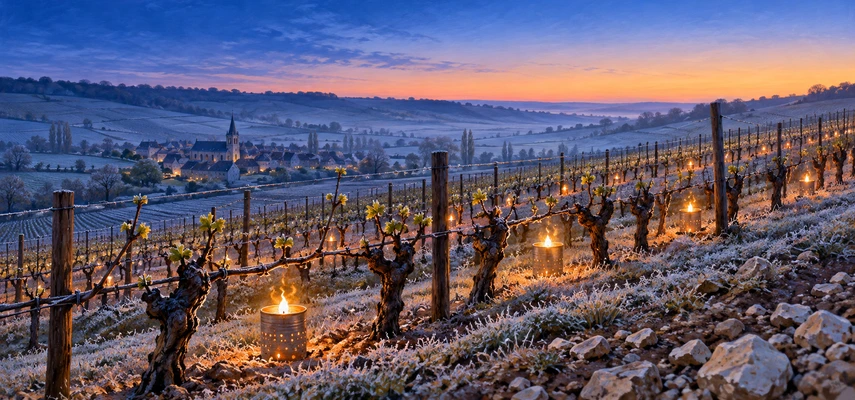

Chablis is Chardonnay with its surroundings turned up. The grape that can produce a broad, tropical, heavily oaked white elsewhere often gives lemon, green apple and a firm line of acidity here. That isn’t a different variety hiding behind a French place name. It’s a lesson in how climate, site and winemaking change the same raw material.
The most useful question isn’t “Does Chablis taste of limestone?” It’s “What do these sites let Chardonnay do, and how do growers protect the result?” We’ll follow that chain through frost, slopes, cellar choices and labels. This independent lesson follows the Chablis and Chardonnay requirements in the WSET Level 3 specification; its practice material is original, not official WSET examination content.
Where Chablis sits, and why that matters
Chablis lies around the town of the same name in the Yonne, in northern Burgundy, well north of the Côte d’Or. Vineyards occupy the Serein valley and its surrounding slopes and plateaux. All the area’s principal appellation styles are dry white wines from Chardonnay. The Chablis wine board’s introduction describes the region’s northerly, semi-continental setting.
For Level 3, think cool continental conditions, with cold winters, spring frost risk and significant vintage variation. Summer days can still become hot: “cool climate” doesn’t mean the vines spend August shivering. In cooler seasons, achieving flavour ripeness can be difficult. In warmer seasons, growers may need to preserve acidity and avoid excessive sugar accumulation or sunburn.
Chardonnay ripens relatively early, which helps it succeed at this latitude. Its early budding creates a different problem: tender green tissue may emerge while damaging frosts are still possible. A grape can be well suited to a region’s growing season and still need costly protection near the beginning of it.
Rain and humidity can encourage fungal disease, while hail can damage fruit locally. Harvest rain complicates decisions about ripeness, dilution and rot. Vintage therefore affects both the wine’s potential style and the volume available for sale. Climate gives the broad setting; the weather supplies this year’s practical difficulties.
Read the slope before memorising the soil
In a cool region, a well-exposed slope can intercept more useful sunlight than a poorly exposed site. South-facing aspects often assist ripening; drainage and airflow also matter. Cold air can collect in low areas on still nights, so a valley-floor site may face greater radiation-frost risk than a suitable slope above it. That is a tendency, not immunity for every hillside.
The Grand Cru sector occupies a favourable hillside on the Serein’s right bank, overlooking Chablis. Its predominantly south to south-west exposure helps Chardonnay ripen. Premier Cru sites occur on both sides of the valley with differing aspects. The wine board’s Grand Cru account connects its location and exposure with the wines’ character.
Topography also changes practical costs. Steeper parcels can require more difficult tractor work or additional hand labour. Exposed sites may face wind; shallow soils can dry rapidly. A favoured address still needs management suited to the actual parcel, especially in unusual weather.
Kimmeridgian, Portlandian and the fossil question
Kimmeridgian refers to a geological age associated locally with alternating limestone, marl and clay-rich layers, often containing small marine fossils. Marl mixes clay and calcium carbonate. These materials help shape soil structure, drainage, water storage and rooting conditions. The important link is how the vine obtains water and grows, not the idea that its roots collect a ready-made oyster aroma.
Portlandian, often called Tithonian in modern geological terminology, is associated with younger, harder limestone in the area. Petit Chablis frequently occupies higher slopes or plateau sites on these formations. The wine board’s geology seminar explains the distinction. Don’t turn the two geological names into “good soil” and “bad soil.” Exposure, soil depth, water availability and management still affect performance.
Tasters often use “mineral,” “stony,” “chalky” or “flinty” for Chablis. Those are sensory descriptions, not a chemical test identifying a vineyard’s bedrock. A fossil-rich origin doesn’t demonstrate direct transfer of rock flavour into the wine. In an explanatory answer, describe a plausible water, temperature or ripening mechanism before moving to the finished wine.
Four levels to recognise on a label
The local wine board commonly presents a four-level ladder. Technically, Premier Cru is a designation within Chablis rather than a separate grape or producer ranking. The official overview provides the familiar hierarchy. These are delimited origins and production requirements, not a tasting competition repeated every harvest.
| Label | What it tells you |
|---|---|
| Petit Chablis | A distinct appellation, commonly on higher slopes and plateaux. Fresh citrus or floral fruit, lighter body and early drinking are useful expectations. |
| Chablis | The broader core appellation. Wines typically show dry, fresh citrus or apple character, with concentration and ageing potential varying by site and producer. |
| Chablis Premier Cru | Wine from specified sites within Chablis, often with favourable exposure. A named climat may appear, and greater concentration or complexity is possible. |
| Chablis Grand Cru | One Grand Cru appellation with seven recognised climats on a defined hillside. Wines can be richer and more concentrated while retaining freshness. |
The Petit Chablis profile explains its plateau setting. “Petit” doesn’t mean dilute wine made from discarded Grand Cru grapes. It identifies an origin. Likewise, a producer’s name alone cannot tell you which appellation is in the bottle: the same business may make wines from several levels.
A climat is a specifically identified vineyard area with its own historical and geographical identity. It doesn’t mean the day’s weather. Premier Cru names such as Fourchaume or Montée de Tonnerre identify sites, not grape varieties. The Premier Cru account explains the site-based structure. Some smaller names can sit within a principal climat’s grouping, so different labels needn’t imply different hierarchy levels.
The seven Grand Cru climats are Blanchot, Bougros, Grenouilles, Les Clos, Preuses, Valmur and Vaudésir. Learn that they share one appellation before treating them as seven separate appellations. Their names can appear after Chablis Grand Cru. An optional site name gives more geographical detail; its absence doesn’t turn Grand Cru into village Chablis.
Frost protection: the expense starts before the grapes exist
Frost can kill new shoots and developing inflorescences, sharply reducing the eventual crop. Later secondary growth may partly compensate, but it doesn’t necessarily restore the original volume or ripening schedule. This is why protecting a small green shoot has consequences for both this year’s wine and the grower’s income.
Growers can use vineyard candles or heaters to add heat locally. Sprinklers provide another method: water releases heat as it freezes, helping protect tissue when the system is designed and operated correctly. They require a dependable water supply and careful timing. Ice isn’t a magic insulating coat that works regardless of water application. The BIVB’s Chablis teaching presentation illustrates local frost protection.
Choice depends on the site, available infrastructure and frost conditions. Equipment, fuel, water and overnight labour add costs, and protection has limits. In a damaging frost year, those costs may be spread over fewer bottles. A small harvest can raise unit costs even before demand affects market prices.
From Chardonnay juice to a recognisably fresh wine
Healthy fruit and an appropriate picking date provide the foundation. Growers manage crop levels and canopy to reach flavour ripeness while retaining acidity. Leaving too much crop can delay ripening; removing too much leaf can expose berries during heat. The useful response follows conditions rather than an annual instruction to do everything more aggressively.
After pressing and juice clarification, controlled fermentation produces a dry white. Stainless steel or other neutral vessels preserve fruit without obvious new-oak aromas. The wine can retain fresh apple or citrus character, with lees contact adding some texture. Stainless steel doesn’t prevent complexity, and its presence doesn’t prove that every cellar step was identical.
Malolactic conversion is common in Chablis. It transforms sharper malic acid into softer lactic acid, helping balance naturally high acidity. A wine may still taste crisp afterwards because it began with substantial acidity. The Maison Castel production account gives an example using controlled fermentation, malolactic conversion and lees ageing. Don’t infer “no malo” simply from a fresh finish.
Oak is a choice, not a contradiction. Some producers use barrels for fermentation or maturation, particularly for more concentrated wines. Older barrels or a limited proportion of new oak can add texture with restrained wood flavour. Pascal Bouchard’s Chablis example combines tank and barrel components. It’s a producer example, not a legally fixed regional recipe. More oak isn’t automatically more quality; the fruit must carry it.
Explain quality and price from evidence
Petit Chablis often prioritises youthful freshness; Chablis offers a wide range of concentration and development potential. Premier and Grand Cru sites can support greater intensity and complexity, but the label doesn’t guarantee that every bottle will outperform every lower-tier wine. Vintage, harvest decisions, producer skill and storage all matter.
For quality, assess balance, intensity, complexity and length. A very high-acid wine isn’t automatically outstanding: it needs sufficient fruit and a balanced overall impression. Nor is a rounder warm-vintage wine automatically inferior because it contradicts a memorised image of Chablis. Describe what is actually present, then judge how well the parts work.
Ageworthy examples may develop honeyed, nutty or savoury complexity. Not every bottle needs ageing, and acidity alone doesn’t guarantee improvement. Fruit concentration and sound condition matter. A wine intended for early drinking can fulfil its purpose very well without becoming more interesting after a decade.
Grape prices reflect land, origin, yields and vineyard work. Frost prevention, difficult terrain, sorting, barrels and longer cellar time raise production costs. Transport, storage, applicable import charges and trade margins influence shelf prices. Demand for a limited Grand Cru supply or a sought-after producer can add a premium beyond those costs. Classification affects market expectations; it doesn’t replace the commercial explanation.
For an exam answer, join each link explicitly: favourable exposure improves ripening potential; ripe Chardonnay supplies flavour to balance acidity; suitable cellar choices preserve or build on that fruit. Then explain which decisions cost more. That chain gives you an answer you can adapt when the question changes the site, the season or the producer’s intended style.
Knowledge check: 10 original questions
Choose one answer for each question. The questions are independent practice material.
1. Why is Chardonnay’s early development both useful and risky in Chablis?
2. Which mechanism best explains why aspect matters in a cool region?
3. What does the term climat identify on a Chablis label?
4. Which statement about Grand Cru is accurate?
5. Why can a Chablis remain crisp after malolactic conversion?
6. What is the key protective mechanism of appropriately operated frost sprinklers?
7. What is the most accurate interpretation of mineral tasting language?
8. Which production statement is correct?
9. What best explains frost damage increasing production cost per bottle?
10. Which label supplies an origin rather than a judgment that the wine is defective or dilute?
Answers and explanations
1. D — Two timings, two outcomes. Earlier ripening helps Chardonnay reach maturity in a northerly region. Early budding, however, exposes young tissue when frost remains possible. The advantage and the hazard concern different stages of development.
2. B — Exposure and ripening. Useful sunlight can improve ripening prospects in a cool setting. Actual outcomes still depend on weather and other site factors. Aspect doesn’t guarantee higher alcohol or remove frost risk from every slope.
3. C — A vineyard identity. A climat is a specifically identified vineyard area, shaped by historical recognition and geographical conditions. It is neither the weather forecast nor an annually renewed ranking of the producer.
4. A — One appellation, several names. The seven recognised climats sit within the Chablis Grand Cru appellation. Site names add detail. Neither seven grape varieties nor mandatory strong oak follows from the label.
5. D — Starting acidity matters. Conversion changes the acid balance but doesn’t imply that the finished wine must taste soft or buttery. Substantial starting acidity can leave a crisp wine afterwards. Freshness alone cannot identify the cellar process.
6. B — Heat released during freezing. Freezing water gives off heat, which a correctly operated system uses to protect vulnerable tissue. Supply and timing matter. The explanation isn’t simply that any ice coating guarantees protection.
7. C — Sensory language. Tasters can use stony or chalky to communicate impressions. Those words don’t prove a direct route from bedrock to aroma or uniquely identify an appellation. Geological explanations need plausible vine-growth mechanisms.
8. A — Producer choices. Steel and barrel use vary, and some wines combine components. Lees contact is possible in different vessels. A classification level doesn’t impose a universal oak recipe for the whole region.
9. D — Fewer bottles carry the costs. Many expenses remain even if frost reduces the harvest. Protection adds further spending, and a smaller saleable crop raises the cost allocated to each bottle. Market demand is a separate issue.
10. B — An appellation name. Petit Chablis identifies a delimited origin with its own requirements. It isn’t a fault diagnosis or a statement that the wine was diluted. Fresh, early-drinking wines can be good examples of their intended style.
Written exercise 1: connect climate with decisions
Question — 5 marks: Explain why spring frost is a concern in Chablis, describe one active protection method, and explain one cost consequence.
Indicative marking points: Award one mark each for Chardonnay budding early; cold events occurring after budburst; damage reducing the crop; a correctly explained active method; and protection expense or fewer bottles carrying fixed vineyard costs.
Model answer: Chardonnay buds relatively early, so green shoots can emerge while spring frosts are still possible. A cold event after budburst can kill shoots and developing inflorescences, reducing the eventual harvest. Growers may use vineyard candles to add heat locally. Buying fuel and deploying protection require expenditure, while any remaining crop loss spreads vineyard costs over fewer bottles. The method reduces risk within its limits rather than guaranteeing a full harvest.
Why it earns credit: It links a grape trait to a hazard, describes the damage, gives a functioning method and follows through to price-related costs. Naming “frost” and “candles” without explaining either would be incomplete.
Written exercise 2: assess a stylistic comparison
Question — 5 marks: A Petit Chablis is light and citrus-led; a Chablis Grand Cru is more concentrated with subtle oak and a longer finish. Suggest five reasons for the difference without assuming classification alone guarantees quality.
Indicative marking points: Award one mark each for more favourable Grand Cru exposure; greater ripening or fruit concentration potential; different vineyard crop/selection decisions; barrel influence on the second wine; and different maturation choices or time affecting texture/development.
Model answer: The Grand Cru hillside may offer more favourable exposure, helping ripening in a cool region. Suitable fruit concentration can support a fuller wine. The producer may also make different crop and selection decisions. Some barrel fermentation or maturation could account for subtle oak, while longer maturation or lees contact may develop texture. These are possible explanations to investigate, not conclusions proven by the label; the wines still need individual quality assessment.
Why it earns credit: Five distinct influences connect site and production with sensory outcomes. A bare statement that Grand Cru is better would explain none of them. These are indicative educational points, not an official WSET mark scheme.
One-page revision summary
| Topic | Connection to remember |
|---|---|
| Location and grape | Northern Burgundy, around the Serein valley; dry white Chardonnay. |
| Climate | Cool conditions support acidity, while vintage variation affects ripeness and crop size. |
| Chardonnay | Earlier ripening suits the growing season; early budding increases frost exposure. |
| Sites | Aspect, slope, cold-air movement and water supply influence ripening and hazards. |
| Geology | Kimmeridgian limestone/marl and younger Portlandian/Tithonian formations shape growing conditions; fossils don’t prove direct flavour transfer. |
| Hierarchy | Petit Chablis, Chablis, Chablis Premier Cru and Chablis Grand Cru supply progressively specific origin information. |
| Grand Cru | One appellation has seven recognised climats, not seven grape varieties or estate ranks. |
| Frost protection | Candles add heat; freezing water releases heat in properly operated sprinkler systems. Both involve costs and limits. |
| Winery | Neutral vessels, oak, lees and malolactic conversion can all play roles. Crispness doesn’t prove that conversion was avoided. |
| Quality and price | Assess balance, intensity, complexity and length. Explain price with origin, production costs, distribution margins and demand. |












