











Champagne explained through a label can sound deceptively simple: a place, perhaps a vintage, and a word such as Brut. Each answers a different question. The place tells you the origin; the vintage identifies a harvest; Brut describes sweetness. None tells you, by itself, whether the wine will taste mainly of citrus and apple or offer layers of toast, nuts and mature fruit.
For WSET Level 3, connect those details with vineyard conditions, grape choices and traditional-method production. This guide follows the Champagne origins, grapes and terms in the official specification. Learn the five assigned growing areas, then explain how a producer can use their differences to build a particular wine.
A northern French origin with a demanding climate
Champagne comes from the defined appellation in north-eastern France, east of Paris. It isn’t a generic name for every sparkling wine. The regional introduction describes a patchwork of vineyards within that shared origin. A blend can combine contrasting parcels; a more specific bottling can emphasise one of them.
Northerly latitude contributes to cool growing conditions. Climate combines oceanic and continental influences: maritime air moderates conditions, while continental weather can bring frost and temperature extremes. Rain, storms and variable weather can affect yields and fruit health. The climate account provides the framework; don’t reduce it to “always cold and wet.”
Altitude, slope and aspect create local differences. Sun-facing slopes can improve exposure, while cold-air drainage can reduce the risk associated with low frost pockets. The aim is enough ripeness for suitable flavours while retaining high acidity and moderate sugar for base wines. High acidity is useful; thin, underripe fruit isn’t automatically desirable.
Keep oceans and large lakes in their proper role when revising sparkling geography. Champagne’s oceanic influence is relevant, but it isn’t explained by an adjacent ocean or a dominant lake. Likewise, fog is an important cooling factor in some coastal sparkling regions, not the principal general explanation for Champagne. Apply each natural factor where it actually matters.
Chalk, marl and the vine’s water supply
Chalk is an important part of Champagne’s identity, but the region also has marl, clay, sand and other limestone settings. Porous chalk can combine drainage with water storage. Those properties influence root conditions and water availability, rather than delivering a finished chalk flavour directly to the glass. The official soil account shows how soils and grape choices vary across the appellation.
Growers still need to manage crop and canopy. Too much crop can delay adequate ripening; poorly managed shade can hinder flavour development or airflow. At the same time, stripping away every leaf can expose fruit excessively in a hot spell. Vineyard work aims at healthy, appropriate ripeness, not one fixed rule for every season.
Three principal grapes, three useful contributions
Chardonnay supplies a useful reference for freshness, citrus or floral character and ageability in suitable wines. Pinot Noir can add body, structure and red-fruit character. Meunier often contributes accessible fruit and roundness. These are broad blending roles, not ingredients that behave identically at every site. The Champagne grape guide explains their importance while recognising that other varieties also exist.
Meunier’s later budburst can reduce exposure to some spring-frost events compared with the other two principal grapes. It isn’t frost-proof, and the timing of the event still matters. Chardonnay and Pinot Noir also differ in their growth and ripening behaviour, so planting choice belongs alongside soil, exposure and local climate in a sensible explanation.
Pinot Noir and Meunier have dark skins, yet can produce white juice with careful pressing and limited skin contact. The grape colour therefore doesn’t mean the finished wine must be red or rosé. For a white sparkling style, unwanted colour and phenolic extraction are things to control rather than achievements to maximise.
Five growing areas to locate and compare
Montagne de Reims, around Reims and toward Épernay, is strongly associated with Pinot Noir. Exposures vary around the slopes, so don’t imagine every vineyard facing the same direction. Pinot-based fruit from suitable parcels can contribute structure and body to blends.
Vallée de la Marne follows the Marne west from the Épernay area. Meunier is especially important in the western valley, with Pinot Noir also significant in eastern areas. Clay-rich and marly settings add a different growing context from the classic chalk slopes. Later budburst helps explain Meunier’s usefulness where spring frost is a concern.
Côte des Blancs, south of Épernay, is closely associated with Chardonnay and chalk. Côte de Sézanne, farther south-west, also provides an important Chardonnay reference. They shouldn’t be collapsed into one place merely because the grape is shared. Local conditions and producer choices can still produce different expressions.
Côte des Bar, farther south in the Aube, is particularly associated with Pinot Noir and marly soils. It remains Champagne, with its own site variation. The Comité Champagne vine factsheet is useful for the main grape-and-area pairings. These are memory anchors, not claims that other varieties are absent or that one area has a monopoly on quality.
Careful harvest and pressing protect the raw material
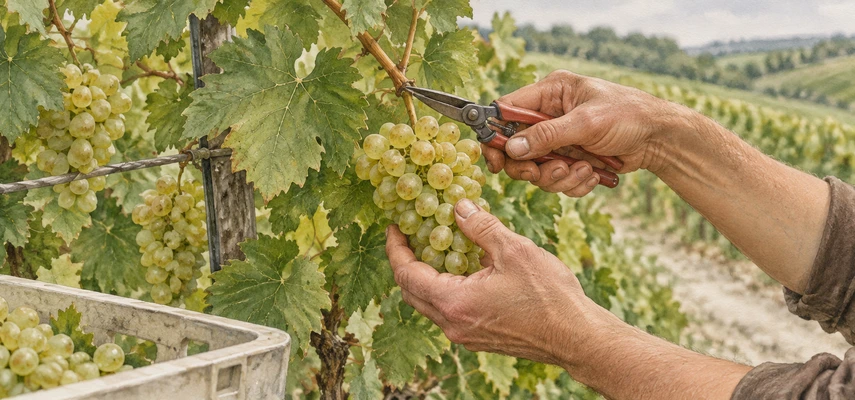
Grapes are harvested by hand in Champagne. Careful handling keeps bunches as intact and sound as possible before pressing, helping limit premature extraction and oxidation. Picking decisions consider variety, location and fruit condition; a single fixed annual date wouldn’t serve every parcel. The harvest account places that work within the production sequence.
Gentle whole-bunch pressing separates juice into fractions with different compositions. The first fraction, the cuvée, differs from the later taille. Here cuvée has a specific pressing meaning, although the word can also refer more broadly to a blend or bottling. The production factsheet sets out the pressing and subsequent stages.
Clarification removes solids before the first alcoholic fermentation makes still base wines. Stainless steel is common, while some producers use oak. Malolactic conversion is optional: it can soften acidity, whereas preventing it preserves a different acid profile. The fermentation explanation illustrates why two producers can start with comparable fruit yet pursue different styles.
Blending and bottle development create the finished style
Blending can combine varieties, sites and harvest years, balancing acidity, fruit and structure. Reserve wines from earlier harvests can support consistency or add developed character. By contrast, a vintage bottling expresses one harvest year under the relevant rules. A non-vintage wine isn’t simply the producer’s leftovers; selecting and balancing components is a central skill.
Liqueur de tirage supplies sugar and yeast for the second fermentation in bottle. Retained carbon dioxide creates the sparkle. Afterwards, time on lees allows autolysis to contribute bread, biscuit or brioche-like complexity and texture. Riddling collects sediment in the neck, disgorgement removes it, and dosage helps set the final profile before closure. Article #38 explains those stages in detail.
The minimum cellar maturation is 15 months from tirage, including at least 12 months on lees, for non-vintage Champagne. Vintage Champagne requires at least three years of maturation. Producers often allow longer. The official production brochure distinguishes the minimums from common practice. Don’t add the twelve months to the fifteen: it is included.
Longer ageing can increase complexity, but the base wine needs sufficient balance and concentration to benefit. Meanwhile, storage, stock and working capital all cost money. A long maturation period explains part of a price; it doesn’t replace tasting evidence of quality.
Read six Champagne terms without mixing their jobs
Non-vintage means no harvest year is claimed; blending different years commonly supports a consistent house style. Vintage Champagne is made from one harvest year, rather than a multi-year blend. Neither term identifies sweetness or automatically proves superiority. The official Champagne FAQ distinguishes these uses.
Blanc de Blancs identifies white Champagne from white grapes, commonly Chardonnay. Blanc de Noirs identifies white Champagne from dark-skinned grapes, notably Pinot Noir and/or Meunier. The terms don’t mean “sweet” and “dry,” nor does Blanc de Noirs mean rosé. Rosé can be made by controlled maceration or by blending with eligible red Champagne wine. The label guide is useful for separating style information from compulsory label details.
Premier cru and Grand cru relate to eligible village origins inherited from Champagne’s historical classification system. They aren’t a Burgundian-style ranking of named individual vineyards, nor current tasting scores. A wine without either term can still be excellent. Do not treat the old village-percentage system as a present-day formula fixing the price of every grower’s grapes.
Sweetness is another axis. Brut nature has less than 3 g/L sugar and no sugar added after second fermentation; Brut has less than 12 g/L; Demi-sec has 32–50 g/L. Extra Dry is sweeter than Brut despite its name. The dosage explanation shows why final sugar needs to be considered alongside acidity and balance. These figures describe standard categories; applicable analytical tolerances aren’t a reason to confuse their intended order.
Assess quality and price through evidence
A convincing Champagne balances acidity, fruit, alcohol, sweetness and effervescence, with appropriate length, intensity and complexity. A fresh style can be successful without years of obvious toast; a mature wine needs more than a famous label. Smaller or finer-looking bubbles alone don’t establish the method, age or quality of a wine.
Separate cost of production from market forces. Hand harvesting, careful pressing, individual-bottle work, lees storage and delayed release add costs. Strong demand, limited supply and brand reputation affect the achievable price separately. Therefore, “expensive because Champagne” isn’t a complete explanation: identify the actual work or demand pressure involved.
For revision, reconnect vineyard choices in #4, white-wine fermentation in #5, maturation in #8 and sparkling methods in #38. Article #40 supplies the comparison beyond Champagne; #49 compares classification systems.
Knowledge check: Champagne
1. Which statement best defines Champagne?
2. Which pairing is a useful study anchor?
3. Why can Meunier’s later budburst be useful?
4. What does Blanc de Noirs mean?
5. Which statement correctly describes the non-vintage maturation minimum discussed here?
6. What does a vintage Champagne identify?
7. Which statement about Premier cru and Grand cru is correct?
8. Why can careful pressing produce white wine from Pinot Noir?
9. Which statement about sweetness categories is correct?
10. Which example most directly concerns market forces?
Answers and explanations
1. C — A protected origin with requirements. Champagne is a particular appellation. Traditional-method production elsewhere doesn’t make the wine Champagne.
2. B — A principal grape-and-area connection. Chardonnay is strongly associated with Côte des Blancs. The pairing doesn’t mean every other grape is absent.
3. D — Timing affects exposure. Buds that haven’t opened may avoid damage from an early spring-frost event. Later budburst doesn’t make the vine frost-proof.
4. A — Grape colour and finished colour differ. Dark-skinned Pinot Noir and/or Meunier can be pressed for white wine. Blanc de Noirs doesn’t identify sweetness or rosé.
5. C — The lees period is included. The fifteen-month minimum includes at least twelve months on lees; those periods aren’t added together.
6. B — A harvest claim. Vintage identifies the year of the grapes. It doesn’t itself identify sweetness, grape proportions or a release date.
7. D — Village-origin terms. These classifications concern eligible origins inherited from the historical system. They aren’t present-day tasting scores or Burgundian individual-vineyard ranks.
8. A — Control extraction. Dark skins contain colour; careful handling and pressing can limit what enters the juice. Dosage doesn’t whiten red wine.
9. C — The terminology can mislead. Extra Dry occupies a sweeter category than Brut. Acidity still affects the impression of balance.
10. B — Demand influences price. Scarcity and reputation affect what a market will pay, separately from harvest, equipment and storage costs.
Written exercise 1: Explain five Champagne production choices (5 marks)
Explain how careful pressing, malolactic conversion, reserve-wine blending, lees ageing and dosage can each influence the style of a Champagne.
Model answer: Gentle pressing can limit unwanted colour and phenolic extraction, supporting a delicate white base wine. Malolactic conversion can soften acidity, while avoiding it retains a sharper acid profile. Reserve wines can help maintain a consistent style or add developed character to a blend. Extended lees contact can add bread-like complexity and texture through autolysis. Dosage can adjust final sweetness and help balance the wine’s acidity.
Why it earns credit: Award one mark each for an explained style link covering (1) pressing, (2) malolactic choice, (3) reserve blending, (4) lees contact and (5) dosage. Naming the stages without explaining their effects doesn’t satisfy the question.
Written exercise 2: Explain a Champagne price difference (5 marks)
A long-aged, small-production Champagne costs more than a simpler, younger bottling. Explain four plausible production-cost reasons and one separate market-force reason.
Model answer: Labour-intensive vineyard work and hand harvesting can raise the cost of the fruit. Careful pressing and selection can reduce the volume allocated to the particular premium wine. Longer cellar maturation occupies storage space. Holding stock for longer delays income and ties up working capital. Separately, strong demand for a scarce producer or bottling can support a higher market price.
Why it earns credit: Award one mark each for (1) vineyard/harvest labour, (2) selection or usable-volume cost, (3) storage cost, (4) delayed income/capital and (5) demand relative to scarce supply. Do not assume the two wines must have identical crop costs or that expensive production automatically creates demand.
One-page revision summary
| Name or idea | Anchor | Explain the consequence |
|---|---|---|
| Champagne | Defined north-eastern French appellation | A method alone doesn’t establish origin |
| Climate and weather | Cool latitude, oceanic/continental influences | Acidity and moderate sugar are useful; frost and rain remain risks |
| Altitude / aspect | Local exposure and cold-air movement | Site differences matter within one appellation |
| Soils | Chalk, marl and other settings | Drainage and water supply, not direct mineral flavour transfer |
| Montagne de Reims | Pinot Noir | Structure/body reference, with varied slopes |
| Vallée de la Marne | Meunier, with eastern Pinot Noir contexts | Later budburst can reduce some spring-frost exposure |
| Côte des Blancs / Côte de Sézanne | Chardonnay | Separate areas sharing an important grape |
| Côte des Bar | Southern Aube, Pinot Noir, marl | Remains Champagne; not uniform with northern areas |
| Main grapes | Chardonnay, Pinot Noir, Meunier | Freshness / structure / fruit-roundness, qualified by site and method |
| Traditional method | Base wine, tirage, bottle fermentation, lees, sediment removal, dosage | Each stage has a different purpose |
| Non-vintage / Vintage | No harvest-year claim / single harvest | Generally style consistency / particular year; neither defines sweetness |
| Maturation | NV fifteen months including twelve on lees; vintage at least three years | Minimums differ from a producer’s longer practice |
| Blanc de Blancs / Blanc de Noirs | White grapes / dark-skinned grapes vinified white | Separate grape identity from finished sweetness |
| Premier cru / Grand cru | Eligible village origins | Historical origin categories, not current tasting scores |
| Brut nature / Brut / Demi-sec | Under 3 g/L with no post-fermentation sugar / under 12 / 32–50 | Sugar categories differ from quality; Extra Dry is sweeter than Brut |
| Commerce | Production costs / market forces | Work and storage differ from demand and reputation |
Take an imaginary “vintage Grand cru Blanc de Blancs Brut.” Explain the separate information in each term, then list the important questions the label still doesn’t answer about flavour, balance, maturity and value.












