










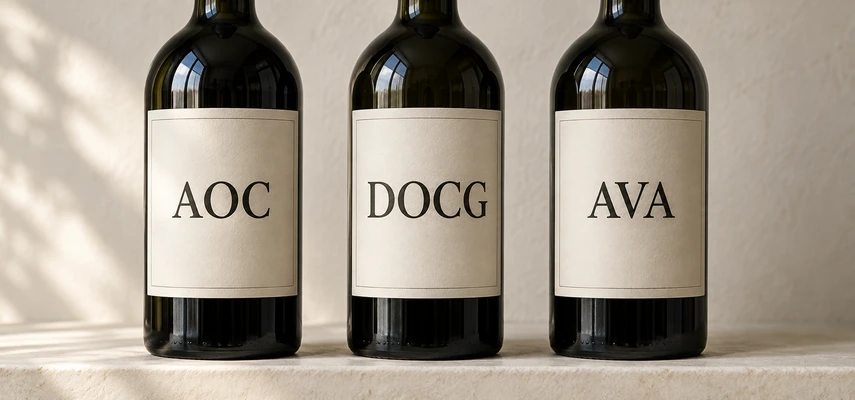

Wine laws and labels become easier to read once you ask what each term actually describes. Is it an origin, a grape-ripeness category, a maturation rule or a producer classification? Those claims can appear together, but they don’t mean the same thing. A label isn’t one international ladder from ordinary to magnificent.
This comparative guide follows the terms assigned in the WSET Level 3 specification. It reinforces the regional lessons rather than replacing their production explanations. Read the denomination first, then any narrower origin, grape, vintage or style claim. Finally, separate what the label guarantees from what you still need to discover by tasting.
France: protected origin and classifications are different layers
AOC, Appellation d’Origine Contrôlée, identifies a controlled French origin and production framework; AOP is the corresponding European protected-origin terminology. IGP, Indication Géographique Protégée, identifies a protected geographical indication. Vin de Pays is the older French regional-wine terminology associated with the IGP category. These aren’t interchangeable with a producer’s tasting score. The French agriculture ministry’s explanation establishes the origin framework.
Meanwhile, Vin de France identifies French wine without a narrower protected geographical indication. It doesn’t mean law-free wine or necessarily poor wine. Grape and vintage claims are controlled where used; the official VSIG certification guidance shows that the absence of AOC doesn’t eliminate label controls. A producer may choose a broader category for stylistic flexibility.
At the same time, Bordeaux’s cru classé refers to a classified growth within a particular classification, not a new grape or a universal French vineyard rank. The 1855 classification and Saint-Émilion’s system have different histories and rules. Cru bourgeois is a separate Médoc classification; the Bordeaux classification account records its current five-year framework. Don’t treat it as another name for an 1855 classed growth.
By contrast, Burgundy’s premier cru and grand cru concern classified vineyard origins within its appellation structure. Producer, vintage and condition still affect the actual bottle. The Chablis appellation guide illustrates this geography-based distinction. Bordeaux’s château classification shouldn’t be pasted over Burgundy’s vineyard hierarchy merely because both use the word cru.
French production and harvest terms add other information
| Term | What to understand | Avoid assuming |
|---|---|---|
| Nouveau | A young wine intended for early release, familiar in Beaujolais and Beaujolais-Villages | Every Beaujolais is Nouveau or incapable of ageing |
| Sur lie | Maturation on lees; protected local usage can carry additional production and bottling rules | It always means oak ageing or a sweet wine |
| Vendanges Tardives | Alsace late-harvest mention for specified ripe grapes and conditions | It is a grand-cru vineyard rank or a universal botrytis requirement |
| Sélection de grains nobles | Alsace selection of nobly rotted berries for concentrated sweet wine | It is identical to every late harvest or implies fortification |
The Beaujolais-Villages reference, Loire appellation guide and Alsace’s separate VT and SGN explanations give the relevant local contexts. The shared lesson is to identify what the term regulates before predicting flavour. A harvest term and a vineyard designation answer different questions.
Germany: ripeness, finished sweetness and origin need separate reading
Qualitätswein is a regulated category tied to a recognised wine-growing area. Prädikatswein adds specified grape-ripeness or harvest qualifications and doesn’t permit enrichment. The Prädikat is about the harvested material and its requirements, rather than a simple measurement of the finished wine’s sweetness. Fermentation decisions still matter, especially for the earlier categories.
| Prädikat | Main study anchor | Important distinction |
|---|---|---|
| Kabinett | Ripe grapes meeting the category’s minimum must weight | Not automatically dry or sweet from the word alone |
| Spätlese | Later-picked, riper grapes | Not necessarily a sweet finished wine |
| Auslese | Selected ripe bunches | Selection doesn’t make botrytis compulsory in every example |
| Beerenauslese | Selected very ripe berries, commonly involving noble rot | Different from simply leaving every bunch later |
| Trockenbeerenauslese | Highly concentrated, shrivelled, nobly rotted berries | Trocken here doesn’t mean a dry finished wine |
| Eiswein | Grapes harvested and pressed naturally frozen, with concentrated juice | Not artificial freezing; noble rot isn’t the defining requirement |
The German Wine Institute’s Prädikat guide supplies these distinctions. Meanwhile, read a finished-style term such as trocken separately. A statutory category, sweetness description and named vineyard can coexist; don’t force them into one meaning.
Alongside those statutory categories, the VDP is a producers’ association with its own private origin-based classification. VDP.Grosses Gewächs (GG) identifies dry wine from a VDP.Grosse Lage under that framework, rather than every German wine from a famous vineyard. The VDP classification distinguishes site designation from the dry-wine name.
However, don’t conclude that Großes Gewächs has no meaning in wider German law. The current national origin framework also regulates Großes Gewächs and Erstes Gewächs. National rules and an association’s additional requirements must be distinguished. Older summaries describing Germany only through must weight miss that developing origin structure.
Austria and Tokaj: similar-looking terms, local rules
Austria also uses Qualitätswein and Prädikat, but apply Austrian requirements rather than importing German thresholds or assumptions. DAC, Districtus Austriae Controllatus, identifies regionally typical Qualitätswein with rules for the named origin and style. It isn’t a grape name or a guarantee that every Austrian bottle belongs to a DAC. The Austrian Wine key-facts reference explains the categories.
In Tokaj, Aszú refers to concentrated sweet wine made using selected botrytised berries macerated in must or wine, followed by production and maturation requirements. Eszencia comes from the free-run juice of aszú berries and can ferment only very slowly to low alcohol. They aren’t simply two names for the same recipe or an automatically fortified wine. Disznókő’s Aszú account and Eszencia profile explain the different routes.
Italy: denomination and additional mentions
DOC, Denominazione di Origine Controllata, and DOCG, Denominazione di Origine Controllata e Garantita, are traditional terms within Italy’s protected-designation-of-origin framework. IGT, Indicazione Geografica Tipica, corresponds to protected geographical indication. The Italian ministry’s category reference explains that relationship. DOCG doesn’t guarantee that you will prefer every bottle to every DOC or IGT.
Classico generally identifies a historically established core zone where that mention is authorised. Riserva indicates additional requirements, often including longer maturation, under the specific denomination. It isn’t one identical number of years across Italy. Compare the Chianti Classico production area with Barolo’s specification to see why the full name matters. Chianti Classico is a distinct denomination, not merely any Chianti aged longer.
Spain and Portugal: origin plus local maturation rules
Spain’s DO and DOCa/DOQ sit within the protected-origin framework; DOQ is the Catalan-language form of the qualified category. Vino de la Tierra (VdlT) corresponds to geographical indication. Vinos de Pago identifies a recognised estate-origin category with defined requirements, rather than every brand containing the word pago. The Spanish ministry’s classification reference provides the framework.
Joven signals a youthful style, while Crianza, Reserva and Gran Reserva involve specified maturation where applicable. Check the denomination and colour: red, white and rosé requirements can differ, and local rules can exceed broader requirements. Rioja’s classification guide gives a concrete example. Reserva isn’t a universal promise of identical time in wood everywhere, and generic labelling doesn’t prove no maturation occurred.
Meanwhile, Portugal’s DOC/DOP identifies protected origin and production requirements; IGP, often labelled Vinho Regional, supplies a different regional framework. The Portuguese certification guide explains both. Alentejo DOC and Alentejano IGP therefore aren’t interchangeable names. A broader category can permit different grapes or choices without automatically establishing lower sensory quality.
The Americas: don’t translate every origin into an AOC
| System | Meaning and practical example | What it doesn’t establish alone |
|---|---|---|
| US AVA | American Viticultural Area: a defined grape-growing area with distinguishing features and boundaries | A mandatory grape recipe or universal quality rank |
| Canadian VQA | Provincial origin and production certification; Ontario and British Columbia have their own frameworks | One identical rule for every Canadian wine |
| Chilean DO region and DO sub-region | Geographical levels within Chile’s origin system, with further narrower divisions | A direct translation of every European production rule |
| Costa, Entre Cordilleras, Andes | Supplementary Chilean geographical indications distinguishing coastal, intermediate and Andean settings | Three replacements for every named valley or mandatory tasting profiles |
The TTB AVA explanation, Ontario VQA rules and Chilean origin decree show why geography and production restrictions need separate checking. Read applicable origin, variety and vintage percentages individually. A percentage remembered from one country isn’t a reliable answer for all three claims worldwide.
South Africa and Australia: levels describe geography
South Africa’s Wine of Origin scheme distinguishes geographical units, regions, districts and wards. An estate wine must come from its defined eligible vineyards and be made and bottled on the estate; it isn’t simply any wine carrying an attractive property name. An estate can include qualifying adjoining farms rather than one vineyard. The WO scheme account explains how origin certification protects the claim. A smaller ward isn’t automatically a higher tasting score than a larger district.
Australia distinguishes zone, region and sub-region. For example, Barossa is a zone containing the Barossa Valley and Eden Valley regions; High Eden is a sub-region. The official GI register defines their boundaries. South Australia, the state, isn’t the same as the much broader South Eastern Australia zone. Neither is a maturation category.
Sparkling, fortified, vintage and ageing terms answer other questions
Brut concerns sweetness in sparkling wine, whereas traditional method concerns production. Blanc de blancs concerns white-grape origin; blanc de noirs is white wine from dark grapes. Read the appellation as well: Champagne, Cava and Prosecco have different rules. The Champagne dosage reference illustrates why a sweetness term shouldn’t be mistaken for a region or quality rank.
Meanwhile, for Port, Vintage and LBV identify a harvest but follow different pre-bottling maturation routes. Tawny with an age indication describes an approved mature blended style, not one compulsory harvest or identical ages for every component. The current Port regulation supplies category-specific requirements. Other fortified names, such as Fino, Amontillado and Oloroso, also reflect different production and maturation paths rather than a simple price hierarchy.
Finally, a vintage is a harvest-year claim under applicable rules, not the year of bottling or a universal promise of 100% from one year. An ageing mention needs its own legal context. Use the label to frame sensible expectations, then assess the bottle’s actual quality and condition. This separation prevents a classification from doing work it was never designed to do.
Knowledge check: Laws and labels
1. Which question should be asked first about a classification term?
2. What does Vin de France establish here?
3. Which statement distinguishes Bordeaux and Burgundy?
4. What does Spätlese establish most directly?
5. Which VDP statement is correct?
6. What does Italian Riserva mean most defensibly?
7. Which statement about a US AVA is correct?
8. Which Australian relationship is correct?
9. What do Chile’s Costa, Entre Cordilleras and Andes add?
10. What should a vintage date be understood as?
Answers and explanations
1. C — Identify the claim type. Origin, ripeness, maturation and producer classification describe different things. A prestigious appearance doesn’t clarify the rules.
2. B — Broad French identity. Vin de France lacks a narrower protected geographical indication. It still falls under wine and labelling controls.
3. D — Context changes the meaning. Bordeaux’s growth classifications and Burgundy’s vineyard hierarchy aren’t one identical system. Read the specific regional framework.
4. A — Harvest category and final style differ. Fermentation decisions affect residual sugar. Spätlese isn’t automatically sweet from the statutory term alone.
5. C — Private framework alongside law. The VDP defines additional association requirements. Wider German law also regulates relevant origin terms, so neither layer should be ignored.
6. B — Read the full denomination. Riserva requirements depend on the applicable specification. One memorised number doesn’t apply to all Italian wine.
7. D — A geographical definition. AVAs identify growing areas under defined boundaries. They don’t themselves impose a universal grape recipe or sensory rank.
8. A — Distinguish levels and names. Barossa is the broader zone in this example. Similar wording doesn’t make state, zone, region and sub-region identical.
9. C — Additional origin context. These indications distinguish coastal, intermediate and Andean settings. They supplement the named-origin framework rather than replacing it wholesale.
10. B — Harvest, with local rules. Vintage claims concern grape harvest year and applicable percentages. They don’t universally require every component to be from that year.
Written exercise 1: Decode a German label logically (5 marks)
An original study label identifies a German origin, Riesling, Spätlese, trocken and a vintage. Explain five distinct claims without treating them as one quality score.
Model answer: The origin identifies where the wine qualifies to come from under the applicable rules. Riesling identifies the stated grape variety. Spätlese supplies a Prädikat ripeness/harvest qualification rather than proving finished sweetness by itself. Trocken supplies the separate dry-style information. The vintage identifies the stated harvest year under the relevant rules; none of these words alone establishes the tasted bottle’s overall quality or condition.
Why it earns credit: Award one mark each for (1) origin, (2) grape, (3) Prädikat distinction, (4) finished dryness and (5) vintage correctly separated from a quality guarantee. The scenario is an original exercise, not an actual commercial label approval.
Written exercise 2: Compare origin and maturation claims (5 marks)
Explain five distinctions among a US AVA, an Australian sub-region, Italian Riserva, Spanish Reserva and Port Vintage.
Model answer: An AVA identifies a defined US grape-growing area rather than a maturation requirement. An Australian sub-region identifies a narrower geographical level within the Australian GI structure. Italian Riserva requires the rules of its particular denomination, often involving additional maturation. Spanish Reserva also needs the relevant denomination and wine colour to interpret its maturation rules. Port Vintage identifies a single-harvest category with its own production and maturation conditions, rather than an age-indicated multi-harvest Tawny blend.
Why it earns credit: Award one mark each for (1) AVA geography, (2) Australian geographical level, (3) local Italian requirements, (4) local Spanish requirements and (5) Port harvest/category distinction. Similar-looking prestige words don’t make the systems interchangeable.
One-page revision summary
| Identify the claim type | Key examples | Keep separate |
|---|---|---|
| Protected origin | AOC/AOP, IGP, DOC/DOCG, DO/DOCa/DOQ, DOC/DOP | Sensory quality or personal preference |
| Broader wine category | Vin de France; Vin de Pays/IGP; IGT; VdlT; Vinho Regional | No law or automatic inferiority |
| Regional classification | Cru classé, cru bourgeois; Burgundy premier/grand cru | Different regions’ meanings of cru |
| Harvest or grape condition | VT, SGN, German Prädikats, Austrian Prädikat, Aszú, Eszencia | Finished sweetness and fortification |
| Private association framework | VDP and VDP.GG | Wider national law still applies |
| Typical regional style | Austrian DAC | A grape variety or every Austrian wine |
| Origin levels | AVA, VQA, Chile DO levels and supplementary indications, WO levels, Australian GI levels | One international hierarchy or universal percentages |
| Additional maturation | Riserva, Crianza, Reserva, Gran Reserva | One fixed period across all denominations and colours |
| Production or release | Nouveau, sur lie, traditional method | Vineyard rank or guaranteed oak flavour |
| Sparkling label | Brut, blanc de blancs/noirs | Sweetness, grape colour and method are different claims |
| Fortified category | Port Vintage/LBV/age-indicated Tawny; Fino/Amontillado/Oloroso | One universal age or price ladder |
| Vintage | Harvest-year claim under applicable rules | Bottling year or universal 100% rule |
Choose two labels from different countries. Sort each visible term into origin, grape, harvest, maturation, style or classification, then state one thing the label cannot tell you without tasting or further information.












