










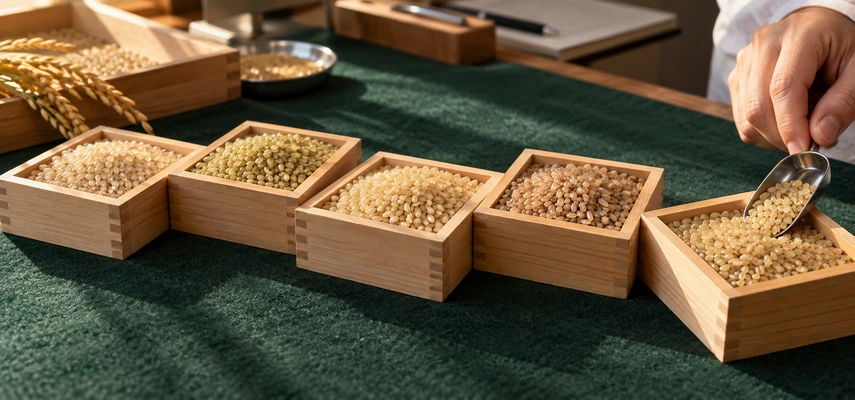

Can a rice name tell you what a sake will taste like? It supplies useful clues, but the answer isn’t a five-entry flavor dictionary. Sake rice varieties differ in their agricultural and processing characteristics. The brewer then decides how to use those characteristics, and several later decisions can pull the finished drink in different directions.
The five varieties prescribed in the official WSET Level 3 specification are Yamada-nishiki, Gohyakuman-goku, Miyama-nishiki, Omachi and Akita-sake-komachi. Learn all five, including the less familiar last name. Then attach each to a practical question about growing, polishing, kōji or fermentation rather than to a guaranteed aroma.
Compare sake rice varieties through brewing behavior
Start with grain size and integrity. A large grain can offer useful scope for polishing, but size alone doesn’t establish how well it tolerates a particular milling regime. The shape and position of shinpaku, the opaque central region, also matter. A brewery needs a grain that works after preparation, not merely one that looks impressive in a sample tray.
Next consider water absorption, steamed-rice texture and enzyme digestibility. These influence the material available for kōji cultivation and the release of sugars in the mash. Protein content also matters because enzyme action releases smaller nitrogen-containing compounds that affect nutrition and taste. The relevant characteristics interact, so avoid making one favorable trait stand in for the whole assessment.
Finally, consider agriculture. A variety suited to one climate may be less practical somewhere else. Plant height, lodging risk, ripening conditions and reliable supply affect what a brewery can obtain. Lodging means the crop falls or leans over, which can complicate grain development and harvesting. An excellent brewing possibility still has to survive the field.
Yamada-nishiki: a useful combination of grain traits
Yamada-nishiki is strongly associated with Hyōgo, where it was developed. The prefecture’s agricultural account identifies large grains, a clear central shinpaku and relatively low protein as important characteristics. These help explain why brewers value it. They are more useful than simply repeating its reputation as the “king” of sake rice.
Large, suitably structured grains offer opportunities for polishing while retaining material appropriate for brewing. A well-positioned shinpaku can support kōji development within the grain. Together, those traits help explain the variety’s association with demanding production, including ginjō styles. The chain is grain suitability → useful preparation and kōji behavior → scope to pursue the intended sake style.
However, that scope doesn’t make Yamada-nishiki an automatic quality certificate. Growing conditions, the rice lot, polishing, yeast and fermentation management still matter. Nor must every sake made from it be delicately fruity. Treat its reputation as the result of valued brewing characteristics and accumulated experience, rather than as a flavor instruction printed inside the grain.
Its regional association also needs careful wording. Yamada-nishiki is not grown only in Hyōgo, and using it doesn’t establish that the brewery itself is there. Distinguish the variety’s origin, the crop’s place of cultivation and the sake’s production location. A bottle can connect more than one prefecture without anything contradictory happening.
Gohyakuman-goku: know the Niigata connection
Gohyakuman-goku, also written Gohyakumangoku, has a particularly strong association with Niigata. The Niigata Sake Brewers Association identifies it among the prefecture’s important brewing rice. Its presence in a regional production system reflects both agricultural availability and established brewing practice, not a requirement that every local sake use it.
It is often discussed alongside restrained, clean styles associated with Niigata. That is a useful stylistic context if it remains qualified. A clean-tasting sake is an outcome of rice handling, kōji management, yeast, fermentation and finishing together. Simply replacing another variety with Gohyakuman-goku doesn’t reproduce an entire brewery’s process.
For an explanatory answer, begin with how a particular lot behaves during preparation and kōji cultivation, then connect that behavior to process management. Avoid an unsupported universal polishing limit. The grain’s structure and integrity, the equipment and the brewer’s method all matter. “This variety cannot make this grade” is a stronger claim than a typical handling comparison can justify.
Also avoid translating “clean” directly into “dry.” Clean describes an impression of clarity or restraint in flavor, while sweetness is a separate observation. A restrained sake can retain sweetness; a dry one can show pronounced savory character. Keeping these sensory ideas separate improves both written explanations and tasting notes.
Miyama-nishiki: growing suitability belongs in the answer
Miyama-nishiki is associated with Nagano and is also grown in other cooler regions. The official Nagano tourism account of brewing rice highlights its cold resistance and cultivation beyond Nagano. That matters because a brewing variety must fit the growing season as well as the brewery’s desired process.
Here the causal chain begins outside the brewery: adaptation to cooler growing conditions → a practical regional raw material → opportunities for local brewing decisions. This explains an agricultural advantage without claiming that cold-resistant plants inherently produce a cold-tasting drink. Climate affects the crop; sensory temperature is a different matter entirely.
When studying a Miyama-nishiki sake, examine the actual polishing ratio, production category and finishing choices. A variety can support more than one intended style. If a sample seems restrained or firm, describe the observation and consider the full process. Don’t promote a familiar regional association into proof that the rice must be Miyama-nishiki.
Its name can also become an examination trap when learners remember only Yamada-nishiki and overlook the different first word. Keep the full names attached to distinct regional and agricultural information. Recognition is the first step; explaining why suitability to the field matters is the Level 3 addition.
Omachi: heritage, handling and the temptation of a flavor rule
Omachi is strongly associated with Okayama and is an important heritage variety. The Okayama prefectural agricultural guide emphasizes its large grain and large opaque core, and describes the rich character associated with sake made from it. Those are useful facts, provided a typical impression is not rewritten as a law.
The relevant explanation connects grain structure and behavior during preparation and digestion with the material that enters fermentation. Rice that dissolves readily can offer opportunities to develop a fuller expression, but the brewer must manage that behavior. Richness is not produced by variety alone, and faster dissolution is not always the best target.
Omachi also illustrates why agricultural difficulty and drinking quality are different topics. Maintaining a heritage crop can require particular effort, yet the effort itself isn’t a tasting descriptor. A sympathetic history should lead to better questions about sourcing and handling, not a rule that every bottle deserves the highest quality conclusion.
Similarly, don’t assume Omachi can be recognized blind from one earthy or savory note. Yeast, starter method, fermentation and maturation can create overlapping impressions. A reliable producer statement can establish the rice; the glass can establish what this particular sake feels and tastes like. Those are complementary forms of evidence.
Akita-sake-komachi: regional breeding with a practical purpose
Akita-sake-komachi was developed in Akita for sake brewing. It is not simply the table-rice variety Akitakomachi with an optional word inserted. The Akita prefectural breeding report identifies it as a distinct non-glutinous brewing cultivar. Exact names matter because similar romanized labels can conceal different agricultural identities.
The Akita brewing association describes large grains suitable for substantial polishing, elastic steamed-rice texture, relatively low protein and useful starch digestibility. These provide a concrete explanation for its interest to brewers pursuing refined styles. The qualities concern what the grain allows during preparation and brewing, rather than an exclusive aroma embedded in the crop.
For example, manageable polished grains and suitable steamed texture can help a brewer produce the intended kōji. Digestibility then influences how rice material becomes available in the mash. Meanwhile, protein levels affect the pool from which nitrogen-containing compounds can arise. Keep these mechanisms distinct instead of grouping them all beneath the unhelpful word “premium.”
Regional breeding also connects agricultural practicality with brewing goals. Developing locally useful material can reduce dependence on one famous variety grown elsewhere and support a region’s own production choices. That does not make local rice universally superior. It makes the breeding problem more interesting: agronomic reliability and brewing performance must work together.
Turn five names into a useful comparison
Suppose two breweries use the same variety but different polishing ratios, kōji approaches and yeast. Different finished styles would be unsurprising. Conversely, two breweries using different varieties may pursue similar sensory goals through process adjustments. Rice creates opportunities and constraints; brewing decisions determine how those possibilities are used.
For study, construct a comparison with three columns: regional association, relevant grain or agricultural property, and brewing implication. Write Yamada-nishiki with Hyōgo and its valued large, centrally structured grain; Gohyakuman-goku with Niigata and established regional brewing use; Miyama-nishiki with cooler-region adaptation; Omachi with Okayama and its large grain and core; and Akita-sake-komachi with Akita’s breeding and processing goals.
In practice, compare same-grade sakes made from the prescribed varieties where suitable examples are available. The specification recommends such comparisons, including Yamada-nishiki and Gohyakuman-goku, alongside another named variety. Similar grade reduces one source of variation but doesn’t control every production decision. Record the remaining differences rather than attributing everything you taste to rice.
For the recommended practical flight, verify that each bottle uses 100% of its stated variety: Yamada-nishiki, Gohyakuman-goku, and one of Miyama-nishiki, Omachi or Akita-sake-komachi. Keep the grade shared and record other differences. Taste blind first, then explain which observations might relate to the rice and which remain confounded by brewing choices.
Variety is only part of the raw-material story: cultivation and grading shape what reaches the brewery, while rice preparation changes how it behaves there. Test those interacting factors in the integrated production examples.
One-page revision summary
Remember all five full names and distinguish crop origin from brewery location. Explain grain size, shinpaku, protein, digestibility or growing suitability before suggesting an implication. Use regional and sensory associations as context, then qualify them with actual brewing choices. A strong comparison tells the reader why a variety is useful while leaving enough room for the brewer to do something interesting with it.
Written practice: original TFE exercises
These suggested marks and indicative points are independent teaching guidance, not official WSET marking schemes.
Exercise 1: 5 suggested marks
Explain two reasons why brewers value Yamada-nishiki, connecting each to a brewing implication. Mapping: Unit 1 LO1 and LO2.
Indicative marking points:
- Identify large grains.
- Explain their scope for suitable polishing.
- Identify central shinpaku.
- Connect structure to kōji penetration and development.
- Qualify the outcome by preparation or fermentation management.
Model answer: Yamada-nishiki has large grains that offer useful scope for polishing when their integrity is maintained. Its clear central shinpaku is also valuable because grain structure can support mould penetration and kōji development. These properties give the brewer material suited to demanding production goals, but the actual result still depends on the rice lot and subsequent management.
Why it works: Each characteristic is connected to a practical consequence; the final qualification prevents raw-material advantages becoming a guaranteed quality claim.
Common mistake: Writing only that it is famous or always makes the best sake.
Exercise 2: 5 suggested marks
Explain why a comparative tasting of two rice varieties does not isolate rice variety as the only cause of flavor differences. Mapping: Unit 1 LO1 and LO2.
Indicative marking points:
- The samples differ in variety.
- Polishing and preparation may also differ.
- Kōji and yeast may differ.
- Fermentation or finishing can affect sensory results.
- Use matched information and qualify attribution rather than assuming sole causation.
Model answer: Although the two sakes use different rice varieties, they may also differ in polishing, preparation, kōji and yeast. Fermentation conditions and finishing provide further possible causes of sensory differences. Choosing similar grades and documenting producer information improves the comparison, but observed differences should still be treated as evidence to investigate rather than proof of a single rice effect.
Why it works: It identifies confounding factors and explains how to make the comparison more useful without claiming it is fully controlled.
Common mistake: Treating the same premium grade as proof of identical production in every other respect.
Knowledge check: 10 original practice questions
Independent TFE questions, not official WSET examination items. Choose one answer per question; explanations follow separately.
1. Which statement correctly identifies Akita-sake-komachi?
2. What does lodging refer to in rice cultivation?
3. What is a useful reason to consider grain integrity?
4. Which variety is particularly associated with Niigata?
5. Which conclusion about rice variety and aroma is justified?
6. Which trait helps explain Yamada-nishiki’s brewing reputation?
7. Which characteristic is particularly relevant to Miyama-nishiki’s regional use?
8. Which comparison best follows the recommended approach to rice-variety tasting?
9. Which prefecture is most closely associated with Omachi?
10. Which regional association is especially important for Yamada-nishiki?
Answers and explanations
1. B — A distinct non-glutinous rice cultivar developed for brewing.. The Akita breeding report identifies the cultivar separately from the familiar table-rice name Akitakomachi. Mapping: Unit 1 LO1 Range 1; LO2 Range 4.
2. B — Crop stems falling or leaning over.. Lodging is an agricultural problem relevant to crop development and harvest, not a sake-finishing operation. Mapping: Unit 1 LO1 Range 1; LO2 Range 4.
3. C — The grain must tolerate the intended polishing and preparation.. Preparation must leave usable material; large size alone does not guarantee the necessary handling performance. Mapping: Unit 1 LO1 Range 1; LO2 Range 4.
4. A — Gohyakuman-goku.. Gohyakuman-goku is an important Niigata brewing rice, as confirmed by the prefectural association. Mapping: Unit 1 LO1 Range 1; LO2 Range 4.
5. A — Variety influences opportunities, but other brewing choices also shape aroma.. Rice interacts with kōji, yeast, fermentation and finishing, preventing a simple one-variety-one-aroma rule. Mapping: Unit 1 LO1 Range 1; LO2 Range 4.
6. D — Large grains with a clear central shinpaku.. Grain size and central structure offer useful preparation and kōji opportunities; the result still needs management. Mapping: Unit 1 LO1 Range 1; LO2 Range 4.
7. C — Adaptation to cooler growing conditions.. Cold resistance helps explain its association with Nagano and cultivation in other cooler regions. Mapping: Unit 1 LO1 Range 1; LO2 Range 4.
8. D — Similar-grade examples with documented rice and remaining production differences.. Similar grade improves comparability, while documenting other factors prevents unsupported single-cause claims. Mapping: Unit 1 LO1 Range 1; LO2 Range 4.
9. D — Okayama.. Omachi is a heritage variety strongly associated with Okayama; that does not identify every brewery using it. Mapping: Unit 1 LO1 Range 1; LO2 Range 4.
10. B — Hyōgo.. Yamada-nishiki was developed in Hyōgo and remains strongly associated with it, although grown elsewhere. Mapping: Unit 1 LO1 Range 1; LO2 Range 4.












