










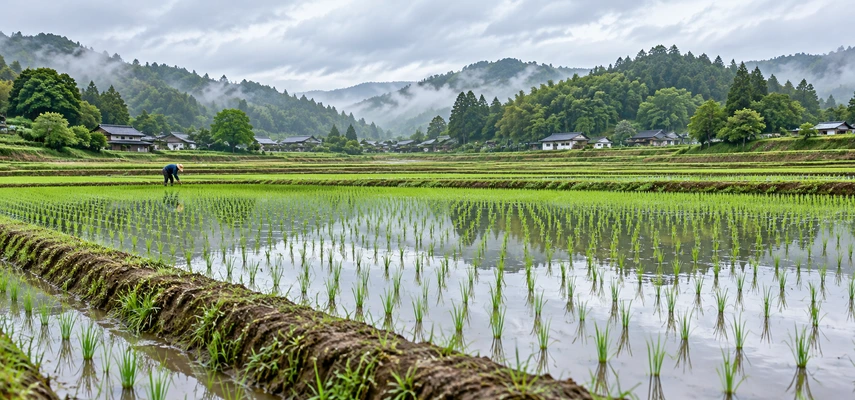

How much of a sake’s future is decided before the brewery receives any rice? Farmers cannot determine the final aroma in a bottle, but they shape the material the brewer must handle. To understand sake rice grown and graded for brewing, follow the crop from the seedling nursery to the inspection sample. Each stage can change the opportunities and problems that arrive at the brewery door.
The WSET Level 3 specification requires the rice-growing year, suitable cultivation conditions and the prescribed rice grades. The point is causal understanding. A field isn’t merely a picturesque introduction before the technical work begins; water management, weather, nutrition and harvest handling help establish the grain’s processing behavior.
Sake rice grown and graded begins with a suitable field
An appropriate field combines workable soil, dependable water management and a growing season suited to the variety. Paddy cultivation needs water retention, yet farmers must also be able to drain the field at the right stages. Soil that holds water without allowing useful management isn’t automatically ideal. The field has to function across the season, not just look attractively flooded on planting day.
For example, Hyōgo’s agricultural account of Yamada-nishiki describes suitable areas around Miki and Katō with clay-rich soils and basin or valley settings. Such examples explain why particular crops became associated with particular places. They do not establish a universal rule that all sake rice needs the same valley, soil texture or temperature pattern.
Sunlight, temperature and weather during growth influence grain formation. A suitable variety must ripen within local conditions while maintaining useful agricultural and brewing characteristics. Meanwhile, farmers balance crop nutrition against excessive vegetative growth. Sake-specific rice can present challenges such as tall plants and lodging risk, so a large potential grain does not come free of agricultural complications.
Grow healthy seedlings before transplanting
In a typical transplanted paddy system, farmers first raise seedlings from seed rice in a nursery. This establishes young plants that can be moved into prepared fields. The nursery phase matters because uneven or unhealthy plants make later crop management more difficult. Transplanting is therefore a change in growing location, not the beginning of the seed’s life.
The seedlings are then transplanted into the prepared paddy, often using machinery. Spacing and establishment influence how the crop develops. Plants produce tillers, the additional shoots that can bear grain-bearing heads. Farmers need a useful stand with appropriate growth, rather than the maximum possible number of stems regardless of their condition.
Regional calendars vary with variety and climate. A Kagoshima extension guide illustrates the sequence for a local table-rice crop, including nursery work, transplanting and midseason management. Its specific dates aren’t a national timetable for sake rice. Learn the agricultural logic without moving one prefecture’s calendar wholesale into every examination answer.
Drain and re-flood the paddy deliberately
Paddy management is not continuous deep flooding from planting to harvest. Midseason drainage temporarily removes water and allows the soil surface to dry. This helps manage excessive tillering and root conditions, while firmer ground can support later operations. The exact timing and intensity depend on crop development, soil and weather.
The Ōita prefectural guidance on midseason drainage treats it as a managed operation, not abandonment of the crop. Afterward, re-flooding or intermittent irrigation supports the next stages as appropriate. “Draining and re-flooding” describes a sequence of purposeful decisions; it does not mean farmers simply forget to water the field and then correct the mistake.
The causal chain is managed water regime → changed soil and root conditions and controlled plant growth → support for a useful, harvestable crop. That chain is sufficiently detailed for an introductory explanation without claiming that one drainage practice guarantees superior sake. The agricultural result still interacts with weather and other management choices.
Ears appear, then grains fill and ripen
The rice plant eventually produces its grain-bearing head, or panicle, often called an ear in general descriptions. Heading is the emergence of that structure; flowering and fertilization lead into grain development. These stages matter because the plant must successfully form and fill the grains that will later be harvested.
During grain filling and ripening, starch accumulates and the physical properties of the developing rice take shape. Weather at this point can influence more than yield. NRIB research links growing temperature during grain filling with amylopectin structure and subsequent enzyme digestibility. The brewery can therefore encounter different processing behavior even within one named variety.
However, the correct conclusion isn’t that a hot year always produces one fixed flavor. The mechanism passes through the crop and its brewing properties; growers and brewers can respond. An examination answer should identify that intermediate step. “Weather affects quality” is true but too broad to explain what the brewery actually inherits.
Nitrogen and lodging connect field decisions to grain quality
Nitrogen supports plant growth, but excessive supply can encourage growth that increases lodging risk and can raise grain protein. Protein is a useful brewing component in appropriate proportions, yet an excess may make a particular intended style harder to achieve. This is a management problem, not an argument that the crop should receive no nutrition.
The MAFF account of Hyōgo’s Yamada-nishiki production system describes locally developed cultivation and nutrient management. It illustrates the relationship between experienced farming and a specialist brewing material. The relevant point is how growers manage plant and grain development, rather than the romantic idea that a famous field automatically brews excellent sake.
Lodged plants can complicate ripening and mechanical harvest, increasing handling difficulties and the risk of unsuitable material. Therefore, varietal traits and management have to work together. A plant that grows impressively tall has not necessarily performed better for the farmer or brewer. Agricultural success includes bringing usable grain safely through the season.
Harvest, dry and remove the husks
Harvesting at an appropriate stage aims to collect sufficiently developed grain while limiting damage and loss. Mechanical harvest combines several operations, but the conceptual sequence remains useful: collect the crop, separate the grain, manage its moisture and prepare it for storage and further processing. Premature or delayed decisions can create different problems, so there is no benefit in treating speed alone as the goal.
Drying reduces grain moisture for safe storage and handling. It must be controlled: poorly managed drying can contribute to cracking and inconsistent behavior. Moisture also affects the brewer’s later calculations for washing and soaking. A bag of rice carries a moisture history, even though that history doesn’t appear as an aroma on a label.
Removing the husks produces brown rice. The bran layers and germ are not necessarily removed at this stage; polishing is a separate operation that follows. Keeping these steps distinct prevents a common process error. The crop doesn’t become deeply polished sake rice simply because it has passed through harvest and dehusking machinery.
Know the five prescribed agricultural rice grades
The specification names above special, toku-jo; special, toku; first grade; second grade; and third grade. In Japanese inspection terminology, the two upper brewing-brown-rice grades are 特上 and 特等, commonly romanized tokujō and tokutō. Keep the specification’s terms recognizable while understanding the formal Japanese labels.
These are grades of the agricultural rice lot, not premium classifications of finished sake. The MAFF brown-rice inspection standards distinguish brewing brown rice from other rice categories. They assess multiple criteria, including the proportion of sound grains, grain character, moisture and limits for damaged, dead or discolored grains, husks and foreign material.
Higher grades require a lot to meet the applicable stricter combination of criteria. It is misleading to reduce the entire decision to shinpaku size or to one attractive photograph. A sample could meet one criterion and fail another. Likewise, protein analysis or an excellent brewing trial may provide useful additional information without replacing the formal inspection criteria.
Think of a grade as standardized information about the incoming material. It helps communication between growers, suppliers and breweries. It doesn’t tell the brewer exactly how the crop will behave under every process, and it certainly doesn’t assess the balance or finish of a future sake. That final drink has several transformations still ahead of it.
Read a crop report like a brewer
Imagine two rice lots with the same variety name. One has consistent moisture and sound, uniform grains; the other includes more damaged material and has a different drying history. Those differences can influence polishing losses, water uptake and preparation consistency. The brewer therefore has reasons to inspect the actual lots even before comparing their official grades.
Next, imagine a sound lot whose starch behaves differently after an unusually warm ripening period. A high agricultural grade does not erase that biochemical difference. The sensible response is to evaluate processing behavior and adjust the brewing plan where appropriate. Grade and process testing answer related but different questions.
Agricultural inspection should remain distinct from the classification of finished sake. Connect the crop to the brewery through grain structure and rice preparation, where moisture and composition become processing decisions.
One-page revision summary
Follow seedlings, transplanting, managed draining and re-flooding, heading, ripening, harvesting, drying and husk removal in sequence. Explain field suitability through soil, water and weather, then connect nutrition and lodging to usable grain. Learn all five prescribed grades and their multi-criterion basis. Above all, distinguish agricultural rice grading from the production classifications and sensory quality of finished sake.
Written practice: original TFE exercises
These suggested marks and indicative points are independent teaching guidance, not official WSET marking schemes.
Exercise 1: 5 suggested marks
Describe midseason drainage and explain why it can be useful during rice cultivation. Mapping: Unit 1 LO1.
Indicative marking points:
- Water is temporarily removed during the growing season.
- Soil is allowed to dry to an appropriate degree.
- The operation can control excessive tillering.
- Changed soil conditions can support root management.
- Re-flooding or intermittent irrigation then supports later crop development according to conditions.
Model answer: Midseason drainage temporarily removes water from the paddy and allows a managed degree of soil drying. It can help control excessive tillering and improve the root environment rather than maintaining unchanging flooded conditions. Water is subsequently restored or managed through intermittent irrigation as the crop requires. Timing and intensity depend on the field and crop.
Why it works: It describes the action and connects it to two management purposes, then places it within the season rather than treating drainage as a permanent condition.
Common mistake: Saying that rice remains deeply flooded throughout the entire growing year.
Exercise 2: 5 suggested marks
Explain why a high agricultural rice grade does not establish that the finished sake will have high sensory quality. Mapping: Unit 1 LO1 and LO2.
Indicative marking points:
- Agricultural grade concerns a rice lot.
- Inspection includes sound grain and grain character.
- Moisture, defects and foreign material also matter.
- Subsequent preparation and brewing affect the sake.
- Sensory assessment of the actual sake is required for a quality judgment.
Model answer: A rice grade communicates standardized information about the raw material, including sound grains, character, moisture and permitted defects or foreign material. It does not describe how the brewer will polish, prepare and ferment the lot. Those later choices affect the result, so balance, complexity and persistence must be assessed in the finished sake rather than inferred from the agricultural grade.
Why it works: It identifies what the grade does measure and the additional process and sensory evidence needed for the proposed conclusion.
Common mistake: Calling toku-jo a synonym for daiginjō or assuming a rice grade is a tasting score.
Knowledge check: 10 original practice questions
Independent TFE questions, not official WSET examination items. Choose one answer per question; explanations follow separately.
1. What is a principal reason to use midseason drainage?
2. What is lodging?
3. What follows managed drainage when crop conditions require water?
4. Which sequence lists the five prescribed grades from highest to lower?
5. Which step normally precedes transplanting in a nursery-based system?
6. Why is weather during grain filling relevant to brewing?
7. Which group best describes formal rice-inspection considerations?
8. What does husk removal produce?
9. Which consequence can excessive nitrogen management create?
10. Why should a brewer still evaluate a rice lot after checking its grade?
Answers and explanations
1. D — To manage excessive tillering and root/soil conditions.. Temporary drainage changes growing conditions and supports crop management; it is not brewery processing. Mapping: Unit 1 LO1 Ranges 1–2; LO2 Range 4.
2. A — A plant’s stems falling or leaning over.. Lodging is a crop-management concern that can complicate grain development and harvesting. Mapping: Unit 1 LO1 Ranges 1–2; LO2 Range 4.
3. C — Re-flooding or appropriate intermittent irrigation.. Water management changes through the season; draining and restoring water are purposeful operations. Mapping: Unit 1 LO1 Ranges 1–2; LO2 Range 4.
4. D — Toku-jo, toku, first grade, second grade, third grade.. The first five names are agricultural rice grades; premium sake categories belong to a different system. Mapping: Unit 1 LO1 Ranges 1–2; LO2 Range 4.
5. A — Growing seedlings.. Seedlings are established before they are transferred to the prepared paddy. Mapping: Unit 1 LO1 Ranges 1–2; LO2 Range 4.
6. B — It can alter grain starch properties and later digestibility.. Crop conditions can change raw-material behavior, which then interacts with brewery decisions. Mapping: Unit 1 LO1 Ranges 1–2; LO2 Range 4.
7. C — Sound grain, character, moisture, defects and foreign material.. The inspection is a multi-criterion assessment of the incoming agricultural material. Mapping: Unit 1 LO1 Ranges 1–2; LO2 Range 4.
8. B — Brown rice, before further polishing.. Dehusking and polishing are separate steps; brown rice retains outer material removed during subsequent milling. Mapping: Unit 1 LO1 Ranges 1–2; LO2 Range 4.
9. C — Growth and lodging problems and increased grain protein.. Nitrogen is necessary, but excessive supply can create agricultural and processing difficulties. Mapping: Unit 1 LO1 Ranges 1–2; LO2 Range 4.
10. A — Grade does not fully specify process behavior or the effect of later brewing decisions.. Grade helps describe material quality, while actual lot properties and brewery management still affect the outcome. Mapping: Unit 1 LO1 Ranges 1–2; LO2 Range 4.












