










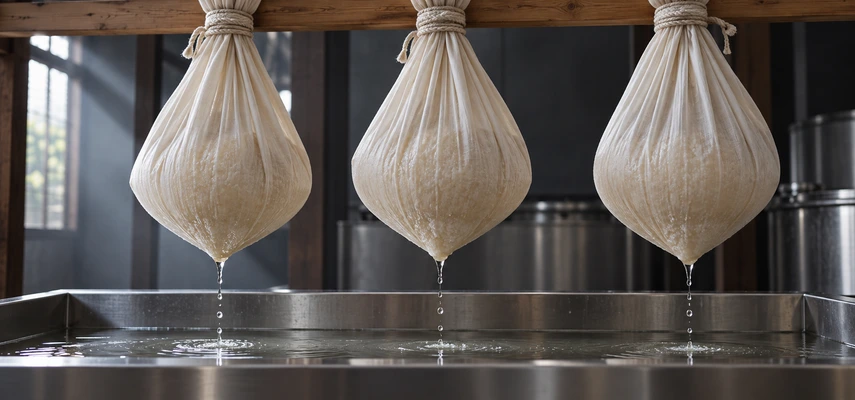

Can one tank of fermented mash produce more than one expression of sake? Sake pressing makes that possible because the liquid changes through separation and the brewer can collect different portions. Before discussing those portions, distinguish the equipment used, the fraction collected, the solid residue and the measure of how much residue remains. They answer four different questions.
The WSET Level 3 specification names all four groups. Confusing them creates predictable errors: shizuku is a collection approach, arabashiri is a fraction, sake-kasu is residue and kasu-buai is a ratio. None is simply another premium grade with an unfamiliar Japanese name.
Sake pressing separates a mixed material
Moromi contains liquid, rice-derived solids, yeast and other material from fermentation. Pressing, often described through terms such as jōsō or shibori, separates sake from much of that solid material. Cloth and other separation equipment retain solids while liquid passes through. This is physical separation, not a new round of starch conversion.
The NRIB explanation of pressing describes different ways of achieving that separation. “Pressing” can be used broadly even when the brewer deliberately avoids substantial externally applied pressure. Therefore, don’t assume every sake described through this stage has undergone the same mechanical treatment.
Separation also isn’t identical to all later filtration or clarification. Fine suspended material can remain in the liquid, and the brewery may subsequently settle, fine or filter it. Understanding the boundary between operations explains why a pressed sake need not already have the appearance and stability intended for the finished bottle.
Yabuta-shiburi uses a controlled mechanical press
Yabuta is a familiar manufacturer name associated with automatic filter presses; the syllabus includes yabuta-shiburi and assakuki. A series of cloth-covered plates and pressure elements separates liquid from the mash. Pressure is applied through the equipment to recover sake while retaining the solid cake.
The Tatenokawa production account describes the accordion-like arrangement and its use at that brewery. This provides a practical example rather than a rule that every press is identical. Loading, pressure course, timing and cleaning all affect how the operation performs.
Mechanical pressing supports organized throughput and consistent handling, but the machine’s presence doesn’t define the sensory quality. A well-managed automated operation can suit a demanding product. Conversely, selecting an expensive piece of equipment doesn’t erase the need for a suitable mash or careful collection decisions.
Funa-shibori and fune-shibori use bags in a press
Fune refers to a traditional press arrangement in which cloth bags filled with moromi are placed in a vessel. Liquid initially emerges under the material’s own weight; pressure is subsequently applied to recover more. Funa-shibori and fune-shibori are related forms encountered in the prescribed terminology.
The important physical distinction is that bags contain the mash while the press applies force to the stacked material. The bags are not strainers through which the entire solid mash is meant to pass. The process manages solid retention and liquid recovery, with the pressure course changing as separation proceeds.
The method can allow carefully controlled handling and fraction collection, while also requiring labor, time and appropriate hygiene. None of those facts independently proves a superior finished sake. The brewer chooses an approach that fits the intended product, scale and practical control of the material.
Fukuro-zuri and shizuku-dori emphasize dripping
In fukuro-zuri, filled cloth bags are suspended so sake drips from them. Shizuku-dori emphasizes collecting those drops. The approach minimizes externally applied squeezing rather than forcing maximum recovery through an increasing-pressure program. It can be selected for particular high-end or delicate expressions.
The JSS account of post-fermentation methods distinguishes this dripping approach from mechanical and bag pressing. Its gentler collection can support a particular expression, but recovery is limited compared with more complete pressing. The remaining material may be handled separately according to the brewery’s plan.
“No externally applied pressure” also does not mean the cloth has no role. The bags still physically separate liquid from solids. Therefore, shizuku sake isn’t evidence that sake bypassed separation altogether, and the name doesn’t guarantee one precise aroma, sweetness or quality level without tasting the actual product.
Fractions describe when the liquid is collected
Arabashiri, naka-dori or naka-gumi, and seme describe portions from a pressing sequence. They are not three rice varieties or three alternative machines. A brewery can separate or combine portions depending on its intended style. The boundaries reflect the actual collection decisions rather than three universally equal volumes.
| Term | Position in separation | Key distinction |
|---|---|---|
| Arabashiri | Initial run | Early liquid before substantial added pressing pressure |
| Naka-dori / naka-gumi | Middle portion | Selected middle collection, also discussed through related terms such as nakadare |
| Seme | Final portion | Later liquid associated with higher pressing pressure |
The same batch can yield all three. That makes a properly documented fraction comparison useful: much of the earlier production history is shared. Still, later handling and bottling may differ, so verify those details before treating a commercial comparison as a perfectly controlled experiment.
Arabashiri is the first run, not necessarily the finished appearance
The initial liquid can be somewhat cloudy as fine material passes through before the cloth-and-cake system becomes a more effective fine barrier. It may also retain a lively impression associated with recently fermented sake. Those are useful typical observations, not requirements that every arabashiri must look equally cloudy or be sold unpasteurised.
Further clarification, storage and bottling change the result. Consequently, the fraction name establishes its place in separation rather than the full finishing history. “Arabashiri” and “nama” answer different questions. One concerns collection; the other concerns heat treatment.
The NRIB and JSS guide explains how liquid character changes during separation. Use that mechanism to qualify an expected tendency rather than treating a first-run label as a promise of a particular sensory note.
Middle and final portions need evaluation, not automatic rankings
The middle fraction is often valued for balance and used for selected bottlings. However, the word naka-dori does not replace sensory evidence. The brewer’s cut, mash and subsequent handling still matter. It would be inaccurate to infer that every middle fraction must outrank every example collected through another approach.
Seme is recovered later under higher pressure and can show a more forceful, bitter or astringent character. The mechanism concerns what additional recovery and pressure bring into the liquid, not the moral worth of extracting more from a raw material. Such material can be assessed for blending or other intended uses.
A primary study of pressing and storage-related compounds found differences between fractions under its test conditions. That supports taking fraction selection seriously, but it does not mean every seme bottle is necessarily faulty. Study-specific measurements need to remain attached to their methods and conditions.
Sake-kasu is the solid residue
Sake-kasu is the cake or lees retained after separation. It includes material that has not passed into the recovered liquid, rather than pure dry starch with no other components. The residue still reflects rice dissolution, fermentation and separation history. It is not the same as nuka, which was removed much earlier during polishing.
The amount and condition of sake-kasu therefore depend on more than the press setting. A mash with different rice digestibility or fermentation development can leave a different quantity of solids. The residue also contains retained liquid, so its weight isn’t simply the weight of completely untouched rice.
This is why an interpretation of yield should consider the upstream process. A gentler recovery may leave more material behind, but a high residue amount doesn’t by itself prove that the brewery used shizuku collection. Several different decisions can affect the same measured result.
Kasu-buai is a mass ratio
Kasu-buai expresses sake-kasu weight as a percentage of the polished rice weight used. The JSS glossary gives that reference explicitly. If 100 kilograms of polished rice produces 30 kilograms of sake-kasu, the ratio is 30%. This is an illustrative calculation, not an average required of a particular grade.
Do not interpret it as 30% of the final liquid volume, and don’t subtract it from 100 to calculate bottled-sake yield. Water additions, dissolved material, alcohol formation and retained liquid complicate that conversion. Kasu-buai is useful precisely because it has a defined basis, not because it summarizes every mass and volume in the brewery.
For a useful comparison, taste fractions from the same mash at the same temperature and with their identities concealed. That holds more variables steady than comparing three unrelated commercial bottles. Record differences in texture, aroma, bitterness and balance before checking the collection labels. The brewer might then blend selected portions to reach the intended finished style. Separate collection creates choices; it does not oblige the brewery to sell every portion individually or to rank the portions in a fixed order.
Pressing follows the main mash, but it is distinct from subsequent clarification and charcoal treatment. For the terminology of retained material and other independent decisions, see muroka, nama, genshu and nigori.
One-page revision summary
Keep method, fraction, residue and ratio separate. Explain mechanical Yabuta or assakuki pressing, fune bag pressing and fukuro-zuri or shizuku dripping through their physical actions. Place arabashiri, naka-dori or naka-gumi and seme within the collection sequence. Finally, define sake-kasu and calculate kasu-buai against polished rice weight before making any qualified inference about style or production yield.
Written practice: original TFE exercises
These suggested marks and indicative points are independent teaching guidance, not official WSET marking schemes.
Exercise 1: 5 suggested marks
Compare fune pressing with fukuro-zuri, connecting the physical method to a practical consequence. Mapping: Unit 1 LO1.
Indicative marking points:
- Both use cloth bags containing moromi.
- Fune places bags within a press arrangement.
- Externally applied pressure recovers further liquid after the initial run.
- Fukuro-zuri suspends bags for dripping with minimal externally applied squeezing.
- Gentler drip recovery can suit a selected expression but generally leaves more unrecovered material.
Model answer: Both methods use cloth bags to retain mash solids. In a fune, the bags are placed in a press and pressure can be increased to recover more liquid. Fukuro-zuri instead suspends bags so sake drips with minimal externally applied squeezing. This can support a selected delicate expression, but limited recovery leaves more material behind than more complete pressing.
Why it works: The answer compares shared equipment, different actions and a consequence without declaring one method universally superior.
Common mistake: Saying dripping means no cloth separation occurred or that the method alone proves the highest quality.
Exercise 2: 5 suggested marks
A brewery uses 100 kg of polished rice and records 30 kg of sake-kasu. State kasu-buai and explain two limits to interpreting the result. Mapping: Unit 1 LO1.
Indicative marking points:
- Kasu-buai is 30%.
- It compares residue weight with polished rice weight.
- The residue includes retained liquid and other components, not only unchanged rice.
- Upstream digestion/fermentation and pressing both influence it.
- It cannot simply be subtracted from 100 to give bottled liquid yield or a quality score.
Model answer: Kasu-buai is 30%, calculated from 30 kg of sake-kasu divided by 100 kg of polished rice. The residue is not pure untouched rice: it includes retained liquid and material affected by fermentation. Its amount reflects both upstream development and pressing, so the ratio alone cannot establish bottled liquid yield or sensory quality.
Why it works: It gives the correct denominator and uses the composition and process history to explain the limits of the calculation.
Common mistake: Treating 30% as a percentage of the final sake volume or assuming that it proves shizuku pressing.
Knowledge check: 10 original practice questions
Independent TFE questions, not official WSET examination items. Choose one answer per question; explanations follow separately.
1. What does a Yabuta-type filter press use to separate liquid and solids?
2. Which names relate to the middle fraction?
3. Which action is characteristic of fukuro-zuri?
4. How is kasu-buai defined?
5. Which statement about quality is most defensible?
6. Which grouping correctly distinguishes the terms?
7. What distinguishes sake-kasu from nuka?
8. Why might the first liquid appear somewhat cloudy?
9. What does seme describe?
10. What is arabashiri?
Answers and explanations
1. C — Cloth-covered press elements and applied pressure.. Mechanical pressure and filtration cloths support controlled recovery from moromi. Mapping: Unit 1 LO1 Range 4; LO2 Range 4.
2. A — Naka-dori and naka-gumi.. These are collection terms, distinct from rice structure, starter method and agricultural grading. Mapping: Unit 1 LO1 Range 4; LO2 Range 4.
3. A — Suspending filled cloth bags to collect dripping sake.. The bag retains solids while liquid drips with minimal externally applied squeezing. Mapping: Unit 1 LO1 Range 4; LO2 Range 4.
4. B — Sake-kasu weight as a percentage of polished rice weight.. The defined mass basis differs from final liquid yield and from seimai-buai. Mapping: Unit 1 LO1 Range 4; LO2 Range 4.
5. A — Methods and fractions influence possibilities, but the actual sake needs sensory assessment.. Production information supports explanation without replacing observation of balance and other quality evidence. Mapping: Unit 1 LO1 Range 4; LO2 Range 4.
6. D — Shizuku describes collection; arabashiri a fraction; sake-kasu residue; kasu-buai a ratio.. The terms answer different process questions and should not be treated as interchangeable quality categories. Mapping: Unit 1 LO1 Range 4; LO2 Range 4.
7. D — Sake-kasu remains after mash separation; nuka was removed during rice polishing.. The residues arise at different operations and have different composition histories. Mapping: Unit 1 LO1 Range 4; LO2 Range 4.
8. C — Fine material can pass before the cloth-and-cake barrier becomes more effective.. Initial turbidity can reflect the developing separation barrier and may change through later processing. Mapping: Unit 1 LO1 Range 4; LO2 Range 4.
9. D — The later fraction associated with higher pressing pressure.. The fraction can have different character, but its name is not itself proof of a fault. Mapping: Unit 1 LO1 Range 4; LO2 Range 4.
10. B — The initial liquid run from separation.. It describes collection position rather than the whole finishing history or legal category. Mapping: Unit 1 LO1 Range 4; LO2 Range 4.












