










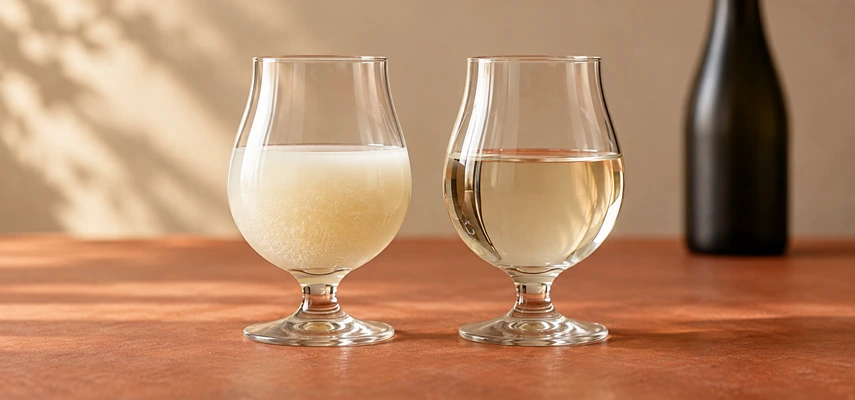

Nigori sake, nama, genshu and muroka can appear together on a label, which makes them look like competing categories in one classification system. They actually answer different questions. Nigori concerns retained solids and cloudiness; nama concerns heat treatment; genshu concerns water adjustment; muroka concerns filtration or charcoal treatment in producer-specific usage.
Once you separate those questions, a crowded description becomes manageable. A sake can be clear and nama, cloudy and pasteurized, or both genshu and muroka. None of those combinations is inherently contradictory. The useful skill is identifying what the label confirms without silently adding several facts it never supplied.
Nigori sake deliberately retains cloudy material
Nigori has a cloudy appearance associated with retained rice-derived solids. Its separation is coarser than that used to obtain a fully clear expression, allowing some material to remain in the liquid. The JSS production overview relates this appearance to coarse-mesh separation.
Cloudiness therefore doesn’t mean no separation happened. Sake production still involves separating the fermented mash according to the applicable process. Calling nigori simply untouched moromi erases an important production distinction and can lead to confusion with other rice-based drinks.
The degree of turbidity can vary. Some products have a relatively light haze; others carry more suspended material and a thicker texture. Don’t demand the same opacity from every bottle. Describe the actual appearance and palate instead of treating the word as a precise measurement of solids.
Cloudiness is not a sweetness measurement
Nigori can feel creamy or substantial because of retained material, but body and sweetness aren’t identical. Sweetness depends on the product’s composition and the way its components are perceived. The appearance alone doesn’t establish the sugar level or the balance between sweetness, acidity and alcohol.
This matters when recommending a bottle. If a guest wants a sweet sake, use actual product information or tasting evidence rather than selecting any cloudy example automatically. If a nigori is relatively dry, that doesn’t make it incorrectly named; the appearance term never promised dessert-level sweetness.
Cloudiness isn’t automatically carbonation either. Some nigori products are sparkling or retain active fermentation, while others are still. Read the product’s handling and opening instructions. In particular, don’t shake a potentially pressurized bottle simply because you want to disperse sediment before serving.
Nama concerns omitted pasteurisation
Nama-zake is unpasteurized sake. The NTA labeling standard defines the relevant no-heating condition after production. It doesn’t define a cloudiness level, an alcohol strength or an ingredient family.
Without pasteurization, enzymes can remain active and microbial stability needs appropriate management. That gives storage and distribution a practical importance. Follow producer instructions, commonly involving refrigeration and protection from heat and light, rather than assuming a closed bottle is unaffected by its surroundings.
Nama often carries an expectation of freshness, but the actual profile still depends on rice, yeast, fermentation and storage. A lively aroma doesn’t prove heat history in a blind sample. It can support a reasoned possibility, while confirmation requires production information or the label.
Once-heated terms need their full names
Nama-chozo is stored without heat treatment and heated later around dispatch or bottling. Nama-zume is heated before storage and bottled without the later treatment in the familiar sequence. Neither is the same as a sake that has never been pasteurized.
The NRIB bottle-label glossary distinguishes these histories. Timing matters because enzymes can act during an unheated storage interval. A treatment after that interval doesn’t reverse every compositional change that has already occurred.
When the question supplies only the shorthand nama, avoid inventing a once-heated sequence. When it supplies a full term, preserve that distinction. This is an easy place to lose precision through an apparently helpful translation such as fresh sake that collapses several production histories together.
Genshu concerns water adjustment
Genshu is commonly explained as undiluted sake: the usual water adjustment after production has been omitted. Many examples are relatively strong because fermentation reached a high alcohol level, but the word alone doesn’t establish a fixed minimum ABV. Read the actual alcohol statement.
There is a useful legal nuance. The NTA permits the genshu term despite a limited water adjustment within a change of less than one percentage point of alcohol strength. Therefore, the absolute claim that no drop of water could ever have been added is too strict. The usual educational contrast remains omitted routine dilution, with the specific labeling allowance acknowledged.
Don’t confuse this with water used during brewing. Rice washing, soaking, starter preparation and mash building all involve water. Genshu doesn’t mean the sake was fermented without it. The question is the later adjustment of the finished liquid, not whether water participated anywhere in production.
Strength and concentration require actual evidence
An undiluted high-strength sake can feel more powerful in alcohol and flavor concentration than a comparable diluted version. But comparing unrelated bottles doesn’t isolate water adjustment as the cause. Fermentation endpoint, sweetness, acidity and other variables may differ too.
Likewise, a relatively low-alcohol genshu can exist if the sake reached that lower strength through its production rather than routine dilution. The name describes a processing history, not a universal number. Avoid replacing a label measurement with a category stereotype.
Genshu also doesn’t establish junmai status. A permitted alcohol-added sake can be genshu if the relevant water-adjustment condition is met. Brewing alcohol addition and later dilution are independent questions, so the combination isn’t a contradiction.
Muroka needs production context
Muroka is often rendered as unfiltered, but the NRIB/JSS guide warns that usage varies. A producer may mean omission of secondary filtration or filtration without active charcoal. Cloth separation during pressing can still have occurred.
That makes the claim absolutely no filtration at any stage unreliable. The English word can invite an interpretation broader than the actual producer meaning. If the detail matters, check the production account rather than arguing from the translation alone.
Omitting charcoal treatment can retain components affecting color, aroma and palate expression. The sake may show more character of a particular kind than an otherwise comparable treated version, but it need not be visibly cloudy. Muroka and nigori are therefore separate pieces of information.
Read a combined description one question at a time
Consider an original hypothetical label reading junmai ginjo muroka nama genshu. Junmai ginjo supplies ingredient and designated-production information. Muroka requires its producer-specific filtration interpretation. Nama identifies omitted pasteurization. Genshu concerns the water-adjustment history, with its labeling nuance.
The description doesn’t automatically tell you whether the sake is sweet, cloudy, sparkling or outstanding. Those remain separate observations or production facts. Reading the label accurately means preserving what is known while keeping the unanswered questions visible.
Now add nigori to another hypothetical description. That adds deliberately retained cloudy material; it doesn’t rewrite the heat or dilution facts already supplied. A useful revision exercise is to remove one term at a time and ask which piece of information disappears. If removing nama also makes your imagined cloudiness disappear, you have linked two independent variables without evidence.
Handle the bottle according to its actual needs
Check refrigeration requirements, serving guidance and opening instructions. A still pasteurized nigori and a potentially pressurized nama nigori may require different handling. Their shared cloudy appearance isn’t enough to determine a safe opening routine, and aggressive shaking isn’t a universal serving instruction.
Sediment can settle during storage, changing how the liquid looks before service. Follow the producer’s directions for redistribution where appropriate, and avoid assuming settled material means spoilage in a style that deliberately contains it. Conversely, unexpected haze in a product intended to be clear deserves investigation.
After opening, protect the product from unsuitable temperature and prolonged exposure. Don’t invent one universal number of days for every combination of these terms. Product composition, packaging, condition and handling differ; specific producer guidance is more useful than an unsupported expiry rule.
Describe first and infer second
In tasting, record clarity, color, aroma and palate from the sample. A clear pale sake is compatible with several combinations of these terms. A cloudy sample gives direct appearance evidence, while its heat and water-adjustment histories may remain uncertain.
Build any production inference from several relevant observations, then state the limits. A full palate alone can’t prove genshu, and a fresh aroma alone can’t prove nama. This distinction between observed evidence and confirmed production facts is especially valuable in blind tasting, where an attractive story can otherwise outrun the glass.
For a final comparison exercise, take four hypothetical products: a clear pasteurized genshu, a cloudy diluted nigori, a clear nama and a clear muroka with unspecified heat history. For each, write one confirmed fact and two things still unknown. The task rewards precision rather than guessing the missing label. It also shows why a retailer’s short category heading can help navigation without serving as a complete technical specification.
The independent dimensions become clearer alongside filtration, pasteurization and water adjustment. Apply the same discipline to blind production conclusions, where a plausible clue is not a complete production record.
One-page revision summary
Keep four questions separate: retained cloudy solids, pasteurization, water adjustment and filtration or charcoal usage. Nigori doesn’t guarantee sweetness or bubbles; nama doesn’t guarantee cloudiness; genshu doesn’t guarantee a fixed strength; muroka doesn’t prove no separation occurred. Combine confirmed facts carefully and use actual product instructions for storage, opening and service.
Written practice: original TFE exercises
These suggested marks and indicative points are independent teaching guidance, not official WSET marking schemes.
Exercise 1: 5 suggested marks
Explain why a clear sake can be described as muroka nama genshu without contradiction. Mapping: Unit 1 LO2.
Indicative marking points:
- Clarity records the absence of visible suspended material.
- Muroka can concern omitted secondary filtration or charcoal according to producer usage.
- Pressing or other separation can still have occurred.
- Nama describes omitted pasteurization.
- Genshu concerns water adjustment, a separate question from clarity or heat.
Model answer: The terms answer different questions. A clear sake can still be muroka if the producer omitted charcoal or the relevant secondary filtration while separating mash solids. Nama concerns heat treatment and genshu water adjustment. Neither requires cloudiness, so the combined description is compatible with a clear appearance.
Why it works: It separates observable appearance from three processing histories and acknowledges the qualified use of muroka.
Common mistake: Assuming unfiltered means untouched mash or that all nama must be cloudy.
Exercise 2: 5 suggested marks
A customer expects every nigori to be sweet, sparkling and unpasteurized. Explain why each assumption needs checking and give an opening precaution. Mapping: Unit 1 LO2; LO4.
Indicative marking points:
- Nigori describes deliberately retained cloudy material.
- Cloudiness does not measure residual sweetness.
- It does not establish carbonation.
- It does not establish pasteurization history.
- Check producer opening instructions and do not shake a potentially pressurized bottle.
Model answer: Nigori indicates retained cloudy material, not a fixed sugar level, carbonation or heat history. Sweetness needs actual product information or tasting; bubbles and nama status need separate evidence. Check the producer’s instructions before opening, particularly for potentially pressurized products, and do not assume shaking is appropriate.
Why it works: Each claim is attached to the evidence it requires, and the handling advice follows the actual product risk rather than the appearance alone.
Common mistake: Treating nigori as one universal production recipe or recommending vigorous shaking of every bottle.
Knowledge check: 10 original practice questions
Independent TFE questions, not official WSET examination items. Choose one answer per question; explanations follow separately.
1. What limited adjustment can still be compatible with the NTA genshu label rule?
2. What does nigori principally describe?
3. Which claim about nigori needs separate evidence?
4. Why can muroka sake be clear?
5. Which combination is inherently contradictory?
6. What does nama identify?
7. Which describes nama-chozo?
8. Which statement about genshu is most accurate?
9. What can a full palate alone prove in blind tasting?
10. What is the appropriate opening approach for a potentially pressurized nigori?
Answers and explanations
1. C — Water adjustment changing alcohol strength by less than one percentage point.. The specific exception prevents an overly absolute no-drop-of-water interpretation. Mapping: Unit 1 LO2 Range 2; LO1 Range 4.
2. B — Cloudiness associated with deliberately retained solids.. The appearance and separation style do not independently establish strength or heat history. Mapping: Unit 1 LO2 Range 2; LO1 Range 4.
3. C — It is necessarily sweet and sparkling.. Sweetness and carbonation are not guaranteed by cloudiness. Mapping: Unit 1 LO2 Range 2; LO1 Range 4.
4. A — It may omit charcoal or secondary filtration while mash separation still removes solids.. Producer usage and separation history matter more than a broad English translation. Mapping: Unit 1 LO2 Range 2; LO1 Range 4.
5. D — None of these combinations is inherently contradictory.. Each term addresses a different production variable and can combine with the others. Mapping: Unit 1 LO2 Range 2; LO1 Range 4.
6. A — Omitted pasteurization under the relevant description.. Nama concerns heat history, with practical consequences for handling and stability. Mapping: Unit 1 LO2 Range 2; LO1 Range 4.
7. D — Stored unheated, then heated later around bottling or dispatch.. The storage interval differs from nama-zume, which is heated before storage. Mapping: Unit 1 LO2 Range 2; LO1 Range 4.
8. B — It concerns omitted routine water adjustment, with a limited labeling allowance.. The definition concerns later adjustment rather than all brewing water or a universal strength. Mapping: Unit 1 LO2 Range 2; LO1 Range 4.
9. C — It is an observation that needs other evidence before assigning a production history.. Several variables affect body, so one observation cannot confirm genshu or another complete process account. Mapping: Unit 1 LO2 Range 2; LO1 Range 4.
10. B — Follow producer instructions and avoid assuming shaking is appropriate.. Cloudiness alone cannot establish the correct opening routine or carbonation status. Mapping: Unit 1 LO2 Range 2; LO1 Range 4.












