










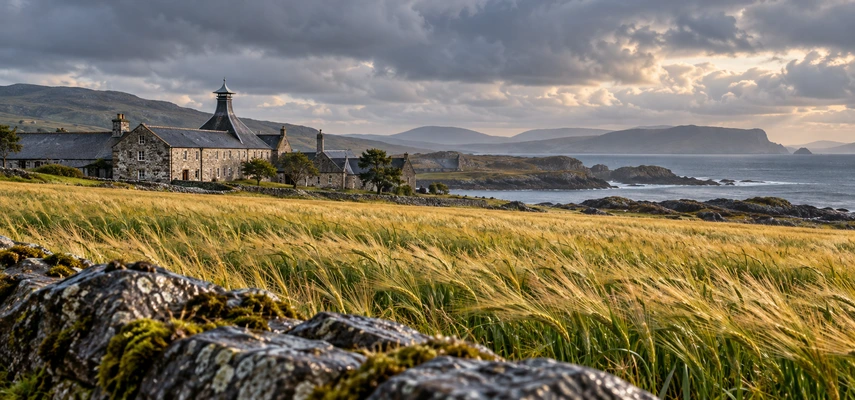

“Single malt” sounds as though it ought to mean one barrel, one batch, or perhaps one particularly distinguished grain. It means none of those things. The “single” refers to one distillery, while “malt” identifies a production category built around malted barley. A bottle can contain whisky from several casks and still be a single malt.
That small vocabulary correction opens up Scotch whisky explained through production. Single malt and blended Scotch share the protected Scottish framework but arrive at their finished compositions differently. Understanding that difference is more useful than treating the categories as rungs on a quality ladder.
Scotland is part of the definition
Scotch whisky must be distilled and matured in Scotland. Its identity includes origin, ingredients and production requirements rather than simply a Scottish-looking label. The minimum maturation is three years in oak. A spirit made elsewhere cannot become Scotch merely by following a similar grain recipe.
The official Scotch Whisky technical file sets out the protected product’s framework and production. For Level 1, keep the major anchors clear: grain, fermentation, distillation, Scottish origin and oak maturation. A regional map can be interesting without replacing these requirements.
Scotch has more categories than the two receiving most attention here. This lesson concentrates on single malt and blended Scotch because they are the central comparison in the Level 1 syllabus. Learning them carefully is better than assuming every bottle with the word “blended” belongs to one undifferentiated group.
What malting does for barley
Barley stores starch. During malting, controlled germination develops the enzyme system needed for conversion, and drying then halts the germination process. In later mashing, those enzymes help break starch down into sugars. The sequence prepares a sugary liquid that fermentation yeast can use.
This is the production reason behind a word that can otherwise sound like a style adjective. Malted doesn’t simply mean rich-tasting or old-fashioned. It describes processing of the grain with a practical consequence. The resulting enzymes connect the starting cereal with the fermentable liquid needed to make alcohol.
Malted barley is ground and mixed with water during mashing. Yeast is added to the resulting sugary liquid for alcoholic fermentation. The alcoholic wash then feeds the still. Conversion supplies fermentable sugar; fermentation creates ethanol; distillation concentrates that ethanol. Keeping those jobs separate makes Scotch production easier to explain.
The grain’s contribution is also more than a neutral source of alcohol potential. Fermentation and the material being fermented help establish the aromatic starting point. Later distillation and maturation reshape it. The finished whisky doesn’t need to smell like a bowl of barley for that initial material to have mattered.
Single malt: one distillery, malted barley, pot stills
Single Malt Scotch Whisky is made at a single distillery from water and malted barley, without adding other cereals, and uses batch pot distillation. It then meets the Scottish oak-maturation requirements. “Single distillery” is the geographical production meaning of single, not a promise about one cask or one year’s output.
Pot stills work in batches. They concentrate alcohol and select a mixture of volatile compounds from the alcoholic wash. In the introductory framework, this lower-strength approach is associated with a spirit carrying medium to pronounced aroma. Equipment details and operating choices help explain variation among distilleries.
A distillery can combine suitable casks from its own production to make a single malt bottling. That may help maintain a recognisable style or build complexity. There is no contradiction between the category and the act of combining casks. The category asks where the malt whisky was produced, not whether the bottler used exactly one barrel.
This is a useful examination trap to practise aloud. If someone says, “It contains several casks, so it can’t be single malt,” the response is to identify the wrong unit. Cask count isn’t what “single” measures. The relevant unit is the distillery.
Blended Scotch: malt and grain together
Blended Scotch Whisky combines one or more single malt Scotch whiskies with one or more single grain Scotch whiskies. Its cereal story therefore includes malted barley and other grains. Both the malt and grain components must qualify as Scotch; the blender doesn’t escape the origin and maturation framework by combining them.
Grain whisky commonly uses continuous column distillation. Such equipment can produce a lighter style that a blender can combine with malt components. “Lighter” doesn’t mean irrelevant. A less assertive component may affect balance and texture or allow another characteristic to stand out in the finished combination.
The Scotch Whisky Association’s category guidance describes blending as work towards a recognisable character. The blender selects components for their roles in that result. A component that seems restrained on its own may be useful in an arrangement, just as a supporting instrument matters without taking every solo.
Blending can pursue consistency and complexity together. Casks and production lots vary, so maintaining a familiar result requires judgment. The operation is a craft decision within category rules, not a synonym for diluting good whisky with an arbitrary liquid. Water adjustment is a separate production operation.
Compare the label facts
| Feature | Single Malt Scotch Whisky | Blended Scotch Whisky |
|---|---|---|
| Distillery meaning | Malt whisky from one distillery | Combination of malt and grain Scotch components |
| Cereal basis | Malted barley, without other cereals | Malted barley and other grains through the components |
| Distillation distinction | Batch pot distillation | Components may involve pot and column distillation |
| Shared requirements | Scottish distillation and maturation; at least three years in oak | Scottish distillation and maturation; at least three years in oak |
The table identifies production differences, not a winner. Preference depends on the particular whisky and the drinker’s aims. A strongly characterful single malt and a carefully balanced blend can both make sense. Category terms help explain construction; they don’t relieve anyone of assessing the actual liquid.
Peat explains some smoke, not all Scotch
Peat can be burned as part of drying malted barley. Smoke-related compounds can then influence the resulting whisky. This links a later smoky impression to a decision early in production, before fermentation and distillation. It isn’t a consequence of whisky simply spending time in Scotland.
Peat is optional. Some single malts have prominent smoky character and others do not. Blends can also include peated malt components, depending on the intended style. “Scotch tastes smoky” is therefore too broad. The better statement is that some Scotch has smoke associated with peat used in malt drying.
For revision, place the choice in its proper stage. Peat relates to drying the malt, not adding a smoky syrup at bottling. A barrel may contribute toasted or other oak-related impressions, but that is another mechanism. Similar descriptive words don’t necessarily point to the same production cause.
Oak develops character without fixing one flavour
Both categories require at least three years in oak in Scotland. Cask history, wood activity and maturation conditions influence what develops. Vanilla, spice, fruit, cereal and other associations may appear in different combinations. No single tasting note is compulsory for every Scotch, and age alone cannot predict the complete profile.
A used cask can still contribute character. “Used” doesn’t mean it has become a chemically inert box, while “new” doesn’t mean it will make every spirit better. Producers select casks in relation to the spirit and the desired outcome. The interaction is more informative than a simple new-versus-old quality ranking.
Scotch may use permitted plain caramel colouring to adjust appearance. This is distinct from arbitrary flavouring or sweetening. A dark colour therefore doesn’t prove a particular age or a particular type of cask. Age information and production evidence deserve more weight than the liquid’s shade alone.
A bottle also doesn’t acquire extra qualifying oak maturation while it sits at home. Storage time after bottling is different from maturation in cask. This distinction matters whenever a numerical age or minimum is being interpreted, even though the detailed legal treatment of labels goes beyond this introductory comparison.
Practise explaining two imaginary bottles
Bottle A is a single malt made at one Scottish distillery, combining several of its casks. It uses malted barley and pot distillation, and it meets the minimum oak maturation. Those facts are compatible. Multiple casks haven’t changed the single-distillery origin of the malt whisky.
Bottle B combines qualifying malt and grain Scotch whiskies to reach a consistent house style. Some malt component might contribute a smoky note, while another element changes balance. The result is blended Scotch. It doesn’t become younger than the qualifying minimum simply because the components were combined.
Now remove the tasting adjectives from both examples. The category decisions are still understandable. Add the sensory descriptions back only when supported by the actual sample or producer information. This order helps separate production identity from reasonable, but variable, expectations about character.
Extend the grain-and-oak comparison through Bourbon and Tennessee, rye and other whisky countries.
What to remember
Single malt means malt whisky from one distillery, made from malted barley using pot stills. Blended Scotch combines malt and grain Scotch whiskies. Both require distillation and maturation in Scotland and at least three years in oak. Peat is optional, blending has legitimate stylistic aims, and permitted caramel can influence colour.
Connect each fact with its purpose: malt supplies enzymes for sugar conversion; yeast makes the alcoholic wash; stills concentrate alcohol and shape character; oak develops the spirit; blending builds the intended finished profile. That chain turns label vocabulary into production knowledge you can use.
Knowledge check: 12 original practice questions
Independent TFE questions, not official WSET examination items. Choose one answer per question; explanations follow separately.
1. What is the minimum oak maturation for Scotch?
- Six months
- One year
- Two years
- Three years
2. Can several casks from one distillery form a single malt bottling?
- No, only one cask is permitted
- Yes, single does not mean single cask
- Only if vodka is added
- Only before fermentation
3. Which cereal basis defines single malt Scotch?
- Corn and rye
- Potato
- Malted barley without other cereals
- Sugar cane
4. Which statement about peat is accurate?
- It is compulsory in all Scotch
- It is added only after bottling
- It defines the word single
- It is optional and can contribute smoke through malt drying
5. Which components define blended Scotch?
- Vodka and malt spirit
- Malt and grain Scotch whiskies
- Rum and brandy
- Only wine and botanicals
6. Which distillation method is used for single malt Scotch?
- Batch pot distillation
- No distillation
- Continuous column only
- Maceration without distillation
7. Which is a legitimate aim of blending?
- Maintaining a recognisable style
- Avoiding all maturation requirements
- Changing foreign spirit into Scotch by naming it
- Removing the need for grain
8. What does single mean in Single Malt Scotch Whisky?
- One cask
- One distillery
- One year of maturation
- One fermentation vessel
9. What role do malt enzymes play?
- Converting starch into sugars
- Making bottle glass
- Adding caramel colour
- Removing the need for yeast
10. What does dark colour establish about a Scotch on its own?
- It is the oldest bottle
- It must be peated
- It is necessarily single malt
- No exact age or category beyond appearance
11. Which addition is relevant to Scotch appearance where permitted?
- Any artificial flavouring
- Mandatory sugar syrup
- Plain caramel colouring
- Juniper essence
12. Which geographical statement is correct?
- Only bottling in Scotland is needed
- Maturation can occur anywhere
- Scotch must be distilled and matured in Scotland
- Any barley whisky can use the name
Answers and explanations
1. D — Three years. Scotch must mature for at least three years in oak in Scotland; many products mature longer. Mapping: LO2.
2. B — Yes, single does not mean single cask. Combining that distillery’s suitable malt casks does not contradict the single-distillery category meaning. Mapping: LO2.
3. C — Malted barley without other cereals. Single malt Scotch uses malted barley, water and yeast rather than a mixture of other cereal grains. Mapping: LO2.
4. D — It is optional and can contribute smoke through malt drying. Peat smoke during malt drying can influence aroma, but both peated and unpeated styles exist. Mapping: LO2.
5. B — Malt and grain Scotch whiskies. Blended Scotch combines qualifying single malt and single grain Scotch whisky components. Mapping: LO2.
6. A — Batch pot distillation. Batch distillation in pot stills is a defining part of the single malt Scotch production framework. Mapping: LO2.
7. A — Maintaining a recognisable style. Blenders select qualifying components to produce consistency and potentially complexity within category rules. Mapping: LO2.
8. B — One distillery. The term refers to the distillery origin of the malt whisky, not the number of casks or vessels. Mapping: LO2.
9. A — Converting starch into sugars. Enzymes developed through malting support starch conversion so that fermentation yeast receives usable sugars. Mapping: LO2.
10. D — No exact age or category beyond appearance. Cask influence and permitted colouring can vary, so colour cannot reliably establish age or malt/blend identity. Mapping: LO2.
11. C — Plain caramel colouring. Plain caramel colouring is permitted for appearance; this does not permit arbitrary flavouring or sweetening. Mapping: LO2.
12. C — Scotch must be distilled and matured in Scotland. The protected framework requires Scottish distillation and maturation, alongside the other production requirements. Mapping: LO2.











