











A label can say “100% agave” and “reposado” without repeating itself. The first tells you about the source of the fermentation sugars. The second tells you about a class shaped by later production, including maturation. Reading them as answers to different questions makes tequila labels much less crowded.
Here is tequila explained from field to bottle, with the two labelling systems kept apart. Blue agave supplies the agricultural foundation. Processing makes its stored carbohydrates fermentable, yeast produces alcohol, and distillation concentrates it. Later choices then create different presentations within the protected category.
The plant is blue agave, not a cactus
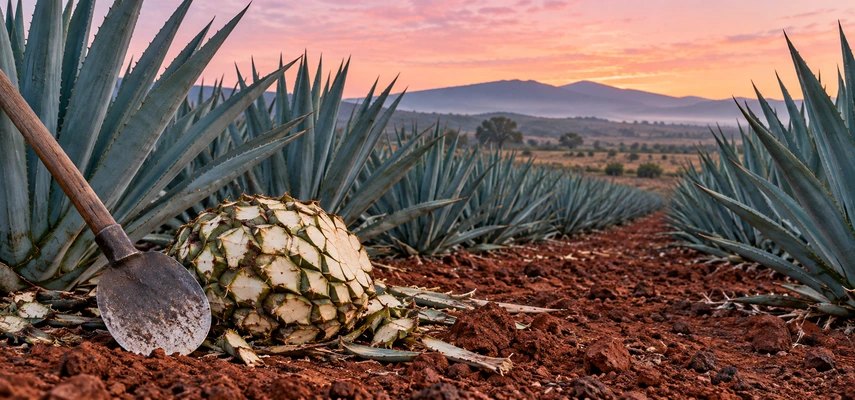
Tequila uses blue agave, Agave tequilana Weber blue variety, grown within the defined origin framework in Mexico. Its long, pointed leaves can encourage the casual description “cactus”, but agave is a different plant group. For this lesson, remembering the correct agricultural material matters more than botanical detail.
The harvested heart, often called a piña, supplies the material processed for production. The leaves are removed during harvesting. This is not a process of fermenting a cactus fruit or using the plant merely as a flavouring in a neutral drink. Agave-derived carbohydrates provide fermentable material at the heart of the spirit’s identity.
The defined area matters as well as the species. Planting blue agave anywhere in the world does not make every resulting distillate Tequila. The Tequila Regulatory Council’s overview connects the plant, origin and regulated process. Protected names require more than a matching ingredient or a Mexican-looking bottle.
Cooking solves a carbohydrate problem
Agave stores carbohydrates that need conversion into fermentable sugars. Cooking helps bring about that conversion. It is a different route from simply pressing sugar-rich grape juice, and it should not be described as the same starch-and-malt process used for barley. Different plants present different preparation problems.
After suitable processing, sugars are extracted into a liquid that can be fermented. The equipment and operating details can vary. For Level 1, concentrate on the causal sequence: conversion makes suitable sugars available, extraction provides the fermentation medium, and yeast performs the next biological task.
Cooking does not produce the ethanol. It prepares fermentable material. Nor is distillation a substitute for cooking or fermentation. Keeping the functions separate helps answer a question even if the wording changes: identify whether the producer is making sugar accessible, making alcohol, or concentrating alcohol already present.
Fermentation and distillation build the base
Yeast converts fermentable sugars into ethanol and carbon dioxide while also producing compounds relevant to aroma. That alcoholic liquid then feeds distillation. Raw material and fermentation therefore influence the spirit before it ever sees a barrel. A clear young Tequila can have considerable character without an oak contribution.
The syllabus associates Tequila with typically lower-strength distillation. Compared with highly concentrated neutral-alcohol production, this can retain a more noticeable aromatic connection with the fermented base. The distinction concerns the production approach, not a requirement to bottle at the strength leaving the still.
A cooked-agave, herbal, vegetal, peppery or fruity impression may be useful when describing particular examples. Such words are possibilities rather than compulsory ingredients or universal tasting notes. A peppery association does not establish that pepper was added. Describing an impression and identifying a production addition are separate claims.
Water adjustment, blending and other permitted finishing operations can shape the eventual bottle. Their use must follow the rules applying to the category and class. A general production technique is not permission to apply every possible additive to every Tequila while retaining the same designation.
Two sugar-source categories
The two central category terms are Tequila and Tequila 100% agave. The broader Tequila category requires at least 51% of the fermentation sugars to come from the specified blue agave, with a permitted remainder from other sugars. The 100% agave category uses that agave for all the fermentation sugars.
These percentages concern sugar origin. They do not describe bottled alcohol strength, the proportion of plant fibre in the glass, or the fraction of the drink made from water. Reading “100%” as pure alcohol would confuse a recipe claim with an ABV statement.
Nor does 100% agave automatically tell you whether the Tequila is blanco, reposado or añejo. A producer can make different classes within the category. Treat category and class like two axes on a chart: one identifies the source of fermentable sugar; the other describes later production characteristics.
The phrase also should not be expanded into a universal claim that every product bearing it is additive-free. The sugar-source designation answers a specific question. To assess permitted later treatment, consult the class rules and actual production information rather than asking one label phrase to certify the entire process.
Blanco and silver
Blanco, also called silver, identifies the clear presentation central to the beginner comparison. It emphasises the spirit’s character without the obvious oak influence associated with longer-aged classes. The detailed standard allows limited holding under specified conditions, so “blanco means literally no storage of any kind” is an unnecessary overstatement.
For study, connect blanco with the relatively direct agave-and-production profile. Do not equate colourless with flavourless. The fermented base and distillation choices can supply pronounced aroma, just as an unaged rum or a botanical spirit can be clear and still expressive.
A clear appearance alone is not an authenticated class certificate, however. The label and producer’s compliance establish the designation. Sensory observation helps describe a sample, while the production record answers how it was made. Keeping those roles separate prevents confident guesses from becoming false rules.
Joven, oro and gold
Joven, oro and gold refer to the same class vocabulary for this lesson. Under the official NOM-006 standard, the class includes blends of blanco with matured Tequila and can also include blanco adjusted through permitted abocamiento. The golden appearance is therefore not a simple minimum-age statement.
Abocamiento refers to specified permitted adjustments, which can include caramel colour and other listed materials within the applicable limits. The beginner takeaway is not a complete additives manual. It is that gold appearance does not establish a long period in oak, and the class should not be reduced to “old Tequila”.
A hypothetical gold bottle might therefore look more mature than a paler aged example without that appearance proving the relationship. If the question asks for age, use a relevant maturation designation. If it asks about colour, describe colour. The two observations can be related without being equivalent.
Reposado and añejo
Reposado requires at least two months of maturation in direct contact with oak or holm oak. Añejo requires at least one year, with a container-capacity restriction in the official definition. The distinction gives an actual maturation condition, unlike treating every golden appearance as evidence of age.
Wood contact can contribute colour and aromas such as vanilla, toast or spice while the spirit develops. The starting Tequila, cask activity and storage conditions all affect the balance. A longer minimum is not a complete prediction of flavour, and more wood character is not automatically better for every purpose.
These are minimums, not statements that every reposado spends exactly two months or every añejo exactly one year in wood. A compliant producer may exceed a threshold. As with other spirit labels, the rule establishes a qualifying condition rather than supplying the full biography of every component.
Extra añejo is another recognised class beyond the central terms required here. It is useful to know that the naming system continues, but the main revision task is distinguishing blanco/silver, joven/oro/gold, reposado and añejo. Additional vocabulary should not displace secure understanding of the core terms.
Blending changes the arrangement
Blending can help a producer reach an intended profile, combining suitable components within the rules. This might support consistency or complexity, or contribute to a class such as joven. It is a production tool whose precise meaning depends on what is combined and how the final drink is classified.
The label is therefore best read as a structured set of claims. First establish Tequila identity and origin. Next check the sugar-source category. Then identify the class. Finally consider the producer’s actual process and descriptive information. That order is more dependable than judging the entire bottle by its colour.
Work through a label example
Imagine “Tequila 100% agave reposado”. The sugar-source phrase says all fermentation sugars come from the required agave. Reposado adds a minimum oak-contact maturation condition. Neither statement sets the retail ABV to 100%, and neither promises one identical tasting note across every compliant product.
Now compare a bottle labelled gold. You cannot infer a longer age merely because its liquid looks darker. Ask which class and permitted process produced that appearance. The exercise is useful because it tests relationships between facts, rather than only whether a student can translate a Spanish word.
Follow the agave’s production logic into raw-material conversion and cocktail balance.
What to remember
Follow blue agave from its defined origin through cooking, extraction, fermentation and typically lower-strength distillation. Then separate sugar-source categories from later classes. Tequila and Tequila 100% agave concern fermentable-sugar origin; blanco, joven, reposado and añejo concern a different part of the production story.
Attach two months to reposado and one year to añejo, using the official definitions. Keep caramel, blending and other adjustments qualified by the rules. With those distinctions clear, the label becomes a useful account of production instead of a contest between clear and gold.
Knowledge check: 10 original practice questions
Independent TFE questions, not official WSET examination items. Choose one answer per question; explanations follow separately.
1. What is reposado’s minimum maturation in the official standard?
- One year
- Two months
- Two weeks
- Three years
2. Why is agave cooked in the introductory production model?
- To make stored carbohydrates available as fermentable sugars
- To replace distillation
- To add oak colour
- To create ethanol directly
3. Which terms identify the same class vocabulary?
- Malt, grain and rye
- VS, VSOP and XO
- Blanco, reposado and añejo
- Joven, oro and gold
4. Which statement about blanco is useful and accurate?
- It always means 100% agave
- It must be made without fermentation
- It can be clear and characterful
- It must be neutral
5. What agave-sugar minimum applies to the broader Tequila category?
- 10%
- 100%
- 40%
- 51%
6. Which plant is required for Tequila?
- Any cactus
- Blue agave
- Rye
- Sugar cane
7. What is añejo’s minimum maturation?
- Ten years
- One year
- One month
- Two months
8. Which pair can appear together without redundancy?
- Cactus spirit and Cognac
- 100% ABV and reposado as equivalent claims
- 100% agave and reposado
- Gold and ten-year minimum as equivalent claims
9. What does Tequila 100% agave identify?
- No possible later permitted treatment
- 100% bottled alcohol
- An añejo minimum
- The source of all fermentation sugars
10. What does gold colour establish on its own?
- A mandatory ten-year age
- No reliable long-age conclusion
- An añejo label
- 100% agave sugar source
Answers and explanations
1. B — Two months. The official definition requires at least two months in contact with the specified oak wood. Mapping: LO2.
2. A — To make stored carbohydrates available as fermentable sugars. Cooking supports conversion before yeast fermentation creates the alcoholic liquid. Mapping: LO2.
3. D — Joven, oro and gold. Joven/oro/gold belong together and should not be mistaken for three separate age minimums. Mapping: LO2.
4. C — It can be clear and characterful. Raw material, fermentation and distillation can supply character without obvious oak influence. Mapping: LO2.
5. D — 51%. The broader category allows a permitted remainder of other sugars, unlike the 100% agave category. Mapping: LO2.
6. B — Blue agave. Tequila uses the specified blue agave within its protected origin and production framework. Mapping: LO2.
7. B — One year. Añejo has a one-year minimum, alongside the other conditions in its class definition. Mapping: LO2.
8. C — 100% agave and reposado. The first term identifies sugar-source category and the second identifies a later production class. Mapping: LO2.
9. D — The source of all fermentation sugars. The designation concerns sugar source rather than ABV, age class or every finishing decision. Mapping: LO2.
10. B — No reliable long-age conclusion. Permitted blending and adjustments mean colour alone is not an age or sugar-source certificate. Mapping: LO2.












