










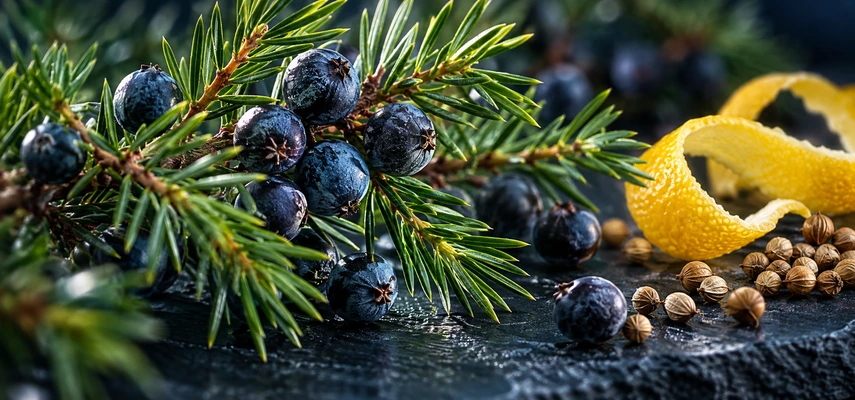

Gin can smell of pine, citrus, flowers, spice or a combination that sends a description wandering around the garden. Yet its definition has a clear centre: juniper must provide the predominant flavour. The freedom to use other botanicals does not remove that requirement.
Here is gin explained through a useful contrast. A relatively neutral spirit base supplies the alcohol; botanical processing supplies defining character. Understanding how those roles fit together makes the category easier to recognise and prevents “London Dry” from being mistaken for an address on a map.
Juniper keeps the category recognisable
Juniper contributes the familiar pine-like association that many readers connect with gin. Its berry-like cones contain aromatic compounds used in production. Other botanicals may add their own characteristics, but juniper has to remain predominant. Simply including a tiny amount of juniper is not the same as meeting that sensory requirement.
Predominant flavour also does not necessarily mean juniper must be more than half the botanical recipe by weight. Different materials contribute different amounts and kinds of aroma. A small mass of one potent ingredient may have a substantial effect. Recipe weight and perceived flavour are related without being interchangeable measurements.
Think of a conversation with a recognisable lead voice and several others adding detail. More voices can change the character, but the lead remains identifiable. The analogy explains the relationship without specifying a universal recipe. Gin producers can pursue different styles while retaining the same defining botanical centre.
The base supplies alcohol, not the whole identity
Gin is a flavoured spirit. A suitable agricultural alcohol base is produced through fermentation and distillation before botanical character is established. The restrained base gives the producer room to build the intended profile. Calling that base relatively neutral does not mean the finished gin must be neutral too.
This is an important distinction from plain vodka. Both can involve high-strength agricultural alcohol in their production story, but the later decisions differ. Plain vodka is associated with a light or relatively neutral finished style. Gin requires juniper-led flavour. A shared kind of base does not make the final categories identical.
A spirit flavoured with citrus alone is therefore not gin merely because it is clear and made from neutral alcohol. The specific juniper requirement matters. The category is defined by more than the general act of adding aroma to a distilled base.
What counts as a botanical?
Botanicals are plant materials used to contribute flavour. In gin they can include juniper, seeds, peels, roots, herbs or flowers, depending on the recipe. Coriander seed and citrus peel are familiar examples. They illustrate the possible range rather than forming a compulsory ingredient list for every gin.
Different parts of a plant can contribute differently. Citrus peel, for example, offers a different aromatic material from the juice used in a sour cocktail. Identifying a citrus impression in gin does not mean the producer mixed lemonade into the base. Ingredient form and extraction method help explain the character.
Nor does a long botanical list automatically establish complexity or quality. Ingredients can overlap, support each other or compete. A carefully balanced short recipe may achieve a clear result, while a longer list provides no guarantee. Count is information about construction, not a self-executing tasting score.
Maceration extracts through soaking
Maceration means soaking material in liquid to extract compounds. Botanical material placed in a suitable alcoholic medium can release flavour-related substances. Time, temperature and the characteristics of the material influence what is extracted. It is an extraction step rather than a new alcoholic fermentation.
The difference matters when describing the process. The botanicals are not generally supplying the fermentable sugar from which the base alcohol was made. Their role is flavouring. A beginner explanation should keep alcohol production and botanical extraction in separate boxes, even when they occur within the same overall production business.
Maceration may form part of a sequence that later includes distillation. It can also be relevant to other flavoured spirits. The term identifies an operation, not a complete gin classification on its own. Knowing that something was soaked does not establish which final category name it can legally carry.
Redistillation carries selected aromas
Redistillation means distilling again. A spirit base can be distilled in the presence of natural botanical material so that volatile compounds contribute to the collected spirit. This is one reason a colourless gin can have a pronounced aroma: aromatic compounds can be present without the visible plant material travelling into the bottle.
Some production arrangements use botanicals in the liquid, while others allow vapour to encounter them in a basket. The details affect extraction and collection. For Level 1, recognise that botanical flavour can be introduced through distillation; you do not need to memorise every equipment variation or operating setting.
The government-hosted Dovey botanical gin specification describes maceration and redistillation in a concrete example. Its particular botanical proportions belong to that product. They demonstrate a method without becoming universal conditions imposed on all gins.
Redistilling with botanicals also differs from merely adding a purchased flavouring after the base has been distilled. Both can be relevant in flavoured-spirit production generally, but category terms can distinguish the permitted routes. A production verb needs to match the actual operation rather than serving as decorative language.
Gin is wider than London Dry
The general gin category allows variation within its defining juniper-led framework. More specific terms add conditions about production or composition. It is therefore helpful to learn the broad family first, then ask what an additional label term promises. A narrow style should not be used as the definition of every member of the family.
London Dry Gin is the key term in this lesson. It describes a production and composition style, not a requirement that the drink be made within London. A compliant product made elsewhere can use the designation. The word London in this context is not functioning like Cognac’s protected geographical boundary.
The basic distinction is that botanical flavour is obtained through distillation with natural plant material, with tight restrictions on later additions, colouring and sweetening. It is not simply a gin that tastes dry or looks traditional. The relevant category provisions define the production claim more precisely than a sensory adjective can.
For a beginner, that is enough to prevent the major confusion. There is no need to bury juniper and botanical distillation under a list of trace-compound limits. Detailed legal interpretation belongs to the relevant jurisdiction and current product rules, while the Level 1 goal is recognising what the term means.
Dryness, bitterness and aroma are different
“Dry” concerns sweetness in this setting, while juniper, citrus and floral descriptions concern flavour or aroma. Bitterness is another sensory dimension. A strongly aromatic gin does not have to be sweet, and a citrus impression does not automatically mean the drink contains enough acid to behave like lemon juice in a cocktail.
These distinctions become useful at the bar. A gin may smell of citrus peel while a sour cocktail still needs its sour component from a separate ingredient. Likewise, tonic can add bitterness and sweetness that do not originate in the gin. Describe the component and the completed drink separately.
A mixed drink can therefore obscure the gin’s own character. For study, use producer information, label facts and optional separate sensory observations to understand the spirit itself. Tasting is not required to learn the production framework, and the Level 1 written examination does not add a practical gin-identification test.
Read a hypothetical label carefully
Imagine a gin made in Wales and described as London Dry. Its location does not create a contradiction. The next questions concern the defining juniper character and the production and composition conditions. A London postal address would not compensate for failing those requirements, just as a different address does not automatically disqualify it.
Now imagine a neutral spirit flavoured mainly with orange and only a faint juniper trace. It cannot be assumed to qualify as gin merely because juniper appears in the ingredient story. Predominance is a sensory condition, not a box ticked by the presence of any amount.
A third product may be a legitimate gin with a different permitted flavouring approach but not qualify for a more specific distilled or London designation. The right response is to read the complete label and process. Broad family membership does not automatically establish every narrower claim within it.
A useful way to describe gin
Start by recognising the juniper-led centre. Then identify broad supporting impressions: citrus, spice, herbal or floral, for example. Become more specific only when the evidence supports it. There is no reward for inventing a rare botanical merely because the description seems more impressive with one included.
Next connect the character with the method cautiously. Botanical extraction and distillation explain how a profile can develop; tasting alone does not reveal the exact recipe, quantities or equipment. A good description can be precise about the sensation while remaining modest about an unverified production inference.
Place gin’s juniper requirement beside vodka’s neutral-base approach and other flavoured spirits and bitters.
What to remember
Gin is a flavoured spirit with predominant juniper character. Other botanicals contribute variety, while maceration, redistillation and permitted flavouring approaches explain different routes to aroma. A neutral base is a starting point, not the defining flavour of the finished gin.
London Dry adds a production and composition meaning and does not require a London origin. Keep sensory description separate from ingredient identification, and never treat a botanical count as a quality certificate. Those few distinctions make a crowded gin shelf much easier to read.
Knowledge check: 10 original practice questions
Independent TFE questions, not official WSET examination items. Choose one answer per question; explanations follow separately.
1. What does a citrus aroma prove about a gin?
- A citrus-like sensory impression
- Enough acidity for every sour cocktail
- Added lemon juice in a fixed amount
- London origin
2. What does London Dry Gin chiefly describe?
- An age statement
- A potato requirement
- Only a London address
- A production and composition style
3. Can a qualifying London Dry Gin be produced outside London?
- No
- Yes
- Only without juniper
- Only if oak-aged
4. Which operation repeats distillation to introduce botanical character?
- Distilling again
- Grinding barley
- Storing a bottle
- Adding sugar only
5. Which statement about other botanicals is accurate?
- Every gin requires the same seventeen plants
- Recipes vary within the category rules
- Only flowers may be used
- Citrus must replace juniper
6. Which statement about botanical recipe weight is correct?
- Every botanical contributes equally per gram
- Juniper must always exceed half the recipe by weight
- Flavour predominance is not automatically a majority-by-weight rule
- Recipe weight has no possible sensory influence
7. Does a longer botanical list automatically mean better gin?
- Yes, if all plants are named
- Yes, without exception
- Only if every plant weighs the same
- No, balance and outcome still need assessment
8. Which distinguishes gin from plain vodka?
- A universal grape base
- Mandatory oak ageing
- No fermentation
- Required juniper-led flavour
9. What is maceration?
- Bottle labelling
- Alcoholic fermentation
- Extraction by soaking
- Barrel charring
10. What must provide gin’s predominant flavour?
- Citrus
- Vanilla
- Juniper
- Gentian
Answers and explanations
1. A — A citrus-like sensory impression. Aroma, ingredient form and acidity are different questions, so a citrus association alone establishes none of the extra claims. Mapping: LO2.
2. D — A production and composition style. The designation adds conditions about production and composition rather than a London-only geographical boundary. Mapping: LO2.
3. B — Yes. The designation is a style and production term rather than a requirement for manufacture in London. Mapping: LO2.
4. A — Distilling again. A spirit base can be distilled again with botanicals to carry volatile flavour compounds into the distillate. Mapping: LO2.
5. B — Recipes vary within the category rules. Botanical variety is compatible with the defining juniper requirement; no single example recipe defines all gin. Mapping: LO2.
6. C — Flavour predominance is not automatically a majority-by-weight rule. Different materials have different aromatic potency, so perceived predominance and mass are not equivalent. Mapping: LO2.
7. D — No, balance and outcome still need assessment. Ingredient count does not establish the quality or complexity of their interaction in the finished drink. Mapping: LO2.
8. D — Required juniper-led flavour. The categories can share a type of neutral base while differing in their finished flavour requirements. Mapping: LO2.
9. C — Extraction by soaking. Soaking botanical material extracts compounds and is distinct from making ethanol through yeast fermentation. Mapping: LO2.
10. C — Juniper. Other botanicals may contribute, but juniper retains the defining predominant role. Mapping: LO2.











