










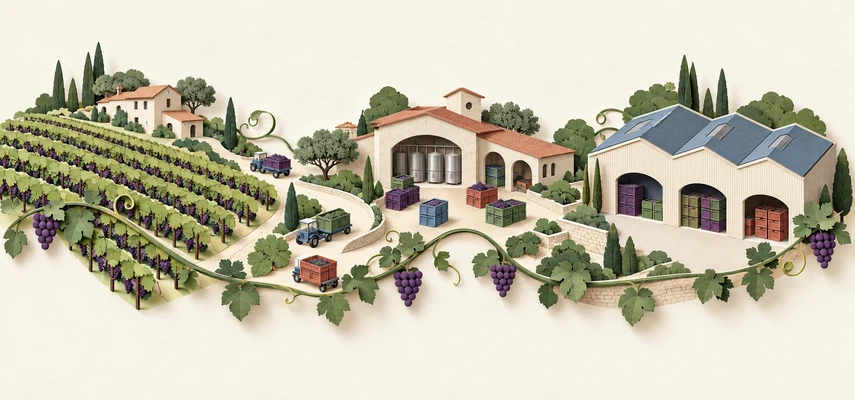

The name on a bottle doesn’t tell you who owned the vineyard, who operated the press or who paid to hold the wine before sale. One business may do all three. Another may own the brand and arrange the rest through contracts. Both can produce serious wine, but their resources and risks look very different.
Wine business models explained through ownership are much easier to compare than a list of labels. Ask what the business controls, what it buys, what it sells and when it gets paid. Then consider what happens after a poor harvest, an unexpectedly large order or a year of weak demand.
The WSET Diploma specification includes estates, growers, grower-producers, merchants, co-operatives, custom crush facilities, virtual wineries and conglomerates in D2. These are useful analytical models, not mutually exclusive boxes into which every real company fits. Production structure also differs from route to market: an estate and a merchant can each sell through distributors or directly where permitted.
Estates connect vineyard and winery decisions
An estate integrates vineyard production with making and selling wine associated with that operation. The business may own or control relevant resources through arrangements such as leases; don’t turn an analytical description into an unverified legal label claim. Terms such as “estate bottled” can have specific rules in particular markets.
Integration allows growing and winemaking decisions to be coordinated. A winery seeking a particular style can plan vineyard work, harvest timing and cellar capacity together. Its account of origin may also support communication with customers. These advantages need execution: owning the vine doesn’t guarantee excellent fruit or a successful brand.
The commitment is substantial. Land, vineyard establishment, winery facilities and wine inventory can absorb capital for years. A geographically concentrated estate may have limited alternative fruit when its own crop is damaged. A weak selling season then meets costs already committed in both vineyard and cellar.
Evaluate the fit between scale, site and intended market. A well-positioned estate can build a distinctive proposition, but expansion may be constrained by suitable land, permitted origin, capacity and demand. Buying extra grapes could help a wider business respond, while the sourcing and labelling of the resulting wine need to remain clear.
Growers concentrate on the grape crop
A grower produces grapes for sale rather than necessarily making and marketing finished wine. Its core skills and resources sit in the vineyard. Selling fruit avoids the need to finance an entire winery, packaged inventory and consumer-facing brand, although the vineyard itself still requires substantial investment and annual work.
The buyer relationship is central. Contracts can address quantity, quality parameters, payment, harvest coordination and acceptance. A reliable relationship may improve planning for both parties. Dependence on a small number of buyers, however, can weaken bargaining power and expose a grower when demand changes.
A high crop isn’t automatically a commercial success if fruit fails the agreed specification or has no suitable buyer. Conversely, producing a lower crop at greater expense needs a price or other benefit that justifies the cost. The grower’s result depends on saleable fruit and the terms actually achieved, not only vineyard appearance.
Specialisation can support technical focus, but it leaves the business exposed to grape-market conditions. Compare the resources avoided downstream with the value and control surrendered by not selling finished wine. Neither side of that comparison proves that vertical integration is always preferable.
Grower-producers add the wine business
A grower-producer uses its own grape production to make and sell wine. This overlaps with an integrated estate; the useful emphasis is the grower’s move into downstream production and commercial responsibility. Definitions and customary usage vary, so explain the activities rather than pretending the terms describe entirely separate legal species.
The opportunity is to capture more value from a distinctive crop and develop a recognisable wine. The obligation is to perform or arrange winemaking, maturation, packaging and selling. A vineyard surplus calculation alone cannot establish whether the additional stages will pay.
Imagine a grower with a dependable grape buyer considering its own label. It must compare the foregone grape receipt with the net return from wine after all additional costs, losses and waiting time. It also needs the capability to attract customers. A higher bottle price isn’t directly comparable with the price per kilogram of fruit.
Small scale may allow close attention and a clear identity, while making equipment utilisation and market access harder. Contracting selected operations can reduce the initial investment, but the grower-producer still needs appropriate agreements and oversight. The business has changed its responsibilities even if it hasn’t bought every machine.
Merchants organise supply beyond their own vineyards
A merchant sources grapes, must or wine from other producers and sells wine through its own commercial operation. The precise activities vary: some undertake extensive production, blending, maturation and bottling; others buy wine at a later stage. Identify what is purchased before comparing costs and control.
The Bourgogne Wine Board’s account of its trade recognises estates, cooperative cellars and maisons de négoce within the same region. The merchant model is part of a production and trading system, not a shortcut description of inferior quality.
Sourcing can give access to more origins, quantities or styles than one vineyard supplies. Relationships, selection, technical work and blending may support consistency or a broad portfolio. In exchange, the business depends on available supply, agreed specifications and suppliers whose priorities may change.
Less vineyard ownership can reduce one category of capital commitment without making the business asset-free. Cellars, inventory, staff, credit and customer development still require funding. In a scarce vintage, competition for suitable supplies can raise cost. In a weak market, purchased stock may sell slowly even though the supplier still expects payment.
Co-operatives pool resources for their members
A co-operative is owned and organised for its members under its applicable rules. In wine, growers can combine fruit and resources to support facilities, expertise and selling power that would be difficult to fund individually. The precise services and obligations depend on the organisation.
The Comité Champagne’s explanation illustrates the variety: collective production can lead to cooperative-brand sales or wine that members market under their own labels. Pooling facilities doesn’t require every bottle to have the same commercial destination.
Shared capacity can spread investment and support professional technical staff. Collective purchasing or selling may also improve negotiating strength. Those benefits depend on effective management, appropriate capacity and a market for the output. Joining a large organisation doesn’t make oversupply or cash-flow pressure impossible.
Governance and incentives need evaluation. Members may differ in site, quality potential, crop size and desired payment timing. Payment rules can influence whether extra vineyard effort is rewarded. A system recognising relevant quality differences creates different incentives from one rewarding only volume. Avoid assuming every cooperative uses the same formula.
Quality depends on fruit, decisions and execution, as in other models. A cooperative can pursue ambitious wine and a strong brand; another may serve a different market. Ownership structure alone is insufficient evidence for either a quality judgement or a price prediction.
Custom crush facilities sell production services
A custom crush facility makes wine or performs agreed operations for clients. Its income can come from service charges rather than solely from selling its own branded bottles. Sharing equipment across clients can improve utilisation, while allowing a client to avoid building equivalent capacity from scratch.
Specify the service: receiving grapes, fermenting, maturing, testing, storing and packaging aren’t automatically one inclusive package. Agreements need to allocate decisions, materials, timing, losses, records and responsibility for an unacceptable result. A cheap quoted crush fee says little about the complete cost if storage and bottling are separate.
Peak harvest creates competing demands. The facility needs enough suitable capacity and competent staff, while the client needs confidence that its fruit receives the agreed treatment at the right time. Clear communication and specifications help, but they don’t eliminate the risk of dependence on another operator.
Legal arrangements also matter. The US TTB’s winery application guidance distinguishes custom crush from alternating proprietorship, where separate proprietors qualify to operate using shared premises. Treating both casually as “renting a winery” can obscure important regulatory responsibility. Other jurisdictions require their own analysis.
Virtual wineries coordinate a brand without the full asset base
A virtual winery organises wine production and sales while relying substantially on others’ vineyards, facilities or services. It may concentrate on sourcing, specifications, brand development and customer relationships. “Virtual” describes the organisation of resources; actual grapes still need actual equipment somewhere.
Lower initial fixed investment can allow a concept to be tested without buying land and a complete winery. It can also offer flexibility to adjust sourcing or volume. This is a different cost structure, not an absence of cost: contracted services, wine inventory, packaging and market development still need payment.
Control depends on agreements, relationships and oversight. Supplier availability, batch consistency and scheduling may be difficult when the brand is a small customer of a busy producer. Switching suppliers can introduce style or continuity problems. The business must preserve traceability and make accurate claims about origin and production.
A strong brand and clear market can make outsourced production commercially sensible. A label with no reliable route to customers remains exposed, however efficiently the wine was sourced. Avoid equating low facility investment with low overall business risk.
Conglomerates combine businesses and capabilities
A conglomerate brings multiple businesses or brands within a wider group. In wine, portfolios may span regions, price positions and routes to market, with combinations of owned assets and contracted supply. Some groups also have interests outside wine. Identify the actual structure rather than assuming identical integration everywhere.
Treasury Wine Estates’ own corporate site illustrates a multi-brand group with vineyard and winemaking resources. The example establishes the existence of that structure; it doesn’t prove that every group enjoys the same economies or financial performance.
Potential advantages include shared expertise, procurement, distribution relationships and access to capital. A portfolio across regions may reduce dependence on one local harvest. Yet different markets can weaken together, and a larger organisation may bring coordination costs, competing priorities or difficulty preserving a brand’s distinct identity.
Scale should be tied to a mechanism. Buying larger quantities may improve purchasing terms; using common systems may spread administrative cost. Neither guarantees that an acquisition creates value or that every brand will receive ideal attention. Evaluate integration, demand and the resources required to manage the portfolio.
Compare the activity before judging the label
For a useful comparison, follow one proposed wine through fruit sourcing, production, inventory and sale. Name who controls each stage, who pays before receipts arrive and who bears a bad outcome. Then consider the intended style, available capital, technical skills and customers.
These models can coexist within one business or region. An estate may buy additional fruit, a merchant may own vineyards, and a cooperative may operate a powerful brand. The best D2 answers preserve those distinctions without forcing reality into tidy but misleading boxes. Explain what the structure enables, what it costs and the conditions under which its advantages actually matter.
Use transportation and distribution and wine supply and demand as tests of the business reasoning here: identify who bears a cost or risk, explain how the route to market changes it and distinguish revenue from the return retained by the producer.
Original Diploma practice
These original exercises are not official WSET questions and have no official mark allocations.
Question 1: evaluate moving from grapes to wine
A grower proposes making and selling its own wine because the bottle price is much higher than the grape price. Evaluate the reasoning and the information needed.
Indicative answer points: different units; conversion and loss; foregone receipt; additional activities; funding; demand and net return.
Outline answer: A bottle price cannot be compared directly with a price per kilogram. Allow for saleable recovery, foregone grape income, processing, maturation, packaging and selling costs. Assess the skills and contracts needed, the time before payment and credible demand. Compare net outcomes over a consistent period rather than assuming that more stages automatically mean more profit.
Question 2: compare a co-operative and a virtual winery
Compare how these models can reduce the need for an individual grower or brand owner to build a complete winery. Evaluate one important limitation of each.
Indicative answer points: member ownership; pooled resources; service contracts; governance; dependency; timing and quality incentives.
Outline answer: A cooperative pools member resources through its ownership and operating arrangements, potentially spreading facilities and expertise across growers. Its limitation may be the need to reconcile different member priorities and suitable quality incentives. A virtual winery purchases or contracts production resources while concentrating on its brand and market; dependence on supplier capacity and specifications can limit control. Neither eliminates inventory funding or the need for customers.
Question 3: assess scale and resilience
A multi-region group claims its size guarantees lower costs and protects it from wine-market downturns. Evaluate the claim.
Indicative answer points: procurement; shared capabilities; geographic diversification; correlated demand; coordination; portfolio fit.
Outline answer: Scale can support purchasing terms, specialist expertise and shared systems, while multiple regions reduce exposure to one local harvest. These are conditional advantages. Coordination costs, poor utilisation or weak brand fit can offset savings, and demand can fall across several markets together. Compare specific cost mechanisms, exposures and management requirements rather than treating size as a guarantee of efficiency or resilience.












