










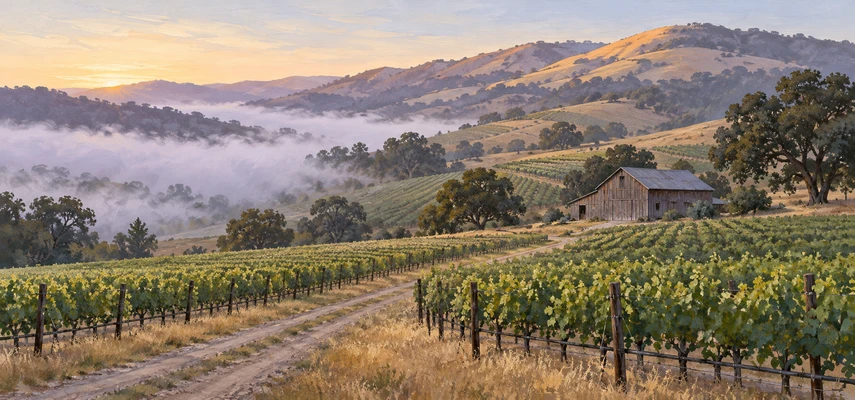

Napa Valley and Sonoma are close neighbours, but “California sunshine” doesn’t explain their wines very well. Marine air, fog, elevation, aspect and shelter can alter ripening over surprisingly short distances. So can the producer’s choice of grape, picking date, extraction and market.
For Diploma study, use Cabernet Sauvignon and Pinot Noir as starting points, then connect geography with production and economics. A recognised origin can support a premium, but expensive grapes, barrels and hospitality still need to produce a wine that customers want. The label can’t do the cash-flow planning.
Locate Napa Valley beyond a single warm valley floor
Napa Valley lies north of San Francisco Bay, inland from the Pacific. Its southern end receives greater influence from San Pablo Bay, while valley orientation, elevation and local shelter complicate a simple south-to-north warming pattern. Mountain slopes and benches need their own consideration alongside the valley floor.
The Napa Valley Vintners’ regional account describes diverse soils, relief and growing settings. Oakville and Rutherford provide central Cabernet references; St. Helena and Calistoga introduce other valley settings, while Howell Mountain and Mount Veeder bring different elevated contexts. Los Carneros crosses Napa and Sonoma counties near the bay. These names organise geography without making every parcel inside them identical.
Alluvial, sedimentary and volcanic-influenced materials can create different rooting, fertility and water relationships. More exposed upland fruit may experience different radiation and wind from a fog-prone low site. A higher vineyard can also sit above some morning fog. Don’t assume height always means a cooler daily temperature or a guaranteed quality advantage.
Explain Cabernet Sauvignon through the actual fruit
Cabernet Sauvignon is central to Napa’s identity, with Merlot, Cabernet Franc and other grapes also supporting blends and varietal wines. The regional Cabernet account emphasises differences between vineyard settings. Black-fruit character and substantial tannin are useful reference points, but alcohol, acidity, ripeness and oak contribution need assessing in the actual bottle.
Warmth can help Cabernet reach flavour and phenolic maturity. Excessive heat or delayed picking can also produce dehydration, rising potential alcohol and declining freshness. A producer needs to judge the material rather than assuming the latest possible harvest is always the most ambitious one. Firm tannin can support development when enough sound fruit and balance accompany it.
Mountain-versus-valley comparisons need similar discipline. Soil depth, crop, exposure, water and cellar handling can all affect structure. “Mountain” isn’t a recipe for maximum extraction, and “valley floor” isn’t a synonym for simple wine. Compare a defined pair of sites before assigning their differences to one cause.
Give Sonoma more than a Pinot Noir identity
Sonoma County lies west of Napa, with substantial Pacific exposure and varied inland valleys. Sonoma County, Sonoma Valley and Sonoma Coast aren’t interchangeable boundaries. The growers’ terroir and AVA account places Russian River Valley, West Sonoma Coast, Petaluma Gap, Alexander Valley and other origins within a varied county.
Marine influence supports cooler Pinot Noir and Chardonnay settings, while warmer inland sites can suit Cabernet Sauvignon, Zinfandel and other material. Alexander Valley provides an important Cabernet reference, while Dry Creek Valley adds a different Zinfandel and Sauvignon Blanc context. Don’t move every Sonoma vineyard into coastal fog simply because Pinot Noir is the chapter’s second headline grape.
Russian River Valley itself contains varied exposures and soils. The growers’ neighbourhood discussion explores differences within the AVA. Those neighbourhoods are a study of local character, rather than a reason to invent a separate federally approved AVA for every informal name. More detailed local knowledge still needs accurate legal geography.
Pinot Noir can supply red-fruit fragrance, acidity and a different tannin profile from Cabernet, with site and handling affecting the result. Thin skins and delicate fruit don’t imply simple wine. Whole-bunch use, maceration, pressing and maturation can change texture and aroma, but no one technique guarantees complexity or a long future.
Connect vineyard choices across Napa and Sonoma
Temperature affects growth, ripening and acid retention. Sunlight supports photosynthesis, with exposure also changing bunch heat and sunburn risk. Water availability depends on rainfall, soil depth, rooting, drainage and permitted irrigation. Nutrient availability influences vigour and crop balance. A shallow dry hillside and a deeper alluvial parcel may need different responses to the same warm week.
Weather creates frost, hail, heat, drought and harvest-rain risks. Downy and powdery mildew and bunch rot remain possible where conditions allow. Vineyard establishment considers exposure, drainage, access, slope and training. Planting materials should match variety, clone, rootstock, soil and water conditions. Pinot planted for a cool maritime site and Cabernet selected for an inland parcel need separate suitability arguments.
Nutrient and water management follows observation and analysis within applicable rules. Canopy management balances productive leaf area, airflow and fruit protection. Harvest timing balances flavour, sugar, acidity, phenolic maturity and health. Hazard management includes erosion control, appropriate frost precautions and access planning. Pest and disease management combines monitoring, canopy work and proportionate intervention. A dry summer doesn’t remove powdery mildew or make every irrigation decision straightforward.
Wildfire smoke adds a distinct risk. UC Davis’s technical guidance recommends testing grapes to assess potential smoke impact. Exposure doesn’t justify declaring every bottle from an entire region faulty, and a smoky oak aroma alone doesn’t establish smoke damage. Fruit assessment, sampling, contracts and communication need evidence rather than a blanket vintage judgement.
Follow fruit handling through fermentation and maturation
Winemaking approaches begin with the target style. Careful grape transportation limits crushing, oxidation and unwanted fermentation. Reception should separate origins, varieties, health and ripeness. Processing and pressing affect yield and phenolic pickup. Cabernet and Pinot lots can require different destemming, whole-bunch and extraction decisions even within one winery.
Alcoholic fermentation decisions include yeast, temperature, vessel and nutrient management. Extraction and pressing should suit skin and seed maturity. More colour isn’t necessarily useful if harsh tannin overwhelms fruit. Malolactic conversion and subsequent maturation should fit acidity, texture and microbial stability. A concentrated Cabernet programme shouldn’t automatically become the model for a finer Pinot Noir.
White production also matters to both regions. Pre-fermentation clarification adjusts white-juice solids for the intended fermentation. Must adjustments require analysis and legal permission. Chardonnay can follow protected fresh-fruit or fuller barrel-and-lees routes, while Sauvignon Blanc can be managed for different aromatic and textural aims. Lees maturation can build texture, with oxygen and microbiological condition monitored.
Wood maturation involves vessel age, size, toast and time. New French oak may suit one lot and obscure another. Blending eligible lots can improve balance while preserving origin and category entitlement; combining varieties, parcels or maturation lots are separate choices. A varietal label needn’t mean every drop came from one grape or one vineyard.
Finishing adjustments, sulfur dioxide and filtration depend on analysis and stability needs. Post-fermentation clarification removes unwanted material; stabilisation considers protein and tartrate risks. Microbiological safeguards should fit analysis, retained sugar and distribution. Packaging and closures should protect the intended drinking period. Wine transportation requires suitable temperature management, including long-distance shipping and the final delivery leg. A premium bottle isn’t insulated from heat by its price tag.
Read AVA, grape and vintage claims separately
An American Viticultural Area is a defined grape-growing origin, rather than a mandated grape-and-method recipe or official quality rank. The TTB’s appellation guidance sets an 85% minimum origin requirement for wine using an AVA, alongside other conditions. An AVA needn’t be contained inside one county, and overlapping or nested areas require accurate boundary reading.
The general federal single-variety rule for these grapes is at least 75% from the stated variety. The TTB’s labelling training material also distinguishes the 95% vintage-year requirement for AVA-labelled wines from other appellation situations. These percentages answer three different questions: where, which grape and which harvest. Applicable state rules and the complete claim still need checking.
International recognition and trade rules, national US law, California requirements and local controls interact. Industry associations such as the regional vintner and grower organisations promote and represent producers; they don’t turn a marketing description into a federal appellation. A geographical indication communicates origin under conditions, while PDO and PGI are EU frameworks rather than classifications automatically assigned to California AVAs. Wines without a specific GI claim still face applicable labelling and production rules. Reserve and estate-related wording need their own contextual reading rather than assumptions imported from European specifications.
Make wine economics concrete
Supply depends on suitable fruit, weather losses, available vineyard land, contracts and stocks held for maturation. Demand differs between accessible regional wines, specialist Pinot, collectible Cabernet and tasting-room purchases. Costs include land or grape purchase, labour, sorting, temperature control, vessels, storage, insurance and finance. Legislation affects sourcing, sales and distribution; currency exchange changes export returns. Prestige can support a price without guaranteeing either demand or profit.
The 2025 final California Grape Crush Report, released in April 2026, separates variety, purchased tonnage and pricing district. District 4 is Napa County; District 3 combines Sonoma and Marin. These are reporting districts, not AVA boundaries or retail-price lists. A district average doesn’t reveal every vineyard contract, and grape cost alone doesn’t tell you the producer’s margin.
Consider an invented teaching example: a winery pays $6,000 for a US ton of grapes and ultimately sells 600 bottles from that material. Fruit alone costs $10 per sold bottle before cellar work, losses, packaging, storage, sales and overhead. If fewer bottles are sold, the effective burden rises. These are illustrative assumptions, not current Napa or Sonoma prices or a universal conversion yield.
A grower may supply fruit, while an estate can coordinate vineyard and cellar decisions. A broker connects parties; a merchant sources wine or grapes; a winery provides production capacity. A virtual winery contracts production, and a custom crush facility supplies agreed services. A cooperative can share equipment and market access; a conglomerate may coordinate businesses. These are possible functions, not equal-prevalence claims. Ownership, production responsibility and brand identity can be different things, so contracts need to allocate fruit quality, smoke risk, traceability and payment clearly.
Importing into another market adds freight, compliance and currency exposure. Retail needs clear origin, style and price information; HoReCa buyers require service training. Direct-to-consumer sales can retain revenue but add acquisition, hospitality, fulfilment and compliance costs. The 2026 direct-to-consumer research programme is a useful current industry reference; it shouldn’t be turned into a promise that every tasting room earns easy margins. Wholesale and direct channels have different costs and reach.
Mature and emerging markets contain varied customers. Wine brands can lead with producer, grape, vineyard or AVA. Marketing concepts begin with a target customer; marketing options include comparative flights, technical notes and vineyard visits. The five Ps connect product, price, people, place and promotion. A high bottle price needs a coherent customer proposition, while a broader-origin wine can succeed through clarity, reliability and value.
Compare the evidence here with northern California as a regional case, then apply the regional comparison framework to the comparison. Compare growing conditions, production decisions, style, quality and the commercial reasons for price. Establish the differences rather than assuming that one familiar name must be better.
Original Diploma practice
These original exercises practise explanation and evaluation. They aren’t official examination questions, marking schemes or accounts of actual bottles tasted.
Question 1: compare Cabernet and Pinot decisions
Compare vineyard and cellar decisions for an inland Cabernet Sauvignon parcel and a cooler maritime-influenced Pinot Noir parcel.
Reasoned outline: Establish actual temperature, water, exposure, crop and fruit health. Explain harvest, skins, extraction, fermentation, malolactic conversion and maturation. Compare costs and intended customers without assuming either wine needs maximum ripeness or new oak. A grape’s reputation needs to be connected with suitable material and production decisions.
Question 2: assess an AVA quality claim
A retailer says a smaller AVA guarantees higher quality and that a Cabernet Sauvignon label proves the wine is entirely Cabernet from that site. Evaluate the claims.
Reasoned outline: Distinguish origin, variety and vintage rules, including the relevant minimums and other applicable conditions. Explain that an AVA identifies a growing area without prescribing a blind-tasting grade. Compare actual producer choices, balance, condition and price. More precise origin information doesn’t replace quality assessment or establish a 100% varietal recipe.
Question 3: evaluate a premium winery budget
Using the invented $6,000-per-ton and 600-sold-bottle example, assess the claim that a $10 fruit cost means every dollar above $10 is profit.
Reasoned outline: Identify cellar labour, vessels, losses, packaging, finance, storage, overhead and selling costs. Compare wholesale receipts with retail shelf price and direct sales with hospitality and fulfilment costs. Discuss unsold stock and timing, then explain why a district grape-price average isn’t a complete business plan. Revenue, gross contribution and profit are different measures.
Analytical tasting preparation: compare California styles
The official recommended-sample programme, printed page 23, includes California Pinot Noir at very good or outstanding quality from any AVA. It also asks for two Cabernet Sauvignons contrasting in quality or region. Napa and Sonoma can support a suitable comparison, but the exercise doesn’t require either origin for every bottle. California Chardonnay, Sauvignon Blanc, Merlot and Zinfandel also have relevant essential selections across the wider California chapters; this red-led comparison doesn’t replace those rows.
Write full systematic descriptions blind. Justify quality through balance, length, intensity and complexity using actual fruit, structure and development evidence. Assess bottle-ageing suitability separately, considering retained fruit and integration rather than alcohol, tannin, obvious oak or price alone. These are proposed selections and methods, not actual tasting results or predetermined official bottle grades.












