










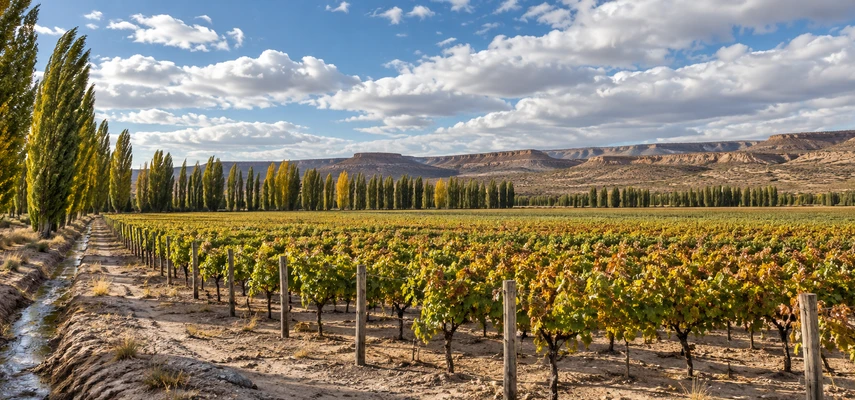

Patagonian wine doesn’t need a glacier in the background to make geographical sense. Much of Argentine Patagonia’s established vineyard area lies in dry, irrigated valleys, with warm sunny days, cool nights and wind all relevant to the crop. The snowy mountain postcard leaves out rather a lot of the vineyard work.
For Diploma study, compare the actual setting with Mendoza, Salta or San Juan before predicting a wine. Latitude, elevation, water, grape and season interact. Pinot Noir is an important Patagonian reference, but Malbec, Merlot, Cabernet varieties and whites stop the discussion becoming a single-grape exercise.
Locate Patagonia’s vineyard areas accurately
Patagonia’s wine regions include growing areas in Río Negro, Neuquén, La Pampa and Chubut, with small additional plantings recorded farther south. The INV’s regional report provides a dated inventory rather than evidence that all this large territory is suitable vineyard land. It should be read with its reference year attached.
Río Negro’s Alto Valle and other river-valley settings form an important established reference. Neuquén includes San Patricio del Chañar, a centre of more recent vineyard and winery development. La Pampa adds Río Colorado-related growing areas, while Chubut contains quite different sites, including Trevelin and Sarmiento. Province, valley and vineyard each add another level of precision.
These names don’t all mean the same altitude, rainfall or ripening period. A vineyard beside a northern Patagonian river can experience a substantially different season from a far-southern site. The right comparison uses the actual parcel rather than assuming every bottle comes from an interchangeable cold frontier.
Explain the dry valley and managed oasis
Much of the established eastern growing area sits in a dry continental environment, with irrigation supporting cultivation. Low rainfall, sunny days and cool nights help explain opportunities, while frost and wind remain practical constraints. Dry doesn’t mean warm all year, and cool nights don’t erase the effects of a hot afternoon.
The Humberto Canale vineyard account links its Alto Valle setting with varied alluvial soils and canal irrigation. It is a useful producer example of managed water in a dry region. The existence of flowing water doesn’t establish unlimited future supply or remove the need for entitlement, maintenance and sensible allocation.
Alluvial soils can combine sand, silt, clay and stones in different depths and proportions. Drainage and water storage influence roots and crop balance. A particular soil description at one estate isn’t a formula for every wine in Río Negro, and a calcareous component doesn’t turn into a literal mineral flavour.
Consider wind as a benefit and a cost
Wind can dry vine surfaces and moderate temperature, helping reduce some disease pressures under suitable conditions. It can also increase water loss, impede growth, damage shoots and complicate vineyard operations. Windbreaks and training need to fit the site; stronger wind isn’t automatically a better quality ingredient.
Chacra’s estate description documents old vineyards, irrigation and shelter trees in Río Negro. Use the specific management example while treating claims that dry air eliminates disease with caution. Old or ungrafted vines still need monitoring, and neither wind nor a chosen irrigation method establishes universal immunity to pests.
Frost is another important constraint. Relative elevation, cold-air drainage, budbreak and the timing of autumn cold can affect which variety and crop are viable. A late-ripening grape might suit one warmer parcel while remaining a poor commercial choice in a cooler site with a short season.
Keep Chubut’s examples separate from the northern valleys
Chubut broadens the Patagonian discussion beyond Río Negro and Neuquén. A lake-influenced Sarmiento site and a more Andean-influenced Trevelin setting need separate climate explanations. Moving south also changes frost exposure and season length; it doesn’t supply a single compulsory sensory style.
Otronia’s Sarmiento account gives a particular lower-elevation, far-southern example with Pinot Noir, Chardonnay and other grapes. Its wine range includes Pinot Noir, Chardonnay and Malbec. The existence of Malbec there is a useful reminder that a regional cool-climate reputation isn’t a planting prohibition.
Don’t convert an extreme-site story into a permanent world’s-southernmost claim or assume every year supplies ideal ripeness. Nor does an organic producer’s location guarantee disease-free fruit. The important explanation connects actual risks, monitoring, crop decisions and the intended style with a viable harvest.
Compare Patagonia with Mendoza, Salta and San Juan
Mendoza’s broad vineyard picture includes both warmer production areas and higher, cooler sites. Salta combines a northerly latitude with substantial elevation, while San Juan includes warmer valleys and higher settings such as Pedernal and Calingasta. Patagonia can achieve cooler growing conditions at much lower elevations than an extreme northern site. Latitude and altitude are different routes into the climate explanation.
Malbec can therefore support a useful comparison across regions, provided the wines also have comparable objectives. Compare actual fruit, structure, ripeness, extraction, oak and age. A fresher example isn’t automatically Patagonian, and a fuller wine isn’t automatically from a warmer Mendoza district.
Pinot Noir and Chardonnay give further Patagonian references, while Merlot, Cabernet Franc, Cabernet Sauvignon and aromatic whites belong in suitable settings. Torrontés provides an important northern comparison rather than an instruction to make every region’s identity revolve around the same grape. The better answer explains why the chosen material fits the particular growing opportunity.
Connect vineyard decisions with style and cost
Temperature affects growth, ripening and acid retention. Sunlight supports photosynthesis, while aspect and exposure change bunch temperature. Water availability depends on supply, soil storage, rooting and irrigation decisions. Nutrient availability influences vigour and crop balance. A windy Pinot parcel needs an argument about shelter and water as well as retained freshness.
Weather creates frost, hail, heat, drought and harvest-rain risks. Downy and powdery mildew and bunch rot remain possible where conditions allow. Vineyard establishment considers exposure, drainage, access, slope and training. Planting materials should match variety, clone, rootstock, soil and water conditions. A dry northern oasis and a colder southern site can require different material and crop expectations even within the same broad Patagonia discussion.
Nutrient and water management follows observation and analysis within applicable rules. Canopy management balances productive leaf area, airflow and fruit protection. Harvest timing balances flavour, sugar, acidity, phenolic maturity and health. Hazard management includes erosion control, appropriate frost precautions and access planning. Pest and disease management combines monitoring, canopy work and proportionate intervention.
Suitable frost precautions, irrigation maintenance and windbreak management all create costs. Lower yield may raise cost per bottle without making the fruit better if the season or vine condition is unsuitable. A producer needs to explain the benefit of selection and vineyard work in the resulting wine, rather than treating scarcity as a quality conclusion.
Explain Pinot and white production alongside the reds
Winemaking approaches begin with the target style. Careful grape transportation limits crushing, oxidation and unwanted fermentation. Reception should separate origins, varieties, health and ripeness. Processing and pressing affect yield and phenolic pickup. Fragrant Pinot Noir needs handling fitted to its fruit, while a selected Malbec or Merlot may need a different structural objective.
Alcoholic fermentation decisions include yeast, temperature, vessel and nutrient management. Extraction and pressing should suit skin and seed maturity. Cold-climate reputation doesn’t mean every lot needs extra extraction to appear serious. Whole-bunch use, destemming, cap work and press fractions should each have a reason in the actual material and intended wine.
Malolactic conversion and subsequent maturation should fit acidity, texture and microbial stability. Wood maturation involves vessel age, size, toast and time. Blending eligible lots can improve balance while preserving origin and category entitlement. A single-vineyard label doesn’t mean the producer avoided all choices among harvests, fractions or maturation lots.
White production deserves its own attention. Pre-fermentation clarification adjusts white-juice solids for the intended fermentation. Must adjustments require analysis and legal permission. Chardonnay can follow a fresh-vessel or barrel-and-lees route; aromatic whites need their own fermentation and sweetness objectives. Lees maturation can build texture, with oxygen and microbiological condition monitored. Retained acidity is useful only as part of a balanced wine.
Finishing adjustments, sulfur dioxide and filtration depend on analysis and stability needs. Post-fermentation clarification removes unwanted material; stabilisation considers protein and tartrate risks. Microbiological safeguards should fit analysis, retained sugar and distribution. Packaging and closures should protect the intended drinking period. Wine transportation requires suitable temperature management, including warehouses and final delivery. Remote origin can make logistics more demanding without excusing poor arrival condition.
Read Argentine origin claims before comparing price
The INV’s origin-protection resources identify recognised geographical mechanisms, while its current labelling guidance distinguishes claim conditions. Province, region, vineyard, grape and vintage need separate checks. A Patagonian name is a sourcing statement under applicable rules, not a promise that the wine is automatically organic, low alcohol or superior to a Mendoza bottle.
International recognition and trade rules, national Argentine law, regional requirements and local controls interact. Industry associations and regional bodies promote and represent producers, while authorised agencies establish legal entitlement. A geographical indication communicates origin under conditions; PDO and PGI are EU frameworks rather than classifications automatically assigned to Argentine IGs or DOCs. Wines without a specific GI claim still face applicable production and labelling rules. Reserve, estate-related wording and sustainability expressions need their actual conditions rather than an automatic tasting grade.
Supply depends on healthy fruit, weather losses, contracts and stocks held for maturation. Demand differs between accessible regional wines, selected Pinot Noir, Malbec and white releases. Costs include vineyard labour, irrigation, frost precautions, windbreaks, sorting, temperature control, vessels, storage, insurance and finance. Legislation affects sourcing, claims and distribution; currency exchange changes export returns. Price can reflect low recovery, distance and positioning as well as sensory quality.
A grower may supply fruit, while an estate can coordinate vineyard and cellar decisions. A broker connects parties; a merchant sources wine or grapes; a winery provides production capacity. A virtual winery contracts production, and a custom crush facility supplies agreed services. A cooperative can share equipment and market access; a conglomerate may coordinate businesses. These are possible functions, not equal-prevalence claims. Fruit contracts need clear health, maturity, origin, delivery and payment terms.
Importing into another market adds freight, compliance and currency exposure. Retail needs clear origin, style and price information; HoReCa buyers require service training. Direct-to-consumer sales can retain revenue but add hospitality, customer acquisition and fulfilment costs. Mature and emerging markets contain varied customers. A regional export average isn’t an individual wine’s retail price, and a higher invoice price doesn’t establish the producer’s margin without its costs.
Wine brands can lead with producer, grape, vineyard or IG. Marketing concepts begin with a target customer; marketing options include comparative flights, technical notes and vineyard visits. The five Ps connect product, price, people, place and promotion. A compelling Patagonian story can attract attention; repeat purchases depend on the bottle delivering the appropriate style, quality, condition and value.
Compare the evidence here with South Africa’s Coastal Region as a regional case, then apply the regional comparison framework to the comparison. Compare growing conditions, production decisions, style, quality and the commercial reasons for price. Establish the differences rather than assuming that one familiar name must be better.
Original Diploma practice
These original exercises practise explanation and evaluation. They aren’t official examination questions, marking schemes or accounts of actual bottles tasted.
Question 1: compare two routes to cooler conditions
Compare a lower-elevation Patagonian vineyard with a higher Salta or Mendoza site, explaining why neither latitude nor altitude alone predicts the wine.
Reasoned outline: Establish actual heat, exposure, water, soil, variety and season. Compare frost, wind, canopy, harvest and cellar objectives. Assess quality and costs from evidence. Different geographical routes can create similar opportunities without producing identical wines.
Question 2: assess a wind-and-organic claim
A buyer assumes strong Patagonian wind guarantees disease-free organic fruit and higher wine quality. Evaluate the claim.
Reasoned outline: Explain drying benefits alongside water loss, damage and operational costs. Check monitoring, actual certification and fruit health, then assess the wine’s balance and condition. A helpful climatic effect isn’t immunity or a sensory quality grade.
Question 3: untangle a regional price comparison
A retailer assumes every Patagonian Pinot should cost more than every Mendoza Malbec because the region is smaller and farther away. Evaluate the proposal.
Reasoned outline: Compare actual production scale, yield, labour, maturation, logistics, distribution margins, demand and sensory quality. Keep export averages separate from individual retail prices. Regional size and distance are cost factors, not a complete price list.
Analytical tasting preparation: finish Argentina’s comparisons
The official recommended-sample programme, printed page 23, includes Malbec from Salta or Patagonia at very good or outstanding quality as optional. Pinot Noir from any region at very good or outstanding quality is also optional. A suitable Patagonian bottle can support either comparison; the programme doesn’t require a separate compulsory Patagonian flight.
Argentina’s essential selections remain Torrontés and Bonarda at good or very good quality, Mendoza Malbec at acceptable or good quality, Mendoza Malbec at very good or outstanding quality, and Cabernet Sauvignon or a Cabernet-dominated blend at very good or outstanding quality. Other optional selections include Chardonnay or Sauvignon Blanc at very good quality and Cabernet Franc at very good or outstanding quality. This chapter’s regional contrasts supplement that full national programme.
Write full systematic descriptions blind. Justify quality through balance, length, intensity and complexity using actual fruit, structure and development evidence. Assess bottle-ageing suitability separately, considering retained fruit and integration rather than acidity, rarity or regional reputation alone. These are proposed selections and methods, not actual tasting results or predetermined official bottle grades.












