











D3 revision gets interesting when the maps come off the wall. Can you explain why two wines made from the same grape taste different? Can you support a quality judgement without knowing the label? Can you turn a vineyard problem into an argument about style, cost and price before the clock wins?
Those are connected skills. A useful revision session moves between regional knowledge, causal explanations and sensory evidence. Another evening spent highlighting place names may feel reassuring, but the exam won’t ask how fluorescent your notes have become.
This guide brings those skills together through original comparison drills, a two-part theory rehearsal and a proposed twelve-wine tasting session. The exercises are independent educational practice, not official questions, specimen papers or predictions of examination marks.
Build D3 revision around the actual assessment
The official Diploma specification places D3 on two consecutive examination days. Day one has a two-hour theory paper and an 80-minute theory paper. Day two has two six-wine tasting papers, with 90 minutes for each paper. Theory therefore totals three hours twenty minutes; tasting totals three hours.
That structure has a practical consequence: knowing a region and delivering an answer under time pressure are different achievements. Practise retrieval before opening the book, then practise selecting what the question needs. A beautifully accurate paragraph about pruning earns its place only if pruning helps answer the task.
Keep two revision records. The knowledge record holds gaps such as confusing a larger geographical area with a smaller appellation. The performance record holds habits such as writing a long introduction, leaving comparisons implicit or giving an ageing conclusion without reasons. Each needs a different remedy. Reading another chapter won’t automatically fix time allocation.
Use current instructions supplied by your Approved Programme Provider for examination arrangements. The rehearsal below borrows the assessment’s broad timing, not a supposed fixed question count or official allocation of marks.
Compare mechanisms across the world
Start with a question, rather than a country heading: how can a grower retain freshness while achieving adequate ripeness? Then compare sites through temperature, sunlight, water, crop, canopy and harvest decisions. Explain the mechanism before attaching a regional example. A cool night and an early harvest can both help preserve acidity, but they aren’t the same process.
Take two hypothetical Chardonnay vineyards. Site A has cool growing conditions and regular autumn rain. Site B ripens fruit more quickly and depends on managed irrigation. At A, an earlier harvest might reduce rot exposure but leave insufficient flavour development. At B, waiting for flavour can increase sugar and reduce acidity. These are conditional scenarios, not claims that every vineyard in a named country behaves alike.
Now carry each scenario into the cellar. A producer seeking a brisk, fruit-focused style might limit new oak and avoid malolactic conversion. Another seeking a richer style might use barrel fermentation, lees contact and malolactic conversion. Don’t treat those choices as a package that always travels together. Partial conversion, older barrels and selective lees work give a winemaker intermediate options.
Add the legal question: does the proposed origin or label permit the grape, process and claim? Then add the commercial question: will the intended customer pay for the extra labour, barrel inventory and delayed release? A coherent comparison reaches style, quality and price through connected decisions. It doesn’t stop after naming a climate.
Repeat the method with a red-wine problem. Imagine fruit with ripe flavours but a firm tannin structure. Gentler extraction might improve balance; more extraction might simply increase the burden on the fruit. Oak could add complexity, yet excessive oak could obscure it. A longer ageing period raises storage and finance costs without guaranteeing a better result.
A useful comparison sheet has five short entries: shared problem, contrasting conditions, producer response, sensory consequence and limitation. Its final entry matters. If a conclusion depends on vintage, site, yield or customer segment, say so. Qualifications strengthen a reasoned answer when they identify what could change the outcome.
Turn knowledge into written explanations
Build paragraphs around a claim and a causal chain. For a hypothetical steep vineyard, explain how difficult machinery access increases manual work, how that affects labour costs, and why higher production costs require either a viable selling price or another source of margin. The slope itself doesn’t prove the wine tastes better.
For an evaluation, introduce the competing consideration. A longer maturation period can develop desirable complexity and support a producer’s positioning, but it also ties up stock, uses space and exposes the wine to handling and storage risks. Whether it makes commercial sense depends on the style, condition of the wine, demand and achievable price.
For a comparison, keep the two subjects in the same paragraph where possible. Writing a miniature essay about A followed by a miniature essay about B leaves the reader to do the comparing. A sentence that states the shared problem and explains the different responses does more work.
Read command words carefully. Description identifies characteristics; explanation supplies reasons; evaluation weighs consequences against an explicit objective. These are useful writing distinctions rather than a substitute for the wording on the actual paper. Before writing, underline what is being compared, the requested outcome and any boundaries imposed by the question.
During timed practice, leave a small reserve for rereading. Look for unsupported absolutes: always, best, all and guarantees. Replace them with the actual mechanism or evidence. Also remove expensive detours. A paragraph that answers a different question is still a detour, even when its facts are excellent.
Observe the wine before choosing its identity
Blind tasting is easier to derail when the first aroma produces a confident guess. Once that guess settles in, every later observation can start auditioning for the same story. Write what you perceive before deciding what might have produced it.
For appearance, record clarity, colour depth and hue as separate observations. A deposit or visible gas may also matter, but neither is a shortcut to an age or quality verdict. On the nose, check condition before considering aroma strength and the particular characters you can support. An intense smell can still be faulty; a restrained wine can still be sound.
On the palate, separate sweetness from fruit flavour and acidity from the overall impression of freshness. A wine smelling of ripe peach isn’t necessarily sweet. A wine’s alcohol warmth doesn’t measure its body on its own. Body concerns the combined impression of weight and texture, which can involve several components.
For red wines, distinguish tannin quantity from tannin texture. Abundant but fine-grained tannins and a smaller amount of rough, drying tannin create different experiences. Neither observation alone establishes quality. Ask whether fruit, acidity, alcohol and texture work together, rather than rewarding the largest structural measurement.
Describe flavour strength separately from flavour character. Then check whether a creamy texture, slight spritz or another palate feature adds useful information. For the finish, follow the persistence of identifiable flavour rather than timing alcohol heat or a drying sensation. Those sensations may remain after the enjoyable flavour has disappeared.
Consult the current Level 4 tasting resources for the official form and instructions. Where the form calls for one position on a scale, make one choice. Illustrative aroma examples are prompts for precise observation, not a shopping list that must all appear in a note. This article doesn’t reproduce the proprietary tasting sheet or lexicon.
Explain quality and ageing separately
Start a quality explanation with evidence from the glass. Consider how components balance, how clearly flavours register, whether different characters form a coherent whole and how long worthwhile flavour persists. Don’t merely write a flattering adjective after a long list of aromas.
Suppose an invented wine shows forceful acidity, noticeable oak and modest fruit that fades quickly. Its structure is substantial, but the note doesn’t yet demonstrate integration, concentration or a sustained finish. Compare that with an invented wine whose less forceful structure supports clear, layered flavour and a persistent finish. More acid or tannin isn’t an automatic promotion.
Bottle-ageing suitability needs its own explanation. Ask whether sufficient fruit and structural support are likely to remain while desirable development occurs. Identify what improvement you expect, not simply how long the bottle might survive. A sound wine can be very enjoyable now without a persuasive case for improvement in storage.
After revealing labels in practice, compare observations before discussing reputation. If everyone upgrades a quality conclusion after seeing the producer, return to the original notes. The label can help investigate production choices; it can’t retrospectively supply a longer finish.
Organise a twelve-wine practice session
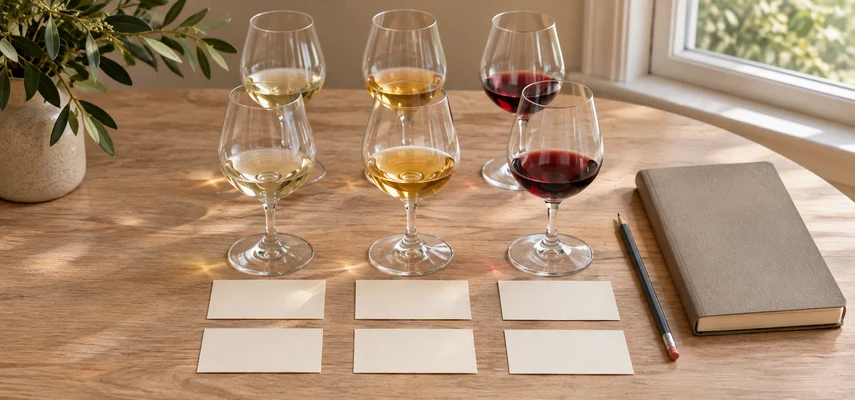
Use two separately timed flights of six wines. Ask a tutor or experienced organiser to choose bottles, conceal labels and manage serving conditions. The types below come from the specification’s recommended sample context, but their arrangement is an original teaching choice. Target quality bands are purchasing guidance, not verified judgements on unseen bottles or a prediction of exam groupings.
For flight A, source two Marlborough Sauvignon Blancs: one at an acceptable-to-good target level and another at very good. Add a New Zealand Chardonnay targeting very good-to-outstanding, an Argentine Torrontés targeting good-to-very-good, a Canadian white Icewine targeting very good-to-outstanding, and a South African Chenin Blanc targeting very good-to-outstanding.
For flight B, source two Mendoza Malbecs at contrasting acceptable-to-good and very-good-to-outstanding targets. Add a Californian Merlot targeting good-to-very-good, a Californian Zinfandel targeting very good-to-outstanding, a Barossa Valley Shiraz targeting very good-to-outstanding, and a South African Pinotage targeting very good-to-outstanding.
These selections don’t replace the complete essential and optional tasting programme. Nor should the organiser force the higher-priced bottle into the higher-quality role. If the actual bottles fail to show the intended contrast, that is a useful result to discuss rather than a reason to rewrite the notes.
Allow 90 minutes per flight, including checking conclusions. As a personal practice method, divide the available time between observation, conclusions and a final review; adjust after identifying where you actually lose time. Don’t mistake an equal fifteen-minute average per wine for an official instruction about how to handle every sample.
After each flight, separate errors of observation from errors of interpretation. Missing sweetness calls for palate calibration. Noticing ripe fruit but assuming a hot origin calls for testing alternative explanations. Correcting the right error makes the next session much more useful.
Test a written comparison using Bordeaux’s Left Bank and China’s wine regions. Explain the evidence for differences in climate, production and style before judging quality or discussing the reasons for a price difference.
Original Diploma practice
These tasks and indicative answers are original, non-official exercises. They have no official marks, model-question status or guaranteed grade. No wines have been tasted for this article.
Question 1: rehearse the two-hour theory component
Use a 120-minute session to compare two hypothetical producers of Chardonnay, one pursuing an accessible fruit-focused wine and one a premium, more textural wine. Evaluate vineyard risks, harvest decisions, cellar choices, legal checks and routes to a viable price. Plan, write and review within the session; the single extended task is a teaching device, not the official paper’s question count.
Indicative points: connect conditions to ripening; distinguish cellar options; check the proposed origin claim; explain storage and inventory costs; consider the customer; identify limits. Outline answer: An effective comparison connects each choice to a defined commercial and sensory objective. Premium intentions don’t remove the need for balanced fruit or a viable market.
Question 2: rehearse the 80-minute theory component
In 80 minutes, evaluate the claim that stricter regional rules necessarily produce higher-quality wine at a higher price. Use two contrasting regional examples from your existing notes, checking the actual rules before the session. Reserve time to identify where evidence about law ends and inference about quality begins.
Indicative points: define each rule’s scope; consider permitted variation; separate compliance from sensory performance; evaluate costs; consider reputation and demand. Outline answer: Rules can constrain production and establish an origin claim, while individual execution and market conditions still affect quality and price. A convincing answer gives mechanisms and exceptions rather than treating a category as a tasting result.
Question 3: analyse the six-white-wine flight
Complete full notes and separate quality and ageing conclusions during the 90-minute flight A session. After the reveal, compare the Sauvignon pair, assess the Chardonnay’s texture, and explain how sweetness and acidity interact in the Icewine. Discuss Torrontés aroma and Chenin structure without assuming either from the label alone.
Indicative points: record observations first; distinguish sugar from ripe aroma; compare balance and flavour persistence; justify quality; explain expected ageing development. Outline answer: The stronger explanation identifies differences that were actually recorded before the reveal. If the proposed quality contrast wasn’t observed, investigate bottle condition, service and calibration rather than inventing supporting sensations.
Question 4: analyse the six-red-wine flight
During flight B’s 90 minutes, assess every wine and compare the Malbec pair before choosing identities. After the reveal, discuss tannin amount and texture, fruit concentration, oak integration and finish across the flight. Explain ageing suitability independently for each wine.
Indicative points: avoid quantity-as-quality reasoning; compare actual balance; identify supported oak observations; test alternatives to regional guesses; distinguish survival from improvement. Outline answer: A persuasive quality judgement connects integration and sustained flavour with the selected conclusion. Neither the Barossa label nor the Malbec price supplies missing sensory evidence; an ageing case must explain the desirable development expected from the wine in the glass.











