










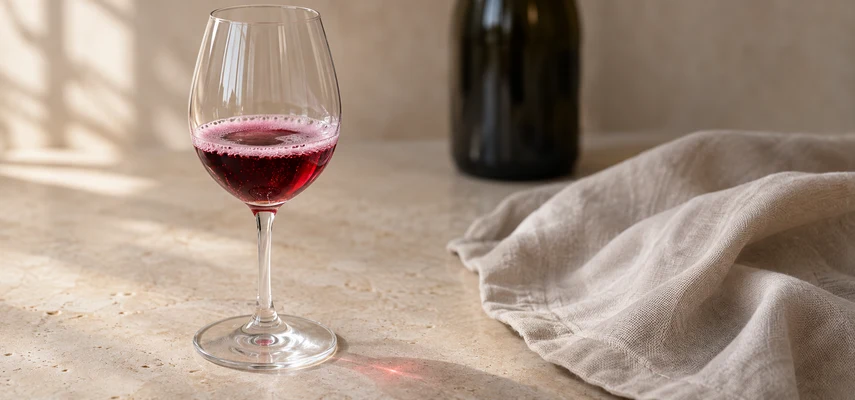

Italy’s sparkling wines don’t all begin with the same ambition. Franciacorta and Trentodoc build their identities around bottle fermentation and maturation. Lambrusco offers another set of possibilities: different dark-skinned varieties, contrasting colours, variable sweetness and both tank and bottle routes under particular rules.
The useful comparison isn’t “serious white wine versus cheerful red wine.” It’s how growing conditions, grapes, extraction, fermentation, time and business choices produce different results. A vibrant, well-balanced sparkling red can succeed on its own terms without auditioning to taste like a Chardonnay-based wine.
Franciacorta: explain the site before the cellar
Franciacorta lies in Lombardy, south of Lake Iseo, within the province of Brescia. Glacially influenced landscapes and varied soils create different growing settings rather than one identical vineyard. Local exposure, elevation, water availability and seasonal weather affect ripening and the fruit available for a blend.
Warmth can help develop flavour, while useful acidity and moderate sugar remain important for a sparkling base. Excess heat, dry conditions, frost or disease can complicate that balance. Site selection, planting material, canopy, water, nutrient and crop management therefore influence both quality potential and production cost.
Chardonnay and Pinot Noir are central to the grape framework, with Pinot Bianco and the permitted Erbamat contribution adding options under defined conditions. The Franciacorta consortium’s production account connects grapes, hand harvesting and bottle fermentation. Its promotional quality language shouldn’t be mistaken for an independent grade on every wine.
Gentle handling and pressing can support a clean base with controlled phenolics. Fermentation vessel, malolactic conversion and blending decisions affect the starting wine before the second fermentation. Time with lees then offers opportunities for texture and development, followed by sediment removal and finishing. A shared method still allows considerable variation in style.
Franciacorta labels attach conditions to the choices
The approved May 2024 production rules distinguish the grape and ageing requirements of different expressions. The general framework permits Pinot Bianco up to 50% and Erbamat up to 10%; Satèn has its own Chardonnay-and-Pinot-Bianco conditions. Don’t apply the wider Erbamat allowance to Satèn.
Satèn has a maximum pressure of five atmospheres and is a Brut expression, not a synonym for sweet. Its gentler pressure is connected with its production controls. The Italian text specifies a maximum tirage-sugar allowance; an English summary reversing that to a minimum would reverse the instruction’s meaning.
Basic Franciacorta requires at least eighteen months on lees from tirage to disgorgement. Non-vintage Rosé and Satèn require twenty-four months; millesimato expressions require thirty; riserva expressions require sixty. These are the lees periods, which must be distinguished from any separate release conditions. Rosé also requires at least 35% Pinot Noir under its grape-composition rules.
Longer maturation increases stock, space and finance commitments. It can create a different style and support a premium proposition, but neither the month count nor the category establishes outstanding sensory quality automatically. Assess the fruit, balance, texture and persistence actually present, then explain ageing potential separately.
Trentodoc: mountain influence with site variation
Trentodoc comes from Trentino in northern Italy. The institute’s territory guide describes vineyards at different elevations, mountain influences and moderating effects associated with Lake Garda. That range is more useful than assuming every parcel is equally high, cold or exposed.
Elevation and night temperatures can help retain acidity while slopes and aspect change sunlight and heat receipt. They also create practical differences in access, ripening and management. Rain, frost, hail, water supply and disease remain vineyard questions; mountains don’t guarantee either healthy grapes or a particular aroma in every bottle.
Chardonnay and Pinot Noir dominate the familiar discussion, while Pinot Bianco and Meunier are also permitted. The grape guide describes these options and hand harvesting. Planting material, crop and canopy need to support suitable fruit at the actual site, rather than a predetermined flavour profile from the grape name.
Base-wine fermentation, blending, bottle second fermentation, lees maturation and finishing connect the vineyard with the glass. A producer can use these choices to pursue different levels of fruit expression, texture and development. Malolactic conversion or oak should be investigated as a production decision, not assumed present in every wine.
Distinguish Trento origin from the Trentodoc identity
Trento is a DOC origin; Trentodoc is the collective identity used to communicate its bottle-fermented wines. It isn’t a DOCG simply because Franciacorta is one. Similar grapes and methods don’t merge their legal frameworks or minimum timings.
The institute’s category guide gives minimum lees periods of fifteen months for non-vintage, twenty-four for millesimato and thirty-six for riserva. Compare those figures with the correct Franciacorta categories rather than borrowing one number for both regions. Producers can choose longer holding, but the actual wine still needs to justify a quality conclusion.
A longer programme requires a business to fund the interval before selling. An estate retaining its grapes, a merchant coordinating bought components and a co-operative sharing facilities distribute cost and control differently. Larger ownership may change available capital and distribution, not the basic requirement to make a balanced wine.
For Trentodoc price, consider grape cost, vineyard access, production, storage, packaging and the route to the customer. For quality and bottle-ageing suitability, consider sensory evidence. A mountain photograph can communicate origin, but it doesn’t tell you how long the enjoyable flavour lasts.
Lambrusco: begin with several varieties and origins
Lambrusco isn’t one uniform grape-and-wine combination. The consortium’s variety guide distinguishes names including Sorbara, Salamino and Grasparossa, while different appellations define permitted combinations and origins. Don’t infer that all bottles must be equally dark, sweet or tannic.
The familiar Modena and Reggio Emilia settings include plain and hillside vineyards. Warm growing conditions, fertile soils in some areas, moisture and vine vigour create different management demands from a steep northern sparkling vineyard. Crop, canopy, nutrition, water and fruit health still need to serve the intended wine rather than maximum volume alone.
The consortium’s denomination guide associates Sorbara with paler colour and freshness, Salamino with fruit and moderate structure, and Grasparossa di Castelvetro with more evident body and tannin. Those are useful tendencies, not compulsory notes or a quality ranking. Actual extraction, ripeness, fermentation and sweetness can change the result.
Sorbara, Salamino di Santa Croce and Grasparossa di Castelvetro each have their own composition rules. Broader Modena and Reggiano categories provide different possibilities. A grape’s appearance in a name doesn’t mean every appellation bearing a Lambrusco description permits the same blend or percentages.
Follow Lambrusco’s extraction and fermentation choices
Skin contact determines how much colour and phenolic material enters the wine. A pale rosé and a deeper sparkling red can therefore require different extraction objectives. More colour doesn’t automatically mean better concentration, while more tannin can be a disadvantage if it overwhelms the fruit.
Tank fermentation is an important route, helping producers retain fruit and manage production efficiently. Bottle-fermented examples also exist. The approved 2024 Sorbara text explicitly provides for natural fermentation or refermentation in bottle and tank, with category conditions. The name Lambrusco isn’t proof of either added carbonation or compulsory tank-only production.
Frizzante and spumante describe different gas categories, while a sweetness expression adds another dimension. Don’t use lower pressure as a synonym for lower quality. A dry wine can prioritise freshness and fruit, while retained sugar can be balanced effectively in another style. Stability matters when fermentable sugar remains.
The consortium’s character account presents a range of colours and styles. Its celebration of the category doesn’t eliminate the need to assess individual condition, balance and finish. A wine can be straightforward and successful without requiring either sweetness or heavy extraction to make it convincing.
Compare business models through their consequences
For Franciacorta, Trentodoc and Lambrusco, distinguish the grower selling grapes from the estate retaining fruit for its own wine. A merchant may assemble components and market a range. A co-operative can provide shared services and sell wine. Conglomerate ownership can add resources or distribution access, while overlapping arrangements complicate a simple label-based description.
Supply depends on suitable fruit, yields and available stock. Demand depends on customers, occasions, prices and alternatives. Costs include vineyard work, base-wine handling, pressure equipment or bottle operations, maturation, packaging, transport and selling. Long holding can increase financing needs, but short production doesn’t remove technical or marketing costs.
Each of the three traditions can support different brand propositions. A producer must define the product and price position, identify the people needed to make and explain it, choose placement through suitable channels, and promote a credible reason to buy. Specialist restaurants, local visitors and broader retail require different levels of selling effort and support.
Regional associations provide information and collective identity; they don’t set an infallible tasting verdict. The Franciacorta consortium, Trento DOC institute and Lambrusco consortium also cover different scopes. Compare their work with the actual appellation and brand arrangements instead of assuming every organisation exercises the same legal powers.
Keep origin, sweetness and method separate
DOC and DOCG are protected-origin designations in the Italian system. A geographical indication, an origin category, a method description and a collective identity answer different questions. The exact label claim must be checked within the applicable framework, even when two wines share a grape or bottle-fermentation process.
The EU sparkling sweetness bands need category context: Brut is below Extra Dry in sugar level, while Brut Nature carries a no-added-sugar-after-secondary-fermentation condition. Don’t automatically apply a fully sparkling label table to every semi-sparkling category. National and appellation terms need their own checks.
For a comparison, write down what the label establishes and what remains unknown. Origin and minimum holding can explain constraints; they don’t reveal actual cellar choices, bottle condition or final sensory quality. The distinction is especially useful when comparing a developed white wine with a fresh sparkling red.
Assess all three with the same evidential discipline
Use the official Level 4 tasting resources to record clarity, colour depth and hue, plus visible bubbles or sediment. Assess nose condition before aroma strength and specific character. On the palate separate sweetness, acidity, alcohol warmth and body; tannin quantity and texture deserve particular attention in sparkling reds without being invented where absent.
Distinguish flavour strength from flavour character, record mousse and other tactile features, and follow the persistence of identifiable flavour on the finish. Make one scale choice where instructed; illustrative descriptors prompt observation rather than demand every listed example. Explain quality through balance, definition and persistence. Justify bottle-ageing suitability independently by describing expected improvement and the components likely to support it.
Compare the observed wine with its intended style, not with a single fashionable ideal. Low dosage, high acidity, dark colour and long lees time aren’t interchangeable quality points. A useful conclusion connects the evidence instead of counting impressive features.
Connect Cava and German Sekt with sparkling production methods when testing the explanation: trace a production choice into the wine’s sensory evidence, then distinguish its contribution to style from its implications for quality and cost.
Original Diploma practice
These original tasks include indicative points and outline answers, not official questions or marks. Suggested bottles are sourcing targets; no actual tasting or verified bottle grades are claimed.
Question 1: compare two bottle-fermented origins
Compare a hypothetical non-vintage Franciacorta with a non-vintage Trentodoc. Explain growing conditions, grapes, base-wine choices, minimum lees periods, costs and the evidence needed to judge quality.
Indicative points: site variation; grape framework; bottle fermentation; eighteen versus fifteen months; finance; sensory assessment. Outline answer: Shared method doesn’t imply identical conditions or rules. The different minimum periods establish constraints, while actual quality still depends on fruit, choices, condition and the finished wine.
Question 2: evaluate a Satèn explanation
A seller calls Satèn a sweet, low-quality Franciacorta because its pressure is gentler. Evaluate the statement through permitted grapes, pressure, sweetness category, production controls and tasting evidence.
Indicative points: separate Satèn conditions; white grapes; maximum pressure; Brut; maturation; balance. Outline answer: Satèn’s controlled expression isn’t a lower-quality category or a synonym for sweet. A quality judgement needs evidence from the wine, while the production explanation must preserve the direction of any maximum limit.
Question 3: challenge a Lambrusco stereotype
Explain why a paler dry Sorbara-style wine and a deeper, more structured Grasparossa-style wine can both be legitimate Lambrusco expressions. Include grapes, extraction, fermentation route, pressure and sweetness without asserting that every bottle follows the same pattern.
Indicative points: varieties; origins; colour extraction; tannin; tank or bottle; category checks. Outline answer: Lambrusco’s diversity comes from distinct fruit and permitted production choices. Neither deeper colour nor greater sweetness establishes superior or inferior quality on its own.
Analytical tasting preparation: preserve the alternatives
Source a Franciacorta or Trentodoc targeting very good quality, reflecting an essential study choice. Adding the other origin can make a useful independent comparison, but both aren’t compulsory under that row. Source a Lambrusco targeting good-to-very-good quality as one alternative in the essential Lambrusco-or-Australian-Sparkling-Shiraz selection; an additional wine showing the contrast is optional.
Indicative points: alternatives; condition; sweetness and acidity; mousse; tannin in red; quality; ageing. Outline answer: Conceal identities, write full notes and justify conclusions independently before the reveal. Use the regional and production information to test explanations, keeping sourcing intentions separate from grades established by the actual tasting.












