










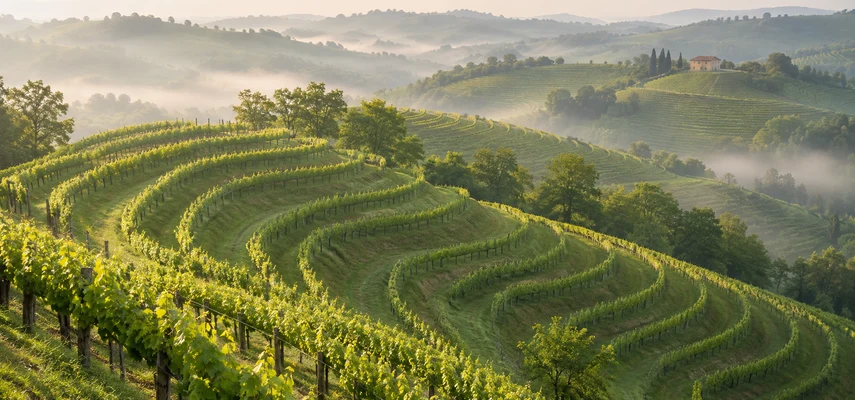

Prosecco and Asti can both put a large pressure tank at the centre of production, yet they ask it to do different jobs. One familiar sequence starts with a base wine and creates sparkle through another fermentation. Another starts with aromatic must and preserves a deliberate balance of grape sugar, alcohol and gas.
That distinction explains much more than the word “tank” alone. Add the differences between Glera and Moscato, the origins on the label and the intended customer, and these wines become a useful lesson in why the same equipment doesn’t imply the same style or quality.
Locate Prosecco before choosing a stereotype
Prosecco’s Italian origin framework includes the broad Prosecco DOC across Veneto and Friuli-Venezia Giulia, alongside the more focused Conegliano Valdobbiadene and Asolo DOCGs. Glera is the central grape. Don’t treat a grape name, a protected origin and a particular sparkling category as interchangeable pieces of information.
The Prosecco DOC consortium identifies the broad production area and Glera-based framework. Many DOC vineyards offer a different operational setting from the steep hills associated with Conegliano Valdobbiadene. That doesn’t make every DOC vineyard flat or every hillside wine excellent. It gives you questions about access, labour, ripening and scale.
The Conegliano Valdobbiadene regional account describes slopes, varied soils, sea and pre-Alpine influences, rain and intensive vineyard work. Aspect and elevation affect exposure and temperature; rainfall, drainage and soil storage affect water availability. Good drainage doesn’t abolish drought risk, and breezes don’t guarantee immunity from fungal disease.
Glera’s crop and canopy need management appropriate to the site and intended wine. Nutrient supply can affect vigour; excess growth can make fruit exposure and disease control harder. Harvest must balance flavour, acidity, sugar and condition. A producer seeking a fresh aromatic base isn’t simply trying to pick the least ripe grapes available.
Explain Prosecco’s common production sequence
Gentle pressing and suitable clarification help prepare the must for its first alcoholic fermentation. Temperature and yeast decisions can protect fruit and floral character, while vessels and oxygen management influence the developing base wine. A producer must judge the actual material rather than follow a generic “cooler is always better” rule.
In the familiar tank sequence, a completed base wine receives fermentable sugar and yeast and undergoes a second fermentation in a closed pressure-resistant vessel. The retained carbon dioxide dissolves in the wine. Clarification and bottling under pressure preserve the sparkle. The consortium’s winemaking explanation describes this Martinotti approach.
Relatively short production can prioritise direct fruit character and early release. It can also improve equipment throughput and reduce the amount of stock held compared with a long bottle-maturation programme. Those are style and business consequences, not proof that every tank wine is simple or that a longer process must taste better.
Blending can balance available components and support a recognisable product. The finished sweetness depends on the intended wine and permitted process, not merely whether its aromas suggest ripe pear. Keep fruit flavour separate from residual sugar, and assess quality through balance and sustained character rather than the method’s reputation.
Read the current Prosecco labels carefully
The approved September 2025 DOC specification distinguishes still, frizzante, spumante and spumante rosé. The familiar white framework is Glera-based with a limited complementary-grape allowance. Rosé has its own Glera and red-vinified Pinot Noir proportions, rather than permission to add any pink wine.
DOC spumante uses tank fermentation, while the frizzante rules also provide for bottle fermentation. Rosé is a spumante type and has a minimum sixty-day elaboration period. Don’t transfer that requirement to every white Prosecco or describe a bottle-fermented frizzante as proof that all DOC spumante can use any method.
Within Conegliano Valdobbiadene, the consortium’s type guide explains Rive, Cartizze and Sui Lieviti. Rive identifies specified hillside origins with conditions including hand harvesting and a vintage indication. Cartizze is a defined subzone. Sui Lieviti retains lees in bottle; it isn’t simply another name for every tank-produced wine.
Asolo Prosecco DOCG is a separate protected origin, not a Rive inside Conegliano Valdobbiadene. These origin distinctions can affect supply, cost and positioning, but a smaller named area doesn’t provide a sensory grade before tasting. Compare actual wines rather than turning the legal framework into an infallible quality pyramid.
Asti: Moscato’s aromatic character in a different landscape
Asti’s production area lies in Piedmont, with sites across parts of Asti, Cuneo and Alessandria provinces. Hilly terrain, calcareous and clay-rich soils, exposure and seasonal weather help explain vineyard decisions. A warm exposed slope and a cooler or wetter position won’t necessarily ripen fruit in the same way.
Moscato Bianco supplies the characteristic aromatic foundation. Crop balance, canopy, water, nutrition and harvest timing need to preserve suitable aroma, acidity and fruit health. Intense grape aroma doesn’t excuse rot, poor balance or a short finish in the finished wine.
The approved Asti specification needs careful reading. Its operative vineyard-composition rule requires at least 97% Moscato Bianco, with a limited allowance for eligible other aromatic white grapes. Don’t silently turn that into a claim about a verified percentage in an individual bottle, or copy an unconditional “every vineyard must be 100%” statement from an older summary.
The designation includes Asti spumante, a metodo classico expression, Moscato d’Asti and a late-harvest category, with further conditions. The classic sweet Asti-method explanation is therefore an important production model, not a complete legal description of every wine under the designation.
Follow the classic sweet Asti-method sequence
For the classic sweet style, clarified Moscato must can be held cold before a controlled fermentation. The yeast produces alcohol and carbon dioxide from grape sugar. Gas can initially escape before it is retained under pressure; fermentation is arrested when the intended balance has been reached, leaving unfermented sugar.
Cooling slows yeast activity, while yeast removal and careful handling help maintain stability. The wine must not simply be bottled sweet with a hope that fermentation stays asleep. Unlike the familiar Prosecco sequence, this model doesn’t require a dry base wine followed by a separate bubble-producing fermentation.
Gancia’s Asti notes give a producer example of cold-held must and a Martinotti process aimed at Moscato’s aromatic expression. Its stated sugar and alcohol values describe that product, not every Asti. The producer’s description also shouldn’t be used to erase the other expressions permitted by the official rules.
Cold holding, refrigeration, filtration and pressure equipment have costs. Relatively early release can reduce some inventory commitments, but stability and aromatic preservation remain technical demands. A sweet wine with modest alcohol isn’t automatically an easy wine to make, or a low-quality one.
Distinguish Moscato d’Asti from Asti spumante
Moscato d’Asti is characteristically sweet, aromatic and relatively low in alcohol, with a gentler gas expression than a fully sparkling Asti spumante. The approved general rules set actual alcohol within 4.5–6.5% and limit the relevant overpressure to no more than 2.5 bar at 20°C. Actual and total alcoholic strength aren’t the same measure: the latter also accounts for potential alcohol from remaining sugar.
Asti spumante occupies a different category, and its rules allow a wider sweetness range than the classic sweet stereotype suggests. Moscato d’Asti shouldn’t be called “Asti with less quality,” and an Asti with a drier finish shouldn’t be declared impossible merely because many familiar examples are sweet.
The production explanation must match the named category. Check alcohol, sugar, pressure and permitted method before comparing two bottles. For quality, then assess whether aromatic definition, sweetness, acidity, alcohol and texture form a coherent whole. An exciting perfume can be one strength without settling every other dimension.
Compare costs, business structures and demand
For both Prosecco and Asti, supply depends on suitable grapes, yields, stock and permitted production. Demand depends on customers, occasions, distribution and alternatives. A broad accessible brand and a small site-focused release can operate within the same wider category while facing different price expectations.
Growers may sell fruit, estates may retain it for their own wine, and merchants may buy components and coordinate a branded range. Co-operatives can share equipment and services. Conglomerate ownership can provide finance and distribution resources, but it isn’t a winemaking method or a guarantee that every wine tastes alike. These models can overlap; investigate the actual business.
Steep Prosecco hills can impose labour costs that a more accessible site avoids. Asti producers may need cold must storage and reliable stability controls. Tank capacity, bottling, packaging, transport and selling costs then shape the economics of each. A cheaper shelf price doesn’t reveal which producer has the healthier margin.
Marketing needs a coherent product and price position. People include growers, cellar staff, sales teams and hospitality professionals. Placement concerns the channels where the intended customer can buy the wine; promotion explains a credible reason to choose it. Regional consortia support collective identity and information, while individual brands still need a viable proposition.
Separate sweetness, aroma and quality in the glass
DOC and DOCG are Italian protected-origin designations within the EU framework, not laboratory measurements of flavour. A geographical indication and a permitted production description answer different questions. Check each category’s sweetness permissions rather than assuming every origin permits every EU term.
The EU sparkling sugar bands place Extra Dry above Brut in sugar category. “Dry” on a sparkling label needs that technical context. A wine smelling of flowers and ripe grapes can nevertheless taste dry, while sweetness doesn’t automatically lower quality.
For analytical study, use the official Level 4 tasting resources. Record clarity, colour depth and hue, plus visible bubbles or sediment. Assess nose condition before aroma strength and specific character. On the palate separate sweetness, acidity, alcohol warmth and body; consider tannin quantity and texture where relevant, without inventing either in a delicate white wine.
Distinguish flavour strength from flavour character, note mousse and other tactile features, and follow the persistence of identifiable flavour on the finish. Make one scale choice where requested; illustrative descriptors guide observation without demanding every example. Explain quality through balance, definition and persistence. Justify bottle-ageing suitability separately through expected improvement and the components available to support it.
Connect Italy’s other sparkling wines with sparkling production methods when testing the explanation: trace a production choice into the wine’s sensory evidence, then distinguish its contribution to style from its implications for quality and cost.
Original Diploma practice
These original tasks offer indicative points and outline answers, not official questions or marks. No wines were tasted for this article; proposed quality targets aren’t verified grades on individual bottles.
Question 1: compare two tank sequences
Compare familiar Prosecco production from a completed base wine with the classic sweet Asti-method model. Explain starting material, fermentations, gas retention, sugar, stability, style and cost.
Indicative points: dry base versus must; second versus controlled initial fermentation; pressure; arrest; yeast removal; intended character. Outline answer: The vessel can be similar while the sequence differs. Trace the sugar and fermentation decisions rather than assuming both wines acquire sweetness and sparkle in the same way.
Question 2: evaluate a hillside price premium
A hypothetical Prosecco producer proposes a higher price for a named hillside wine. Evaluate labour, origin conditions, supply, distribution, customer demand and sensory evidence.
Indicative points: access; harvesting; category conditions; scale; margin; quality. Outline answer: A hillside origin can raise costs and support a distinctive proposition, but willingness to pay and actual quality still need evidence. A legal name doesn’t guarantee either a profitable premium or an outstanding wine.
Question 3: correct an Asti generalisation
Assess the claim that all Asti is sweet, made through exactly one fermentation and legally from vineyards containing only Moscato Bianco. Identify what the classic model explains and where the approved category rules require more care.
Indicative points: classic sweet sequence; wider sweetness permissions; metodo classico; Moscato d’Asti distinction; operative97% vineyard rule; individual bottle uncertainty. Outline answer: A useful teaching model isn’t the entire designation. Match the explanation to the actual category and avoid turning a vineyard allowance into an invented bottle analysis.
Analytical tasting preparation: compare essential selections
Ask an organiser to source a Prosecco targeting acceptable quality and another targeting good-to-very-good quality, plus an Asti or Moscato d’Asti targeting good-to-very-good quality. These reflect essential study selections; the Asti choice is an alternative, not a demand for both bottles.
Indicative points: condition; aroma versus sugar; acidity; alcohol and body; mousse; finish; separate ageing. Outline answer: Conceal identities and write full notes before comparing production details. Explain observed quality differences rather than assuming the sweeter or lower-alcohol wine ranks lower, and treat the sourcing targets as intentions rather than grades already established by tasting.











