










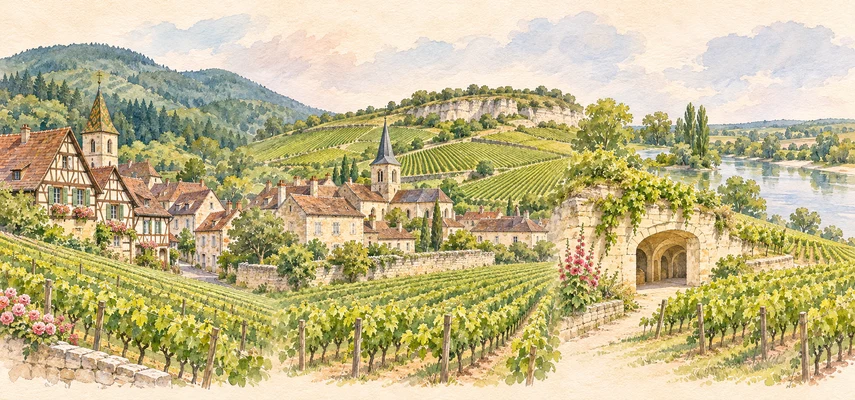

French sparkling wines beyond Champagne aren’t one substitute waiting for a cheaper price tag. Crémant d’Alsace, Crémant de Bourgogne, Crémant de Loire, Saumur and Vouvray bring different grapes, growing conditions and commercial choices to the bottle. Their shared use of bottle fermentation makes the differences more interesting, not less.
For Diploma study, follow a consistent route: locate the origin, identify the fruit and vineyard challenges, explain production, check the label rules, then connect style and quality with costs and demand. The method gives you a fair comparison without pretending that every wine outside Champagne belongs on the same shelf.
Crémant d’Alsace: regional fruit with a separate rulebook
Crémant d’Alsace comes from northeastern France, where the Vosges shelter much of the vineyard from westerly weather. Sites still vary in exposure, elevation, soils and water availability. Shelter doesn’t eliminate rain or disease, and a cool-climate label doesn’t prevent a hot season. Crop and canopy management must produce healthy fruit with acidity and flavour appropriate to a sparkling base.
Pinot Blanc, Auxerrois, Riesling, Pinot Gris, Chardonnay and Pinot Noir form the familiar established grape range. Pinot Blanc and Auxerrois shouldn’t simply be treated as the same variety. Earlier picking for sparkling production can retain acidity and moderate potential alcohol, but the harvest still needs adequate flavour and sound fruit.
The Alsace wine body’s account explains bottle second fermentation and the importance of whole, healthy grapes. Fruit-focused examples can differ from longer-matured wines in development and texture. The producer’s grape choices, base-wine handling and actual time on lees help explain those differences; the regional name alone doesn’t.
For current law, use the January 2026 approved specification. Alongside the established grapes, it provides a controlled adaptation-variety framework, including conditions for whites and rosés. Pinot Noir remains the conventional rosé basis, but “no other grape can ever be permitted” is too absolute under the current text. Planting and blending conditions are separate controls.
A Crémant d’Alsace grower selling grapes and an estate selling finished bottles take on different costs and market risks. A co-operative can share facilities, while a merchant can assemble components and manage a branded range. Evaluate the actual wine’s quality and ageing potential through sensory evidence; none of those business forms guarantees a particular result or price.
Crémant de Bourgogne: more than one grape pairing
Crémant de Bourgogne draws on a broad Burgundian production area with contrasting sites, soils and degrees of exposure. A cooler northern source and a warmer southern one may offer different ripening patterns. Frost, disease, water and heat risks need to be considered at the vineyard scale rather than inferred from one regional average.
Chardonnay and Pinot Noir are central, but they don’t exhaust the possibilities. The producers’ vineyard guide also identifies grapes including Aligoté and Gamay, with other less common varieties. Plant material, crop balance and harvest timing affect the fruit available for a particular blend. A grape associated with still wine doesn’t automatically give the same result when picked and made for sparkling wine.
Traditional production combines a base wine with bottle second fermentation, maturation, sediment removal and finishing. The UPECB cellar explanation describes that sequence. Lees contact can contribute texture and development, but the strength and clarity of the fruit still matter. Longer storage isn’t a way to manufacture concentration that wasn’t present.
Eminent and Grand Eminent need careful terminology. The UPECB’s technical rules describe collective marks operating within the appellation: Eminent requires at least twenty-four months on lattes; Grand Eminent requires at least thirty-six, alongside further conditions. These aren’t two new protected appellations, and their requirements shouldn’t be imposed on every ordinary Crémant de Bourgogne.
For Crémant de Bourgogne businesses, a longer-matured range increases stock and finance commitments while offering a different product proposition. An estate, merchant or co-operative must still find customers for that proposition. Brand recognition and distribution can support price, while actual balance, texture and persistence support quality. Those are related but separate arguments.
Crémant de Loire: a broad origin with several building blocks
Crémant de Loire spans a substantial part of the Loire vineyard, including Anjou, Saumur and Touraine contexts. Oceanic influence generally diminishes farther inland, and soils vary from schist and sandstone to limestone and other formations. The national Crémant federation’s regional account highlights that range rather than one uniform landscape.
Chenin Blanc and Cabernet Franc are important, with other permitted grapes contributing according to the wine and the rules. Chenin’s acidity makes it useful for sparkling production, but harvest timing must still balance flavour, sugar and condition. Cabernet Franc or another dark-skinned component raises choices about extraction and colour rather than automatically determining a rosé.
Canopy, water, nutrient and crop management affect ripening and fruit health across this broad area. A grower on a sheltered limestone site and one on a different soil farther west needn’t face identical problems. Pressing, base-wine fermentation, blending and bottle maturation then offer further ways to shape style and texture.
The approved June 2026 specification includes controlled adaptation varieties and particular conditions, including exceptions affecting some proportions. Don’t copy an older grape list and present it as the complete current law, or borrow Champagne’s ageing clock because the second fermentation also happens in bottle.
Crémant de Loire supply and price depend on grapes, yields, production commitments and demand for the finished range. A grower, estate, merchant or co-operative distributes those responsibilities differently. Wider brand ownership can bring resources without erasing individual wine differences. Check quality and bottle-ageing suitability independently rather than assuming a broad origin must mean a simple or short-lived wine.
Saumur: sparkling identity alongside other regional wines
Saumur’s sparkling wines have their own production context within the wider Loire. Tuffeau limestone and excavated cellars are important features, but the sparkling area also reaches into other soil settings. Proximity to the river, exposure and local climate influence growing conditions. Not every supplying parcel sits above a photogenic white cellar.
The InterLoire appellation guide distinguishes Saumur’s sparkling production from its still wines. Chenin is important, while Chardonnay and other permitted components widen the options. Don’t turn a particular producer’s blend into an appellation-wide requirement, or apply a still Saumur grape rule to every sparkling wine.
Sparkling fruit needs a suitable balance of acidity, sugar, flavour and health. Canopy work, water and nutrient management, crop and harvest timing therefore affect both base-wine quality and cost. Bottle second fermentation, lees maturation and finishing create further variation. “Saumur” by itself doesn’t specify final sweetness, exact lees duration or one standard flavour profile.
Commercially, Saumur’s cellar infrastructure and history of merchant production help explain its sparkling identity. A hypothetical estate retaining its fruit, a merchant buying components and a co-operative sharing services face different control and finance questions. None should be assigned a quality tier simply from the business description.
Evaluate price through supply, demand and the actual costs of production and selling. Evaluate quality and ageing through the wine’s balance and sustained character. A familiar regional house can help a customer choose, but its reputation doesn’t supply sensory evidence for an unopened bottle.
Vouvray: Chenin’s range includes sparkling wine
Vouvray lies in Touraine, east of Tours, on the northern side of the Loire. Its sites include limestone with varying overlying soils, and growing conditions need to be considered through exposure, water and the season. Spring frost, disease pressure and the trade-off between ripeness and acidity are useful starting points for explaining management.
Chenin is the principal grape. The approved Vouvray specification also names Orbois as an accessory variety under limits, so “legally always one hundred per cent Chenin” is too broad. Planting proportions and assembly conditions must be read in their own sections rather than assumed identical.
The Vouvray growers’ syndicate presents still dry, sweeter and fine-bubble wines within the regional identity. That range makes harvest and allocation decisions interesting. Fruit suitable for a sparkling base isn’t automatically the same selection a producer would choose for a concentrated sweet still wine.
Bottle fermentation, time with lees, sediment handling and finishing help shape sparkling Vouvray. Pétillant and mousseux are different product categories; neither should be translated automatically into the contemporary pét-nat production shorthand. Nor should the existence of sweet still Vouvray lead you to assume every sparkling Vouvray is sweet.
A Vouvray grower selling fruit and an estate making both still and sparkling wines face different resource demands. Merchant and co-operative options can change scale and equipment access; larger ownership can change available capital and distribution. Assess the actual structure before inferring control or authenticity. The finished wine’s style, quality, ageing potential and price still need separate evidence.
Compare vineyard and cellar choices fairly
Across Crémant d’Alsace, Crémant de Bourgogne, Crémant de Loire, Saumur and Vouvray, ask what the producer needs from the base wine. A modest sugar level leaves room for alcohol gained during another fermentation; useful acidity supports freshness. Neither objective makes unhealthy or flavourless fruit desirable.
Site selection, planting material, crop and canopy determine what is possible and at what cost. Nutrient and water management should match vine needs, while hazard and disease management protect the potential crop. Harvesting and grape-handling rules differ between appellations: the shared traditional method isn’t permission to copy one region’s entire vineyard rulebook into another.
In the cellar, gentle pressing and appropriate clarification can support a clean base. Neutral or oak vessels, fermentation management, malolactic conversion and blending can change style before the bottle fermentation begins. Lees contact, disgorgement and dosage then create another set of decisions. The production sequence is shared; the exact choices aren’t.
Quality depends on execution and the result in the glass. A long maturation period can add development and cost, but insufficient fruit or poor balance doesn’t become excellent merely by waiting. Bottle-ageing suitability needs an argument about expected improvement, distinct from the price or time already spent in the producer’s cellar.
Connect regional identity with the customer
For each of these five origins, distinguish grower, estate, merchant and co-operative models from conglomerate ownership. These descriptions can overlap. A brand can purchase components and own vineyards, while a co-operative can provide services as well as sell wine. The useful comparison concerns resources, control, costs, risk and market access, not a compulsory ranking of business types.
Supply depends on grapes and stock commitments; demand depends on customers and available alternatives. Production costs include vineyard work, pressing, fermentation, bottles, handling, maturation and finance. Selling adds packaging, distribution and marketing. A lower shelf price than a famous Champagne doesn’t prove low production cost or poor quality.
Marketing requires a clear product and price position. People include growers, cellar teams and the trade professionals explaining the wine. Placement might involve local visits, specialist retailers, restaurants or broader distribution. Promotion should explain a credible regional and sensory proposition. These choices apply to all five origins, but an individual producer must choose a workable combination rather than attempt every channel.
Industry associations can provide regional information and collective promotion; the UPECB and Crémant federation illustrate different organisational scopes. A protected designation and a geographical indication establish particular origin claims, while a collective mark adds its own conditions. They aren’t interchangeable legal labels.
European sparkling sweetness terms also need their own interpretation. The official EU sugar bands place Extra Dry above Brut in sugar category. Finished sweetness isn’t identical to dosage quantity or grape aroma. Check national and appellation terminology rather than assuming a familiar word makes all regional conditions the same.
Taste with the origin hidden first
Use the official Level 4 tasting resources to record clarity, colour depth and hue, plus visible bubbles or sediment. Assess nose condition before aroma strength and specific character. On the palate separate sweetness, acidity, alcohol warmth and body, noting tannin amount and texture where relevant to the actual wine.
Distinguish flavour strength from flavour character, record mousse and other texture, then follow identifiable flavour on the finish. Make one scale choice where instructed; illustrative descriptors guide observation rather than demand a memorised inventory. Explain quality with evidence of balance, definition and persistence. Support bottle-ageing suitability separately with an account of the improvement expected and the components likely to sustain it.
Reveal the origin after those conclusions. A Chenin connection, a longer maturation programme or a particular blend may help explain observations. It shouldn’t dictate notes that weren’t recorded. Regional knowledge is more useful when it tests a hypothesis than when it writes the tasting note in advance.
Connect Prosecco and Asti with sparkling production methods when testing the explanation: trace a production choice into the wine’s sensory evidence, then distinguish its contribution to style from its implications for quality and cost.
Original Diploma practice
These independent exercises have indicative points and outline answers, not official questions or marks. The tasting activity is proposed; no actual wines or official bottle grades are claimed.
Question 1: compare Alsace and Vouvray fruit choices
Compare a hypothetical Crémant d’Alsace blend with a Chenin-led sparkling Vouvray. Explain site, grape, harvest, base-wine and maturation choices, distinguishing established grapes from current controlled permissions.
Indicative points: climate; fruit health; acidity and sugar; blend options; separate legal texts; style limits. Outline answer: Shared bottle fermentation doesn’t erase differences in grape supply or rules. Compare mechanisms and permitted choices without assigning either origin a fixed flavour or quality grade.
Question 2: evaluate an extended-ageing proposition
A Crémant de Bourgogne producer wants to sell a Grand Eminent wine. Explain why a collective mark isn’t a new appellation, and evaluate the production, stock and customer implications of the proposition.
Indicative points: underlying AOC; mark conditions; longer holding; finance; sensory trials; demand. Outline answer: The mark adds defined requirements within the appellation, while the commercial decision still needs a viable price and customers. Compliance and extended maturation don’t establish an automatic sensory superiority over every other bottle.
Question 3: distinguish three Loire origins
Explain why Crémant de Loire, Saumur and Vouvray can’t be treated as interchangeable labels on the same assumed blend. Include grape options, geographical scope, production checks and business positioning.
Indicative points: separate origins; Chenin role; other grapes; actual rules; distribution; quality evidence. Outline answer: Overlapping regional context and methods don’t merge the appellations. Verify each claim against its own scope, then explain how the producer uses those options to meet a sensory and commercial objective.
Analytical tasting preparation: keep optional samples optional
Ask an organiser to choose a Crémant d’Alsace and a sparkling Vouvray, with a Crémant de Bourgogne, Saumur or Crémant de Loire as a useful extension. The official programme lists Crémant of any AC, Vouvray or Saumur as optional samples of any quality level; it doesn’t assign them a compulsory higher-quality target.
Indicative points: condition; sugar versus fruit aroma; texture; flavour persistence; supported quality; separate ageing. Outline answer: Conceal labels and write complete notes before comparing production information. If choosing contrasting quality levels for teaching, treat those as the organiser’s intended comparison, not an official requirement or a verified grade before tasting.











