










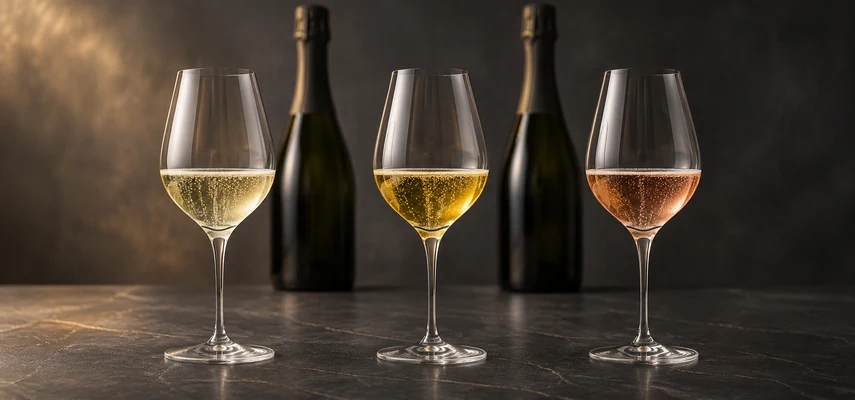

A Champagne label can describe several different things at once: the harvest year, grape colour, finished sweetness, origin and producer’s place in the market. The trouble starts when those descriptions are treated as one ladder of quality. Vintage isn’t a synonym for dry, blanc de blancs isn’t a synonym for expensive, and prestige isn’t a tasting result.
Understanding Champagne styles means separating those claims, then reconnecting them with production and sensory evidence. Once you do that, a complicated label becomes a set of useful questions rather than a collection of impressive French words.
Non-vintage and multi-vintage: consistency with room for variation
Non-vintage Champagne doesn’t declare a harvest year. It commonly blends wines from different years, using reserve wines alongside more recent components to pursue a recognisable style. The word commonly matters: the absence of a vintage claim isn’t, by itself, a complete inventory of the blend’s years.
The Union des Maisons de Champagne’s style discussion explains the central role of the non-vintage wine and the competing demands on a harvest. A producer may need suitable wine for immediate blending, future reserves and other releases. Those decisions affect stock, finance and the range it can offer later.
Multi-vintage can emphasise the deliberate contribution of several years. It doesn’t create an automatic quality grade above every bottle labelled non-vintage. Ask which components, maturation choices and sensory results support the proposition. A more elaborate description of the blending philosophy isn’t a substitute for the actual blend.
Consistency also doesn’t mean every release must be analytically or sensorially identical. Available components and harvest conditions change. The skill lies in meeting the producer’s objective with different materials, rather than pretending that vintage variation never reaches the cellar.
Vintage Champagne: a harvest claim with production consequences
A vintage Champagne identifies a particular harvest. The approved rules require the grapes used for its base wines to come from the stated year, with specified exceptions concerning finishing liqueurs. Don’t import a generic vintage-percentage rule from another category without checking Champagne’s own requirements.
The approved production specification also gives vintage-labelled wine a minimum thirty-six-month period from tirage before consumer release, compared with fifteen months for the general release rule. The separate minimum before disgorgement is twelve months. Thirty-six months before release shouldn’t be casually rewritten as thirty-six compulsory months on lees.
Declaring a vintage involves judgement about the wine and the portfolio. A producer might want to show the character of a year, but it must also consider available quantity, its other blends, holding costs and customers. Different producers need not make the same decision in the same year.
An unfamiliar vintage isn’t necessarily poor, and a celebrated vintage doesn’t make every bottle outstanding. Vineyard, selection, winemaking, storage and bottle condition still matter. For an evaluative answer, explain the opportunities of a particular harvest and the choices made with it rather than awarding quality by calendar.
Prestige cuvées: investigate the producer’s promise
Prestige cuvée generally describes a producer’s leading or especially ambitious offering. It doesn’t replace the appellation’s actual production rules with one universal extra category, grape recipe or price. Such wines can differ in harvest scope, source, blend, maturation and presentation.
Some are vintage wines; a prestige proposition can also be built across years. Krug’s Grande Cuvée account gives a concrete example of an ambitious wine assembled from multiple harvests. Its producer’s qualitative claims are part of its positioning, not independent proof of a grade awarded to every bottle.
When assessing a premium price, separate production costs from market value. Selected components, long holding, packaging and distribution can raise costs. Reputation, demand and scarcity can influence willingness to pay. None tells you, without tasting, how well fruit, acidity, texture and development are integrated.
A good written evaluation can recognise a serious production commitment while questioning an unsupported conclusion. “Expensive to make” and “worth the price to this customer” are different arguments. Both need evidence appropriate to the question.
Blanc de blancs, blanc de noirs and rosé
Blanc de blancs identifies a white wine made from white grapes. Chardonnay is the dominant association in Champagne, but it isn’t the only authorised white grape. Blanc de noirs identifies a white wine made from dark-skinned grapes, principally Pinot Noir and Meunier in the familiar Champagne context.
The French consumer authority’s label guide distinguishes these terms from rosé and vintage claims. Keeping grape colour separate from wine colour helps explain why dark grapes can produce a pale wine: careful handling limits contact between juice and pigmented skins.
Rosé can obtain colour through maceration or through blending a red Champagne base wine with white base wines before the second fermentation. The Comité’s current grape and production account describes both approaches. Rosé therefore doesn’t necessarily mean sweet, and a darker shade doesn’t establish a higher quality level.
These styles can offer useful contrasts in fruit, structure and texture, but don’t turn tendencies into compulsory tasting notes. A Chardonnay-based wine can gain weight through production and maturation. A dark-grape white wine can be restrained and delicate. The grape-colour description narrows a production question; it doesn’t answer every sensory one.
Read sweetness terms in the right order
EU sparkling-wine sweetness terms describe the finished sugar level under defined conditions. They don’t simply name how much sugar went into the dosage liqueur. The European Commission’s current Annex III extract gives the bands; the figures below are grams of sugar per litre of finished wine.
On a narrow screen, scroll the table sideways to read all columns.
| Term | Sugar band |
|---|---|
| Brut Nature | Below 3 g/L, with no sugar added after secondary fermentation |
| Extra Brut | 0–6 g/L |
| Brut | Below 12 g/L |
| Extra Dry | 12–17 g/L |
| Sec | 17–32 g/L |
| Demi-Sec | 32–50 g/L |
| Doux | Above 50 g/L |
Extra Dry is therefore sweeter by category than Brut. Sec means dry in everyday translation, but on this sparkling scale it sits above Extra Dry. Memorise the sequence as a set of technical label terms rather than trusting ordinary-language guesses.
The underlying EU regulation also addresses overlapping eligibility and a three-gram-per-litre label tolerance, without removing the conditions for using a term. The table is a study guide, not a complete product-compliance decision tree. In particular, Brut Nature’s no-added-sugar condition still matters.
Perceived sweetness isn’t a laboratory reading. Acidity, flavour and texture influence balance, so two wines within the same band needn’t seem equally sweet. A lower sugar figure doesn’t guarantee greater complexity or a more enjoyable wine. Taste the relationship between the components rather than rewarding the smallest number.
Separate origin, method and national terminology
Champagne is a protected origin, not a generic word for any wine with bubbles. A protected designation or geographical indication defines claims and conditions within a legal system. Traditional method describes a production approach; it doesn’t grant the right to use another region’s name.
That distinction matters when comparing labels internationally. A French Champagne label, a German Sekt label and a South African Cap Classique description operate in different category and origin frameworks. Shared production features don’t make their terms exact legal equivalents. Check the relevant rules before transferring a sweetness, origin or ageing assumption between countries.
Within Champagne, grand cru and premier cru concern eligible village origins under the approved rules. They don’t establish one universal tasting grade, sweetness or maturity. A vintage blanc de blancs can also be Brut and carry an eligible cru claim: each expression answers a different question.
The practical revision method is to identify what each term claims and what it leaves unknown. If the label says nothing about an actual disgorgement date, don’t invent one. If it supplies a lot code, don’t mistake that code for a harvest year merely because it contains digits.
Decode producer information without ranking the initials
The Comité’s label guide explains professional registration initials. RM identifies a récoltant-manipulant, NM a négociant-manipulant, CM a co-operative producer and RC a grower-co-operator selling under an individual label. ND and MA identify other distribution or brand arrangements.
These codes help investigate who is involved in production and selling. They aren’t a sequence from artisanal excellence to industrial mediocrity. A merchant may make a carefully selected wine; a grower’s direct control doesn’t abolish vineyard or cellar risks. Assess actual operations and the wine, not the appeal of an initial.
Also distinguish producer address from grape origin. The location of a registered business isn’t automatically the location of every supplying parcel. Brand, producer and source can be connected without being identical, especially where a blend draws on several districts.
Use label information after sensory conclusions
For blind practice, follow the official Level 4 tasting resources. Record clarity, colour depth and hue, plus visible bubbles or sediment. On the nose separate condition, strength and specific aroma character. On the palate assess sweetness, acidity, alcohol warmth and body separately; consider tannin amount and texture where relevant rather than forcing a red-wine expectation onto every pale sample.
Distinguish flavour strength from flavour character, note mousse and other texture, and assess the persistence of identifiable flavour on the finish. Make one scale selection where requested; illustrative descriptors are prompts rather than a compulsory vocabulary recital. Explain quality through the observed balance and sustained character. Support bottle-ageing suitability independently by identifying what desirable development you expect and why the wine can support it.
Only then reveal the labels. Ask whether a vintage claim, grape choice, blend or finishing decision helps explain the observations. If a prestige label instantly transforms your conclusion, check which sensory evidence actually changed. Usually the answer is the label, which isn’t a flavour.
Connect French sparkling wines beyond Champagne with sparkling production methods when testing the explanation: trace a production choice into the wine’s sensory evidence, then distinguish its contribution to style from its implications for quality and cost.
Original Diploma practice
These original tasks include indicative points and outline answers, not official questions or marks. Suggested samples are procurement targets, not actual tastings or verified bottle grades.
Question 1: untangle a combined label
Explain the separate claims in “Vintage, Blanc de Blancs, Grand Cru, Brut.” Identify what each establishes and give three important facts about the bottle that still require investigation.
Indicative points: harvest; grape colour; eligible origin; sweetness; production choices; condition; quality. Outline answer: The terms describe different dimensions rather than four steps on a quality ladder. They don’t establish exact blend details, actual lees duration or the sensory quality of the individual bottle.
Question 2: evaluate a prestige claim
A seller says a multi-year wine can’t be a producer’s prestige offering and that a vintage wine must therefore cost more and taste better. Evaluate the claim through actual product positioning, holding costs, demand and sensory evidence.
Indicative points: producer proposition; multiple harvests; selected components; inventory; market value; independent assessment. Outline answer: Harvest scope doesn’t impose one universal hierarchy of prestige, price or quality. Compare the producer’s actual wine and costs with customer demand and what the tasting demonstrates.
Question 3: explain the sweetness puzzle
Two hypothetical wines are labelled Brut and Extra Dry. Explain why a customer expecting Extra Dry to be the less sweet category could be misled. Then explain why the bands don’t predict every drinker’s perception exactly.
Indicative points: technical sequence; below12 versus12–17; finished sugar; acid balance; flavour; no automatic quality ranking. Outline answer: Extra Dry occupies the higher sugar band, despite its everyday-language name. Perception still depends on the components of the actual wines, so use the category as information rather than a complete sensory description.
Analytical tasting preparation: compare styles without merging the sample columns
Source a rosé Champagne targeting good-to-very-good quality from the essential programme. For optional extensions, choose a blanc de blancs targeting very good quality or a Demi-Sec targeting good-to-very-good quality. If comparing prestige, follow the separate optional recommendation: an outstanding-target prestige cuvée from the same producer as the essential very-good-target non-vintage Champagne.
Indicative points: essential versus optional; condition; sweetness and acidity; texture; supported quality; independent ageing. Outline answer: Conceal identities and write observations first, then use production and label details to test explanations. Don’t convert the optional prestige target into a compulsory bottle, or treat a procurement target as a grade already established by tasting.












