










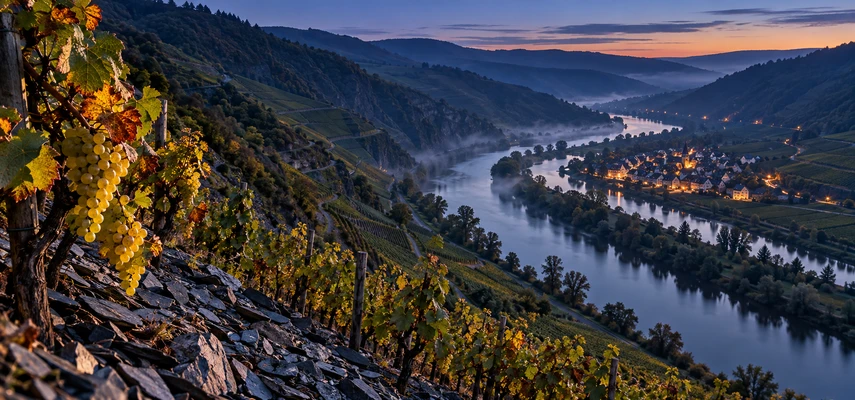

A steep German vineyard doesn’t automatically mean a delicate sweet Riesling. The Mosel makes that style possible, among others; the Ahr is particularly associated with red Pinot Noir. Both show how a carefully positioned slope can help grapes ripen at a northerly latitude, and how expensive that advantage can be to maintain.
For Diploma study, separate three questions before reading the label: where did the grapes grow, how ripe were they at harvest, and how sweet is the finished wine? Germany gives those questions several different vocabularies. Confusing them makes a dry wine seem impossible or a prestigious vineyard appear to guarantee quality. Neither conclusion survives a useful tasting.
Locate two regions rather than one northern stereotype
The Mosel region includes vineyards along the Mosel and its tributaries, the Saar and Ruwer. The German Wine Institute’s regional profile distinguishes several subregions, including the Middle Mosel, terraced lower stretches and the Upper Mosel. Riesling is central, but Müller-Thurgau, Elbling and other varieties also occur. Not every Mosel vineyard is a steep slate Riesling site.
The Ahr is a smaller region farther north, following a tributary of the Rhine. Its regional profile highlights Spätburgunder, the German name for Pinot Noir, and the regional speciality Frühburgunder, an earlier-ripening Pinot form. Red wines at this latitude aren’t an accident that contradicts the climate; suitable sites, grapes and management help explain them.
Temperature affects ripening speed and acid retention, while sunlight influences sugar production and the bunch environment. Shelter, exposure and slope can matter more than a latitude comparison suggests. Warm favourable sites may help maturity in a cool season, but heat and water shortage can become liabilities in a hot one. “Cool climate” isn’t a guarantee of low alcohol or unripe fruit.
Explain the slope without tasting slate literally
Slope orientation changes the sunlight received by vines; elevation and cold-air movement affect local conditions. River settings can influence the surrounding climate, but water below a vineyard doesn’t guarantee protection from frost. A steep photograph also says little about soil depth or the roots’ access to moisture.
Water availability depends on rainfall, rooting, drainage and soil reserves. Nutrient availability influences vigour and crop balance. Weathered slate is important in many celebrated Mosel and Ahr sites, alongside other soils. Its thermal and physical properties can influence the growing environment, but slate doesn’t enter the glass as a pre-made mineral flavour.
Weather brings spring frost, hail, rain near harvest and periods of heat or drought. Downy and powdery mildew and bunch rot require monitoring. Damp conditions may support noble rot in suitable fruit, or destructive rot when timing and health are wrong. Warmth can help ripening without making every late-harvest choice sensible.
Count the work behind the view
Vineyard establishment involves slope stability, exposure, access, permitted varieties and practical training. Planting materials should suit the intended variety, vigour, soil and water conditions. Maintaining terraces and moving through awkward parcels can make labour expensive. Mechanisation possibilities vary; don’t infer the method of every vineyard operation from the region’s steepest example.
Nutrient and water management should follow vine status and applicable rules. Canopy management balances effective leaf area, airflow, ripening and protection from excessive sun. On a damp site, opening the canopy can help fruit dry; on a hot exposed slope, too much removal can increase berry damage. One fashionable canopy treatment doesn’t solve both problems.
Harvest timing balances flavour, sugar, acidity, health and the intended style. Hazard management includes maintaining walls, controlling erosion, securing access and considering frost precautions where appropriate. Pest and disease management combines observation, canopy decisions and justified interventions. The Ahr’s continuing reconstruction after the 2021 flood also shows that winery buildings, equipment and routes to market can be vulnerable alongside the vines. Don’t assume every business has recovered identically.
Read Riesling through the balance it achieves
Riesling can retain substantial acidity while developing a range of fruit character and ripeness. A Mosel example may combine vivid acidity with relatively modest alcohol and retained sugar, but dry, broader and more powerful styles also exist. Saar and Ruwer provide useful site and maturity comparisons, without requiring every wine from either tributary to taste sharper than every Middle Mosel bottle.
Careful grape transportation limits crushing, heating and unwanted oxidation. Reception should separate origins, varieties, maturity and fruit condition. Processing and pressing decisions affect juice fractions, phenolics and the material available for different cuvées. Pre-fermentation clarification adjusts solids to support the intended fermentation; removing every possible particle isn’t a universal quality goal.
Must adjustments require analysis and permission. Alcoholic fermentation may take place in tank or wood, with temperature, yeast and nutrition managed for the intended wine. Fermenting more sugar produces more alcohol; retaining sugar changes sweetness and technical stability needs. Neither choice alone determines whether the wine is good.
Malolactic conversion may be avoided to preserve a desired acid profile, while lees maturation can contribute texture without new-oak flavour. Blending eligible lots can help balance, provided origin and category claims remain valid. A fragrant, light wine can be complete, while a richer sample can still lack integration. Don’t reward Riesling simply for having more of everything.
Separate Prädikat from finished sweetness
The German Wine Institute’s Prädikat guide explains that the categories concern grape ripeness at harvest, with minimum must weights varying by variety and region. Kabinett, Spätlese and Auslese aren’t universal residual-sugar bands. A wine labelled with one of these terms may need additional information before its finished sweetness is clear.
Beerenauslese and Trockenbeerenauslese concern increasingly concentrated selected material, with noble rot important; Eiswein uses grapes harvested and pressed frozen under its rules. These are distinct concentration situations, not six consecutive picking dates on every estate. Prädikatswein cannot be enriched; permitted enrichment of Qualitätswein is a different matter from adjusting the sweetness of finished wine.
The sweetness guide distinguishes trocken, halbtrocken and sweeter categories. Feinherb isn’t a legally fixed sweetness category. Acidity also affects the perception of retained sugar, so an off-dry wine can feel brisk and a technically dry one can feel broad. Read the label, obtain technical information when available and assess the actual palate.
Understand the 2026 origin framework
Germany’s revised wine-law guidance makes the updated origin-labelling rules mandatory from the 2026 vintage, with older vintages subject to their applicable transitional provisions. Don’t present the 1971 framework as the whole current system or assume every older bottle must be relabelled.
The origin hierarchy distinguishes broader regional, village and individual-site claims, with specific conditions for the more tightly defined categories. A narrower origin carries a regulated proposition; it doesn’t establish an outstanding score for every bottle. Check vintage, category and operative wording rather than translating a familiar label by guesswork.
VDP classification is another framework to distinguish. The association’s own explanation sets out its estate, village and classified-site hierarchy and the dry Grosses Gewächs style from its top sites. VDP membership and terms aren’t identical to the entire national system. Nor should a VDP approach to Prädikat labelling be assumed to describe every non-member’s wine.
International and EU protection frameworks, national German law and local protected-origin specifications interact. A geographical indication links origin with defined conditions; Qualitätswein and Prädikatswein occupy the PDO framework. Landwein illustrates PGI, while eligible Deutscher Wein without GI follows another set of claims. Neither offers permission to retain a protected Mosel or Ahr identity without qualifying. Industry associations such as DWI and the regional organisations provide information and promotion, with different roles from regulatory authorities.
Give Ahr Pinot Noir its own cellar decisions
Spätburgunder can provide red fruit, floral character and fine tannin, with concentration and structure varying by site, crop and vintage. Frühburgunder’s earlier ripening offers another option and another timing problem; it isn’t simply an automatic upgrade. Pale colour doesn’t prove dilute Pinot, and deeper colour doesn’t establish greater complexity.
Winemaking approaches range from fresh early-drinking reds to more structured wines. Destemming and any whole-bunch component need to match fruit maturity. Extraction and pressing should consider skin and seed condition, not just colour. Longer maceration and more forceful cap work can increase tannin without improving it.
Malolactic conversion, maturation vessel and oxygen management affect the red programme differently from a fresh Riesling. Tank, large old wood and smaller barrels can all play roles; new oak may add flavour and structure or obscure delicate fruit. A producer should be able to explain the choice through the intended balance, rather than the cost of the vessel.
Protect the chosen style after fermentation
Post-fermentation clarification removes unwanted suspended material. Stabilisation considers protein, tartrate and microbial risks as appropriate. Finishing adjustments, sulfur dioxide and filtration should suit analysis, retained sugar and distribution. A deliberately sweeter Riesling needs sound control of unwanted refermentation; a dry Pinot still needs protection from other spoilage risks.
Packaging and closures should protect youthful aroma or the intended development period. Wine transportation needs suitable temperature and handling. An expensive individual-site wine isn’t immune to heat, and a screwcap or cork cannot compensate for unsuitable storage. Explain quality from what survived in the bottle, not simply what the producer intended.
Follow the steep slope into the selling price
Supply depends on harvest volume, usable fruit and the proportion allocated to particular styles. Demand differs between familiar Riesling, specialist sweet wines and Ahr Pinot Noir. Costs include demanding vineyard labour, selection, cellar work, maturation and inventory. Selective concentrated wines may recover little juice, while steep dry-wine parcels can also be expensive without any special picking category.
Legislation affects production, claims and destination sales. Currency exchange can change an importer’s landed cost without changing wine quality. Importing adds freight, compliance and intermediary margins. Retail needs clear origin and sweetness information; HoReCa buyers need staff able to explain the wine and its food context. Direct-to-consumer sales can retain more revenue per bottle but require visitors, service and fulfilment. Mature and emerging markets contain varied customers, not one national sweetness preference.
A grower may sell grapes, an estate may coordinate vineyard and cellar, and a winery provides production capacity. A merchant can source fruit or wine, while a broker connects parties without necessarily owning stock. A virtual winery manages a brand through contracts; a custom crush facility supplies agreed production services. Treat these as models for assigning responsibility, not claims that each is equally common on Mosel terraces or in the Ahr.
A cooperative can pool member equipment, skills and market access; the Ahr has a notable cooperative tradition. A conglomerate may coordinate several businesses and channels. Scale doesn’t settle quality: examine fruit selection, standards and who bears inventory risk. Wine brands can lead with region, producer, variety or style, each requiring a credible promise.
Marketing concepts begin with a target customer and useful information. Marketing options include comparative tastings, tourism, restaurant training and digital explanation. The five Ps connect product, price, place, people and promotion. Selling every Mosel as sweet or every Ahr red as light may make a simple message, but it also creates avoidable mismatches between buyer and bottle.
Compare the evidence here with Rheingau and Nahe as a regional case, then apply the regional comparison framework to the comparison. Compare growing conditions, production decisions, style, quality and the commercial reasons for price. Establish the differences rather than assuming that one familiar name must be better.
Original Diploma practice
These original exercises and indicative points are teaching material, not official WSET questions or marking allocations.
Question 1: evaluate a northern red-wine site
A fictional buyer dismisses an Ahr Pinot because the region lies north of the Mosel. Explain what the latitude comparison misses.
Indicative points: exposure, shelter, local heat, variety, season, fruit and cellar choices.
Outline answer: Latitude supplies broad context, but a suitable slope and sheltered setting can support red-grape ripening. Assess actual season, crop, maturity and health alongside variety. Extraction and maturation then influence the final balance. Neither a northern location nor a warm site proves poor or excellent wine; the bottle still needs evaluation.
Question 2: evaluate a sweetness assumption
A buyer expects every Spätlese to contain the same residual sugar and to improve longer than every Kabinett. Evaluate both claims.
Indicative points: harvest ripeness, fermentation, label information, acidity, quality and ageing.
Outline answer: Prädikat isn’t a universal finished-sugar band. Fermentation decisions and actual technical information help explain sweetness, while acidity changes its perception. Further ageing needs evidence of balance, remaining fruit and likely positive development. Higher harvest ripeness alone doesn’t establish either superior quality or a longer useful lifespan.
Question 3: compare two Pinot maturation plans
Two fictional Ahr lots differ in concentration and tannin maturity. Evaluate identical intensive extraction followed by new oak.
Indicative points: fruit, tannin, fractions, vessel, oxygen and intended drinking window.
Outline answer: Suit extraction to the material; greater intensity can leave the weaker lot harsh. Keep fractions separate if useful and trial maturation choices for integration. New oak can support one wine and dominate another. Evaluate the resulting balance rather than treating expenditure as proof of quality.
Question 4: assess a terrace wine’s business case
A fictional Mosel grower expects a narrow site claim to cover any production cost. Evaluate the proposal.
Indicative points: labour, usable yield, inventory, legal claims, customer demand and margin.
Outline answer: Steep work and low recovery may raise cost, but the name doesn’t establish a sufficient selling price. Verify the permitted claim, then assess realistic demand and route-to-market costs. Sensory quality and credible explanation help position the wine; neither removes the need for a workable margin.
Analytical tasting preparation: begin the German programme
The official Diploma specification, PDF page 26, sets out a national German programme rather than separate compulsory Mosel and Ahr flights. Its essential Group 1 includes a branded acceptable or good wine; a very good or outstanding dry wine from a contrasting region or different white variety to Wine 3; a very good or outstanding dry Riesling; and very good Spätburgunder. A Mosel dry Riesling and an Ahr Pinot can contribute to that programme, with the contrast supplied by later German lessons.
Group 2 compares Prädikatsweine from the same region, producer and variety: Kabinett or Spätlese, Auslese, and Beerenauslese or Trockenbeerenauslese. A Mosel producer can provide a useful proposed sequence if suitable wines are available. Good Dornfelder and very good or outstanding Eiswein are optional additions. These are study selections, not wines tasted here, automatic grades or examination predictions.
Write full systematic descriptions blind before revealing labels. Compare sweetness, acidity, alcohol, body, tannin where relevant, aroma, development and finish. Justify quality through balance, concentration, complexity and desirable persistence. Assess bottle-ageing suitability separately through retained fruit, structure and existing development. A sweeter wine isn’t automatically more complex, and a dry Pinot shouldn’t be penalised for lacking Riesling’s acidity.












