










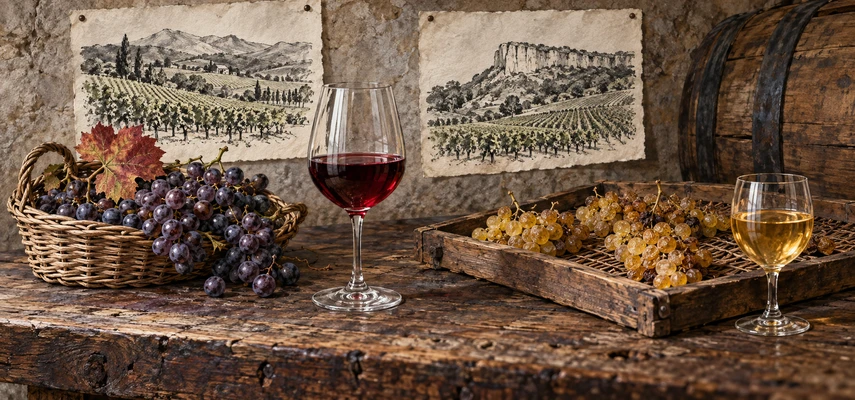

A deep Cahors red and a pale Jura Poulsard have very different arguments to make. Add a bright Gascon white, a concentrated Jurançon and a nutty Vin Jaune, and the idea of one regional tasting shortcut collapses. That’s useful. These wines reward the Diploma habit of asking how a particular result was produced, rather than assigning quality from colour or familiarity.
South West France and Jura are separate syllabus regions in very different parts of the country. This chapter compares their decisions without pretending that they share a climate, a grape family or one legal system of local production rules. The unifying task is explanation: connect growing conditions and cellar choices with style, quality, ageing and price.
Start with two different geographical questions
South West France includes a dispersed collection of vineyards extending from the Bergerac area toward the Pyrenean foothills and inland toward Gaillac and other origins. Atlantic influence matters, but distance from the ocean, relief and warmer inland conditions create variation. It isn’t simply Bordeaux with unfamiliar labels.
Jura lies in eastern France along the Revermont, near the western edge of the Jura mountains. Its semi-continental setting, slopes, limestone and marls create a different growing context. The regional council’s vineyard summary is a useful geographical starting point; don’t confuse the vineyard belt with the entire mountainous department.
Temperature affects ripening speed and acid retention in both regions. Sunlight influences sugar production and bunch exposure, while water availability depends on rainfall, soil depth, texture and rooting. Nutrient availability influences vigour and crop balance. These mechanisms are shared; their local consequences aren’t identical. A damp Jura slope and a dry inland South West site need different decisions.
Weather brings spring frost, hail, heat, drought and awkward harvest rain in different combinations. Downy and powdery mildew and bunch rot require monitoring. A warm drying wind may help fruit condition in one situation while increasing water loss or damaging shoots in another. Never convert a general climatic advantage into a promise that the vintage will cooperate.
Use South West grapes as explanations
Cahors is a red-wine origin centred on Malbec, also known locally as Côt or Auxerrois, with permitted blending partners including Merlot and Tannat. The name Auxerrois here shouldn’t be confused with the different white variety familiar in Alsace. Lot valley terraces and higher limestone areas provide different growing contexts; neither predicts every producer’s extraction or quality.
Madiran puts Tannat at the centre of the red-wine discussion. Colour, tannin and concentration need handling rather than automatic celebration. Suitable fruit maturity, extraction and maturation can produce an integrated wine; powerful tannin with insufficient fruit doesn’t become a virtue because the grape is known for structure.
The South West red-variety guide connects Négrette with Fronton and Fer Servadou with several regional names, including Braucol in Gaillac and Pinenc in Saint-Mont. These help organise a study map, but aromas and local synonyms aren’t quality grades. Duras is a grape associated particularly with Gaillac, not a requirement that every wine from the Côtes de Duras appellation contain it.
Gaillac offers reds, whites, rosés and sparkling styles, with local varieties including Duras, Fer, Len de l’El and Mauzac among the important references. Saint-Mont, Irouléguy and Marcillac add further local comparisons. Learn the actual appellation and wine type rather than forcing the entire South West into a Malbec-and-Tannat pairing.
Compare dry and sweet whites without guessing from aroma
Around Bergerac, red blends and dry whites coexist with sweeter wines. The Bergerac council’s origin guide distinguishes Bergerac and Côtes de Bergerac styles. Familiar Bordeaux-associated varieties appear, but the wines have their own origins, production choices and commercial identities. Pécharmant provides a red comparison; Montravel and Saussignac add other useful references.
Monbazillac uses Sémillon, Sauvignon and Muscadelle for concentrated sweet wines, involving selective harvesting and favourable fruit conditions. Noble rot can help concentration where conditions cooperate; uncontrolled rot is a different outcome. Selection reduces recovery and requires labour, so sweet-wine economics begin before the grapes reach the press.
Jurançon lies in the Pyrenean foothills and makes white wines associated particularly with Petit and Gros Manseng. Jurançon Sec identifies a dry style; sweeter examples depend on suitable ripeness and concentration. Drying on the vine and selective harvest matter here; don’t describe every sweet French white as dependent on noble rot.
Pacherenc du Vic-Bilh offers another dry-and-sweet white comparison near Madiran. Côtes de Gascogne IGP supplies a different commercial and stylistic reference, including aromatic whites associated with Colombard and Gros Manseng. Powerful citrus or tropical-fruit aromas don’t reveal residual sugar. Check the palate and the intended style.
Farm each site for the intended wine
Vineyard establishment involves permitted varieties, exposure, access, training and long-term water conditions. Planting materials should match soils, vigour and the intended crop. The right choice for a vigorous South West site may be unsuitable on a cooler Jura slope with limited rooting depth. Familiarity with a regional variety doesn’t replace a site assessment.
Nutrient and water management should respond to actual vine status and legal conditions. Canopy management balances productive leaves, airflow and bunch exposure. Opening a dense canopy can help damp fruit dry, while excessive leaf removal in a hot season can increase sunburn. The same operation can solve one problem and create another.
Harvest timing balances flavour, sugar, acid, tannin where relevant, fruit health and the forecast. Hazard management includes suitable site choice, erosion control and practical frost precautions where appropriate. Pest and disease management combines observation, canopy measures and justified interventions. Fruit for a clean aromatic white, a structured red or a drying rack needs different selection criteria.
Grape transportation should limit crushing, heating and unwanted oxidation. Reception must separate origins, varieties and condition. For drying grapes, damaged berries may spoil during storage; for a fresh white, uncontrolled juice oxidation may erase the intended aroma. These aren’t minor logistics to consider after the “real” winemaking has finished.
Handle structure and freshness deliberately
Winemaking approaches in the South West range from aromatic tank-fermented whites to structured reds and concentrated sweet wines; Jura adds its own red, topped-up white and voile-aged choices. Processing decisions include sorting, destemming, crushing and handling press fractions. Extraction and pressing should suit fruit condition and the desired tannin or phenolic profile.
Pre-fermentation clarification adjusts white juice solids for a healthy fermentation and intended style. Must adjustments need analysis and permission. Alcoholic fermentation temperature, nutrition and vessel influence the result; choosing a fashionable container doesn’t remove the need to finish fermentation appropriately.
Malolactic conversion changes the acid profile, with different implications for a tannic red and an aromatic white. Maturation may use tank, old wood or newer barrels, affecting texture, oxygen exposure and flavour. Controlled oxygen management can help tannin development, but careless oxidation isn’t a shortcut to softness. A big South West red doesn’t need maximum extraction followed by maximum oak.
Blending eligible varieties, parcels or fractions can improve balance and consistency. Post-fermentation clarification removes unwanted suspended material. Stabilisation considers tartrate, protein and microbial risks as appropriate; finishing adjustments, sulfur dioxide and filtration should match the actual wine and destination. A deliberately sweet wine needs protection from unwanted refermentation, while dryness doesn’t establish freedom from every microbial risk.
Packaging and closures should protect fresh fruit or the intended development period. Wine transportation needs suitable temperature and handling. A wine with a deliberate oxidative or biological ageing history still deserves sound storage; its production method doesn’t make it indestructible.
Give Jura’s familiar five varieties room to differ
Chardonnay, Savagnin, Poulsard or Ploussard, Trousseau and Pinot Noir form the traditional five-variety study framework. Chardonnay and Savagnin supply contrasting white possibilities. Savagnin isn’t Sauvignon Blanc, and neither name predicts whether the wine has undergone a particular maturation method.
Poulsard can produce pale, fragrant reds; Trousseau often supplies a firmer, more deeply coloured comparison, while Pinot Noir adds another red reference. Evaluate actual concentration, tannin and condition before ranking them. A light colour doesn’t prove rosé, dilution or short ageing potential, and darker fruit doesn’t automatically mean a more successful wine.
Arbois and Côtes du Jura cover several wine styles. L’Étoile supplies another white-wine origin, while Château-Chalon is specifically associated with Vin Jaune. Crémant du Jura and Macvin du Jura identify different product categories. An origin name and a production method aren’t interchangeable labels for one golden regional drink.
Separate ouillé white from Vin Jaune
Ouillage means topping up a vessel to replace evaporated wine and limit the headspace. It supports a different maturation aim from leaving suitable wine beneath a yeast veil, or voile. Jura therefore includes fresh, topped-up Chardonnay or Savagnin as well as wines with more pronounced nutty, savoury development. An untopped barrel doesn’t automatically make a wine eligible for the Vin Jaune claim.
The approved Côtes du Jura specification distinguishes the regulated Vin Jaune route. Maturation extends until 15 December of the sixth year after harvest, including at least 60 months under voile, with release from 1 January of the seventh year. That is more precise than treating the familiar “six years and three months” shorthand as six uninterrupted years beneath a perfect veil.
Vin Jaune is traditionally Savagnin-based, dry and unfortified, with nutty and spice-like characters developed through its particular maturation. The voile changes the ageing environment and metabolism; it doesn’t make oxygen irrelevant. Nor should its character be confused automatically with accidental oxidation in a wine intended to remain fresh.
Current rules also deserve attention. Château-Chalon’s August 2026 specification retains Savagnin as the principal variety while permitting limited Enfariné and Gringet under agreements. Older absolute single-variety summaries miss that qualification. The traditional five varieties remain an essential study framework, but aren’t an exhaustive statement of every current experimental permission in every Jura appellation.
The distinctive Clavelin bottle has a nominal 62-centilitre capacity. Don’t translate that into a claim that every starting litre always loses exactly 38 centilitres: evaporation varies. Long maturation, cellar space, losses and delayed revenue help explain cost; the bottle shape itself doesn’t establish quality.
Keep Vin de Paille and Macvin separate
Vin de Paille concentrates selected grapes through drying after harvest before pressing and fermentation. Sound fruit and controlled, ventilated conditions matter: drying damaged berries can concentrate a problem as efficiently as sugar. It isn’t Vin Jaune made sweet, and the name doesn’t require every modern batch to lie on literal straw.
The Jura council’s production overview distinguishes dried-grape wine from Macvin. Macvin du Jura is a vin de liqueur made by adding grape-marc spirit to grape must under its rules. That mechanism differs from fermenting dried grapes and from the unfortified maturation of Vin Jaune. Use the process to explain sweetness and alcohol, rather than grouping everything with a golden colour together.
Crémant du Jura belongs to sparkling production, developed in D4. The presence of these specialities doesn’t mean every Jura producer’s white is oxidative or every bottle needs a ceremonial food pairing. A simple fresh wine still deserves analysis on its own terms.
Read protected claims and business roles accurately
International and EU protection frameworks, national French law and local specifications govern both regions. A geographical indication links a name with defined origin and conditions. AOC/AOP wines occupy PDO; PGI/IGP provides another protected-origin category. Industry associations include the South West and Bergerac organisations and CIVJ in Jura, with different geographical scopes and information roles.
Côtes de Gascogne and Comté Tolosan illustrate South West IGP identities. Franche-Comté IGP provides a wider eastern category with its own conditions. None is an automatic label for any rejected AOC lot. Wines without a geographical indication, including eligible Vin de France, follow another framework and cannot retain protected origin wording merely by opting out of a restriction.
Labelling terms such as sec, Vin Jaune and Vin de Paille communicate different regulated claims; a proprietary cuvée name needn’t be an official rank. Legislation also affects destination sales, packaging information and compliance. Check the actual origin and category rather than borrowing a convenient rule from a neighbouring wine.
Follow cost, scarcity and customer understanding
Supply depends on harvested volume, usable yield and allocation to styles. Demand differs between familiar Malbec, local South West varieties and specialist Jura wines. Costs include farming, selection, drying losses, vessels and stock held for years. Scarcity can support price, but a small production volume doesn’t prove either sensory excellence or enough customers to make the business viable.
Currency exchange changes an importer’s landed costs without changing wine quality. Importing also adds freight, compliance and intermediary margins. Retail needs clear grape and style information; HoReCa buyers consider food, staff knowledge and stock turnover. Direct-to-consumer sales can retain more revenue per bottle but require visitors, service and fulfilment. Mature and emerging markets contain varied buyers rather than one national taste.
A grower may sell grapes; an estate combines vineyards and production; a winery provides processing capacity. A merchant may source fruit or wine, while a broker connects parties without necessarily owning stock. A virtual winery coordinates a brand through contracts, and a custom crush facility performs agreed production tasks. These are business models to assess, not assertions of equal prevalence in both regions.
A cooperative can pool members’ equipment, technical knowledge and commercial reach. A conglomerate can coordinate several businesses and channels, with different scale and management demands. Ask who sets standards, finances inventory and bears loss. Long-aged Jura and selectively harvested South West wines make those responsibilities especially visible, though neither model guarantees quality.
Wine brands may lead with variety, producer, origin or a distinctive style. Marketing concepts begin with a target customer and a credible benefit. Marketing options include comparative tastings, tourism, restaurant education and clear digital explanation. The five Ps connect product, price, place, people and promotion. Selling a topped-up Savagnin as if every buyer expects Vin Jaune invites disappointment; explaining the actual process can create a much better match.
Compare the evidence here with the Mosel and Ahr as a regional case, then apply the regional comparison framework to the comparison. Compare growing conditions, production decisions, style, quality and the commercial reasons for price. Establish the differences rather than assuming that one familiar name must be better.
Original Diploma practice
These original exercises and indicative points are teaching material, not official WSET questions or marking allocations.
Question 1: compare two tannic-red plans
A fictional Cahors producer and a Madiran estate propose identical extraction and new-oak programmes. Evaluate whether the shared plan is justified.
Indicative points: variety, fruit concentration, tannin maturity, fractions, vessel and drinking window.
Outline answer: Both may produce structured reds, but actual fruit and intended style should determine handling. Excessive extraction or oak can overwhelm weaker or less mature material. Compare cap work, press fractions and maturation options, then assess integration and retained fruit. Similar reputations for tannin don’t establish identical needs or quality.
Question 2: distinguish three Jura processes
Compare topped-up Savagnin, Vin Jaune and Vin de Paille. Explain how production affects style and cost.
Indicative points: headspace, voile, drying, fermentation, time, losses and protected claims.
Outline answer: Topping up limits headspace for a different maturation aim from the regulated long Vin Jaune route. Vin de Paille concentrates selected grapes before fermentation through drying. Long storage, evaporation or low recovery raise cost in different ways. None of these descriptions permits the producer to ignore the applicable origin and category conditions.
Question 3: evaluate a sweet-white assertion
A buyer assumes that Monbazillac and Jurançon depend on the same concentration method and must taste equally sweet. Evaluate the claim.
Indicative points: varieties, noble rot versus drying, selection, fermentation and finished balance.
Outline answer: The origins use different grape material and concentration contexts; Jurançon isn’t automatically a noble-rot wine. Finished sweetness depends on the actual wine, not an aroma or regional reputation. Compare acidity, retained sugar, alcohol and concentration. Selective picking and reduced recovery affect both economics and available volume without creating identical styles.
Question 4: evaluate a long-aged wine’s price
A fictional Jura producer calls a high price proof that its wine is outstanding. Evaluate the argument.
Indicative points: storage, losses, cash flow, scarcity, demand and sensory evidence.
Outline answer: Long maturation and reduced volume can explain high cost, while recognition and scarcity may support demand. Neither proves balance, concentration, complexity or length in the bottle. Evaluate quality separately, then assess whether the selling price and realistic sales cover cost and inventory risk.
Analytical tasting preparation: respect the optional column
The official Diploma specification, PDF page 26, places all recommended South West France and Jura samples in the optional column. They are good or very good red or white Bergerac; very good dry or sweet Jurançon; very good or outstanding Cahors; very good or outstanding Madiran; and very good or outstanding Jura of any style. The table doesn’t prescribe an essential regional flight here, and optional doesn’t mean irrelevant to the broader syllabus.
These are proposed study selections, not completed tastings, official bottle grades or predictions of examination wines. A particularly useful extension compares topped-up Jura white with a sound voile-aged example, while a South West pair can test structure or sweetness assumptions. Record methods where known without allowing them to dictate observations.
Write full systematic descriptions blind before revealing identities. Compare sweetness, acidity, alcohol, body, tannin where relevant, texture, development and finish. Justify quality through balance, concentration, complexity and desirable persistence. Assess bottle-ageing suitability separately from the reputation of the origin or method. A mature wine may be excellent now with little further improvement, and a pale red can be more complete than a darker but coarse sample.












