










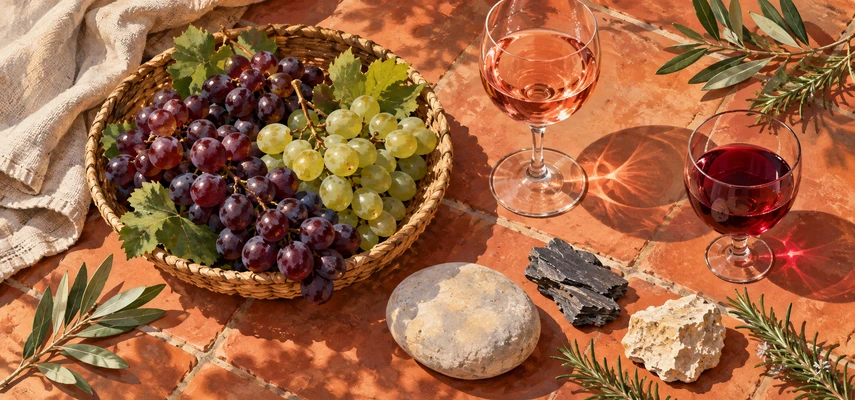

“Southern French red” sounds useful until one bottle offers bright, fragrant fruit and another delivers a wall of tannin. Add a delicate-looking Provence rosé, a substantial Tavel and a fresh Picpoul, and the shorthand starts to wobble. Sunshine matters, but it doesn’t prescribe one grape, one fermentation or one price.
This chapter joins two Diploma syllabus regions: Southern Rhône and South of France. Keep their origins distinct while comparing the shared decisions. How does a grower preserve balance in warm conditions? What does each variety contribute to a blend? Why does a pale rosé cost more than a darker one? Answer those questions with evidence rather than a map coloured entirely in Mediterranean orange.
Put the regions in their own landscapes
The Southern Rhône surrounds places such as Orange and Avignon, with a broader vineyard landscape than the narrow northern corridor. Mediterranean conditions favour warm, dry summers, but altitude, exposure, wind and soil create substantial variation. Languedoc stretches across coastal plains and inland foothills; Roussillon lies nearer the Pyrenees and Spain; Provence occupies a different eastern Mediterranean setting.
Temperature affects ripening speed, acid retention and potential alcohol. Sunlight supports sugar accumulation and changes the bunch environment. Warmth can help a later-ripening variety mature, yet excessive heat can slow vine function and damage exposed berries. In the Rhône and the wider south, “more sun” isn’t an unlimited benefit.
Water availability depends on winter reserves, rain, rooting and soil depth. Nutrient availability influences vigour and crop balance. A shallow, freely draining slope may impose severe stress in a dry year, while a deeper site offers a different reserve. Limestone, schist, sand, clay and rounded stones create varied conditions; none is a flavour ingredient or an automatic quality certificate.
Weather also brings hazards. Mistral in the Rhône and strong winds elsewhere may dry vegetation but damage shoots and increase water loss. Storms can bring hail, erosion and sudden disease pressure after a dry spell. Downy and powdery mildew, bunch rot and other local threats still need monitoring. Dry summers don’t mean disease management can take the season off.
Give each variety a purpose
Grenache can contribute ripe red fruit, generosity and substantial alcohol potential. Its balance depends on yield, site and harvest; an increasingly jam-like profile isn’t inevitable or automatically desirable. Syrah may add colour, dark fruit, pepper and structure. Mourvèdre generally needs a warm, sufficiently long ripening season and can contribute tannin, dark fruit and savoury complexity.
Carignan can supply acidity, colour and structure when the site, crop and fruit maturity suit the aim. Old vines may yield concentrated fruit, but vine age alone isn’t quality evidence. Cinsault often contributes fragrance and a lighter structural component, including in rosés. Neither a supporting variety nor a small blend percentage is necessarily unimportant.
Blending eligible varieties gives a producer options: one lot may supply fruit generosity, another freshness or tannin. That doesn’t make every combination balanced. A component with harsh tannin can spread its problem through the blend, and complementary traits still need compatible proportions. Some wines are single-varietal where permitted; don’t require an invented universal Grenache–Syrah–Mourvèdre recipe.
Farm for balance in both syllabus regions
Vineyard establishment involves permitted varieties, exposure, access, training and the site’s long-term water position. Planting materials should match soil, vigour, disease considerations and expected drought pressure. Bush vines and trellised systems both occur, with different implications for shade, support and mechanisation. A photograph of one traditional vineyard doesn’t describe the whole south.
Nutrient and water management should follow vine condition and legal limits. Canopy management balances productive leaves, airflow and protection from sunburn. In either the Southern Rhône or Languedoc and Provence, exposing every bunch may sacrifice fruit health during a heatwave. Conversely, a dense shaded canopy can complicate ripening and disease control after rain.
Harvest timing balances flavour, sugar, acid, tannin, condition and the forecast. Separate varieties and sites may need different dates. Hazard management can include erosion control, secure supports, suitable ground cover and practical frost protection where appropriate. Pest and disease management combines observation and justified interventions; water competition from cover crops also needs assessment in a dry season.
Grape transportation should limit crushing, heating and avoidable oxidation. Reception should separate origins, varieties and damaged material. That matters for Rhône red blends and for southern whites and rosés: mixing lots before deciding their purpose can remove useful options. Harvest logistics are part of quality, particularly when warm fruit arrives in large volumes.
Choose extraction rather than simply maximising it
Winemaking approaches range from fragrant youthful reds to more structured wines, fresh whites and rosés with very different textures. Processing decisions include sorting, destemming, crushing and any whole-bunch component. Shorter or gentler red maceration may preserve an approachable balance; longer extraction needs enough suitable fruit to support it.
Alcoholic fermentation temperature and cap management influence extraction and aroma. Extraction and pressing should consider tannin maturity and the differences between free-run and press fractions. Whole-berry or carbonic-related approaches may help soften the presentation of some fruit, but don’t define every Carignan or every inexpensive red. A method needs an intended result.
Pre-fermentation clarification is particularly relevant to white and rosé juice. Must adjustments require analysis and legal permission, rather than a blanket response to hot weather. Malolactic conversion changes the acid profile and is generally important in reds; white and rosé decisions depend on style and rules. It isn’t the same operation as lees ageing.
Maturation can involve tank, concrete, large old wood or barrels. Each brings different cost, oxygen and flavour implications. New oak can integrate with concentrated fruit or dominate it; a large old vessel may add little overt wood flavour. A rich southern wine doesn’t need more richness simply because the cellar has a spare barrel.
Post-fermentation clarification removes unwanted suspended material. Stabilisation considers protein, tartrate and microbial risks as appropriate. Finishing adjustments, sulfur dioxide and filtration should suit analysis, intended style and destination. Packaging and closures must protect freshness or planned development, while wine transportation should avoid unnecessary heat. Neither tannin nor alcohol insures a bottle against careless handling.
Read the Southern Rhône hierarchy carefully
Start with Côtes du Rhône, then Côtes du Rhône Villages and its named geographical supplements, and finally the individual crus. These identify different origins and conditions, not guaranteed scores. Inter Rhône’s cru overview helps organise the range. Check the actual wine’s colour and specification before transferring rules between names.
Châteauneuf-du-Pape produces red and white still wines. Grenache is important, but authorised varieties offer substantial blending choice. The familiar rounded stones occur in parts of the appellation, alongside other soils; don’t make every vineyard a hot pebble field or every wine a fixed three-grape blend.
Gigondas offers a useful comparison involving the Dentelles de Montmirail and varied elevation. Its white wines begin with the 2023 vintage, so an older “red and rosé only” summary is incomplete. Vacqueyras, Cairanne and Lirac also deserve comparison across their permitted colours and styles. Rasteau and Vinsobres provide further red-wine references; identify whether a Rasteau is still wine or a separately regulated fortified style.
Tavel is rosé only. Its fuller, more deeply coloured examples challenge the notion that paleness defines good rosé. Compare concentration, freshness and texture rather than rewarding the sample that looks closest to an advertisement. A colour preference may be commercially important without being a quality criterion.
Compare Languedoc sites before comparing reputations
The Languedoc regional appellation sits within a wider landscape of protected origins. Sea influence, altitude and inland relief create differences in ripening and water pressure. A low coastal site and an elevated inland slope shouldn’t receive identical vineyard recommendations merely because both are in the south.
Terrasses du Larzac illustrates inland foothill conditions and cooler nights; Pic Saint-Loup offers another useful study of relief and exposure. Saint-Chinian includes contrasting schist and limestone contexts, while Faugères is associated particularly with schist. Compare water and root conditions without converting geology into a rigid tasting script.
Corbières and Minervois cover varied terrain; Boutenac and La Livinière provide more specific origin comparisons. The Boutenac profile highlights Carignan’s role rather than presenting every ambitious southern red as Syrah-dominated. Fitou is another red-wine origin worth placing on a study map. Name recognition, producer choices and vintage still matter within each category.
Whites need a place at the table. Picpoul de Pinet uses Piquepoul Blanc near the Étang de Thau and provides a useful fresh-white comparison. La Clape includes whites with Bourboulenc playing an important role; Limoux adds another white and sparkling context. Don’t apply a red-blend recipe to the entire Languedoc.
Distinguish Roussillon’s dry wines from its fortified names
The Roussillon council’s origin guide separates dry-wine and vin doux naturel identities. Côtes du Roussillon and its Villages range, Collioure and Maury Sec provide still-wine comparisons across different places and styles. Grenache in its colour forms, Carignan, Syrah and Mourvèdre matter in the wider vineyard picture, with permitted use depending on origin and colour.
Maury Sec isn’t simply a sweet Maury allowed to ferment a little longer under the same claim. Dry and fortified production follow distinct rules. Banyuls, Rivesaltes and Muscat de Rivesaltes connect this area with the fortified-wine syllabus, developed in D5. Their existence doesn’t make every Roussillon wine fortified, sweet or deliberately oxidative.
Heat, drought, wind and demanding slopes can make crop management and access expensive. Lower yields may increase concentration, but excessively stressed vines may fail to ripen desirable fruit. Evaluate what the site actually achieved before turning difficult conditions into a romantic explanation of excellence.
Understand Provence beyond the palest glass
The CIVP appellation map distinguishes Côtes de Provence, Coteaux d’Aix-en-Provence and Coteaux Varois en Provence. These are the three appellations represented by that organisation, not every protected origin in geographical Provence. They make more than rosé, even though rosé strongly shapes their commercial identity.
The Provence rosé production guide describes direct pressing and short skin-contact approaches. Direct pressing generally limits colour extraction; skin contact can increase it, with results also depending on variety and fruit. Controlled temperatures and protection of suitable juice can help preserve aroma. Pale colour doesn’t measure residual sugar, concentration or technical quality.
Bandol makes reds, rosés and whites. Mourvèdre is particularly important in its reds, where warm suitable sites support ripening and substantial structure. Don’t transfer a red-wine minimum proportion to every Bandol rosé. Cassis offers a white-wine counterpoint, while Bellet and Palette remind readers that Provence contains small, distinctive origins as well as major rosé brands.
Separate regulated origin from commercial freedom
International and EU protection frameworks, national French law and local specifications govern Southern Rhône and wider southern wine claims. A geographical indication links a name to defined origin and conditions. AOC/AOP wines occupy PDO, while PGI/IGP is another protected-origin category. Industry associations include Inter Rhône, CIVL, CIVR and CIVP, with different regional scopes; none makes every southern appellation subject to one recipe.
Pays d’Oc IGP provides a useful contrast through varied grapes and varietal-led or blended positioning. It has its own conditions, as do other southern IGPs such as Côtes Catalanes or Méditerranée. These aren’t automatic fallback labels for any lot rejected from an AOC. Wines without a geographical indication, including eligible Vin de France, operate under another set of claims and cannot simply borrow a protected local name.
Labelling terms may identify variety, origin, a named supplement or a producer’s cuvée. An attractive proprietary name isn’t necessarily an official rank. Legislation also affects destination-market compliance, packaging information and sales. Compare the actual applicable text before assuming more freedom means no rules or more restrictions mean better wine.
Explain the producer’s choices and costs
Supply in both syllabus regions varies with harvest volume, usable yield and permitted production. Demand differs between recognised Rhône crus, less familiar Languedoc origins, varietal IGP wines and Provence rosé brands. Costs include vineyard access, water and canopy management, selection, cellar equipment, maturation and stock held before sale. A celebrated name may support price without explaining every euro of the margin.
Currency exchange changes an importer’s landed costs without changing wine quality. Importing also adds freight, compliance and intermediary margins. Retail needs style and price clarity; HoReCa buyers consider menus, staff explanation and turnover. Direct-to-consumer sales can retain more revenue per bottle but require visitors, service and fulfilment. Mature and emerging markets contain different customers, not one national preference.
A grower may supply grapes, an estate may combine vineyards and production, and a winery provides processing capacity under various ownership arrangements. A merchant can source fruit or wine, while a broker connects parties without necessarily owning the stock. A virtual winery coordinates a brand through contracts; a custom crush facility provides agreed production services. Assess their relevance rather than claiming that each model dominates every southern region.
A cooperative can pool member investment, technical skill and market access, an important consideration across the south. A conglomerate may coordinate several businesses, brands and channels. Neither scale nor a small estate structure guarantees quality. Ask who controls standards, owns inventory, pays growers and carries the risk of an unsold vintage.
Match the blend and the message to the buyer
Wine brands may emphasise a Rhône origin, a southern estate, a familiar variety or a recognisable rosé presentation. Marketing concepts begin with a target customer and a credible benefit. Marketing options include comparative tastings, tourism, restaurant education and digital explanation. The five Ps connect product, price, place, people and promotion.
A pale rosé brand may need reliable freshness, consistent presentation and timely distribution. A structured Bandol red or small Languedoc selection may need specialist explanation and a different drinking occasion. A varietal IGP can make the grape immediately legible without promising that all examples taste alike. Evaluate the message alongside production cost, route to market and realistic demand; publicity cannot repair an unbalanced wine or an unworkable margin.
Compare the evidence here with South West France and Jura as a regional case, then apply the regional comparison framework to the comparison. Compare growing conditions, production decisions, style, quality and the commercial reasons for price. Establish the differences rather than assuming that one familiar name must be better.
Original Diploma practice
These original exercises and indicative points are teaching material, not official WSET questions or marking allocations.
Question 1: evaluate a warm-site blend
A fictional producer has generous Grenache, firm Mourvèdre and vividly coloured Syrah. Evaluate how blending could help, and what it cannot repair.
Indicative points: fruit, alcohol, tannin, freshness, eligible proportions and integration.
Outline answer: Trial blends may combine fruit generosity with structure and aromatic range, provided all lots and proportions qualify. Judge balance rather than maximising each component’s intensity. Harsh tannin, excessive alcohol or damaged fruit may persist after blending. Neither the number of varieties nor a familiar blend name guarantees quality.
Question 2: compare two rosé aims
Compare production and commercial decisions for a fresh pale Provence rosé and a fuller rosé intended for food.
Indicative points: fruit, skin contact, pressing, temperature, texture, positioning and limitations.
Outline answer: Variety and maturity affect the starting potential; pressing and skin contact influence extraction. Suitable temperature and juice handling protect the desired aroma. The fuller wine may retain more texture and colour without being less precise or necessarily sweeter. Match the message and channel to the style, and assess quality through balance and persistence rather than appearance.
Question 3: evaluate a drought response
A fictional Rhône grower and an inland Languedoc estate propose removing more leaves to accelerate ripening during severe drought. Evaluate the shared proposal and local differences.
Indicative points: vine function, shade, fruit damage, water reserves, exposure and alternatives.
Outline answer: Severe stress may limit productive activity rather than leave the vine short of sun. More exposure can increase berry damage and water demand. Assess soil reserves, roots, canopy condition and local heat before intervening. A deeper soil or cooler slope may behave differently; one regional weather headline doesn’t establish one useful response.
Question 4: evaluate a price comparison
A merchant assumes every AOC red should cost more than every Pays d’Oc IGP wine. Evaluate the claim for a Rhône and a Languedoc range.
Indicative points: protected claims, actual costs, producer reputation, quality, demand and distribution.
Outline answer: Categories set different origin and production conditions, not a universal price order. Compare vineyard cost, fruit selection, maturation, quality and customer demand for the actual wines. A concentrated IGP selection may cost more to produce and command a higher price than a basic AOC. Neither label establishes margin or sensory merit alone.
Analytical tasting preparation: two regional programmes
The official Diploma specification, PDF page 25, recommends Southern Rhône rosé of good or very good quality. Its red Group 1 compares acceptable or good Côtes du Rhône, good Côtes du Rhône Villages and a very good or outstanding Grenache-led cru blend. Group 2 adds a very good or outstanding cru with noticeable Syrah and/or Mourvèdre character and a very good or outstanding cru with noticeable tertiary development.
PDF page 26 lists five essential South of France selections: good Picpoul de Pinet; good to very good Provence rosé; very good or outstanding Bandol; acceptable or good red Pays d’Oc or AOC wine; and very good or outstanding Languedoc AOC wine. Very good red Pays d’Oc is optional. These programmes are proposed study selections, not completed tastings, official bottle grades or predictions of examination wines.
Write full systematic descriptions blind before revealing identities. Compare sweetness, acidity, alcohol, body, tannin where relevant, texture, intensity, development and finish. Justify quality through balance, concentration, complexity and desirable persistence. Assess bottle-ageing suitability separately through remaining fruit, structure and existing development. A darker rosé isn’t automatically better or worse; a tannic red still needs enough balanced fruit to develop positively. Keep the two regional programmes distinct while using their contrasts to test assumptions.












