










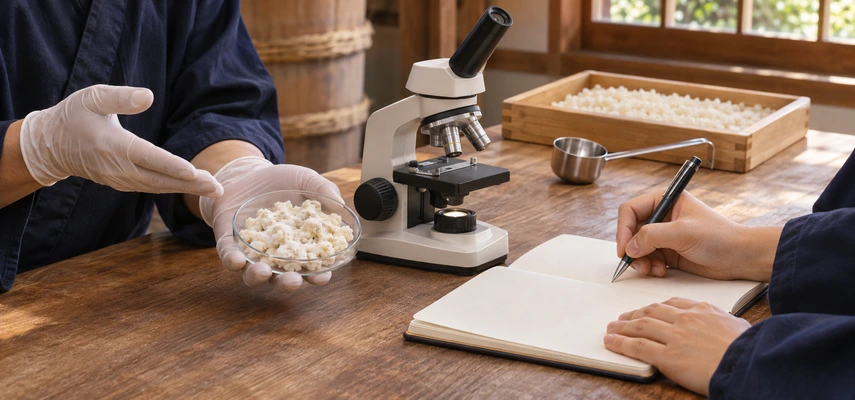

The sake industry is larger than the people standing beside a fermentation tank. Growers supply suitable rice, trained brewers turn it into a product, researchers investigate problems, suppliers distribute cultures and producer organizations share information. The system works because different bodies do different jobs, even when they collaborate.
For Level 3, learn those jobs before collecting acronyms. A question about yeast distribution needs a different answer from one about producer representation or agricultural supply. Once the role is clear, NRIB, the Brewing Society of Japan, JSS and JA stop looking like interchangeable official-sounding names.
The sake industry is a network of functions
The WSET specification places industry organizations within Unit 1 Learning Outcome 3. Its assessment is multiple choice, so this lesson uses original recognition and application questions rather than pretending the topic has an official written-paper allocation.
Think through a hypothetical brewery problem. Rice quality varies between deliveries, a fermentation behaves unexpectedly and the finished product needs an export explanation. Those issues involve agricultural supply, technical knowledge and market communication. One organization might assist with more than one area, but no single acronym should be treated as the answer to everything.
The practical distinction is between producing a product, supplying resources, developing knowledge, representing interests and regulating claims. These functions can connect without becoming identical. A producer association isn’t automatically the legal authority that writes every labeling rule.
Toji lead practical brewing
A toji is a chief brewer responsible for directing production, traditionally working with a team of brewery workers. The role involves coordinating people and processes, not merely performing one ceremonial operation. Rice condition, koji development, starter health and fermentation timing all require connected judgment.
Historically, seasonal labor and regional training traditions helped spread expertise. Workers could move to breweries during the agricultural off-season, bringing skills and returning with experience. That history explains why a guild’s name can be strongly regional while its influence extends much farther.
Modern staffing varies. A brewery may employ year-round personnel, train internally or have an owner directly involved in brewing. Don’t assume every sake must be made by an external seasonal guild team. The central requirement is competent management, while the employment structure is a separate question.
Guilds transmit skills rather than one fixed recipe
Nanbu, Echigo, Noto and Tanba are useful associations from the regional lessons. Guild traditions provide routes for training, practical exchange and professional identity. Their value lies in developing and passing on knowledge that can be applied to real materials and conditions.
They don’t make every member use identical rice or produce the same aroma. A skilled brewer adapts to the workplace, source water and product goal. The tradition is a resource for judgment, not a bottle of regional flavor poured into the mash.
For revision, connect the guild to a human function: skills, training and continuity. Avoid confusing it with an ingredient supplier, a regulator or a special designation. A toji name on a producer story can be interesting context without supplying a complete sensory quality verdict.
NRIB develops and shares technical knowledge
The National Research Institute of Brewing, NRIB, conducts research related to alcoholic beverages and supports technical development. Its institutional history traces its establishment in 1904 and describes research and professional training. The key association is scientific investigation and the development of brewing knowledge.
Its work includes microorganisms and other factors relevant to production and quality. The research topics page provides examples, including brewing characteristics and compounds associated with maturation or undesirable aromas. These illustrate research functions rather than a promise that every individual brewery problem has one published answer.
Research can make a practical problem more understandable. A brewer noticing unwanted aged character may benefit from work on its precursors and formation. That doesn’t mean a laboratory report automatically diagnoses a particular bottle without analysis, but it supplies a stronger basis for investigation than guesswork.
Scientific support doesn’t replace the brewer
An institute can study mechanisms, publish findings and train professionals. The brewery still chooses how to apply the information within its process and commercial objectives. A research result under defined conditions isn’t permission to assume every mash behaves identically.
This is the same distinction used throughout production study: evidence supports decisions, while the actual process needs monitoring. A yeast strain with a reported useful property still requires suitable handling and a compatible fermentation environment. Science and experienced observation can reinforce each other.
NRIB should also be distinguished from the National Tax Agency. Their names may appear near each other in official sake material, but research and tax or labeling administration are different functions. Read the actual source and its purpose before assigning an institutional role.
The Brewing Society of Japan distributes Kyokai yeast
The Brewing Society of Japan, often shortened in study notes to BrewSoc, is particularly associated with pure-cultured brewing yeast and technical information. The NRIB terminology reference identifies production and distribution of Kyokai yeast as a principal activity, alongside publications and related work.
This provides a practical link between microbiological selection and everyday brewing. A distributed culture lets a producer select a known resource rather than relying entirely on an unidentified resident population. The choice can influence fermentation behavior and aroma, while the brewery still controls the conditions in which it works.
Don’t turn distribution into a monopoly claim. Other research bodies and producers also develop or use yeasts. A sake need not use a Kyokai strain simply because it is made in Japan. The useful association is a major recognized supplier and technical society, not the only possible source of every culture.
Distinguish culture supply from a quality guarantee
A numbered yeast identifies a strain or strain family within its actual system. It doesn’t award a premium designation or guarantee outstanding quality. Nutrition, temperature, mash composition and finishing still affect the result, so institutional pedigree cannot replace process control.
Likewise, buying a culture and publishing research are different actions even when connected organizations cooperate. In an MCQ, identify the function being tested. Pure-culture distribution points strongly toward the Brewing Society; a broad national research role points toward NRIB.
A useful memory exercise is to write the verb before the acronym: research, distribute, represent or supply. This reduces mistakes caused by recognizing a familiar name and selecting it before reading what the question actually asks.
JSS represents producers and communicates about sake
The Japan Sake and Shochu Makers Association, JSS, is a national producer organization. Its official description explains its producer membership and information role. It connects makers with industry developments, government and agricultural information, and communication about Japanese drinks.
For readers, JSS materials provide accessible explanations of production, styles and service. For the industry, collective representation and promotion address needs that a single brewery may not handle alone. These activities are distinct from growing rice or conducting every fermentation experiment.
Representation also isn’t the same as universal product certification. A helpful JSS educational chart doesn’t mean every bottle has been individually tasted and assigned a quality level by the association. Interpret each mark, publication or program according to its actual stated purpose.
Collaboration doesn’t erase the separate roles
NRIB and JSS can appear together in activities such as sake evaluation. A dated Annual Japan Sake Awards outline illustrates collaboration. Use it as an example of shared work, not as a current set of entry rules or proof that the organizations are the same body.
A competition result also has a defined scope. It relates to the entered sake and the program’s procedures, not every bottle the producer makes forever. This mirrors the broader lesson: an institutional connection is useful evidence only when the claim stays within its limits.
In revision, ask why collaboration makes sense. Research expertise, producer organization and practical brewing knowledge address complementary parts of the task. Distinct functions can combine effectively without requiring one body to absorb all the others.
JA connects the brewery with agriculture
JA refers to Japan’s agricultural cooperative system, with different local and wider bodies performing different functions. JA Zenchu’s organizational account helps distinguish the representative structure, while ZEN-NOH’s account illustrates agricultural business including rice supply.
For sake, the central link is raw material. Growers need suitable varieties, cultivation support, collection and marketing arrangements; brewers need appropriate rice with reliable information. Cooperative activity can help connect those sides, though individual supply arrangements vary.
JA isn’t the body that gives a sake its ginjo designation or distributes every yeast strain. Keep agricultural support and supply separate from finished-product labeling and microbiological culture distribution. A diagram of the supply chain can make the distinction clearer than another page of acronym definitions.
Place the organizations in the context of production and export statistics, where definitions and dates matter. Their technical contributions also connect to yeast selection, while the practice papers test the industry outcome through MCQs.
One-page revision summary
Toji and guilds develop and transmit practical brewing skill. NRIB researches and supports technical knowledge. The Brewing Society of Japan is strongly associated with Kyokai yeast distribution and publications. JSS represents producers and communicates industry information. JA connects agricultural producers and supply functions. Match the action to the institution, recognize collaboration and avoid converting any association into a universal quality guarantee.
Knowledge check: 10 original practice questions
Independent TFE questions, not official WSET examination items. Choose one answer per question; explanations follow separately.
1. Why might NRIB and JSS work together?
2. Which role most directly describes a toji?
3. What is a principal function of toji guild traditions?
4. Which body is the national brewing research institute?
5. A brewery uses a Kyokai strain. What follows?
6. Which link is most directly relevant to JA in sake production?
7. How is this industry learning outcome assessed in the referenced Level 3 blueprint?
8. Which function is particularly associated with the Brewing Society of Japan?
9. Why should NRIB and the National Tax Agency be distinguished?
10. What does JSS principally represent?
Answers and explanations
1. B — Technical expertise and producer organization can complement one another.. Collaboration combines distinct functions rather than erasing their differences. Mapping: Unit 1 LO3.
2. B — Chief brewer coordinating practical production.. The role centers on directing brewing work and decisions rather than one external institutional function. Mapping: Unit 1 LO3.
3. C — Training and transmitting practical skills.. Guilds provide human expertise and continuity while their workers and influence can travel. Mapping: Unit 1 LO3.
4. A — NRIB.. NRIB is associated with research and technical development rather than producer representation alone. Mapping: Unit 1 LO3.
5. D — A known culture resource is used, with conditions still requiring management.. Yeast identity influences possibilities without replacing the rest of production. Mapping: Unit 1 LO3.
6. C — Agricultural support and rice supply arrangements.. The cooperative system connects agricultural production with markets and users such as breweries. Mapping: Unit 1 LO3.
7. C — Through the MCQ allocation, without an official written-paper allocation.. The practice format follows the actual blueprint rather than inventing written industry marks. Mapping: Unit 1 LO3.
8. D — Distribution of Kyokai yeast.. Pure-culture production and distribution is a central documented activity of the society. Mapping: Unit 1 LO3.
9. A — Research and regulatory administration are different functions.. Official sources can collaborate while retaining different institutional purposes. Mapping: Unit 1 LO3.
10. B — Sake and shochu producers.. JSS is a producer organization with information and communication functions. Mapping: Unit 1 LO3.












