










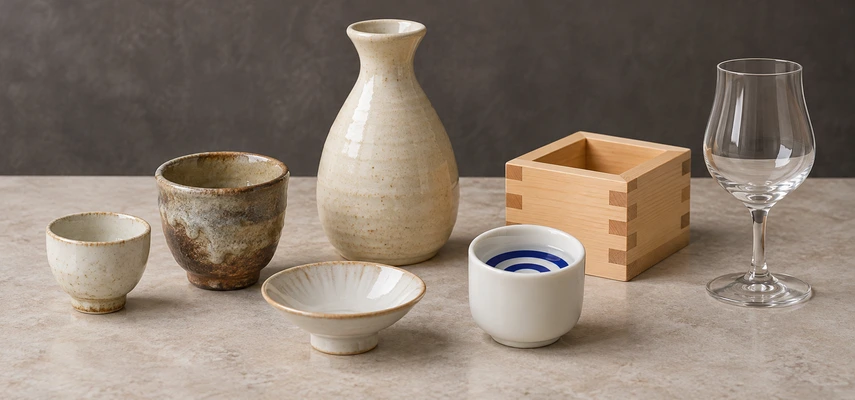

Professional sake service starts with the actual product and the guest’s intended experience. Temperature, vessel and pouring can change how aroma, texture and balance are perceived. A good recommendation explains why those choices suit the sake, rather than announcing that every junmai must be hot or every daiginjo must be icy.
The practical sequence is straightforward: check the bottle and its condition, choose a suitable starting temperature and vessel, open and pour appropriately, then monitor the result. Storage protection still matters throughout service. Warming a small portion for immediate enjoyment is different from leaving the stock warm all evening.
Sake service begins before opening
Confirm the product, heat history, alcohol strength and producer guidance. Check whether the bottle is still or sparkling and whether retained solids require special handling. An unfamiliar closure or active nigori should prompt reading the instructions before moving or shaking it.
Inspect the package and assess condition in the appropriate professional manner. A service plan shouldn’t be used to conceal a fault. If a product seems unsuitable, set it aside and investigate rather than assuming a dramatic temperature change will repair it.
The WSET service guidance connects careful storage with service. Protect the remaining stock while preparing the portion needed. A bottle doesn’t stop being sensitive to heat and light when the first guest arrives.
Chilled is a useful range, not one magic number
Chilled service can suit a fresh, delicate or aromatic expression. The JSS temperature guide describes reishu around 5–10°C and also discusses lighter chilling above that range. Choose a practical starting point according to the product rather than insisting every chilled bottle must be exactly the same temperature.
Very low temperature can suppress aromatic detail and change texture. Letting a sample move slightly warmer may reveal more character without making it a heated service. Observe the actual effect, because intensity and balance can shift as the glass warms.
Don’t confuse refrigeration with a compulsory icy pour. A bottle may need cold storage for stability while showing its best expression at a somewhat higher serving temperature. Prepare the portion sensibly and return the rest to suitable storage.
Room temperature needs context
Room-temperature service often refers to a moderate ambient condition, with around 20°C a useful reference in the JSS guide. It doesn’t mean any temperature reached by a dining room, summer terrace or radiator-side shelf. State a practical range or target when precision matters.
This can be a useful starting point for sake whose aroma and palate benefit from a less chilled presentation. But a warm room can exaggerate alcohol or reduce the intended freshness. The category name alone doesn’t settle the choice.
In a restaurant, measure or check the product rather than relying on the word ambient. The same bottle can reach different temperatures in different rooms. A professional description should tell the guest what experience is intended, not hide uncertainty behind a familiar phrase.
Nuru-kan and atsu-kan describe warmer service
Nuru-kan is approximately 40°C, while atsu-kan is approximately 50°C. These are useful named reference points, not instructions to heat without checking. The actual temperature of the sake matters more than the temperature of the surrounding water or the number of minutes on a timer.
Warming can increase aroma release and alter perceived sweetness, umami, alcohol and texture. Excessive heat can make alcohol feel pungent or overwhelm a delicate expression. A warmer result should therefore be tasted and assessed, not assumed better because the vessel feels impressive.
The JSS account encourages exploration with appropriate styles. It doesn’t support the rule that warming proves low quality. Nor does it require every aromatic sake to be warmed: suitability depends on the product and the result sought.
Warm a portion with control
A water bath provides a manageable way to warm sake in a suitable service vessel. Use heat-safe equipment, avoid heating a sealed bottle and monitor the liquid with an appropriate thermometer. The vessel material, starting temperature and quantity affect the time required.
The Kikusui producer guidance illustrates warming service, while the broader principle is controlled, even heating. A fixed number of minutes isn’t a universal process for every vessel and portion. Check the temperature rather than allowing an example to become an untested rule.
Prepare a sensible amount for prompt service. Repeated heating and cooling or holding a large quantity hot can change the experience. Sparkling sake also needs its carbonation preserved and its own handling plan, rather than being placed into a warm-service routine automatically.
Separate pouring vessels from drinking vessels
A tokkuri is a flask-like pouring vessel, commonly narrow-necked and available in different materials. It can present a controlled portion and participate in warming service where suitable. The guest normally drinks from a separate cup, not directly from the tokkuri.
Decanting can serve presentation, portioning or a particular producer recommendation. It isn’t obligatory for every sake, and sake can also be poured from the bottle. Use a clean, neutral vessel and avoid unnecessary transfer if the goal is to preserve carbonation or minimize exposure.
The Japan Tourism Agency service explanation places pouring and drinking vessels in context. A traditional choice can enrich service, but its shape and material still affect the practical result. Tradition doesn’t remove the need for clean equipment and a suitable temperature.
O-choko and guinomi offer small-cup service
An o-choko is a small sake cup, often used for modest pours. Materials and forms vary, so the name doesn’t establish one exact capacity or shape. Small portions can be useful when a warm sake would otherwise cool before the guest finishes it.
A guinomi is generally a larger, often more substantial drinking cup than a small choko, with considerable craft variation. Don’t treat the distinction as a rigid universal measurement. The actual form, rim and material matter to the drinking experience.
For both, consider temperature retention, comfort and how easily the guest can appreciate aroma. A tactile ceramic cup may suit the intended service, while a different vessel may be more informative in analytical tasting. The best choice depends on purpose rather than prestige.
Kiki-choko supports observation
A kiki-choko is a tasting cup, typically white with a blue concentric pattern inside. The NRIB guide discusses its use in brewing and assessment. The contrast helps examination of appearance, while the neutral interior is useful for seeing the liquid.
The rings don’t identify the grade or guarantee a more accurate quality judgment. The taster still needs suitable light, consistent conditions and systematic observation. A decorative pattern isn’t a substitute for sensory discipline.
A clean tulip-shaped wine glass is also useful for aroma-focused assessment. It can help gather aromatic detail, especially when the aim is analytical comparison. Whatever the vessel, keep it consistent when comparing samples so its influence doesn’t become an unnoticed variable.
Sakazuki and masu have different forms
A sakazuki is a shallow, wide drinking vessel associated with traditional and ceremonial contexts. Its shape differs from a deeper cup, changing the surface and drinking presentation. Use the actual vessel comfortably rather than assuming one formal shape suits every setting.
A masu is a square box, traditionally wooden and associated with measuring as well as service. Wood can contribute aroma, which may be welcome in a cultural service but can complicate neutral analysis. A wooden vessel isn’t automatically the best way to assess a delicate sake’s own aroma.
Overflow service is a particular presentation custom, not a requirement of accurate pouring or generosity in every venue. Consider hygiene, portion clarity and the guest’s comfort. Professional service can be respectful without reproducing every possible custom at once.
Match two contrasting products thoughtfully
For a rich, powerful junmai, a modest warmed trial around nuru-kan can be a reasonable starting proposal if producer guidance supports it. Assess whether the aroma and palate become more integrated or whether alcohol becomes too prominent. Offer the result rather than insisting the label demands it.
For a delicate elegant daiginjo or junmai daiginjo, a suitably chilled starting pour in a clean aroma-friendly glass can preserve and reveal the intended expression. Avoid overchilling to the point that little can be perceived. Gentle warming remains a product-specific possibility, not a universal ban or obligation.
Explain the recommendation through the actual sake and guest preference. A successful service answer includes the chosen temperature, vessel and reason, plus practical handling. It doesn’t simply pair expensive with cold and ordinary with hot.
In a service trial, divide a small quantity of one sound sake between comparable vessels at two measured temperatures. Record the differences in aroma release, alcohol sensation and balance before choosing a recommendation. Tell the guest what you found, with room for personal preference. This makes the decision reviewable and avoids presenting a category stereotype as a universal law. Keep the trial modest and return unused stock to its proper conditions, because exploring service should not become an excuse for unnecessary exposure.
Service starts with sound storage and condition and continues with the interaction explored in food pairing. Use consistent appropriate conditions in systematic tasting before attributing every difference to the sake itself.
One-page revision summary
Check the product before opening. Distinguish chilled and moderate room-temperature service from nuru-kan around 40°C and atsu-kan around 50°C. Warm portions with monitoring, decant for a reason and choose among tokkuri, cups, kiki-choko, sakazuki, masu and glass according to purpose. Protect stock and judge the actual sensory result.
Written practice: original TFE exercises
These suggested marks and indicative points are independent teaching guidance, not official WSET marking schemes.
Exercise 1: 5 suggested marks
Recommend a starting service for a rich powerful junmai and a delicate elegant junmai daiginjo, explaining your choices. Mapping: Unit 1 LO4.
Indicative marking points:
- Check producer guidance and condition for both.
- A warmed trial around40C can suit the rich junmai.
- Assess integration versus excessive alcohol pungency.
- A suitably chilled aroma-friendly pour can suit the delicate daiginjo.
- Avoid universal category rules and adapt to actual result/guest preference.
Model answer: Check both products first. A controlled trial around nuru-kan may suit the rich junmai if it improves integration without emphasizing alcohol. Start the delicate junmai daiginjo suitably chilled in a clean aroma-friendly glass, avoiding excessive chilling. Confirm the sensory result and guest preference rather than treating either category as a fixed temperature command.
Why it works: It provides distinct practical choices and connects them with intended effects and limits.
Common mistake: Saying all junmai must be hot or that any warmed premium sake is necessarily ruined.
Exercise 2: 5 suggested marks
Distinguish a tokkuri, kiki-choko and masu by function and explain a consequence for assessment. Mapping: Unit 1 LO4.
Indicative marking points:
- Tokkuri is a pouring/service vessel.
- Kiki-choko is a tasting cup.
- Its white/blue pattern supports appearance observation.
- Masu is a square measuring/service box, traditionally wood.
- Wood aroma can confound neutral assessment, so vessel choice should fit purpose.
Model answer: A tokkuri holds sake for pouring, while a kiki-choko is a tasting cup whose white and blue interior supports appearance observation. A masu is a square box associated with measurement and service. A wooden masu can contribute aroma, so it may be less neutral for analytical comparison than an appropriate tasting cup or glass.
Why it works: It separates service from drinking functions and explains why material choice matters beyond tradition.
Common mistake: Treating every vessel as interchangeable or assuming wood always improves the sake’s own aromatic clarity.
Knowledge check: 10 original practice questions
Independent TFE questions, not official WSET examination items. Choose one answer per question; explanations follow separately.
1. What is a sakazuki?
2. Which pairing is correct?
3. When should a potentially pressurized product be opened?
4. What does warm service establish about quality?
5. Which is a reasonable starting proposal for delicate aromatic sake?
6. How should warming time be chosen?
7. Which vessel commonly has blue concentric rings inside?
8. Why can a wooden masu complicate neutral tasting?
9. Why use consistent vessels in a comparison?
10. What is the principal function of a tokkuri?
Answers and explanations
1. D — A shallow wide drinking vessel.. Its form and context differ from deeper cups and pouring flasks. Mapping: Unit 1 LO4 service.
2. B — Nuru-kan40C; atsu-kan50C.. These are approximate named service reference points, with actual liquid temperature still checked. Mapping: Unit 1 LO4 service.
3. C — After checking and following its specific instructions.. Product-specific handling takes priority over a universal service ritual. Mapping: Unit 1 LO4 service.
4. D — It establishes a service choice, not a quality level.. Temperature suitability and sensory quality are related questions but not interchangeable labels. Mapping: Unit 1 LO4 service.
5. A — Suitable chilled service without excessive aroma suppression.. The actual product and intended expression determine the final choice. Mapping: Unit 1 LO4 service.
6. C — Monitor the sake, accounting for vessel, quantity and starting conditions.. The intended serving temperature concerns the liquid, not an untested timer rule. Mapping: Unit 1 LO4 service.
7. A — Kiki-choko.. The white/blue contrast supports appearance observation without itself determining quality. Mapping: Unit 1 LO4 service.
8. B — It can contribute wood aroma.. Material-derived character may be appropriate to service but confound assessment of the sake alone. Mapping: Unit 1 LO4 service.
9. B — Shape and material can otherwise become extra variables.. Consistent equipment helps make differences between samples more interpretable. Mapping: Unit 1 LO4 service.
10. C — A pouring/service vessel.. Its role differs from the cups used for drinking or analytical observation. Mapping: Unit 1 LO4 service.











