










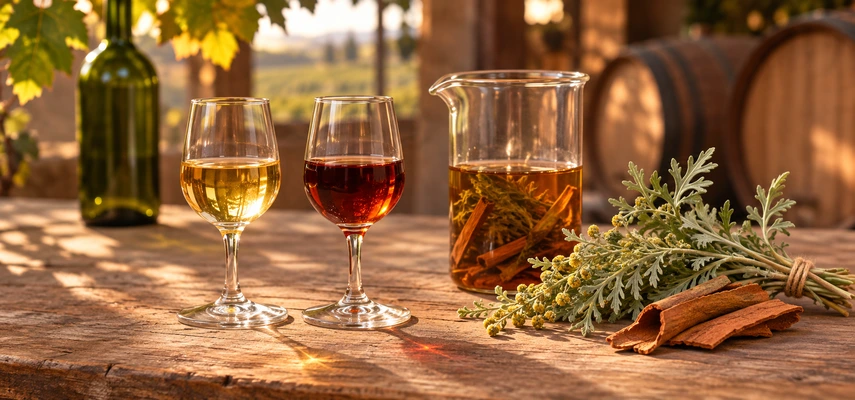

A Manhattan contains a spirit and an aromatised wine, not simply two different kinds of whisky. That distinction matters because vermouth brings a wine foundation as well as sweetness, bitterness and botanical aroma. The same principle helps explain quinquina, chinato and Americano.
Aromatised wines sit naturally in a spirits course because they are important cocktail ingredients and share flavouring tools with botanical spirits. Their foundation, however, is wine. Adding herbs and alcohol does not mean that the entire wine has been distilled into a spirit.
Start with the base, then follow fortification, flavouring, sweetness and blending. This makes the family much easier to navigate than trying to memorise four labels solely through their colour or the cocktail in which they most often appear.
Aromatised wines preserve a wine foundation
The base wine supplies alcohol, acidity, grape-derived character and other components. A relatively restrained white wine can give botanicals room to lead, while a more characterful wine may remain conspicuous in the finished drink. Neither choice is simply an empty container for herbs.
The wine can be blended or treated according to the intended product and applicable framework. Do not assume every aromatised wine begins with one grape variety, one sweetness level or one identical fermentation history.
A coloured finished product also does not establish a red-wine base. Botanical extraction, permitted colouring and other formulation choices can alter appearance. Ask for the producer’s actual wine information before inferring the grape or wine colour from the glass.
This is the central comparison with liqueurs. A liqueur commonly uses a spirit or neutral-alcohol foundation; an aromatised wine retains a wine-based identity. Both can be sweet and bitter, so those sensations alone cannot distinguish their production categories.
Fortification changes strength without distilling the wine
Fortification adds alcohol to raise the wine’s alcoholic strength. The added spirit is typically neutral in the broad production explanation, although specific products and rules can allow other components. The intended result remains an aromatised wine rather than a distillate of the whole mixture.
Adding a small amount of flavour-bearing alcoholic extract can also contribute alcohol. Therefore fortification, flavour introduction and blending can interact within the formulation, even though they are useful to explain as separate functions.
The amount and kind of alcohol need to suit the category and intended balance. More alcoholic strength is not automatically better, and it can alter both flavour perception and extraction behaviour. A successful formulation needs the wine, herbs, sweetness and alcohol to work together.
Do not describe fortification as another fermentation. It raises alcoholic strength by addition, while fermentation produces ethanol biologically from sugar. That distinction is straightforward and frequently useful in production comparisons.
Botanicals can meet the wine directly
One route uses direct contact between botanicals and wine or a prepared wine-alcohol mixture. Soluble components move from the plants into the liquid. Time, temperature, strength and physical preparation affect the resulting extract.
Dolin’s dry-vermouth description identifies herbs and spices macerated in a wine foundation, including wormwood among the disclosed plants. It illustrates a production route without revealing every proportion or making its particular recipe universal.
Direct extraction can contribute colour and bitterness as well as aroma. That is an important contrast with a selected botanical distillate, which contains volatile material but does not transfer every non-volatile plant constituent in the same way.
Separate treatment of different botanicals can give the blender more control. A delicate floral ingredient and a tough bitter root may not benefit from identical extraction conditions. A coherent final blend can therefore begin with several different preparations.
Tinctures and distillates provide alternative tools
Tinctures are alcoholic extracts that can be prepared separately and dosed into the wine. Their concentrated nature allows controlled addition of a particular botanical contribution. They are not automatically identical to the whole botanical or to a distilled aromatic fraction.
Distillates can carry selected volatile aromas obtained through botanical distillation. A distillate may smell strongly herbal without carrying the same bitterness or colour as a macerate. The distinction between soluble extraction and volatile transfer remains as useful here as in gin or amaro.
A producer can combine direct extracts, tinctures and distillates where the applicable rules permit. The methods are complementary options rather than mutually exclusive categories. What matters is how the components are assembled and what each is intended to supply.
Cocchi’s Americano account describes cold alcoholic infusion followed by aromatisation of white wine. The disclosed process offers a concrete link between the botanical preparation and the finished wine-based product, without requiring readers to guess a proprietary formula.
Sugar and mistelle affect the formulation
Sugar can sweeten the product and balance bitterness or acidity. It does not remove those other sensations chemically. A sweet aromatised wine can still show a distinctly bitter finish, and a dry style need not have no botanical sweetness associations at all.
Mistelle is made by adding spirit to unfermented or substantially unfermented grape juice, preventing the juice from completing an ordinary fermentation and preserving grape sugar. It is a sweet grape-based component, not simply another name for fully fermented dry wine.
Depending on the product framework and recipe, such grape material can contribute sweetness and character within a broader formulation. It should not replace the explanation that these categories have a wine foundation. Name the role a component performs rather than treating every grape liquid as identical.
Blending brings wine, extracts, alcohol and sweetening components into balance. A producer may also combine batches to maintain a house profile. Consistency is an active formulation task, not evidence that every ingredient behaved identically each year.
Vermouth requires the wormwood connection
Vermouth is an aromatised wine with a defining wormwood, or Artemisia-derived, connection. The EU category description makes that botanical relationship explicit. Vermouth is not merely any sweet or dry wine infused with whatever herbs happen to be available.
Other botanicals can add citrus, floral, spicy or herbal dimensions. Their balance varies, so the presence of wormwood should not be interpreted as a requirement that raw bitterness overwhelm everything else. Identity and intensity are separate questions.
Dry, white sweet and red sweet styles demonstrate the range within vermouth. Colour and sweetness are independent enough that white does not mean universally dry. Read the style designation and producer information instead of letting appearance do the entire job.
Red vermouth need not begin as red wine
Caramel colour is important in many red-vermouth formulations. It can provide colour without requiring a red-wine base. Botanical extraction and other components can also influence appearance, so the exact recipe still needs product-specific evidence.
Caramel colouring and sweetening are not one indistinguishable operation. A producer can make separate decisions about sugar balance and presentation. Darker vermouth is not automatically sweeter, older or more concentrated in every botanical.
This matters in cocktails because a red sweet vermouth and a dry white vermouth can change several dimensions at once: sweetness, bitterness, aroma and wine character. They are not interchangeable merely because both contain the word vermouth.
Quinquina and chinato: the cinchona reference
Quinquina and Chinato identify important cinchona-associated aromatised-wine traditions. The relevant bitter connection is quinine, naturally associated with cinchona bark. Remember that link before exploring the additional herbs and spices of particular products.
The wine base can be especially characterful. Cocchi’s Barolo Chinato identifies Barolo wine with cinchona bark and other botanical material. It is an example of named wine and botanical character working together rather than a neutral spirit simply coloured to resemble wine.
Do not treat every quinquina or chinato as an identical recipe. Sweetness, strength, base wine and supporting botanicals can vary. Nor should a historical association with remedies be copied into a modern claim that the drink treats illness.
The sensory comparison should therefore include both the wine and the bitter botanical contribution. A floral or spicy note does not erase the cinchona reference, and a bitter finish does not prove that no sugar was used.
Americano: a wine family and a different cocktail name
The Americano aromatised-wine family has an important wormwood and gentian connection. Individual examples may include cinchona and other plants as well. The category should not be reduced to a blanket synonym for quinquina or to one brand’s ingredient list.
Cocchi discloses white wine, sugar and an alcoholic herbal infusion including gentian, wormwood and cinchona among other ingredients. This explains the wine-and-botanical structure while preserving the difference between a named product and the broader family.
The Americano cocktail is a different use of the same word, commonly involving bitter aperitif, sweet vermouth and soda. Do not answer a question about the aromatised-wine category with that cocktail’s recipe. Context determines which meaning is intended.
Use the production map in cocktail comparisons
An aromatised wine can contribute lower-strength wine character, acidity, sweetness, bitterness and botanical aroma to a cocktail. Replacing it with a high-strength spirit changes more than the flavour name. Replacing it with a liqueur can also change the wine foundation and sugar balance.
For a clear written comparison, identify the base first, then the principal botanical requirement, followed by known sweetening and flavouring choices. Treat undisclosed details as undisclosed. This gives a useful explanation without pretending every aperitif bottle can be decoded from colour alone.
What to remember
Aromatised wines begin with wine and combine flavouring, often fortification, sweetening and blending. Direct contact, tinctures and distillates offer different routes. Mistelle is sweet fortified grape juice, not a synonym for dry wine.
Connect vermouth with wormwood, quinquina and chinato with the cinchona/quinine reference, and Americano with wormwood and gentian. Keep red-vermouth colour separate from red-wine assumptions, and distinguish the Americano wine family from the cocktail sharing its name.
Continue your study
To revisit bitter botanical sources, read Amaro and Cocktail Bitters Explained: Gentian, Quinine, and Bitter Spirits. To contrast wine and spirit foundations, read Liqueurs Explained: Spirit Bases, Flavorings, Sweetness, and Cream Liqueurs. To see vermouth’s role in spirit-forward cocktails, read The Four Cocktail Families Explained: Spirit-Forward, Short Sour, Highball, and Long Sour.
Knowledge check: 10 original practice questions
Independent TFE questions, not official WSET examination items. Choose one answer per question; explanations follow separately.
1. Which botanical relationship defines vermouth in the framework discussed?
- Only vanilla
- Wormwood or Artemisia-derived character
- Only juniper
- Only coffee
2. Which pairing is important for the Americano aromatised-wine family?
- Only rye and corn
- Wormwood and gentian
- Only cream and cocoa
- Only agave and oak
3. What is a tincture in this context?
- A carbon filter
- A mandatory grape variety
- An alcoholic botanical extract used in formulation
- A whisky age statement
4. What is mistelle?
- A neutral vodka
- Only red vermouth colouring
- Grape juice fortified before ordinary fermentation is completed
- Any fully fermented dry wine
5. What does fortification do?
- Removes all acidity
- Raises strength by adding alcohol
- Distils the entire wine
- Creates ethanol through a new fermentation
6. Why can red vermouth have a white-wine base?
- All red vermouth is secretly whisky
- Colour can be supplied through formulation including caramel
- Colour always proves the grape variety
- White wine turns into red grapes
7. How can a botanical distillate differ from a macerate?
- It always contains more non-volatile bitterness
- It transfers selected volatile material rather than all soluble constituents
- It must contain every plant pigment
- It is unfermented grape juice
8. Why must Americano be read in context?
- It always means American whiskey
- It can name an aromatised-wine family or a cocktail
- It never describes a wine-based ingredient
- It always means one exact grape
9. Which bitter reference belongs to quinquina and chinato?
- Potato starch
- Cinchona and quinine
- Anethole only
- Lactose
10. What is the central foundation of these aromatised-wine categories?
- Only agave juice
- Only neutral spirit
- Only molasses
- Wine
Answers and explanations
1. B — Wormwood or Artemisia-derived character. The Artemisia connection is part of the vermouth identity, alongside the wine and fortification framework. Mapping: LO3.
2. B — Wormwood and gentian. Americano has this botanical connection, while an individual producer may include additional plants. Mapping: LO3.
3. C — An alcoholic botanical extract used in formulation. A concentrated extract can be prepared separately and dosed into the wine blend. Mapping: LO3.
4. C — Grape juice fortified before ordinary fermentation is completed. Spirit preserves grape sugars in the juice-based component; this is not simply another name for dry wine. Mapping: LO3.
5. B — Raises strength by adding alcohol. Fortification is an addition step, distinct from fermentation and from distilling the whole product. Mapping: LO3.
6. B — Colour can be supplied through formulation including caramel. Colour and wine-base identity are separate questions, so the bottle’s appearance cannot establish the base. Mapping: LO3.
7. B — It transfers selected volatile material rather than all soluble constituents. Distillation and soaking select different groups of compounds, producing complementary formulation tools. Mapping: LO3.
8. B — It can name an aromatised-wine family or a cocktail. The wine category and the bitter-aperitif/vermouth/soda cocktail are different uses of the same word. Mapping: LO3.
9. B — Cinchona and quinine. Cinchona-associated bitterness is the important family connection, with other recipe differences still possible. Mapping: LO3.
10. D — Wine. The wine foundation distinguishes these products from a typical spirit-based liqueur even when both are sweet and botanical. Mapping: LO3.












