










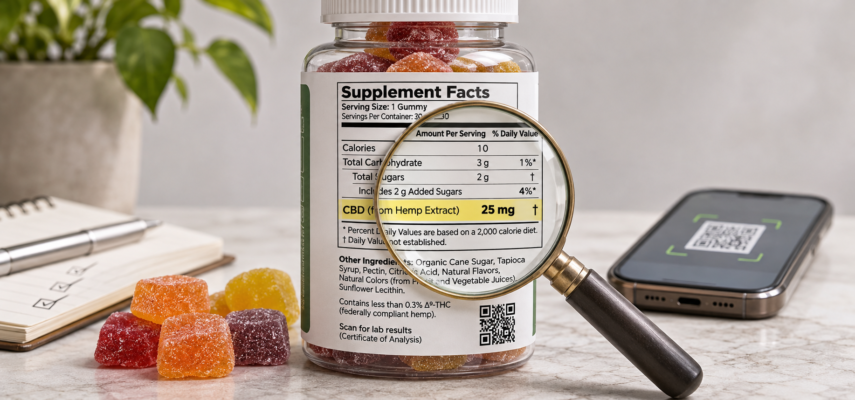
The front of a CBD gummy bottle is advertising. The back is where the facts live, and most people never turn it around. I started flipping bottles after I bought a jar of “extra strength” gummies that tasted like strawberry candy and did less for my evening wind down than a warm shower. The label said 25 mg per piece. It felt like five.
That mismatch is the whole reason this article exists, because the gap between what a gummy claims and what it holds is usually printed in small type on the side you ignore. You do not need a chemistry degree to spot the difference. You need four checks, a phone, and about ninety seconds in the aisle. That is the deal.
What the front of the bottle is actually allowed to say
Marketing copy on the front is barely regulated in the way you would expect. A brand can print “calm,” “balance,” and “full spectrum” without proving much of anything, because those words describe a feeling, not a measurement. The numbers are different. Milligrams per gummy, total count, and serving size are the parts a manufacturer has real reason to get right, so start there and ignore the poetry above it.
Here is the move I make first: find the milligram per gummy and the number of gummies in the jar, then do the division. A 750 mg bottle with 30 pieces is 25 mg each. A 1500 mg bottle with 60 pieces is also 25 mg each. Same dose, sometimes a very different price. That single bit of math has saved me more money than any coupon code, and it takes ten seconds.
Now check whether the number refers to CBD alone or to “hemp extract.” Those are not the same thing. Hemp extract includes other plant compounds, and the CBD portion can be a fraction of the total. If the label will not separate the two, that is your answer about how carefully the batch was documented.
Why the QR code on the jar matters more than the jar
Most reputable brands now print a QR code or a lot number that leads to a certificate of analysis, usually shortened to COA. That certificate comes from a third party lab, not the company’s own equipment, and it reports what the batch actually contained. Cannabinoid profile, potency, and, importantly, a screen for things you do not want to eat.
I will be blunt about this: no COA, no purchase. It is the single fastest filter I have, and it cuts a crowded shelf down to a short list in about two minutes. When you pull up that certificate, look for three numbers. The CBD potency should land close to the label claim, within a reasonable margin. The THC column should read at or below the trace level the federal limit allows. And the contaminants panel should show a passing result rather than a blank space.
That federal threshold traces back to the 2018 farm bill, which separated hemp from marijuana at a legal line drawn by THC content, and the U.S. Department of Agriculture oversees how hemp is grown under it. If a brand cannot tell you where its hemp came from, the certificate usually tells you the rest of the story for them.
A label check you can run in ninety seconds
Run these in order the next time you are standing in a store or scrolling a product page. Skipping a step usually costs you more than the step would have.
- Divide milligrams by gummies. Get your true per piece dose. Compare it against other bottles, not against the marketing on the front.
- Find the COA. Scan the code or search the lot number. If the page does not load, treat the product as unverified.
- Check the potency line against the claim. A gap you can shrug off is fine. A gap that turns 25 into 12 is a different product than the one you paid for.
- Read the ingredient list for what else is in there. Sugar, gelatin, pectin, flavoring, and color are the usual cast. If you avoid animal products, look for pectin instead of gelatin.
- Match the dose to your actual routine. A 10 mg gummy and a 50 mg gummy are not interchangeable, and starting low is the boring advice that keeps people from writing off the whole category after one rough night.
Notice what is not on that list: the word “natural,” the picture of a leaf, and the phrase “premium formula.” None of them are measurable, so none of them get a vote.
The labeling claims that should slow you down
Some language is a signal to look closer. “Proprietary blend” means the individual amounts are hidden behind a single total, which makes it impossible to know how much CBD you are getting. “Full spectrum” and “broad spectrum” describe how much of the plant’s other compounds are present, and while plenty of people care about that distinction, it says nothing about potency or quality. “Doctor recommended” with no name attached is decoration.
And anything that promises to treat, cure, or prevent a disease is a red flag for a different reason. Companies making those claims are stepping outside what the U.S. Food and Drug Administration permits in supplement marketing, and a brand willing to gamble there is a brand gambling with your batch records too.
Where to buy without doing all this detective work
You can absolutely do the homework yourself every time. I did for a year. It got old, so I narrowed my shopping to a handful of brands that publish certificates up front and put the milligram math on the page for me. That is the trade I would recommend: pick two or three sources you have already vetted, then stop re-litigating the decision every time you reorder.
Keeping the origin of your product in a shop that has to hold Federal Trade Commission truth in advertising standards close by puts at least one adult in the room, and if you want a starting point, CBDistillery is one I keep coming back to because the labels hold up to the checks above.
Common questions, short answers
Does a higher milligram always mean a stronger gummy? Only if the certificate backs it up, and only if the per piece number is what you calculated rather than what the front of the bottle implies.
Are gummies less reliable than oil? Not inherently. Gummies are a fixed dose, which makes them easier to repeat, but they also have more ingredients, so the label has more places to get sloppy.
What if two bottles claim the same dose at very different prices? One of them is paying for something you can see, like lab testing, and the other is paying for something you cannot, like a nice bottle. The certificate sorts it out.
Do I need to start at the lowest dose I can find? Start lower than you think, hold it steady for a few days, and adjust from there. Changing two things at once tells you nothing.
The habit that matters most is the least exciting one: turn the bottle around. Every other decision you make about CBD starts with that single move, and the label will tell you more in ninety seconds than a shelf full of promises ever will. So here is your assignment. Next time you pick up a gummy, divide the milligrams before you read the marketing, and see if the number you get matches the story you were sold. Most of the time it does not, and that gap is exactly where you start deciding what you actually want in your routine.












