
Source: magnific.com
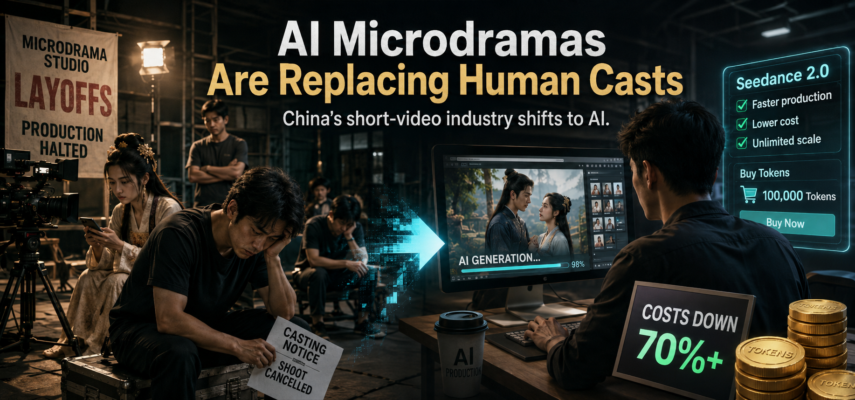
ByteDance released Seedance 2.0 in February. Within months, studios that once hired actors, directors, and full production crews were buying AI tokens instead. The industry The Economist credits with creating 700,000 jobs in China has entered rapid contraction, and the workers who built it are left recalculating their futures.
China’s Duanju Industry and the ByteDance Catalyst That Changed It
According to PetaPixel, Chinese microdramas, known as duanju, are short vertical video episodes designed for smartphone screens, each lasting no more than two minutes. A single story can run anywhere from 20 to 100 episodes, every one of them ending on an extreme cliffhanger engineered to keep viewers watching.
Before AI reshaped the economics, the format had built an industrial ecosystem. Production was concentrated in Guangzhou and Zhengzhou, where elaborate multi-set studios allowed crews to shoot dozens of episodes in a single day. The pace was relentless, but the model worked: skilled crews cycled through sets, actors moved from project to project, and an entire labor market formed around the format’s hunger for volume.
The Economist put the job count for the industry at 700,000. That figure reflects not just actors but directors, set builders, lighting technicians, costume designers, and everyone else the format required at scale.
ByteDance’s release of Seedance 2.0 changed the calculus. Producers who had relied on human casts and crews began turning to AI video generation instead. The format’s appetite for speed and volume, once a strength of the human-staffed model, made it particularly exposed to a technology that could do the same job faster and cheaper.
When Automation Absorbs Human Effort, a Familiar Pattern Emerges
The editorial team at Live Sports Odds has followed the broader story of automated tools taking over tasks that once required human time and skill. The duanju disruption fits a pattern they recognize across digital spaces: studios no longer paying wages because AI handles what workers once supplied.
The specific mechanism PetaPixel describes is stark. AI video technology allows studios to produce microdramas in days instead of weeks, at a fraction of the cost of human-crewed productions. Rather than paying salaries, studios buy tokens from AI companies. The labor transaction is gone; the output remains.
The Live Sports Odds team notes that the same handoff appears in other digital pastimes. An arbitrage calculator now performs the cross-bookmaker odds math that sports bettors once worked through manually, another case of software absorbing the effort humans used to supply themselves.
“Advanced technology can improve people’s quality of life. But for our industry, right now it’s doing more harm than good.”
Li Dazhi, a 32-year-old microdrama actor quoted by PetaPixel, put the dynamic plainly. The observation reflects what a growing number of workers in the format are experiencing directly.
Studio Revenue and Actor Pay Collapse as AI Takes Hold
The displacement is documented in concrete numbers from people inside the industry. One unnamed studio owner told PetaPixel his business is down 70 percent compared to last year. That figure represents not a gradual decline but a structural break driven by producers choosing AI generation over human production.
Li Dazhi, whose career had been built on microdrama work, says his salary has fallen by half since the shift began. Many of his colleagues, he adds, have already switched careers entirely. The speed of the transition has left little time to adapt.
American actress Anina Net had spent several years in China shooting microdramas before the AI shift arrived. Her account of the change is direct: “Boom, everything is AI. Everybody is sitting at home. Everybody is thinking: how is this going to go forward?”
Her description captures what the numbers confirm. This was not a gradual evolution of the format but a sudden displacement of the human infrastructure that had built it.
Viewers Shrug, While U.S. Labor Fights a Different Battle
On the audience side, the transition has generated little resistance. Qingge Gao, a film and TV director in China, offered a candid assessment of consumer sentiment.
“People who watch minidramas, they can easily watch AI minidramas,” Gao said. “Most of them don’t care [whether it’s AI or not].”
That indifference reflects a broader cultural context. AI-generated content is not unusual on Chinese television, and public controversy over AI does not follow the same pattern in China as it does in the United States. The audience appetite for rapid-fire cliffhanger episodes appears largely indifferent to whether a human or an algorithm produced them.
The contrast with the American context is pointed. SAG-AFTRA, the U.S. actors’ union, has pushed for tighter controls on digital replicas of actors, treating AI likeness technology as a labor rights issue that demands formal protection. In China, no equivalent institutional pushback has emerged at the industry level, leaving workers like Li and Net to navigate the shift without organized support.
Anina Net’s question hangs over the entire format. Everybody is sitting at home, she said, and everybody is wondering how this goes forward. The duanju industry built a city-scale production apparatus in a remarkably short time. What replaces that human infrastructure, or whether anything does, remains unresolved.