










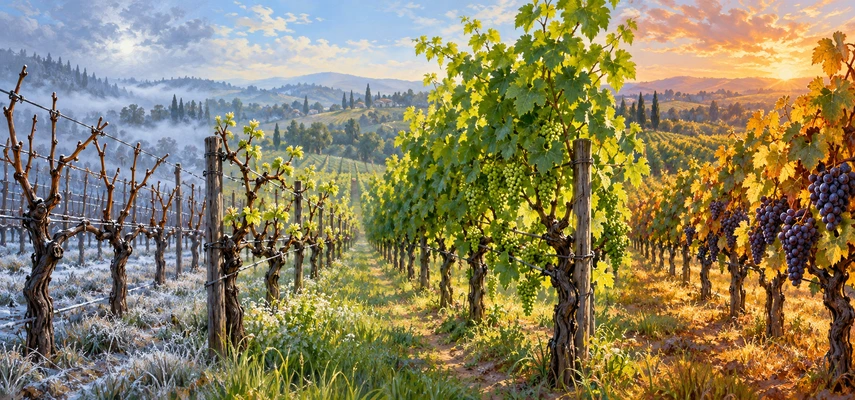

An early spring can look like a gift to a vineyard. Buds open, shoots grow and the season appears to gain a head start. Then a frost arrives. The same development that seemed promising has exposed tender tissues to damage. The grapevine growth cycle explains why the timing of weather can matter as much as its intensity.
For Diploma study, learning the sequence is only the beginning. Each stage changes the vine’s needs, the crop’s vulnerability and the decisions available to the grower. A warm week near flowering does a different job from a warm week during ripening. Meanwhile, the vine is preparing parts of next year’s crop while finishing this year’s.
The official D1 specification includes dormancy, budburst, shoot and leaf growth, flowering, fruit set, berry formation, véraison, ripening and extra-ripening. Think of these as a connected biological sequence, not a universal calendar with fixed dates.
The grapevine growth cycle has two overlapping stories
The visible story runs from spring growth to autumn leaf fall. The less visible story begins inside developing buds, where structures that can produce next season’s shoots and flower clusters take shape. This overlap helps explain why a vineyard can carry the consequences of one season into the next.
Cornell’s account of grapevine flowers describes the two-season formation process. Conditions affecting a developing bud influence crop potential. Conditions during the following season then affect the flowers, fruit set and berries actually produced. Neither year independently guarantees the final yield.
“Phenology” is the study of recurring developmental stages and their timing. Growers record stages to compare seasons and schedule work. A flowering date says something more useful than “the vineyard looked leafy in June.” It identifies a particular process whose success can influence the crop.
Calendar examples need a location and hemisphere. Spring in one hemisphere coincides broadly with autumn in the other, and latitude, variety, elevation and season change dates within each. Even neighbouring blocks can develop at different rates. A stage-based explanation travels better than a month learned without context.
Dormancy: the leafless interval still matters
During dormancy, visible shoot growth has stopped and leaves are absent. The vine survives through its perennial structures and stored resources. Buds carry protected growing points, while carbohydrates stored in roots and wood help support the next renewal of growth.
Cold acclimation, winter conditions and the transition toward renewed growth influence survival and timing. After dormancy requirements are met, accumulating warmth helps development resume. Avoid presenting a single temperature or chilling-hour figure as a universal switch for every variety and location.
The New Mexico State University phenology guide connects seasonal development with environmental conditions and reserve use. Its local calendar examples illustrate a region; they should not be copied into an explanation of every vineyard. Dormancy is a phase of the vine’s life, not evidence that the preceding crop’s demands have been erased.
Budburst: reserves fund the opening move
At budburst, also called budbreak, protected tissues expand and young growth becomes visible. The first leaves cannot instantly supply everything the developing shoot requires. Stored resources therefore help fund early development before the canopy becomes a stronger source of carbohydrates.
Earlier budburst can lengthen the potential growing period, but it may also extend exposure to damaging spring frost. Later budburst may avoid an event that harms an earlier block, yet can leave less time to complete development in a short season. These are competing considerations, not reasons to call either timing universally superior.
If a primary growing point is killed, secondary growth may provide partial recovery. The replacement crop can be smaller or develop later. Evaluating the consequence requires the variety, extent of injury and subsequent season, rather than the statement that “the vine grew back.”
Shoot and leaf growth builds the supply system
New shoots extend and leaves expand. As leaves become functional, photosynthesis supplies more of the vine’s carbohydrates. Sunlight provides energy, carbon dioxide supplies carbon and water supports both photosynthesis and tissue function. Mineral nutrients support the machinery of growth; they do not replace the carbon supplied through photosynthesis.
The British Columbia Wine Grape Council’s physiology guide explains how gas exchange, water movement and carbon supply connect. Stomata must permit carbon dioxide uptake, but opening them also permits water loss. Severe water limitation can therefore constrain growth and carbon supply instead of simply making berries more concentrated.
Warmth influences developmental rates, while available light, water and nutrients influence how well the canopy can function. An actively growing shoot tip is also a consumer of resources. The grower’s problem is not to maximise every kind of growth simultaneously, but to support the intended crop while maintaining a viable vine.
The Council’s development guide describes these changing sources and sinks. Its useful lesson is that demand shifts. A canopy that looks vigorous may still be poorly arranged for light interception or fruit exposure. Detailed canopy choices follow later; here the important point is why their timing matters.
Flowering and fruit set: potential becomes a crop
Clusters become visible on developing shoots and continue toward flowering. At bloom, the cap of fused petals separates, exposing the reproductive structures. Pollination transfers pollen; fertilisation is the subsequent reproductive process. Fruit set describes the transition to developing berries, rather than a promise that every flower will become a grape.
Most commercially grown wine-grape varieties have flowers capable of self-pollination. Conditions still influence success. Cool conditions can slow reproductive processes, while poor light and limited resources can constrain development. The relevant question is whether the flowers successfully form a suitable crop, not whether a region has an attractive average annual temperature.
Reduced fruit set can lower yield per vine. However, fewer berries do not automatically improve quality: the resulting crop still needs appropriate ripening and health. Uneven development can create additional management and selection problems. A causal answer should follow the actual consequence instead of treating every yield reduction as a quality upgrade.
Berry formation: growth changes pace
Berry development is commonly described by two faster growth phases separated by a slower phase. Early growth involves cell division and expansion. Seed development continues during the slower interval, before the later expansion associated with ripening.
The University of California’s growing-cycle teaching material illustrates this changing pattern. The distinction matters because a berry can increase in size through different processes at different stages. Weather or management that changes early development need not have the same effect as a similar event close to harvest.
At this stage, future wine quality remains potential. Berry number and size contribute to yield, but berry composition and health determine what the winery receives. Judging the crop from bunch size alone leaves out the substance of the production question.
Véraison: a transition, not a finish line
Véraison marks the onset of ripening. Berries soften and their appearance changes: black varieties develop red or purple pigmentation, while white varieties become less opaque and change towards their mature colours. Ripening does not begin in every berry at the same instant.
It is therefore possible to observe a cluster with mixed berry colours or stages. A vineyard’s reported véraison date reflects a defined observation of a population, not an identical chemical event in every grape. The exact recording convention should be understood when comparing datasets.
Colour change is useful evidence of development, but it is not a substitute for assessing maturity. A newly coloured berry has not automatically reached the composition required for the intended wine. Sugar, acidity, texture and aroma-related development still need attention.
Ripening: several clocks run together
During ripening, sugar accumulates and berries change in acidity, colour, texture and aroma potential. These changes interact but are not locked together. A sugar reading cannot fully describe flavour maturity or the condition of skins and seeds.
Texas A&M’s berry-ripening account explains that malic acid is consumed through respiration and that higher temperatures can accelerate this loss. Acidity can also change with berry water balance. The outcome is therefore more complicated than “each extra day adds sugar and removes the same amount of acid.”
For a hypothetical comparison, two parcels may reach similar sugar concentrations while differing in acidity and aroma profile. A decision based only on sugar would miss those differences. The appropriate harvest target depends on the style being made, the fruit’s health and the risks of waiting.
Wine style follows from the combination. Sugar provides fermentation potential or residual sweetness; acidity contributes balance; colour and phenolic development affect extraction possibilities; aroma compounds and precursors influence expression. Better alignment with the intended style can improve quality potential, but the cellar still has decisions to make.
Extra-ripening: waiting has a balance sheet
Extra-ripening means continuing beyond an earlier maturity point, often seeking a different composition or style. Some further increase in measured sugar concentration may come from water loss rather than additional sugar imported into the berry. Those are different mechanisms with different implications for juice yield.
The California material distinguishes late concentration from continuing accumulation. The choice to wait can also increase exposure to weather damage, disease, animals or excessive loss of acidity. The result may suit a particular concentrated style, but extended time on the vine is not a universal route to greater quality.
Grapes for sweet wines illustrate the difference between an intended outcome and an accident. Concentration, healthy raw material and sufficient balancing acidity may be important targets. The specific methods of drying, freezing or working with noble rot require their own conditions and controls; ordinary late harvest does not establish that any of those has occurred.
After harvest, functioning leaves can still contribute to reserve replenishment where conditions allow. Cornell’s root study links storage with the following spring’s renewal. Harvest ends the saleable crop’s vineyard phase, but it does not end the vine’s need to remain healthy.
Connect the seasonal sequence with climate and vineyard location and vineyard weather hazards by identifying when each condition acts. Use grapevine anatomy to distinguish the organs involved, then compare harvest decisions with sweet wine production to explain why picking decisions differ with the intended wine.
Original Diploma practice and outline answers
These are original TFE exercises with indicative points, not official WSET examination questions. Use the sequence to explain an outcome, then qualify the conclusion.
Question 1: evaluate an early start
A hypothetical block reaches budburst before another nearby block. Explain one potential advantage and one risk, then identify information needed before judging the outcome.
Indicative points: More potential developmental time; tender growth exposed earlier; frost occurrence and severity; variety and subsequent season; no automatic quality ranking.
Outline answer: Earlier budburst can extend the time available for development, which may help in a constrained season. However, tender tissues may encounter spring frost while a later block remains less advanced. The actual consequence depends on whether a damaging event occurs and how the crop develops afterwards. Variety, injury and later ripening conditions are needed before comparing quality potential.
Question 2: explain a cross-season effect
A vine suffers substantial premature leaf loss before entering dormancy. Explain a possible consequence for the following spring without assuming that the entire next crop must fail.
Indicative points: Less functional photosynthetic area; possible reserve limitation; reserves support early growth; extent and timing matter; later recovery and remaining resources influence severity.
Outline answer: Premature leaf loss can reduce the opportunity to produce and store carbohydrates. Early spring growth draws on reserves before the new canopy fully supplies itself. Lower reserves can therefore constrain renewal or reproductive development. However, the scale of the effect depends on prior reserves, when leaves were lost and the condition of the remaining vine; total crop failure is not established by the scenario.
Question 3: evaluate a higher sugar reading
Late in a hypothetical season, berry weight falls while measured sugar concentration rises. Explain why the result does not by itself prove continued sugar accumulation or improved wine quality.
Indicative points: Concentration is amount relative to volume or mass; water loss can raise the reading; examine sugar per berry and sampling; assess acidity, aroma and health; consider juice yield and style.
Outline answer: If berries lose water, a similar amount of sugar can occupy less liquid and give a higher concentration reading. Measurements of berry weight and sugar per berry can help distinguish mechanisms, with representative sampling. The higher reading says nothing sufficient about aroma development, acidity or fruit health. Less juice may also change costs, so the appropriate conclusion depends on the intended product and the full evidence.
Make the timeline explanatory
Beside each stage in a revision timeline, record what the vine is building, what supplies it and what could interrupt the process. Then connect the interruption to yield, grape composition and the intended wine. That turns the growth cycle from a sequence of names into a way of reasoning about a vintage.












