History of Seaboard
Seaboard railroad history is visible in everyday moments: when travelers in the mid-20th century boarded a “Silver” streamliner bound for Florida or when southern ports loaded agricultural exports onto boxcars. The name Seaboard often stood between local life and the wider world.
Within railroading, Seaboard served as a corporate identity and locomotive brand that tied together commerce, tourism, and regional identity across the southeastern United States. Distinct businesses later used the Seaboard name in aviation, ocean shipping, and agribusiness, but they did not share the railroads’ corporate lineage.
This account traces the most consequential of those threads—the railroads that carried the Seaboard name—and explains why their rise, consolidation, and absorption reshaped transportation in the American Southeast.
Note on terminology: In this article, the word “Seaboard” generally refers to the rail companies and services that bore the name. Other firms in shipping, cargo aviation, or agribusiness that also used the Seaboard name are treated separately where noted, to avoid conflating distinct corporations that shared an evocative brand.
Roots in Seaboard railroad history: building a coastal network
The Seaboard lineage reached back to nineteenth-century railroads including the Raleigh and Gaston Railroad, chartered in 1835 and completed between Raleigh and Gaston on March 21, 1840. After the Civil War, the Seaboard and Roanoke Railroad gained control of the Raleigh and Gaston in 1871. These lines became part of a wider group of affiliated and controlled railroads—including the Raleigh and Augusta Air-Line, Carolina Central, and Georgia, Carolina and Northern—that formed the northern and central portions of the later Seaboard system.
An even earlier predecessor was the Portsmouth and Roanoke Railroad, incorporated in March 1832. It began horse-drawn operations in 1834, completed the Portsmouth–Weldon route by 1837, and was reorganized as the Seaboard and Roanoke Railroad in 1846. In its early years the system developed through the initial construction of short branches, the launch of first services to local customers, and successive consolidations that steadily increased mileage and through routes. By 1899 the associated Seaboard properties totaled about 971 miles and their owners planned a roughly 2,500‑mile combination that would arrange through Tampa–New York service. John Skelton Williams assembled the unified Seaboard Air Line in 1900 and served as its first president.
Corporate unification accelerated in the 1890s. In 1895, a syndicate led by the Williams banking interests acquired the Savannah, Americus and Montgomery Railroad and reorganized it as the Georgia and Alabama Railway. The same interests acquired control of the existing Seaboard group in December 1898 and the Florida Central and Peninsular Railroad in February 1899. The immediate legal predecessor of the unified carrier, the Richmond, Petersburg and Carolina Railroad Company, had been organized on August 5, 1897; a Richmond court authorized its change of name to Seaboard Air Line Railway on April 10, 1900. The affiliated Seaboard, Georgia and Alabama, and Florida Central and Peninsular networks were brought together operationally in 1900, while formal absorptions continued with the Raleigh and Gaston and several related affiliates in 1901, the Georgia and Alabama in 1902, and the Florida Central and Peninsular in 1903.
The consolidated network aimed to provide a continuous route along the eastern seaboard and into the Gulf states that could compete with rival systems. The resulting carrier was oriented toward two principal opportunities: seasonal passenger traffic to Florida and steady freight movements—timber, agricultural products, manufactured goods—between ports, mills, and inland distribution centers.
That dual purpose shaped the company’s investments, rolling stock, and marketing, and established the Seaboard name as synonymous with both leisure travel and commerce in the Southeast. The network served cities and ports that included Jacksonville, Tampa, and Miami, linking inland producers to coastal export points.
Streamliners and the golden age of passenger service
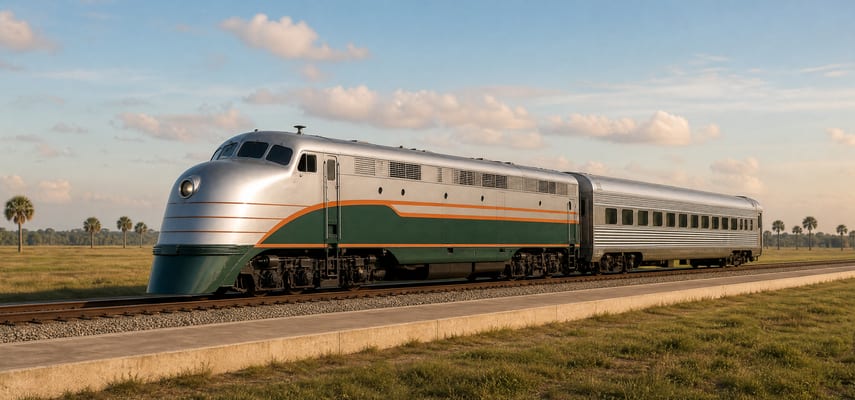
In the years between the 1930s and the early postwar era, Seaboard became nationally visible because of its passenger trains. The Silver Meteor made its inaugural run on February 2, 1939, providing overnight service between New York and Florida, with service to Miami and St. Petersburg. The Silver Star entered service on December 12, 1947, between New York and Miami and St. Petersburg; after its initial winter operation, it was re-established as a year-round New York–Miami train on August 1, 1948.
Demand quickly outgrew the original seven-car Silver Meteor, prompting Seaboard to expand the train and introduce daily service in December 1939. The Silver services linked northeastern cities with Florida destinations and became prominent advertisements for modern rail travel, helping establish Seaboard’s reputation in the competitive East–South passenger market.
The company invested in lightweight cars, refined timetables, and onboard amenities because demographic and economic shifts—automobile ownership, disposable income among middle-class northerners, and the rise of Florida as a tourism magnet—made the seasonal passenger market immensely valuable. For decades, these trains symbolized the modern South’s connection to national leisure patterns.
Wartime traffic and postwar challenges
During World War II, railroads across the United States saw dramatic surges in traffic as troops and materiel moved by rail. The network operating under the Seaboard name carried significant wartime freight and personnel, and like other carriers it deferred many passenger improvements while prioritizing wartime logistics.
The intense wartime use of equipment accelerated wear on infrastructure and rolling stock. The immediate postwar period required heavy capital renewal at a moment when railroads were also facing new competition from highways and airlines.
After the war, the decline in long-distance passenger rail—driven by expanded highway systems, changing patterns of federal investment, and the growth of commercial aviation—presented Seaboard and its peers with a strategic dilemma. Passenger revenues had long cross-subsidized some services, and the sudden erosion of ridership forced carriers to rethink routes, investment, and corporate structure.
1967: Merger with Atlantic Coast Line and the birth of a new company
One of the clearest watershed moments in the Seaboard story occurred on July 1, 1967. The Atlantic Coast Line Railroad Company was merged into the Seaboard Air Line Railroad Company, the surviving corporation, which continued under the new name Seaboard Coast Line Railroad Company.
For the companies involved, combination was a pragmatic response to the structural problems that faced mid-century railroading: overlapping routes, excess capacity, and the urgent need for economies of scale in operations, maintenance, and capital investment.
The new entity—Seaboard Coast Line Railroad Company—sought to rationalize duplicate track, consolidate yards and engine facilities, and reduce redundant administrative costs. The effect of that consolidation was practical as well as symbolic: it altered freight routings, changed how shippers negotiated rates, and reorganized the flow of goods in a region undergoing rapid industrial and agricultural change. For many communities, the merger changed which trains stopped locally and which services were rationalized away.
From declining passenger service to transfer to Amtrak
The late 1960s and early 1970s were brutal for intercity passenger rail. Nationwide declines in ridership, rising losses, and little appetite among carriers for continued passenger subsidies culminated in the creation of Amtrak in 1970. Amtrak began national operations on May 1, 1971, taking over most intercity passenger trains previously operated by private railroads and relieving participating carriers of their passenger-service obligations.
For the Seaboard successor lines, turning over passenger operations to Amtrak allowed a renewed emphasis on freight—where profit still lay—but it also meant the loss of a public-facing brand. Long-distance, luxury trains that had once defined corporate prestige now belonged to a national system; the Seaboard name would remain associated with freight and regional identity rather than the glamour of streamliners.
Consolidation into holding companies and the Family Lines
In the decade after the 1967 merger, Seaboard Coast Line and affiliated southern railroads adopted shared marketing and operating arrangements under the Family Lines System name. Family Lines was a coordinated marketing identity rather than a separate railroad, bringing together Seaboard Coast Line, the Louisville and Nashville Railroad, the Clinchfield Railroad, and smaller affiliated lines.
These arrangements made it simpler to coordinate freight movements over multiple affiliated carriers and to pool administrative and operational resources. For shippers, the new structures could mean more consistent billing and routing.
For employees and customers in small communities, the reorganizations sometimes meant more distant decision-making and a sharper focus on profitability rather than local ties.
Transformation into a larger eastern network: the Seaboard System and CSX
The next consolidation occurred at both the holding-company and operating-railroad levels. In November 1980, CSX Corporation completed the combination of Chessie System and Seaboard Coast Line Industries. On December 29, 1982, the Louisville and Nashville Railroad Company was merged into its parent, Seaboard Coast Line Railroad Company, and the surviving railroad was renamed Seaboard System Railroad, Inc. Effective July 1, 1986, Seaboard System Railroad changed its name to CSX Transportation, Inc.
The formation of the larger eastern system reshaped freight logistics: routes were rationalized to favor higher-density corridors, intermodal traffic—containers and trailers moving between ships and trains—became a strategic focus, and the company invested in signal and yard automation to improve asset utilization.
The old local stations and branch lines were assessed for economic viability; some found new life with short-line operators or were abandoned, while major corridors received capital to handle heavier, faster trains.
For the southeastern economy, the transition from a regionally focused railroad to part of a larger eastern system had mixed implications. On one hand, integration reduced interchange frictions and could lower freight costs for large shippers. On the other hand, centralization meant that rail decisions were increasingly made far from the communities the railroad had once directly served.
Freight focus: commodities, ports, and intermodal growth
Throughout its twentieth-century evolution, the Seaboard lineage adapted to changes in what goods the railroads moved. Where early decades emphasized agricultural products and raw materials, the latter twentieth century saw a shift toward containerized freight, automotive parts, chemicals, and intermodal traffic connecting ports to inland distribution centers.
Ports along the Atlantic and Gulf coasts became critical nodes. As container shipping grew, rail linkages to terminals determined who would capture the value of global trade flows. The Seaboard network’s proximity to major ports gave it an advantage, but exploiting that advantage required investment in intermodal terminals, heavier rails to carry double-stack container cars, and information systems to manage complex logistics.
These investments reflected a larger shift in American freight railroading away from block trains of coal and grain toward more varied, time-sensitive freight. The companies that grew out of Seaboard’s legacy had to master scheduling, terminal management, and partnerships with trucking companies to remain competitive in a logistics environment increasingly driven by supply-chain demands.
Local impacts: communities, yards, and the changing labor landscape
The Seaboard legacy is visible in towns where depots, roundhouses, and classification yards shaped urban form. The decisions made by Seaboard and its successors—where to build a yard, which branch lines to abandon, how to schedule trains—had direct economic consequences for towns that had grown up around rail facilities.
As corporate consolidation and technological change reduced the number of employees required to operate freight railroads, communities that had once relied on large railway workforces faced economic dislocation. At the same time, some abandoned rights-of-way were repurposed as trails or redeveloped, and a handful of branch lines found new life under short-line operators who could run local service more cheaply.
Decisions about yards, service reductions, and route consolidations were made by company leadership and executives who negotiated with unions and appointed managers to oversee transitions. Those executive-level decisions often produced formal restructurings of local operations and reassignment of staff as companies reorganized their regional footprints.
Labor relations were also transformed. Unions remained powerful stakeholders in railroad operations, and mergers required negotiation with multiple craft unions over seniority, work rules, and job protections. Those negotiations shaped the pace and terms of rationalization and modernization.
Parallel uses of the Seaboard name
Two prominent non-rail uses of the Seaboard name arose independently of the Seaboard railroad companies. Arthur and Raymond Norden founded the cargo carrier Seaboard & Western Airlines in 1946. It became Seaboard World Airlines on April 4, 1961, and was absorbed into The Flying Tiger Line, Inc. on October 1, 1980.
Separately, a flour brokerage business founded in 1918 developed into the agribusiness now known as Seaboard Corporation. The company adopted the Seaboard Corporation name in 1982 and formed the ocean carrier Seaboard Marine Ltd. in 1983. Seaboard Marine remains a subsidiary of Seaboard Corporation rather than an affiliate of the Seaboard railroad lineage.
These companies shared the commercially evocative Seaboard name but not a common corporate ancestry: the railroad lineage became part of CSX, the airline followed its own path into Flying Tiger Line, and the agribusiness and its marine subsidiary developed from a Kansas-based milling enterprise.
Why the Seaboard transformations mattered
The Seaboard narrative matters for several practical reasons. First, it illustrates how transportation networks adapt to macroeconomic change: shifting from passenger prominence to freight specialization, from regional fragmentation to large-system consolidation. Those shifts didn’t happen in isolation; they echoed larger trends in U.S. economic life—suburbanization, the interstate highway system, containerization, and globalization.
Second, the decisions taken by Seaboard-era companies affected land use, industrial location, and urban development across the Southeast. Freight routings influenced where distribution centers located; passenger routes shaped tourism flows; yard consolidations changed employment patterns in dozens of small towns.
Finally, the Seaboard case shows how brand identity can outlive particular corporate boundaries. Trains named “Silver” or stations that once displayed a Seaboard shield are cultural touchstones; they testify to the deep local meaning of transportation infrastructure and to the human scale of networks that are often discussed only in terms of tonnage and operating ratios.
Recent decades: legacy, preservation, and the contemporary network
In the decades after the mid-century mergers and consolidations, many physical artifacts of the Seaboard past—depots, bridges, and ironwork—entered new lives. Historical societies and railroad preservation groups have restored stations and preserved locomotives, keeping the memory of Seaboard-era travel alive.
At the same time, the corporate descendants of those rail networks operate as parts of larger, modern freight systems focused on intermodal efficiency and long-haul bulk movements.
For historians and planners, the Seaboard story continues to offer lessons about adaptation. Modern freight companies that trace their lineage to Seaboard-era carriers now prioritize digital operations, precision-scheduled railroading in some corridors, and partnerships with ports and trucking firms. The old regional rivalries have been subsumed into a systemwide calculus that judges infrastructure by its ability to handle containers, automotive components, and time-sensitive retail freight.
Today, as of December 2025, the Seaboard lineage survives within CSX Transportation, CSX Corporation’s principal operating subsidiary: CSX operates an approximately 20,000-route-mile network serving 26 states, the District of Columbia, Ontario, and Quebec, with access to more than 70 port terminals and connections to roughly 250 short-line and regional railroads. In 2025 CSX reported $14.1 billion in revenue; its intermodal network handled about 3.0 million units through roughly 30 terminals, and the company invested $2.902 billion in capital expenditures, including $2.239 billion for track, bridges, signals, and other infrastructure.
Conclusion
The history of Seaboard—most clearly embodied by the railroads that carried the name—is a history of adaptation to changing patterns of mobility and commerce. From the patchwork of nineteenth-century lines that connected ports and towns, through the glamour of mid-century streamliners, to the mergers and rationalizations that folded those lines into a larger eastern freight system, Seaboard’s story maps the economic geography of the American Southeast.
It is a reminder that transportation networks do more than move goods and people: they help define regions, create markets, and leave durable marks on the landscape.