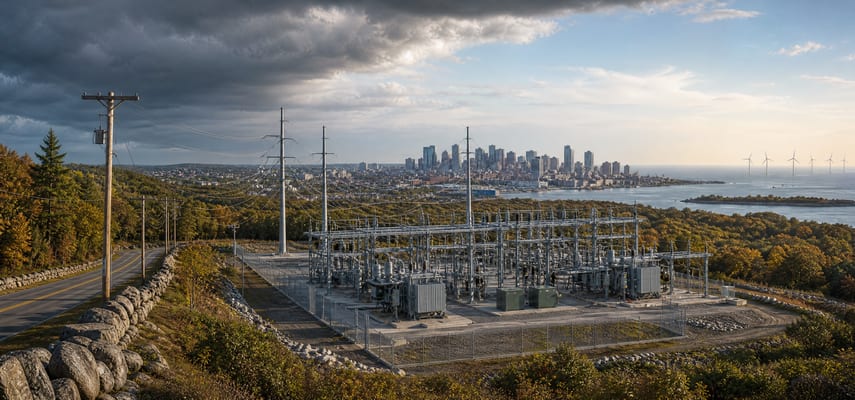
History of Eversource Energy
When a New England utility changed its name to Eversource in 2015, the move was more than a corporate rebrand. It followed a major regional consolidation and strategic shift that remade the company: from a collection of locally branded, regulated utilities into a larger, portfolio-based company that would invest heavily in grid reliability, storm response, and the nascent offshore-wind market. The history of Eversource is therefore a story of mergers and identity, of utility engineering meeting climate-driven transformation, and of how regulators, customers and executives negotiated that change.
Roots in regional utilities: the long shadow of Northeast Utilities
The company that would become Eversource traces its modern corporate lineage to Northeast Utilities, a holding company that for decades grouped a series of electric and gas distribution utilities across New England. Northeast Utilities assembled local utilities through the 20th century, a consolidation common in U.S. electricity markets as companies sought economies of scale in generation, transmission and distribution.
Eversource’s direct predecessor, Northeast Utilities, was formed on July 1, 1966, when The Connecticut Light and Power Company, Western Massachusetts Electric Company and The Hartford Electric Light Company affiliated under common ownership. The holding company grew out of Western Massachusetts Companies through an SEC‑approved stock exchange and registered as a holding company on June 30, 1966. The corporate heritage extends further back: The Hartford Electric Light Company was incorporated on April 12, 1881, and Connecticut Light and Power traces its charter to the Rocky River Power Company, incorporated on June 22, 1905.
Before the NSTAR transaction, Northeast Utilities’ principal regulated subsidiaries included the Connecticut Light and Power Company and Yankee Gas Services Company in Connecticut, Western Massachusetts Electric Company in western Massachusetts, and Public Service Company of New Hampshire. The 2012 merger added NSTAR Electric and NSTAR Gas in Massachusetts; NSTAR Electric’s territory included Boston and surrounding communities. Western Massachusetts Electric later merged into NSTAR Electric at the end of 2017, and Eversource added the former Columbia Gas of Massachusetts distribution business in 2020 through Eversource Gas Company of Massachusetts.
This background mattered because it shaped the company’s starting point in the 2010s: a patchwork of legacy systems and customer expectations, managed under differing state rules, and anchored by a corporate center accustomed to steady, regulated returns rather than rapid expansion into new markets.
2010–2012: The deal that scaled the business — Northeast Utilities and NSTAR merge
On October 18, 2010, Northeast Utilities and NSTAR announced a stock-for-stock merger of equals. The transaction closed on April 10, 2012, after shareholder approvals and required federal and state regulatory reviews, including final approvals from the Connecticut Public Utilities Regulatory Authority on April 2 and the Massachusetts Department of Public Utilities on April 4. NSTAR shareholders received 1.312 Northeast Utilities common shares for each NSTAR share, and NSTAR became a wholly owned subsidiary of Northeast Utilities. The merger brought NSTAR Electric and NSTAR Gas—and the greater Boston market—into Northeast Utilities’ portfolio.
The merged company retained the Northeast Utilities corporate identity immediately after the deal, but the merger rearranged the balance of assets and responsibilities within the firm. The company now faced operational challenges that are common after large utility mergers: integrating IT systems, coordinating storm response across broader territories, and reconciling differing labor contracts and regulatory obligations. For regulators and customers, the merger raised the usual questions: Would consolidation produce efficiencies that would lower rates? Would one state’s priorities dominate corporate decision-making? Those tensions would play out in regulatory filings and in the company’s decisions over the following years.
The merger also reshaped corporate leadership. Thomas J. May, formerly NSTAR’s chief executive, became president and CEO of the combined company while Charles W. Shivery served as non-executive chairman; the new 14-member board was divided equally between nominees of the two predecessor firms. May later assumed the chairmanship on October 10, 2013. A planned succession followed in May 2016, when James J. Judge replaced May as president and CEO and May moved to a non-executive chairman role. Joseph R. Nolan Jr. became president and CEO on May 5, 2021 while Judge moved to executive chairman; Judge retired from the board effective December 31, 2022, and Nolan added the board chairmanship thereafter.
2015: Rebranding as Eversource — a name and a strategy
On January 7, 2015, Northeast Utilities announced that it and its operating companies would begin using Eversource Energy as their unified brand effective February 2. Shareholders approved changing the holding company’s legal name on April 29, and the legal change from Northeast Utilities to Eversource Energy took effect on April 30. The new name was intended to reflect a broader, outward-facing identity rather than a holding-company label. In practical terms, the rebrand accomplished several things.
- It provided a single public-facing name for investors, regulators and customers across multiple states, simplifying the company’s marketing and corporate communications.
- It signaled a strategic pivot beyond traditional poles-and-wires service into customer-facing energy businesses and, over time, into renewable-energy partnerships.
- It allowed legacy operating companies to retain local names for regulatory and operational purposes while presenting a cohesive corporate image for corporate affairs and large-scale projects.
Rebranding matters in utilities because the sector trades heavily on public trust. Utilities are monopoly service providers in their territories; they depend on goodwill with state regulators and communities. The Eversource name therefore had to convey reliability and permanence at the same time it suggested responsiveness to a changing energy landscape.
Storms, reliability and the politics of outage response
One of the recurrent themes in New England utilities’ recent history has been the interplay between extreme weather and customer expectations. Severe storms in the 2010s—Nor’easters and hurricanes that carried heavy winds and ice—put distribution networks to the test. For Eversource, as for other large utilities, performance during outages became a central political and regulatory battleground.
High-profile storm responses highlighted several realities. First, overhead distribution systems are vulnerable to falling trees and limbs, a major cause of storm outages in Eversource’s territory. Second, customers and elected officials expect rapid restoration. Third, regulators increasingly demand accountability; they can impose fines, require after-action reports, and mandate infrastructure investments to enhance resilience.
Eversource has described its resilience work as including vegetation management, pole and wire strengthening, flood-proofing critical facilities and flood-hardening new substations where regulators support such work. Its storm-response plans also rely on mutual-assistance agreements with other utilities. SCADA systems, remotely operated smart switches and other monitoring and control devices give system operators greater visibility into portions of the distribution network and allow some outages to be isolated remotely. These measures have become part of broader public-policy debates about selective grid hardening, undergrounding, vegetation management and the recovery of resilience costs from customers.
Grid modernization, customer technology and the move beyond wires
In Massachusetts, the Department of Public Utilities approved $133 million in Eversource grid-facing visibility and automation investments for the 2018–2020 period and later approved an additional $56 million for 2021. In November 2022, the department approved, with modifications, Eversource’s second grid-modernization plan and its proposal for full-scale deployment of advanced metering infrastructure.
These grid-facing investments included distribution monitoring, automation and control equipment intended to improve system visibility, outage isolation and the management of power flows. Eversource reported that it completed its 2022–2025 Massachusetts grid-modernization program after deploying more than 3,000 monitoring and control devices in substations and on distribution lines.
On the customer side, Eversource offers demand-response programs such as ConnectedSolutions, through which eligible commercial customers can earn incentives for reducing electricity use during peak-demand events. Its full-scale Massachusetts smart-meter rollout came later than its initial grid-facing modernization work: installation began in western Massachusetts in 2025, and the company reported installing 100,000 meters by the end of that year. The eastern Massachusetts rollout began in February 2026 and was scheduled to continue through the end of 2027.
Entering—and later exiting—the offshore wind market
One of Eversource’s most consequential strategic moves was its partnership with Danish renewable-energy developer Ørsted. In February 2019, Eversource acquired 50 percent interests in the South Fork Wind and Revolution Wind projects and an associated offshore lease area. Its equal partnerships with Ørsted also encompassed the Sunrise Wind project.
The ventures made Eversource a co-owner and co-developer of South Fork Wind, Revolution Wind and Sunrise Wind rather than solely a transmission provider. The company also applied its regional construction and grid expertise to onshore transmission lines and interconnection facilities that would carry power from the projects into the electric system.
During its period of ownership, offshore wind diversified Eversource beyond regulated electric and gas distribution and connected the company directly to state clean-energy procurements. It also exposed the company to the permitting, financing and construction risks of multibillion-dollar energy projects. In 2024, Eversource sold its 50 percent share of Sunrise Wind to Ørsted and its ownership shares in South Fork Wind and Revolution Wind to Global Infrastructure Partners. It retained a noncontrolling tax-equity investment in South Fork Wind and, under the divestiture arrangements, continued specified onshore construction work as a contractor rather than a project co-owner.
Regulation, rate cases and the balancing act with state governments
Eversource operates across multiple states—each with its own public utilities commission, environmental priorities and political calendars. That reality forces a constant balancing act. Investment that a Massachusetts regulator embraces as necessary for clean energy may look different to a Connecticut regulator focused on rate impacts. The company has to craft proposals that make technical sense and can survive public scrutiny and public comment processes.
Rate cases and regulatory proceedings therefore shaped Eversource’s strategy just as much as its engineering decisions. The company sought predetermined returns on invested capital for large infrastructure programs, but regulators and intervenors pushed back on costs, phasing and customer protections. In many cases, the resolution of a rate case determined whether the utility could proceed with an expensive transmission project or had to scale it back, seek alternative financing or pursue pilot programs instead.
Also important were settlement negotiations with consumer groups, municipalities and environmental advocates. Those agreements often included consumer protections—bill discounts for low-income customers, performance metrics tied to storm restoration times, and shared commitments on energy-efficiency programming. The give-and-take in these settlements shaped the practical rollout of programs and investments.
Community relations, workforce changes and local presence
Utilities live in communities, and Eversource’s expansion brought intensified scrutiny of its local footprint. The company inherited century-old relationships with labor unions and municipal governments and had to manage those while integrating disparate workforces after the merger and during large construction efforts.
Workforce planning thus became a strategic priority: training crews for new technologies, developing mutual-aid arrangements for large storms and coordinating with towns on vegetation management and pole replacements. Community relations extended to environmental concerns—particularly for transmission lines and offshore projects—where public hearings and municipal approvals can delay or reshape plans.
The 2020s: resilience, decarbonization and the next phase
Today, Eversource continues to invest in transmission, distribution upgrades and pilot storage projects to support decarbonization while strengthening resilience for extreme weather.
In recent years, the utility landscape has shifted further toward decarbonization and electrification. State policies promoting electric vehicles, building electrification and renewable procurement have forced utilities like Eversource to model larger changes in load patterns and grid needs. At the same time, climate-driven extreme weather keeps resilience high on the agenda.
For Eversource, this period has meant continuing to invest in transmission to accommodate offshore wind and other large-scale renewables, upgrading distribution circuits for two-way power flows, and piloting energy-storage projects to smooth variability from renewables. It has also meant navigating the regulatory complexity of rate design for a future where customers have more choice—solar on rooftops, community solar subscriptions, and smart home technologies that change usage patterns.
These developments matter because they determine who pays for what. Traditional regulatory models recover investments through volumetric charges tied to kilowatt-hours consumed. As customers use less electricity per unit of service—through efficiency—or generate their own power, the utility’s revenue model comes under pressure. How regulators and utilities manage that transition will shape the cost and pace of decarbonization.
Why the Eversource story matters beyond New England
Eversource’s trajectory is part of a broader transformation in the U.S. energy sector. The company’s mix of consolidation, rebranding, grid investment and entry into renewable development illustrates challenges facing investor-owned utilities nationwide: how to reconcile long-lived infrastructure with rapid policy-driven change, how to finance resilience without overburdening customers, and how to manage public trust in an industry that is both essential and politically charged.
For policymakers and energy observers, Eversource is a case study in scale: mergers provided technical and financial capability, but they also concentrated decision-making at a regional level that must continually justify investments across state lines. The company’s push into offshore wind shows how utilities can pivot toward new markets if they combine legacy operations with project development expertise. And its storm-response evolution demonstrates that physical grid investments and organizational preparations are both critical to reliability.
Conclusion
The history of Eversource Energy is not a simple arc from local utility to modern energy firm; it is a sequence of adjustments to technology, weather and policy. The 2012 closing of the merger between Northeast Utilities and NSTAR and the 2015 rebranding to Eversource mark clear inflection points, but the company’s subsequent moves—into grid modernization, storm resiliency and offshore wind partnerships—continue to define its pace of change.
As states press for deeper decarbonization and customers demand more resilient service, the next chapters for Eversource will hinge less on corporate names and more on concrete choices: which transmission corridors to build, how to balance rates and investments, and how to integrate intermittent resources without compromising reliability. Those are the decisions that will determine whether the utility’s promise of steady, affordable power endures through the energy transition.