










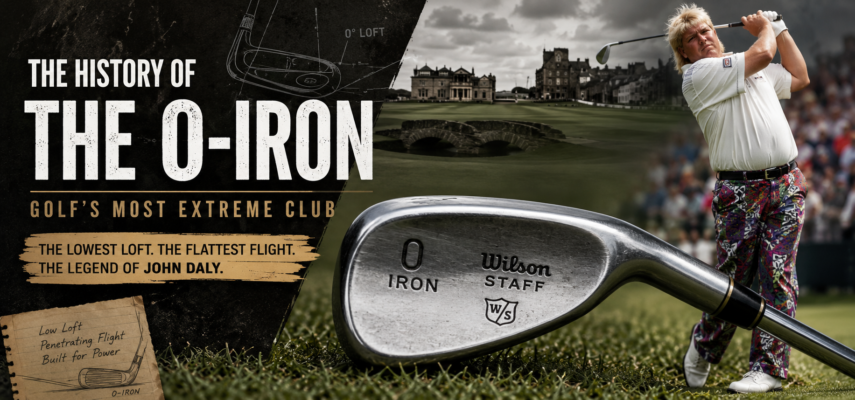
Golf equipment has produced its share of intimidating clubs. The traditional 1-iron earned a reputation for being nearly impossible to hit. The 2-iron became a specialist’s tool. Even the modern driving iron remains most effective in the hands of players with considerable speed and precision.
Then there is the 0-iron.
The 0-iron was never a normal part of the golf bag. It did not emerge from the wooden-shaft era, appear in standard matched sets, or enjoy widespread adoption among professionals. It was instead an experiment at the outer edge of iron design—a club with so little loft that it challenged the practical definition of an iron.
Its history is brief, unusual and inseparable from one of golf’s most extraordinary characters: John Daly.
Before the 0-Iron: The Rise of the Driving Iron
To understand why anyone would create a 0-iron, it helps to understand the original purpose of long irons.
Before metal woods, hybrids and adjustable drivers transformed golf equipment, skilled players often used low-lofted irons from the tee. These clubs were generally called driving irons because they offered a lower, more controlled alternative to wooden-headed clubs.
The 1-iron traditionally sat at the bottom of the numbered set. Depending on the manufacturer and era, it commonly carried roughly 14 to 17 degrees of loft. Its long shaft, small face and low loft made it capable of producing penetrating shots—but only when struck with considerable speed and accuracy.
The difficulty of the club became part of golf folklore. Lee Trevino famously joked that during a thunderstorm he would hold a 1-iron above his head because “even God can’t hit a 1-iron.”
By the late 20th century, however, the traditional driving iron was already becoming less relevant. Metal fairway woods launched the ball more easily, offered greater forgiveness and performed better from imperfect lies. Later, hybrids would make the long iron even less necessary.
Against that trend, the 0-iron moved in precisely the opposite direction.
Instead of making the long game easier, it pushed the low-lofted iron to an almost absurd extreme.
What Was a 0-Iron?
The name can be misleading. A 0-iron did not literally have zero degrees of loft. Such a club would have a nearly vertical face and would be almost incapable of launching a golf ball under normal playing conditions.
The best-known 0-iron, made by Wilson for John Daly, reportedly had approximately 12 degrees of loft—stronger than a conventional 1-iron and similar to the loft of some drivers.
What made it an iron was its shape and construction. It retained the narrow profile, flat face and compact head of a forged long iron rather than the deep body and larger footprint of a wood.
In practical terms, it was an ultra-low-lofted driving iron designed to produce a powerful, piercing flight.
The designation “0” was therefore not part of a universal numbering system. It was a logical extension of the traditional progression: if a 1-iron was the lowest-lofted normal iron, an even stronger club could be labeled a 0-iron.
Golf irons have occasionally been numbered outside the familiar 3-through-9 range, but the 0-iron remained an extreme rarity rather than an established category.
John Daly and the Club That Became a Legend
The 0-iron entered golf mythology through John Daly.
Daly arrived on the professional stage in spectacular fashion when he won the 1991 PGA Championship as an alternate. His enormous drives, exceptionally long backswing and aggressive playing style made him one of the most recognizable golfers of his generation.
He was also an unusually natural candidate for a 0-iron.
Daly possessed enough clubhead speed to launch extremely low-lofted clubs that most golfers could barely get airborne. He also preferred bold shots and was comfortable using equipment that reflected his instinctive, power-driven approach.
Wilson produced a custom 0-iron for him, designed by clubmaker Bob Mandrella. Wilson has described the club as a driving iron built with an unusually stiff, solid iron-bar-style steel shaft.
The club is often associated with Daly’s appearances at St Andrews, where a penetrating iron shot could be especially valuable. On firm links turf, a low shot could land short and run considerable distances along the ground. Contemporary accounts place a custom Wilson 0-iron in Daly’s equipment during the mid-1990s, including around the time of his 1995 Open Championship victory at St Andrews.
That connection gave the club a perfect setting.
Daly won the 1995 Open in a playoff over Costantino Rocca, capturing his second major championship on golf’s most historic course. Although the 0-iron was not solely responsible for the victory, its association with Daly and St Andrews helped transform it from a custom experiment into a cult object.
The club seemed to embody both the player and the course: powerful, unconventional and built for shots that stayed under the wind.
What the 0-Iron Was Designed to Do
The 0-iron served a narrow but understandable purpose.
Its extremely low loft produced a flat launch angle. In windy conditions, particularly on links courses, that trajectory could keep the ball below strong gusts. The club also generated substantial rollout on firm fairways, allowing a well-struck shot to travel a long total distance without climbing high into the air.
From the tee, a player could theoretically use it as a control club when a driver or fairway wood brought too much trouble into play.
It also offered one advantage associated with traditional irons: a skilled golfer could shape the ball and control the face more deliberately than with a larger wood.
But those benefits came at an enormous cost.
A low-lofted iron requires speed because the club itself contributes very little launch. It requires precise contact because the head is smaller and less forgiving than a wood. It also tends to produce poor results when the ball is struck low on the face, toward the heel or toward the toe.
For most players, a mishit 0-iron would not merely lose a few yards. It might fail to become meaningfully airborne.
The club was also poorly suited to rough. Its narrow head could move through the grass, but the lack of loft made it difficult to elevate the ball from anything other than an exceptionally clean lie.
In effect, the 0-iron demanded nearly perfect conditions and nearly perfect execution.
Why the 0-Iron Never Became Popular
The 0-iron disappeared for the same reason the traditional 1-iron declined: other clubs could perform a similar job with far less difficulty.
Fairway woods offered a larger hitting area and a lower, deeper center of gravity. Hybrids combined some of the control of an iron with the launch assistance of a wood. Modern utility irons eventually introduced hollow heads, flexible faces, internal weighting and wider soles that made low-lofted iron shots significantly more playable.
A golfer seeking a club in the 12-to-18-degree range could therefore choose from drivers, strong fairway woods, hybrids and technologically advanced driving irons.
The classic 0-iron offered almost no forgiveness by comparison.
Its name also worked against it. Calling a club a 0-iron advertised difficulty rather than accessibility. Golf equipment companies generally market clubs by promising greater distance, higher launch and improved consistency. The 0-iron promised a challenge.
It was less a commercial product than a custom solution for an exceptional player.
The 0-Iron Versus the Modern Utility Iron
Modern driving irons are sometimes described as descendants of the 0-iron, but the comparison has limits.
Today’s utility irons are designed to disguise their difficulty. Many use hollow-body construction, thin faces and strategically placed tungsten weights. These features help create higher ball speeds and easier launch while preserving an iron-like appearance.
The 0-iron did not attempt to disguise anything.
Its identity came from its severity: minimal loft, a thin profile and a trajectory that depended heavily on the golfer’s ability to generate speed.
A modern utility iron may perform the same basic role—producing a controlled tee shot with a penetrating flight—but it does so through technology rather than brute force.
That distinction explains why utility irons continue to appear in professional golf while the 0-iron remains a curiosity.
A Collectible and a Conversation Piece
Original John Daly-style 0-irons are now sought after primarily as collectibles.
Because the club was never mass-produced in large numbers, authentic examples rarely appear. One Wilson Staff Midsize RM 0-iron described by a golf auction house featured a forged head, a thin topline and approximately 12 degrees of loft.
Replicas and novelty versions have also appeared, including clubs advertised with extremely low or even nominally zero loft. These are generally created for entertainment, experimentation or social-media challenges rather than serious tournament play.
Videos of golfers attempting to hit 0-irons continue to attract attention because the result is unpredictable. A powerful player may produce a remarkably long, low shot. An average golfer may produce a stinging vibration, a ground-hugging line drive or no useful shot at all.
The appeal lies partly in watching someone confront a club that seems designed to expose every weakness in the swing.
The Legacy of the 0-Iron
The 0-iron did not change golf equipment in the way that perimeter weighting, metal woods or hybrids did. It did not create a lasting product category or inspire manufacturers to place 0-irons in standard sets.
Its importance is symbolic.
The club represents an era when professional equipment could be highly personal. Rather than asking what would work for the average golfer, Wilson created a tool for one unusually powerful player with a specific shot in mind.
It also represents the limits of traditional iron design.
For generations, clubmakers reduced loft and lengthened shafts in search of greater distance. The 0-iron showed where that progression eventually led: a club that could be spectacular when struck perfectly but impractical for almost everyone else.
Modern equipment development has followed a different path. Instead of simply lowering loft, manufacturers use materials, weighting and head geometry to make distance easier to achieve.
The 0-iron remains a reminder that more extreme does not always mean more useful.
Golf’s Ultimate Specialist Club
The history of the 0-iron is not the history of a widely used club. It is the history of an exception.
It emerged from the logic of the driving iron, reached public attention through John Daly and became famous because it seemed almost impossible to play. With roughly the loft of a driver and the profile of a blade, it demanded a combination of speed, confidence and precision that few golfers possessed.
That is why the 0-iron still fascinates players.
It occupies the point where serious golf equipment becomes almost mythological—a club created not for the ordinary golfer, but for the rare player capable of making the extraordinary look possible.












