










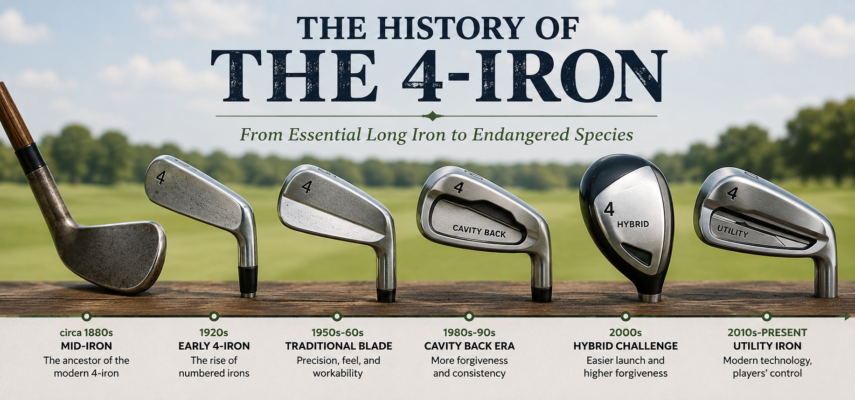
For much of the 20th century, owning a complete set of golf clubs meant carrying a 4-iron.
It was not considered a specialty club. It was not reserved for professionals, purists, or exceptionally skilled ball-strikers. The 4-iron was simply part of the standard progression of irons, occupying the space between the demanding 3-iron and the more manageable middle irons.
Golfers used it for long approaches, tee shots on narrow holes, recovery shots beneath tree branches, and controlled advances from the fairway. A well-struck 4-iron produced one of golf’s most satisfying trajectories: a strong, penetrating flight that seemed to climb gradually before landing with authority.
Today, the club occupies a far less secure place in the golf bag.
Hybrids, utility irons, high-lofted fairway woods, and increasingly powerful iron designs have all challenged its role. Many modern iron sets no longer include a 4-iron as standard equipment. Some begin with a 5-iron, while others start with a 6-iron and expect golfers to fill the remaining distance gaps with easier-launching alternatives.
The 4-iron has not disappeared, but it has become something different. Once an ordinary member of nearly every iron set, it is now a dividing line between traditional iron play and the modern pursuit of forgiveness.
Before the 4-Iron Had a Number
The earliest golfers did not carry numbered irons.
Golf clubs were identified by names that described their appearance, intended use, or place within the set. Clubs such as the cleek, mashie, mid-iron, lofting iron, and niblick performed jobs that would eventually be assigned to numbered clubs.
The closest ancestor of the modern 4-iron was probably the mid-iron.
As its name suggested, the mid-iron occupied the middle ground between low-lofted clubs designed for distance and more heavily lofted clubs intended for shorter shots. Historical club comparisons often place the mid-iron near the modern 4-iron, although early clubs varied considerably from one maker to another.
These early irons were individually forged, frequently by blacksmiths or specialist clubmakers. Standardized lofts, lengths, head weights, and sole designs did not yet exist. One maker’s mid-iron could behave quite differently from another’s.
The heads were compact and relatively unforgiving. The shafts were made from wood, with hickory becoming the preferred material during the 19th century because of its combination of strength and flexibility.
Playing a long iron with a hickory shaft required rhythm rather than violence. Hickory flexed considerably during the swing, and a hurried transition could leave the clubhead behind the hands. Golfers learned to swing smoothly, allowing the shaft to load and unload naturally.
A well-played mid-iron was therefore not merely a display of strength. It was a display of timing.
The Arrival of Numbered Irons
The 4-iron emerged as a distinct club when manufacturers began replacing traditional club names with numbered sets during the early decades of the 20th century.
The numbered system made golf equipment easier to understand and manufacture. Instead of learning the differences among mashies, cleeks, mid-irons, and mashie-niblicks, golfers could purchase a sequence of clubs arranged by loft and length.
As the number increased, the shaft generally became shorter and the loft greater.
Numbered irons began appearing before the 1930s, but the system gained widespread acceptance as large sporting-goods companies produced increasingly standardized sets. Spalding was particularly influential in popularizing numbered iron sets during this period.
The new arrangement gave the 4-iron a clear identity. It sat above the middle irons but below the most demanding long irons. The 1-, 2-, and 3-irons were built primarily for distance and low flight. The 5-, 6-, and 7-irons were easier to elevate and control. The 4-iron formed the bridge between those two categories.
It offered meaningful distance without being quite as punishing as the clubs above it.
That distinction would define the 4-iron for most of the next century.
Steel Shafts Transform the Club
The adoption of steel shafts during the 1920s and 1930s profoundly changed iron play.
Steel was more consistent than hickory. It resisted warping, could be manufactured to tighter specifications, and allowed golfers to swing more aggressively without waiting for a highly flexible wooden shaft to recover.
Steel shafts were approved for use under the Rules of Golf in the late 1920s and rapidly displaced hickory during the following decade. By the mid-1930s, hickory-shafted club production had largely collapsed.
For the 4-iron, steel provided a more predictable relationship between the golfer’s hands and the clubhead. Players could strike the ball with greater speed and confidence, while manufacturers could produce sets with more reliable progression from one iron to the next.
The club still required precision. Its relatively low loft and long shaft offered little protection against poor contact. Shots struck low on the face flew weakly, while impacts toward the heel or toe lost substantial distance.
Nevertheless, the steel-shafted 4-iron became considerably more practical than its hickory-era predecessor.
It was no longer an individually crafted interpretation of a mid-iron. It was a recognizable and repeatable part of a manufactured set.
The 4-Iron Becomes a Standard
By the middle of the 20th century, the 4-iron had become nearly universal.
A traditional matched set might run from the 2-iron through the pitching wedge. Better players sometimes carried a 1-iron, while recreational golfers occasionally omitted the longest clubs. But the 4-iron was rarely questioned.
Its role was broad.
From the fairway, it could be used for long approaches. From the tee, it offered accuracy on short par fours or tight driving holes. From light rough, it provided enough loft to advance the ball without producing excessive height. In windy conditions, it could create a controlled trajectory that remained below the strongest gusts.
The 4-iron was also useful around obstacles. Golfers could position the ball back in the stance, reduce the effective loft, and punch the ball underneath tree branches. Conversely, accomplished players could open the face slightly and produce a higher, softer flight.
These possibilities made the club versatile, but they depended upon the golfer’s ability to find the center of the face.
The classic 4-irons of the era were forged blades. Their thin toplines, narrow soles, compact heads, and concentrated sweet spots gave talented players exceptional feedback and control. They also exposed every technical weakness.
A poor swing received a poor result.
In an age before launch monitors and perimeter-weighted game-improvement irons, golfers accepted that bargain. Learning to hit a 4-iron was considered part of learning to play golf.
The Cavity-Back Revolution
The 4-iron began to change substantially during the second half of the 20th century as manufacturers experimented with perimeter weighting.
Traditional blades concentrated much of their mass behind the center of the clubface. Cavity-back irons redistributed some of that weight around the perimeter of the head. The larger effective hitting area helped preserve ball speed and directional stability when contact occurred away from the center.
This improvement mattered throughout an iron set, but it was especially important in long irons.
A slightly mishit 9-iron might still travel close to its intended distance. The same degree of error with a 4-iron could produce a weak shot that finished dozens of yards short. By increasing stability and moving the center of gravity, cavity-back designs made the 4-iron more playable for ordinary golfers.
Wide soles helped prevent the head from digging excessively into the turf. Lower centers of gravity made it easier to launch the ball. Larger clubfaces inspired confidence at address.
The club still demanded more speed and precision than a short iron, but technology had begun to soften the consequences of imperfection.
During the 1970s, 1980s, and 1990s, the 4-iron remained a standard club even as its construction became more forgiving. Cast stainless steel, perimeter weighting, improved grooves, and better shaft options expanded its usefulness.
Iron sets were evolving, but the composition of the golf bag remained broadly familiar.
That would soon change.
The Hybrid Challenges the 4-Iron
The greatest threat to the 4-iron did not come from another iron. It came from a club that combined characteristics of an iron and a fairway wood.
Hybrids began gaining widespread popularity around the turn of the 21st century. Their larger heads placed more mass low and behind the ball, making it easier to produce height and maintain ball speed. Their shorter shafts made them easier to control than comparable fairway woods.
For many golfers, a hybrid launched higher, flew farther, and performed better from rough than a traditional 4-iron.
The comparison was uncomfortable.
A conventional 4-iron required sufficient clubhead speed to produce an effective trajectory. Golfers who lacked that speed often generated low shots with limited carry. The ball might run after landing, but it struggled to hold a green.
A 4-hybrid could perform the same general distance assignment while providing more help.
The hybrid’s wider sole moved through rough more effectively. Its deeper center of gravity increased launch. Its larger head created more forgiveness. For recreational golfers, the hybrid often transformed a difficult distance into a manageable one.
Manufacturers responded by changing how iron sets were sold. Sets that once began with a 3-iron increasingly started with a 4-iron. Then many began with a 5-iron. In game-improvement categories, the 4-iron frequently became an optional purchase rather than standard equipment.
The club had moved from the center of the set to its outer edge.
Loft Strengthening Changes Its Identity
The modern 4-iron is complicated by another major development: loft strengthening.
Historically, iron numbers corresponded to broadly understood loft ranges. Exact specifications varied, but a golfer could reasonably expect one company’s 4-iron to resemble another’s.
Modern iron construction has weakened that relationship.
Manufacturers have gradually reduced lofts, particularly in distance-oriented and game-improvement sets. A modern 7-iron may carry a loft once associated with a 5-iron, while some contemporary 4-irons are built with lofts that would historically have belonged to a 2- or 3-iron.
This practice is often described as “loft jacking,” but the engineering is more complicated than simply stamping a different number on the sole.
Modern irons can use thin, flexible faces, hollow construction, tungsten weighting, and low centers of gravity to launch a strongly lofted club higher than an older blade with the same loft. Without those design changes, reducing loft could create an unusably low trajectory.
The result is that two clubs marked “4” may perform very differently.
A traditional players’ 4-iron might have approximately 23 or 24 degrees of loft. A strongly lofted game-improvement model may be closer to 19 or 20 degrees. A utility 4-iron could fall somewhere between those ranges, depending on its intended flight.
The number alone no longer tells the complete story.
This has further destabilized the club’s place in the bag. A golfer replacing an older 4-iron with a newer one may unknowingly purchase a significantly lower-lofted club. That can increase distance, but it may also make the club more difficult to launch.
Modern fitting therefore focuses less on the number stamped on the head and more on carry distance, launch angle, descent angle, spin, and consistency.
The Rise of the Utility Iron
Just as hybrids appeared to be pushing the 4-iron toward extinction, a new form of long iron helped revive it.
The utility iron, sometimes called a driving iron, preserves the general appearance and control of an iron while incorporating modern distance technology. Many use hollow bodies, thin high-strength faces, internal weighting, and vibration-dampening materials.
These clubs are designed to produce greater ball speed and forgiveness than a traditional blade without adopting the rounded shape of a hybrid.
The 4-utility iron has become particularly popular because it offers a useful compromise.
It is generally easier to launch than a conventional forged 4-iron, yet it can produce a flatter and more controllable flight than a hybrid. Better players often use one from the tee on firm courses, narrow holes, or in windy conditions.
Modern examples may feature lofts around 22 or 23 degrees and use advanced materials to optimize launch and spin.
In this form, the 4-iron has found a new identity.
It is no longer merely the fourth iron in a matched set. It can be an independently selected scoring tool, chosen because its trajectory fills a specific need.
Why Professionals Still Carry It
The 4-iron remains common among highly skilled players, although even professional bags show the influence of hybrids, utility irons, and higher-lofted fairway woods.
Tour professionals generate enough clubhead speed to launch a 4-iron effectively. More importantly, they value the club’s precision.
Compared with a hybrid, a 4-iron generally produces a more penetrating flight with less tendency to curve sharply left for a right-handed golfer. Its compact head allows accomplished players to control trajectory and shape the ball in either direction.
Professionals may also prefer the predictable turf interaction of an iron from a clean fairway lie.
Yet there is no universal tour setup. Some players carry a traditional 4-iron matching the rest of the set. Others use a more forgiving model at the top of the bag. Some choose a utility iron, while others replace the club entirely with a hybrid or 7-wood.
This variety illustrates the modern reality of the 4-iron.
Its survival no longer depends upon tradition. It depends upon performance.
The 4-Iron in the Modern Amateur Bag
For amateur golfers, the decision to carry a 4-iron should not be based on appearance, pride, or the idea that a “real” iron set must include one.
It should be based on ball flight.
A useful 4-iron must produce more than distance. It must create enough height and spin to remain airborne, separate clearly from the next club in the set, and land at an angle appropriate for the intended shot.
Many golfers can hit a 4-iron far when total roll is included. Fewer can carry it consistently and stop it on a green.
That is why hybrids and high-lofted fairway woods have become so popular. They often create a more functional trajectory even when the number on the launch monitor is similar.
The modern 4-iron is generally best suited to players who possess adequate swing speed, reliable center contact, and a preference for a lower, more controllable flight. It may also appeal to golfers who play frequently in windy conditions or on firm courses where running shots are useful.
For everyone else, replacing it is not an admission of failure. It is an equipment decision.
Golf history is filled with clubs that disappeared because something more effective took their place. The cleek, mashie, and baffy were once familiar tools. Their functions survived even after their names and forms faded.
The 4-iron may be undergoing a similar transition.
A Club Caught Between Two Eras
The history of the 4-iron is the history of golf equipment becoming more specialized.
It began as the loosely defined mid-iron of the hickory era. Numbered sets gave it a permanent identity. Steel shafts made it more consistent. Forged blades made it a demanding but versatile instrument. Cavity backs expanded its forgiveness. Hybrids challenged its necessity. Stronger lofts blurred its specifications, while utility construction offered it a modern path forward.
No other club better illustrates the tension between tradition and assistance.
The 4-iron asks golfers what they value. Some prefer the clean appearance of an iron behind the ball, the penetrating trajectory, and the sensation of a perfectly compressed strike. Others prefer the height, forgiveness, and reliability of a hybrid or fairway wood.
Neither choice is inherently superior.
The original purpose of the 4-iron was to cover a particular distance with control. That purpose remains. Only the tools available to accomplish it have changed.
The 4-iron may never again be as universal as it was during the 20th century. Future iron sets may increasingly begin with the 5- or 6-iron, leaving longer distances to hybrids, utility clubs, and fairway woods.
Yet the club is unlikely to disappear completely.
As long as golfers value trajectory control, precision, and the unmistakable satisfaction of striking a long iron cleanly, the 4-iron will retain a place in the game—even if it is no longer guaranteed a place in every bag.












