










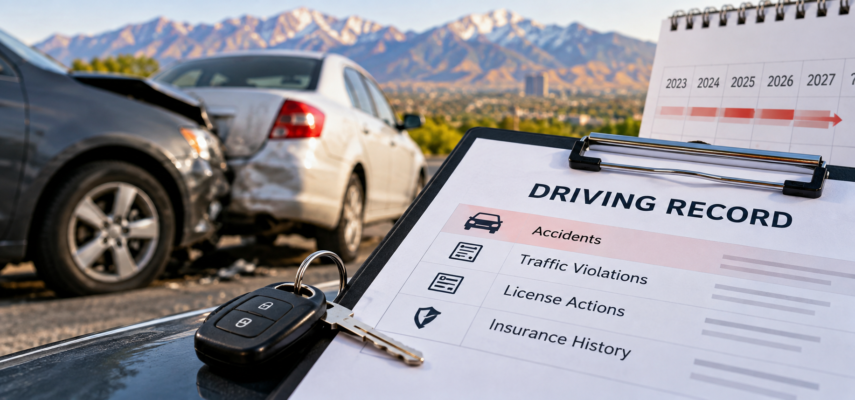
Ever wonder why your insurance premium is still higher a year after a fender bender? The answer often sits on your driving record, where a single accident can stay put for years and shape how insurers see you on the road.
Drivers across Utah often don’t realize how long that mark lingers, or what can be done about it. This guide breaks down what happens to a car accident on driving record checks, from what gets logged to how long insurers keep looking.
What Goes on Your Driving Record?
A driving record generally contains information about your history as a driver. Depending on the state and the type of incident, it may include traffic violations, license-related actions, and certain accidents.
Not every collision is treated in exactly the same way. A minor accident with no traffic violation may be handled differently from a crash that results in a citation or serious injury.
The circumstances surrounding the accident can also affect what appears in your record. For example, whether law enforcement issued a ticket, whether anyone was injured, and whether you reported the accident may all matter.
How Long Does an Accident Stay There?
No single time period applies to every accident. How long an accident stays on a driving record depends on state rules and what information is recorded.
In some cases, an accident may remain visible for several years. An insurance company may also look at accident history for a different period when deciding how a claim affects your premium.
This creates an important distinction. The period an accident appears on a government driving record may not match the period an insurer considers when reviewing your history.
Your Insurance Company May Look at Different Information
Insurance companies use driving and claims history when assessing risk. An accident may therefore continue affecting your insurance even after you stop thinking about the crash itself.
Not every accident automatically raises your premium. Some policies offer accident forgiveness for qualifying drivers. Others may treat an accident differently depending on the circumstances.
Check your policy rather than assuming what will happen.
Fault Can Make a Difference
Responsibility for an accident can affect the consequences. If you were found responsible for causing the crash, the incident may have different effects than an accident where another driver was responsible.
Insurance companies may consider fault when reviewing a claim. A traffic citation can also create a separate issue from the accident itself.
For example, an accident connected to a speeding ticket may result in both an accident entry and a moving violation. Those records can affect your driving history in separate ways.
Can an Accident Be Removed?
Drivers sometimes wonder whether an accident can simply be removed from their record once enough time has passed. In many cases, information remains until the applicable retention period ends.
Don’t ignore an incorrect entry. Check your state’s process for disputing driving-record information and follow the required steps.
What If You Were Not at Fault?
Being involved in an accident doesn’t necessarily mean you caused it. If another driver was at fault, your situation may differ from that of an at-fault driver.
Even a no-fault accident can still appear in certain records or claims databases. Insurance companies may use their own methods to review accident history.
If you’re concerned about how an accident was recorded, review the available documents carefully. Check the accident report, insurance information, and your driving record for inconsistencies.
What About Accidents From Another State?
Moving to another state doesn’t necessarily erase your driving history. States may share driver information, and a previous accident or violation can sometimes follow you when you relocate.
However, how information is reported and retained can vary. If you’ve recently moved and are unsure how an older accident may affect your record, check the rules that apply in your current state.
Don’t assume an accident disappears just because you changed your address or got a new driver’s license.
When an Accident Creates Bigger Problems
Most accidents don’t lead to major legal issues, but some situations are more complicated. Serious injuries, disputed fault, traffic charges, or disagreements with an insurance company can turn a routine collision into a larger matter.
In those circumstances, keeping your accident report, medical records, insurance correspondence, photographs, and other documents can be useful. Don’t throw away paperwork just because the crash happened months ago.
Understanding what remains on your driving history can help you plan ahead. An accident may affect different records for different periods, and insurance companies don’t necessarily use the same time frame as state agencies. Checking your actual driving record, reviewing your insurance policy, and keeping accurate records can help you understand where the accident stands and what effects may remain.











