










Wine began as an agricultural product. Grapes were grown, harvested, fermented, stored, traded, and consumed. In the ancient world, wine was not necessarily glamorous. It was practical, cultural, religious, medicinal, social, and often safer to drink than untreated water.
But over thousands of years, wine became something much more than fermented grape juice. It became a marker of refinement, wealth, geography, taste, history, and status.
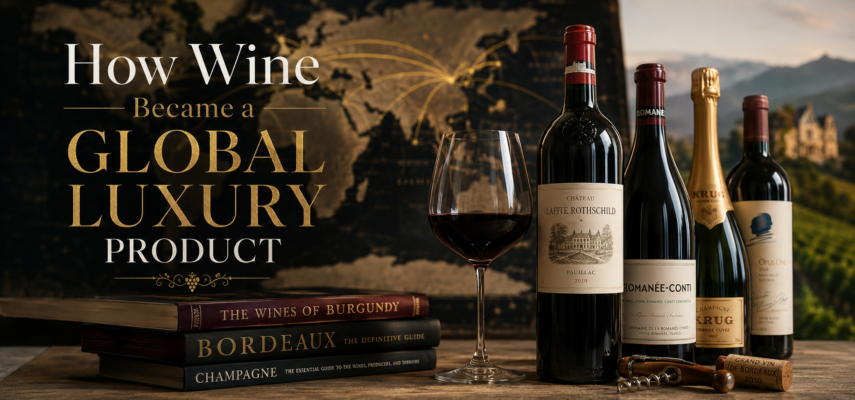
Today, the most famous bottles of wine can sell for hundreds, thousands, or even tens of thousands of dollars. Certain names — Bordeaux, Burgundy, Champagne, Napa Valley, Barolo, Rioja, Super Tuscan — carry meanings far beyond flavor. They suggest prestige, rarity, craftsmanship, and access.
So how did wine become a global luxury product?
The answer is not one thing. It is the result of geography, scarcity, aristocratic patronage, colonial trade, branding, critic scores, investment markets, restaurants, auctions, and the human desire to turn taste into status.
Wine Was Valuable Before It Was Luxurious
Wine has been part of civilization for thousands of years. Ancient Greeks and Romans spread viticulture throughout the Mediterranean. Wine was used in religious rituals, banquets, trade, and daily life.
But early wine was not luxury in the modern sense. It was not usually bottled, labeled, scored, or collected. It was stored in amphorae, barrels, or skins. Quality varied wildly. Much of it was consumed young. Some was diluted with water. Some was flavored with herbs, honey, or spices to make it more palatable.
Still, even in ancient times, better wine carried prestige. Certain regions were known for superior quality. Wealthy Romans prized specific wines, and fine wine appeared at elite banquets. The idea that some wines were better, rarer, and more socially meaningful than others is ancient.
What changed over time was the system around wine. Luxury wine required more than good grapes. It required reputation, preservation, transport, wealthy buyers, and a market that could distinguish one place from another.
Geography Created the First Luxury Signal
The foundation of luxury wine is place.
Wine is unusual because it is deeply tied to geography. A watch can be made in many places. A handbag can be produced in multiple factories. But a Burgundy from Chambolle-Musigny, a Bordeaux from Pauillac, or a Champagne from Champagne depends on a specific origin.
This is where the concept of terroir became powerful.
Terroir refers to the combination of soil, climate, slope, drainage, elevation, sun exposure, and local tradition that shapes a wine. Whether or not one treats terroir romantically or scientifically, the commercial impact is undeniable: it allowed wine to be marketed as something that could not be perfectly replicated elsewhere.
Luxury loves scarcity, and geography creates scarcity naturally.
There is only so much land in Champagne. Only so many vineyards in Burgundy’s Côte d’Or. Only so many classified estates in Bordeaux. Once a region becomes famous, its physical limits become part of its value.
Unlike mass-market beverages, the greatest wines are not supposed to be infinitely scalable. Their limitation is part of their appeal.
Aristocrats and the Church Helped Build Prestige
For much of European history, wine prestige was shaped by elites.
In Burgundy, monasteries and religious orders played a major role in identifying and cultivating top vineyard sites. Monks carefully observed differences between plots of land over generations. They helped build the early idea that one vineyard could produce a more distinctive or superior wine than another just a short distance away.
In Bordeaux, aristocratic estates and wealthy landowners developed large châteaux that eventually became symbols of status. The château itself became part of the wine’s identity. A bottle was not just from a region; it was from a grand estate with history, architecture, family lineage, and reputation.
Wine became tied to courts, clergy, merchants, and nobility. It was served at important tables. It appeared in diplomatic settings. It became part of elite hospitality.
This mattered because luxury is rarely created by quality alone. Luxury requires social validation. People need to believe that certain products belong in important rooms with important people.
Wine entered those rooms early.
Trade Turned Local Fame Into International Reputation
Wine could not become a global luxury product until it could travel.
Bordeaux benefited enormously from trade. Its location near the Atlantic made it well positioned for shipping, especially to England and northern Europe. English demand helped shape Bordeaux’s rise, and over time Bordeaux became one of the most commercially important wine regions in the world.
Port and Madeira also gained international reputations through trade. Their fortified styles made them more durable for long sea journeys. Madeira, in particular, became popular in colonial America because it could withstand shipping and even improve with heat and movement.
Champagne’s rise also depended on trade, branding, and elite association. Its sparkling wines became linked with celebration, monarchy, diplomacy, and eventually global luxury. Champagne did not merely sell wine. It sold occasion.
As trade expanded, wine reputations traveled with merchants, diplomats, aristocrats, and eventually tourists. A local agricultural product became an international symbol.
Bottles, Corks, and Cellars Changed Everything
Modern luxury wine depends on the ability to age, store, authenticate, and present wine.
The rise of glass bottles and cork closures helped transform wine into a collectible object. Wine could now be packaged in a more stable, transportable, and recognizable form. Labels could identify producer, region, vintage, and eventually classification.
A bottle of wine became more than liquid. It became an artifact.
This allowed wine to develop vintage identity. A particular year could be praised, remembered, compared, bought, sold, and cellared. Wine could improve over time, which made patience part of the luxury experience.
Aging also created another key luxury feature: delayed gratification.
The finest wines were not always consumed immediately. They were stored in private cellars, restaurant cellars, estate cellars, and merchant warehouses. To own great wine was to own time, knowledge, and restraint.
That is a powerful status signal.
Classification Made Prestige Official
Luxury markets often need hierarchy.
Wine has many forms of hierarchy: region, vineyard, producer, vintage, critic score, price, and classification. These systems help consumers understand what is supposed to be more prestigious.
The 1855 Bordeaux Classification is one of the most famous examples. Created for the Exposition Universelle de Paris, it ranked top Bordeaux estates into growths, from First Growth to Fifth Growth. The classification was based largely on reputation and market price at the time, but its influence has lasted for more than a century and a half.
The top estates — names like Lafite Rothschild, Latour, Margaux, Haut-Brion, and later Mouton Rothschild — became global luxury icons.
Burgundy developed a different hierarchy, focused heavily on vineyards: regional, village, premier cru, and grand cru. This created an even more land-specific luxury model. In Burgundy, a tiny grand cru vineyard can become one of the rarest and most expensive wine sources in the world.
Champagne built prestige through houses, cuvées, branding, and association with celebration. Napa Valley built its luxury image more recently through quality, critical acclaim, hospitality, and direct-to-consumer marketing.
Different regions used different systems, but the principle was the same: hierarchy creates aspiration.
Scarcity Became Part of the Product
Wine is one of the few luxury goods where scarcity can be both natural and emotional.
A vineyard produces only so many grapes. A vintage happens once. Weather changes every year. A small estate cannot simply double production without changing the nature of the product.
This gives fine wine a built-in scarcity story.
Burgundy is the ultimate example. Many of its most coveted wines come from tiny vineyard holdings. Demand from collectors around the world far exceeds supply. That imbalance pushes prices upward and turns certain bottles into trophies.
But scarcity alone does not create luxury. There must also be desire.
A small vineyard no one cares about is merely small. A small vineyard with history, critical acclaim, famous producers, and wealthy global buyers becomes luxury.
The modern fine wine market is built on this equation:
scarcity + reputation + demand = pricing power.
Restaurants Made Wine a Performance of Taste
Restaurants helped turn wine into a public display of sophistication.
A great wine list is not just inventory. It is a signal. It tells diners that the restaurant has knowledge, access, and seriousness. Sommeliers became cultural interpreters, helping guests navigate regions, vintages, producers, and pairings.
Ordering wine in a restaurant can feel intimidating because it is loaded with social meaning. People worry about pronouncing names correctly, choosing the right bottle, spending too much, spending too little, or looking uninformed.
That anxiety exists because wine became a performance of taste.
In luxury restaurants, wine is part of the theater. The bottle is presented. The label is shown. The cork may be inspected. The wine is tasted. The glassware matters. The pairing matters. The story matters.
Few products have such a formal ritual around consumption.
This ritual reinforces luxury. It makes wine feel ceremonial.
Critics and Scores Globalized Taste
In the late 20th century, wine criticism helped reshape the global wine market.
For many consumers, wine was difficult to understand. Labels were confusing. Regions were complex. Quality was hard to judge before purchase. Critics helped simplify the market by reviewing wines and assigning scores.
The 100-point scale became especially influential. A high score could increase demand, raise prices, and introduce a producer to a global audience. Collectors, retailers, restaurants, and investors paid attention.
This changed wine in two ways.
First, it democratized access to information. A consumer no longer needed to be born into wine culture to learn which wines were considered excellent.
Second, it concentrated market power around external validation. A critic’s praise could make a wine famous. A mediocre review could hurt sales.
Wine became more global, more searchable, more comparable, and more financialized.
The Judgment of Paris Changed the Luxury Map
For much of history, Europe dominated the luxury wine conversation. France, especially Bordeaux, Burgundy, and Champagne, held the strongest prestige positions.
Then came the Judgment of Paris in 1976.
In a blind tasting organized in Paris, California wines were judged against top French wines. To the surprise of many observers, California wines performed exceptionally well, with Napa Valley wines winning both the red and white categories.
This event did not destroy French prestige. Bordeaux, Burgundy, and Champagne remained luxury benchmarks.
But it changed the global imagination. It proved that great wine could come from outside Europe. It gave legitimacy to New World regions and helped Napa Valley become one of the most important luxury wine regions in the world.
After that, fine wine became more global. Australia, Italy, Spain, Chile, Argentina, South Africa, New Zealand, and other regions gained more international recognition.
Luxury wine was no longer only an Old World story.
Napa Valley Built a Modern Luxury Model
Napa Valley is one of the clearest examples of how wine became a modern luxury product.
Unlike Bordeaux or Burgundy, Napa’s global prestige is relatively recent. Its rise was driven by quality improvements, critical acclaim, tourism, hospitality, branding, and wealthy consumers.
Napa understood something important: luxury wine is not only about what is in the bottle. It is also about the experience around the bottle.
Tasting rooms became destinations. Wineries invested in architecture, landscaping, private tours, allocation lists, wine clubs, and direct relationships with customers. Buying wine became part of a lifestyle experience.
Napa also benefited from proximity to American wealth, especially in California. Technology, finance, entertainment, and entrepreneurship created a customer base comfortable with premium pricing and luxury consumption.
The Napa model showed that wine luxury could be built not just through centuries of aristocratic tradition, but through quality, storytelling, hospitality, and modern brand strategy.
Auctions and Investors Turned Wine Into an Asset
Fine wine eventually became more than something to drink. It became something to collect, trade, and invest in.
Auction houses helped create a secondary market for rare bottles. Provenance became crucial. A bottle’s value depended not only on producer and vintage, but also on storage history, authenticity, condition, fill level, label condition, and ownership record.
The most collectible wines began to behave like alternative assets. Wealthy buyers viewed them as stores of value, status symbols, and sources of pleasure.
This created a strange tension at the top of the market.
The more expensive certain wines became, the less likely they were to be opened casually. Some bottles became too financially valuable to drink. They moved from dining tables to cellars, vaults, auction catalogs, and investment portfolios.
Wine’s original purpose is consumption. Luxury wine’s modern identity often includes preservation.
That contradiction is part of its mystique.
Branding Turned Wine Into a Symbol
Great wine brands are not built like ordinary consumer brands.
They often avoid looking too commercial. Their power comes from heritage, restraint, scarcity, and reputation. The best luxury wine brands do not need to shout. They imply.
A famous label can communicate wealth and knowledge instantly. To people outside wine, names like Dom Pérignon, Opus One, Screaming Eagle, Lafite, Romanée-Conti, Sassicaia, and Krug may sound like luxury codes. To collectors, they represent specific histories, styles, and market positions.
Luxury wine branding works because it combines several signals at once:
place, producer, vintage, rarity, price, taste, and social recognition.
A handbag logo is visible in public. A watch can be seen on the wrist. Wine is different. Its status is often shared in smaller circles: at dinner, in a cellar, on a wine list, or among collectors.
That makes wine a more subtle luxury product, but not necessarily a less powerful one.
Global Wealth Expanded the Market
As global wealth expanded, so did demand for fine wine.
Buyers from the United States, Europe, Asia, and other wealthy markets competed for the same limited bottles. China’s rise as a luxury market had a major impact on Bordeaux in particular, especially during periods when prestigious labels became highly desirable as gifts, business symbols, and investment items.
The global luxury wine market became increasingly international. A top Burgundy wine might be produced in tiny quantities in France, reviewed by critics, allocated to importers, poured in New York restaurants, collected in Hong Kong, and auctioned in London.
This global demand made the most famous wines even more expensive.
At the same time, it created opportunities for emerging regions. As top wines became unaffordable, consumers began looking for value in less famous areas. This helped elevate regions such as Etna, Priorat, Oregon, South Africa’s Swartland, and grower Champagne.
Luxury wine created both concentration and exploration.
Why People Pay So Much for Wine
From a purely practical perspective, wine pricing can seem irrational. A $30 bottle can be delicious. A $300 bottle is not necessarily ten times more pleasurable. A $3,000 bottle may be financially absurd for most people.
But luxury pricing is not based only on sensory pleasure.
People pay for story. They pay for rarity. They pay for reputation. They pay for access. They pay for the feeling of drinking something connected to a specific place, year, producer, and tradition.
Fine wine is one of the few luxury products that disappears as it is enjoyed. You can wear a watch for decades. You can resell a handbag. But once a bottle is opened, it is gone.
That makes the experience more intense. Wine is temporary, but the memory can last.
Luxury wine is not only a product. It is an event.
The Paradox of Wine Luxury
The irony of wine is that it remains agricultural at its core.
No matter how expensive it becomes, wine still begins with farming. Weather matters. Soil matters. Labor matters. Fermentation matters. Mistakes happen. Vintages vary. Nature refuses to be fully controlled.
That is part of why wine became luxury in the first place.
It combines human craft with natural uncertainty. It is reproducible enough to build reputation, but variable enough to create mystery. It can be studied endlessly, but never fully mastered.
Wine became a global luxury product because it sits at the intersection of land, culture, scarcity, history, commerce, and desire.
A bottle of wine can be dinner, memory, investment, status symbol, agricultural expression, and cultural artifact all at once.
That is why wine matters — and why the world’s most famous bottles are no longer just drinks.
They are symbols.












