The 7-iron is not the longest club in a golfer’s bag, the most specialized or the most glamorous. It rarely receives the attention devoted to the driver or putter. Yet no other club may better represent the modern iron game.
Golfers use the 7-iron for full approach shots, controlled knockdowns, punch shots from beneath trees and occasional chips around the green. Clubfitters frequently use it to evaluate shafts and lie angles. Manufacturers place it in demo carts. Golf instructors hand it to beginners. Launch-monitor sessions often treat it as the default club for measuring an iron swing.
The 7-iron occupies this central role because it sits near the midpoint of the traditional iron set. It offers enough loft to get the ball airborne, enough shaft length to produce meaningful distance and enough forgiveness to expose neither extreme of the golfer’s technique.
But the club did not always exist. For centuries, golfers carried individually named clubs rather than numbered sets. The history of the 7-iron is therefore not simply the story of one club. It is the story of how golf equipment became standardized, industrialized and increasingly engineered for distance.
Before the 7-Iron, There Was the Mashie
The earliest golfers did not walk onto the course with neatly arranged sets of 4-irons through pitching wedges. Clubs were built individually, often by local craftsmen, and identified by names that described their shape or intended purpose.
The old iron family included clubs such as the cleek, mid-iron, mashie, mashie-niblick, niblick and jigger. Their specifications varied considerably. A mashie produced by one clubmaker might not have matched the loft, weight or length of a mashie made by another.
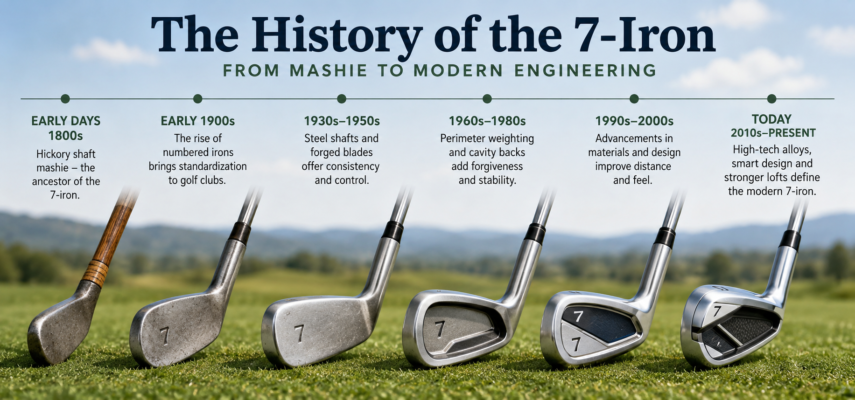
Among these clubs, the mashie is usually considered the closest historical ancestor of the 7-iron. It was an iron-headed club with a wooden shaft, used for medium-length approaches and a variety of shots around the course. Depending on its design, a mashie might perform something like a modern 5-, 6- or 7-iron, although direct comparisons are imprecise.
This lack of uniformity was not necessarily a defect. Early golfers were accustomed to learning the individual characteristics of each club. Equipment was personal, and shotmaking depended heavily on manipulating trajectory with relatively few tools.
As golf became more popular during the late 19th and early 20th centuries, however, the limitations of the named-club system became increasingly apparent. Manufacturers wanted to produce complete sets on a larger scale. Retailers wanted products that could be compared easily. Golfers wanted predictable distance gaps.
Numbering the irons offered a solution.
The Rise of the Numbered Iron Set
Numbered irons began appearing during the early decades of the 20th century, gradually replacing the traditional names. Instead of deciding between a mashie, mid-mashie and mashie-niblick, golfers could purchase a sequence of clubs whose lofts and lengths progressed systematically.
Lower numbers indicated clubs with longer shafts and less loft. Higher numbers indicated shorter, more lofted clubs. The 7-iron emerged as one step in this increasingly standardized progression.
The transition was gradual. Named clubs and numbered irons coexisted for years, and manufacturers did not immediately agree on universal specifications. By the late 1930s and early 1940s, however, numbered iron sets had largely established themselves as the modern standard.
The change fundamentally altered the way golfers thought about their equipment. A club was no longer defined primarily by a traditional identity such as “mashie.” It became part of a distance ladder.
Within that ladder, the 7-iron occupied a particularly useful position. It was shorter and easier to control than a long iron, but it produced considerably more distance than a wedge. It could function as both an attacking club and a recovery club.
The 7-iron was becoming golf’s all-purpose iron.
Steel Shafts Transform the Club
Early irons were commonly fitted with hickory shafts. Hickory gave clubs a distinctive feel, but natural wood varied in weight, stiffness and flexibility. Two apparently similar clubs could behave differently, and shafts could warp or break over time.
Steel changed everything.
The USGA initially resisted steel shafts because they represented a departure from golf’s traditional equipment. It approved their use during the 1920s, while the R&A followed later. By the 1930s, steel had begun displacing hickory throughout the game.
For the 7-iron, steel brought greater consistency. Manufacturers could produce shafts with more predictable flex, weight and durability. Sets could be matched more accurately, allowing the 7-iron to fit into a reliable progression between the 6- and 8-irons.
Steel shafts also encouraged changes in the golf swing. Hickory rewarded smooth timing because the shaft flexed substantially during the motion. Steel allowed golfers to swing more aggressively while maintaining greater control over the clubhead.
The 7-iron increasingly became a club that could be struck with a full, athletic swing rather than merely guided toward the target.
From Hand-Forged Blades to Mass-Produced Irons
The classic iron of the early and middle 20th century was a forged blade. Its head was compact, relatively thin and made from a solid piece of metal. Most of the club’s weight sat close to the center of the face.
When struck properly, a forged 7-iron offered excellent feel and trajectory control. Skilled golfers could alter the ball’s height and curvature, producing low punches, high approaches, fades and draws.
The disadvantage was forgiveness. Shots struck toward the heel or toe lost considerable distance and could twist the clubhead at impact.
Forged blades suited an era in which golf equipment placed the responsibility for performance almost entirely on the player. The golfer had to find the center of the face.
That began to change during the second half of the 20th century.
Perimeter Weighting Makes the 7-Iron Easier to Hit
One of the most important developments in iron design was the movement of weight away from the center of the clubhead and toward its perimeter.
Cavity-back irons removed material from behind the middle of the face and redistributed it around the edges. This increased the clubhead’s resistance to twisting on off-center strikes. A golfer could miss the exact sweet spot and still produce a playable shot.
PING’s early perimeter-weighted irons helped popularize the concept, and cavity backs eventually became the dominant design for recreational golfers.
The technology had a particularly noticeable effect on the 7-iron. Because it was already relatively manageable, perimeter weighting turned it into one of the easiest full-swing clubs in the bag. Beginners who struggled to launch a 4- or 5-iron could often achieve a recognizable golf shot with a 7-iron.
That helped establish the club as the standard teaching tool for new golfers.
A 7-iron was long enough to reveal the fundamentals of the swing but lofted enough to provide encouragement. A reasonably struck shot would rise into the air, travel a useful distance and stop with some predictability.
Why the 7-Iron Became Golf’s Testing Club
Over time, the 7-iron acquired a role beyond ordinary course play. It became the golf industry’s unofficial reference club.
During an iron fitting, players are frequently asked to hit a 7-iron rather than every club in the set. Manufacturers send 7-iron heads to retailers as demonstration clubs. Instructors use 7-irons to evaluate posture, contact, clubface control and swing path.
This practice makes practical sense. A long iron can be too difficult for many golfers, while a wedge may mask certain swing flaws because of its short shaft and high loft. The 7-iron sits between those extremes.
It produces enough speed to generate meaningful launch-monitor data but remains controllable enough for repeated swings. From a fitting perspective, it offers a useful snapshot of how a golfer may perform with the rest of the iron set.
The club’s popularity as a benchmark has reinforced its importance. Golfers increasingly judge an entire set by how the 7-iron looks, feels and performs.
The Loft of a 7-Iron Begins to Change
For much of the 20th century, iron numbers provided a reasonably consistent indication of loft. A traditional 7-iron commonly carried loft somewhere in the mid-30-degree range.
That relationship has weakened dramatically.
Modern manufacturers have progressively reduced—or “strengthened”—iron lofts. Many contemporary game-improvement 7-irons have lofts around 28 or 29 degrees, while some are even stronger. Golf Digest reported that the average 7-iron loft among the game-improvement models in one of its equipment evaluations was approximately 28 degrees.
That means a modern 7-iron may have a loft once associated with a 5-iron or even a strong 4-iron.
Critics often call this trend “loft jacking,” arguing that manufacturers stamp a higher number on a lower-lofted club to advertise greater distance. There is some truth to the criticism: distance sells, and golfers tend to be impressed when a new 7-iron travels farther than their old one.
Yet stronger lofts are only part of the story.
Modern irons often have lower centers of gravity, thinner faces and more sophisticated weight distribution. These features can launch the ball higher than loft alone would suggest. Engineers can therefore reduce loft while still producing a playable trajectory.
The result is that the number “7” no longer defines one specific type of club.
A compact players’ 7-iron might have 34 degrees of loft. A players-distance model might have 30 or 31 degrees. A game-improvement version might have 27 or 28 degrees. All are labeled 7-irons, but they can produce very different distances, spin rates and trajectories.
The Modern 7-Iron Becomes a Piece of Engineering
Today’s 7-iron can contain far more technology than its relatively simple appearance suggests.
Modern designs may feature:
- Hollow clubheads
- High-strength steel face inserts
- Tungsten weighting
- Variable face thickness
- Polymer or foam filling
- Flexible sole slots
- Computer-optimized centers of gravity
The objective is to create more ball speed without sacrificing launch, feel or forgiveness. In some players-distance irons, the face flexes at impact in a manner that resembles a miniature metalwood. Heavy tungsten can be positioned low or toward the toe to improve launch and stability.
These technologies have expanded the 7-iron’s audience. Golfers can now choose from several distinct versions of the club.
A traditional blade rewards precise contact and offers maximum control. A cavity-back model balances feel and forgiveness. A hollow-body iron produces more speed from a relatively compact shape. A super-game-improvement design emphasizes easy launch and stability.
The 7-iron is no longer one standardized object. It is a category of clubs designed around different types of golfers.
The Club That Connects Distance and Precision
The enduring value of the 7-iron comes from its position between power and control.
A driver is built primarily for distance. A wedge is built primarily for precision. The 7-iron asks the golfer to combine both.
It must be swung with enough speed to carry the ball a meaningful distance, yet controlled well enough to hit a relatively small target. It can expose poor contact, but it does not punish the golfer as severely as a long iron. It can produce a high approach shot, but it can also be de-lofted for a low recovery.
That versatility explains why the club appears so frequently in golf instruction. Learning to hit a 7-iron well teaches many of the skills required throughout the set: centered contact, proper low-point control, face awareness and the ability to regulate trajectory.
It is often the club with which beginners first feel like golfers—and the club accomplished players continue using to refine their swings.
A Familiar Number With an Evolving Identity
The modern 7-iron would be almost unrecognizable to a golfer carrying a hickory-shafted mashie a century ago. Its materials, construction, distance and forgiveness have all changed.
Even so, its essential purpose remains familiar.
The mashie was valued because it could handle a broad range of approach shots. The 7-iron inherited that role when numbered sets replaced traditional club names. Steel shafts made it more consistent. Perimeter weighting made it more forgiving. Modern face technology made it faster. Stronger lofts made it longer.
Through every stage of that development, the club remained near the center of the iron set and near the center of the game itself.
The 7-iron may not inspire the same excitement as a new driver or the same devotion as a favorite putter. But it has become something arguably more important: the standard by which golfers understand their iron swings.
From the hickory mashie to the hollow-body distance iron, the history of the 7-iron is the history of golf’s attempt to balance tradition, technology, distance and control.
And that is why, after more than a century of equipment evolution, the 7-iron remains the club in the middle—and often the club that holds the entire set together.