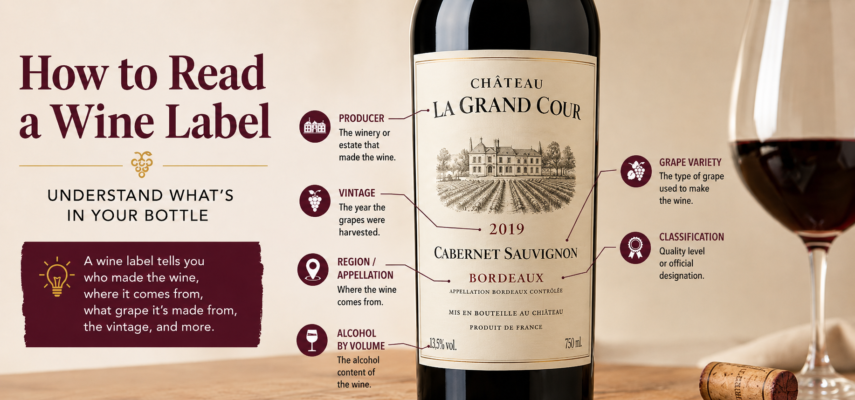
A wine label can feel confusing at first. There may be a grape name, a region, a producer, a vintage, an estate, a classification, or words in another language that assume you already know what they mean.
But once you understand the basic structure, a wine label becomes much easier to read. It tells you who made the wine, where it came from, what grape or style it might be, how old it is, and sometimes what level of quality or tradition it represents.
You do not need to memorize every wine region in the world to read a label well. You only need to know what information matters most and how different countries tend to organize it.
This guide will walk you through the key parts of a wine label so you can pick up a bottle with more confidence.
Why Wine Labels Can Be Confusing
Wine labels are not standardized around the world. Some bottles are labeled by grape variety, while others are labeled by region.
For example, a bottle from California might clearly say Cabernet Sauvignon on the front. A bottle from Bordeaux, France, may not list Cabernet Sauvignon at all, even if Cabernet Sauvignon is one of the main grapes in the wine. Instead, it may emphasize the producer, château, region, and appellation.
This is one of the biggest differences beginners need to understand:
New World wines — such as many wines from the United States, Australia, Chile, Argentina, New Zealand, and South Africa — often label wines by grape variety.
Old World wines — especially from France, Italy, Spain, Germany, and Portugal — often label wines by region, village, or appellation.
That means learning to read a wine label is partly about learning the “language” of the place the wine comes from.
The Most Important Parts of a Wine Label
Most wine labels include a few core pieces of information. Some are obvious, while others require a little interpretation.
1. Producer or Winery
The producer is the person, winery, estate, château, domaine, or company that made the wine. This is often one of the most important details on the label.
Examples might include:
- Robert Mondavi
- Château Margaux
- Domaine Leflaive
- Antinori
- Penfolds
- Catena Zapata
A strong producer can be a helpful sign of quality, especially once you begin recognizing names you like. Even within the same region or grape variety, producers can make very different styles of wine.
One Chardonnay may be buttery, rich, and oaky. Another may be crisp, lean, and mineral-driven. The producer often plays a major role in that difference.
2. Grape Variety
The grape variety tells you what type of grape was used to make the wine. Common examples include:
- Cabernet Sauvignon
- Merlot
- Pinot Noir
- Chardonnay
- Sauvignon Blanc
- Riesling
- Syrah
- Malbec
If a label says Pinot Noir, you know the wine was made primarily from Pinot Noir grapes. If it says Chardonnay, you know the wine was made primarily from Chardonnay grapes.
This is common in places like California, Oregon, Washington, Australia, Chile, Argentina, and New Zealand.
However, many European labels do not prominently list the grape. Instead, they list the region. In those cases, you need to know what grapes are traditionally grown there.
For example:
- Red Burgundy usually means Pinot Noir.
- White Burgundy usually means Chardonnay.
- Red Bordeaux is usually a blend based on Cabernet Sauvignon, Merlot, Cabernet Franc, Petit Verdot, and Malbec.
- Sancerre is usually Sauvignon Blanc.
- Chablis is Chardonnay.
- Barolo is Nebbiolo.
- Chianti is mainly Sangiovese.
This is where wine can feel intimidating, but it becomes much easier with repetition.
3. Region or Appellation
The region tells you where the wine comes from. This can be broad or very specific.
A broad label might say:
- California
- France
- Italy
- South Australia
A more specific label might say:
- Napa Valley
- Sonoma Coast
- Burgundy
- Bordeaux
- Rioja
- Chianti Classico
- Barossa Valley
- Willamette Valley
In many cases, the more specific the place, the more information the label is giving you. “California Cabernet Sauvignon” is broad. “Napa Valley Cabernet Sauvignon” is more specific. “Rutherford Napa Valley Cabernet Sauvignon” is even more specific.
Specificity does not automatically guarantee quality, but it often tells you more about the wine’s identity. Wine is deeply connected to place, and regions develop reputations for certain grapes and styles.
4. Vintage
The vintage is the year the grapes were harvested. If a bottle says 2021, that means the grapes were picked in 2021.
Vintage matters because weather changes from year to year. A warm, dry year can produce riper, fuller wines. A cooler year may produce fresher, lighter, more acidic wines.
That said, beginners should not obsess over vintage. For everyday wine buying, producer, grape, region, and style usually matter more.
Vintage tends to matter more when buying expensive wines, collectible bottles, or wines from regions where weather varies significantly from year to year, such as Bordeaux, Burgundy, Champagne, Germany, and parts of Italy.
For most casual purchases, the vintage simply gives you a sense of age.
5. Alcohol by Volume
Alcohol by volume, often written as ABV, tells you how much alcohol is in the wine.
A wine labeled 13.5% ABV means 13.5% of the liquid is alcohol.
ABV can also give clues about style:
- Lower alcohol wines, around 11% to 12.5%, are often lighter, fresher, or slightly sweeter.
- Medium alcohol wines, around 13% to 14%, are common for many dry table wines.
- Higher alcohol wines, around 14.5% and above, often feel fuller, riper, warmer, and more powerful.
This is not a perfect rule, but it is useful. A 15% ABV California Zinfandel will probably feel richer and heavier than a 12% ABV German Riesling.
6. Classification or Quality Terms
Some labels include official quality terms. These vary by country and can be confusing at first.
In France, you may see terms like:
- Appellation d’Origine Contrôlée, or AOC
- Grand Cru
- Premier Cru
- Cru Bourgeois
In Italy, you may see:
- DOC
- DOCG
- IGT
In Spain, you may see:
- DO
- DOCa
- Crianza
- Reserva
- Gran Reserva
In Germany, you may see:
- Qualitätswein
- Kabinett
- Spätlese
- Auslese
These terms can indicate where the wine comes from, how it was made, how long it was aged, or how ripe the grapes were when harvested.
They do not always mean “better” in a simple way. For example, Reserva in Spain often relates to aging requirements, while Kabinett in Germany often indicates a lighter style of Riesling. These terms are useful, but they need context.
7. Estate, Vineyard, or Cuvée Name
Some labels include an estate name, vineyard name, or special cuvée name.
A vineyard name identifies a specific site where the grapes were grown. This can be important in regions like Burgundy, Barolo, Napa Valley, and Germany, where individual vineyards can have strong reputations.
A cuvée name is often a special bottling or branded wine name chosen by the producer.
For example, a label might show:
- The producer
- The grape
- The region
- A vineyard name
- A special cuvée name
This can make the label feel crowded, but each piece is trying to tell you something about the wine’s identity.
8. Back Label Information
The back label can be very useful, especially for beginners.
It may include:
- Flavor descriptions
- Food pairing suggestions
- Serving temperature
- Aging notes
- Importer information
- Farming or winemaking details
Some back labels are helpful. Others are mostly marketing. Phrases like “smooth,” “velvety,” “bold,” or “elegant” can give you a rough idea of style, but they are not always precise.
Still, the back label is worth reading. It may tell you whether the wine is dry or sweet, light or full-bodied, fruity or earthy, oaked or unoaked.
How to Read a New World Wine Label
New World labels are often more direct for beginners because they usually emphasize the grape variety.
A California label might say:
Producer: Stag’s Leap Wine Cellars
Grape: Cabernet Sauvignon
Region: Napa Valley
Vintage: 2021
ABV: 14.5%
From this, you can quickly understand the basics. It is a Cabernet Sauvignon from Napa Valley, made by a specific producer, from grapes harvested in 2021.
That gives you a strong starting point. Napa Valley Cabernet Sauvignon is usually full-bodied, dark-fruited, structured, and often aged in oak.
How to Read an Old World Wine Label
Old World labels often require more regional knowledge.
A French label might say:
Chablis
Premier Cru
2022
Domaine Example
A beginner might wonder: where is the grape?
In this case, Chablis is a region in Burgundy, France, and its white wines are made from Chardonnay. So the label is telling you the wine’s identity through place rather than grape.
That is the key to Old World labels: region often implies grape and style.
Here are a few useful examples:
Bordeaux usually means a red blend based on Cabernet Sauvignon and Merlot.
Burgundy means Pinot Noir for red wine and Chardonnay for white wine.
Sancerre usually means Sauvignon Blanc.
Rioja usually means Tempranillo-based red wine.
Chianti usually means Sangiovese-based red wine.
Barolo means Nebbiolo.
Champagne usually means sparkling wine made from Chardonnay, Pinot Noir, Pinot Meunier, or a blend of those grapes.
Once you learn a handful of region-to-grape connections, Old World labels become much less intimidating.
Common Wine Label Words to Know
Here are some words that often appear on wine labels and what they usually mean.
Estate Bottled means the producer grew the grapes and bottled the wine themselves, usually indicating more control over the process.
Reserve can mean different things depending on the country. In some places it has legal meaning; in others, especially the United States, it may simply be a marketing term.
Old Vine usually means the grapes came from older vines, which can produce more concentrated fruit. The term is not always legally defined.
Brut means dry, usually used for sparkling wine.
Sec means dry in French, though in Champagne it can indicate a slightly sweet style.
Trocken means dry in German.
Classico in Italian wine often refers to the historic core area of a wine region, such as Chianti Classico.
Riserva in Italian wine often means the wine has met additional aging requirements.
Crianza, Reserva, and Gran Reserva in Spanish wine usually refer to aging categories.
What the Label Does Not Always Tell You
A wine label gives you clues, but it does not tell you everything.
It may not clearly tell you:
- Whether the wine is sweet or dry
- Whether it is heavily oaked
- Whether it tastes fruity, earthy, floral, or mineral
- Whether it is ready to drink now
- Whether you personally will like it
This is why wine buying involves a mix of label reading, experience, recommendations, and personal taste.
The more bottles you try, the more useful labels become. You start connecting the words on the bottle with what you actually taste in the glass.
A Simple Method for Reading Any Wine Label
When you pick up a bottle, ask five basic questions:
1. Who made it?
Look for the producer, winery, château, domaine, or estate.
2. Where is it from?
Find the country, region, appellation, or vineyard.
3. What grape or style is it?
Look for the grape variety, or use the region to infer the grape.
4. What year is it?
Check the vintage.
5. How strong is it?
Look at the ABV for a clue about body and ripeness.
These five questions will help you understand most wine labels at a practical level.
Example: Reading a Napa Cabernet Label
Imagine a bottle that says:
Silver Oak
Napa Valley Cabernet Sauvignon
2019
14.8% ABV
Here is what you know:
The producer is Silver Oak. The region is Napa Valley. The grape is Cabernet Sauvignon. The vintage is 2019. The alcohol level suggests a full-bodied wine.
Even before tasting it, you can expect a structured red wine with dark fruit, oak influence, and enough body to pair with steak, lamb, burgers, or rich dishes.
Example: Reading a French Burgundy Label
Now imagine a bottle that says:
Bourgogne Pinot Noir
Domaine Example
2021
France
This is a red Burgundy made from Pinot Noir. “Bourgogne” is the French name for Burgundy. The producer is the domaine. The vintage is 2021.
You might expect a lighter-bodied red wine with red fruit, acidity, earthiness, and a more delicate structure than Napa Cabernet.
Example: Reading an Italian Chianti Label
Imagine a bottle that says:
Chianti Classico DOCG
Riserva
2018
Italy
This tells you the wine is from Chianti Classico, the historic core of the Chianti region in Tuscany. It is mainly made from Sangiovese. DOCG is an Italian classification, and Riserva indicates additional aging requirements.
You can expect a dry red wine with red cherry, acidity, savory notes, and strong food-pairing potential, especially with pasta, tomato sauces, pizza, roasted meats, and aged cheeses.
Beginner Mistakes to Avoid
One common mistake is assuming that an expensive-looking label means a better wine. Beautiful packaging does not guarantee quality.
Another mistake is assuming that “Reserve” always means premium. In some countries, the term is regulated. In others, it may not mean much.
A third mistake is ignoring region. The region can tell you a lot about style, especially in European wines.
Finally, do not judge a wine only by the front label. The back label, ABV, importer, and region can all provide useful clues.
The Bottom Line
Reading a wine label is not about decoding every tiny detail. It is about identifying the information that helps you understand what is in the bottle.
Start with the producer, region, grape, vintage, and alcohol level. Then look for classification terms, vineyard names, and back-label clues.
Over time, wine labels become less intimidating and more useful. You begin to recognize grapes, regions, producers, and styles. Instead of feeling like a puzzle, the label becomes a map.
And that map can help lead you to wines you actually enjoy.