For most of wine history, France did not merely make great wine. France defined great wine.
Bordeaux meant serious red wine. Burgundy meant elegance. Champagne meant celebration. French labels, French regions, French terminology, and French standards shaped how the world talked about quality. If a wine wanted prestige, it was usually measured against France.
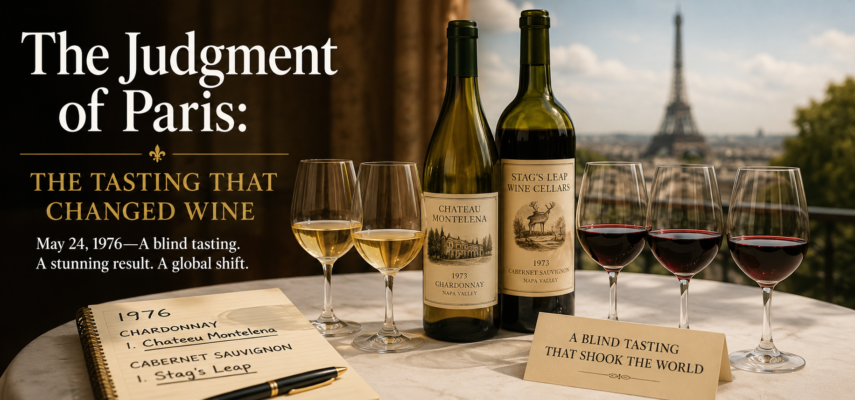
Then, on May 24, 1976, a blind tasting in Paris changed the conversation.
The event became known as the Judgment of Paris, and at first glance, it sounds almost too small to deserve its reputation. A handful of judges. A few bottles of French and California wine. Two categories: Chardonnay and Cabernet Sauvignon. No cameras. No global livestream. No expectation that anything historic would happen.
But when the scores were counted, California wines beat some of France’s most respected bottles in both the white and red categories. Chateau Montelena’s 1973 Chardonnay finished first among the whites, and Stag’s Leap Wine Cellars’ 1973 Cabernet Sauvignon finished first among the reds.
The result stunned the wine world. More importantly, it forced people to ask a question that still matters today:
What if great wine could come from more places than the old world wanted to admit?
Before Paris, Wine Had a Hierarchy
To understand why the Judgment of Paris mattered, you have to understand the wine world before 1976.
France sat at the top. Not because every French wine was great, but because France had the deepest global reputation for fine wine. Its regions had centuries of history, classified growths, famous vineyards, and a language of prestige that consumers, collectors, and critics understood.
California, by comparison, was still trying to prove itself.
American wine had been badly damaged by Prohibition, which lasted from 1920 to 1933. Even after repeal, much of the domestic wine market was not focused on fine wine. Sweet, fortified, and mass-market wines dominated. Serious California producers existed, but they were often treated as ambitious outsiders rather than equals to Europe’s best.
That is what made the Paris tasting so explosive. It did not simply say California could make good wine. It suggested California could make wine good enough to compete directly with elite France.
And it did so in Paris, judged largely by French experts.
Who Organized the Judgment of Paris?
The tasting was organized by Steven Spurrier, a British wine merchant and educator who ran a wine shop and school in Paris, along with his American colleague Patricia Gallagher. The event was partly tied to the American Bicentennial, but it was not designed as a California victory parade. Spurrier expected the French wines to perform well. The California wines were there as a curiosity, a comparison, maybe even a polite nod to American progress.
The format was simple but powerful: a blind tasting.
The judges did not know which wines were French and which were Californian. That mattered. Labels carry enormous psychological weight in wine. A famous château can influence expectations before the glass even reaches the nose. Blind tasting strips away at least some of that bias.
The judges evaluated California Chardonnays against white Burgundies and California Cabernet Sauvignons against red Bordeaux. In theory, France had every advantage: history, reputation, prestige, and home-field confidence.
But in the glass, the results told a different story.
The Wines That Won
The winning white wine was 1973 Chateau Montelena Chardonnay from Napa Valley. The winning red was 1973 Stag’s Leap Wine Cellars Cabernet Sauvignon, also from Napa Valley. The Smithsonian notes that the Stag’s Leap Cabernet came from the winery’s second crop and first vintage produced by founder and winemaker Warren Winiarski.
That detail is part of what makes the story so remarkable.
These were not ancient estates with centuries of accumulated prestige. They were young California producers, still building their identities. Yet in a blind tasting against some of the most respected wines in the world, they came out on top.
The white result challenged Burgundy. The red result challenged Bordeaux. Together, they challenged the assumption that fine wine belonged primarily to Europe.
Why the Result Was So Shocking
The Judgment of Paris was not shocking because California wine tasted good. Some people already knew that.
It was shocking because California wine won under conditions the old wine world respected: blind tasting, expert judges, direct comparison, and classic grape varieties.
This was not a casual American audience choosing familiar domestic bottles. This was not a marketing contest. It was French judges evaluating wines without seeing the labels. That made the result harder to dismiss.
The tasting also exposed a tension at the heart of wine culture. Wine claims to be about taste, place, farming, craft, and quality. But it is also about reputation, tradition, and status. The Judgment of Paris did not eliminate those forces, but it embarrassed them. It showed that prestige can lag behind reality.
California had improved faster than the global wine hierarchy had noticed.
The Role of TIME Magazine
The event might have remained a niche industry story if not for journalist George M. Taber, who was then a correspondent for TIME. His reporting helped carry the result beyond the room and into the broader public conversation.
That publicity mattered. Wine reputations are not built only in vineyards. They are built in restaurants, retail shops, magazines, collector circles, and consumer imagination. Once the story spread, California wine had something it had lacked before: proof.
Not proof that every California wine was better than every French wine. That was never the real lesson.
The proof was that California belonged in the conversation.
What Changed After the Judgment of Paris
The Judgment of Paris helped accelerate the rise of Napa Valley as one of the world’s premier wine regions. It gave American winemakers confidence, attracted investment, and made consumers more willing to take California seriously.
But its influence went beyond Napa.
The tasting helped open the door for the broader idea of New World wine excellence. If California could compete with France, why not Oregon Pinot Noir? Why not Washington Cabernet and Syrah? Why not Australian Shiraz, Chilean Cabernet, Argentine Malbec, South African Chenin Blanc, or New Zealand Sauvignon Blanc?
The Judgment of Paris did not create all of those regions, but it helped change the mental map of wine. It made excellence seem less geographically fixed.
Before 1976, the wine world often looked like a pyramid with France at the top. After Paris, it began to look more like a globe.
It Was Not Really France vs. America
The easy version of the story is “California beat France.”
That is true, but incomplete.
The better version is that the Judgment of Paris showed wine quality was not owned by any one country. France remained great. Bordeaux and Burgundy did not suddenly become irrelevant. In fact, part of the reason the tasting mattered is that the French wines were so respected. Beating weak competition would not have changed anything.
The tasting mattered because California performed well against greatness.
That is a more useful lesson for beginners. Wine is not about declaring one country permanently superior to another. It is about understanding that regions develop, producers improve, and assumptions can become outdated.
France still makes many of the world’s greatest wines. California does too. So do many other places.
The Judgment of Paris did not dethrone France. It expanded the throne room.
What Beginners Should Learn From It
For new wine drinkers, the Judgment of Paris offers one of the most important lessons in wine:
Do not drink the label. Drink the wine.
Famous regions matter. History matters. Reputation can be useful. But none of those things should replace your own experience in the glass.
A $25 bottle from an overlooked region may give you more pleasure than a famous label costing four times as much. A wine from a younger region may surprise you. A producer without global prestige may be making excellent wine. The world of wine is much bigger than the handful of names that dominate luxury lists.
The Judgment of Paris also explains why blind tasting is so revealing. When you remove the label, you remove part of the story. What remains is aroma, texture, balance, flavor, and finish.
That does not mean blind tasting is perfect. Wine is subjective. Judges disagree. Palates vary. But blind tasting can humble even experts, which is exactly why it remains valuable.
Why the Story Still Matters
The Judgment of Paris is now wine legend, but its relevance has not faded. In fact, it may matter even more today.
Modern wine drinkers have more choices than ever. Bottles come from classic European regions, established New World regions, and emerging areas across the globe. Climate change, technology, better farming, and global knowledge-sharing have all changed what is possible.
The old categories still help: Bordeaux, Burgundy, Napa, Rioja, Barolo, Champagne. But they no longer tell the whole story.
The Judgment of Paris reminds us that wine is alive. It changes. It evolves. It surprises people who think they already know the answer.
That is why the tasting remains one of the most important events in modern wine history. It was not just about two winning bottles. It was about the collapse of an assumption.
Great wine could come from California.
And once the world accepted that, it became easier to believe great wine could come from many places.
The Bottom Line
The Judgment of Paris was a small tasting with enormous consequences.
In 1976, California wines went up against some of France’s best in a blind tasting judged by experts. Chateau Montelena won the white category with Chardonnay. Stag’s Leap Wine Cellars won the red category with Cabernet Sauvignon. The results shocked the wine establishment and helped launch California, especially Napa Valley, into the top tier of global wine.
But the deeper lesson is bigger than California.
The Judgment of Paris changed wine because it challenged the idea that greatness had a fixed address. It showed that reputation is not the same as quality, that young regions can mature quickly, and that the best way to understand wine is still the simplest:
Open the bottle. Pour the glass. Taste for yourself.