










History of PepsiCo
From a Carolina soda fountain to a snacks-and-drinks behemoth
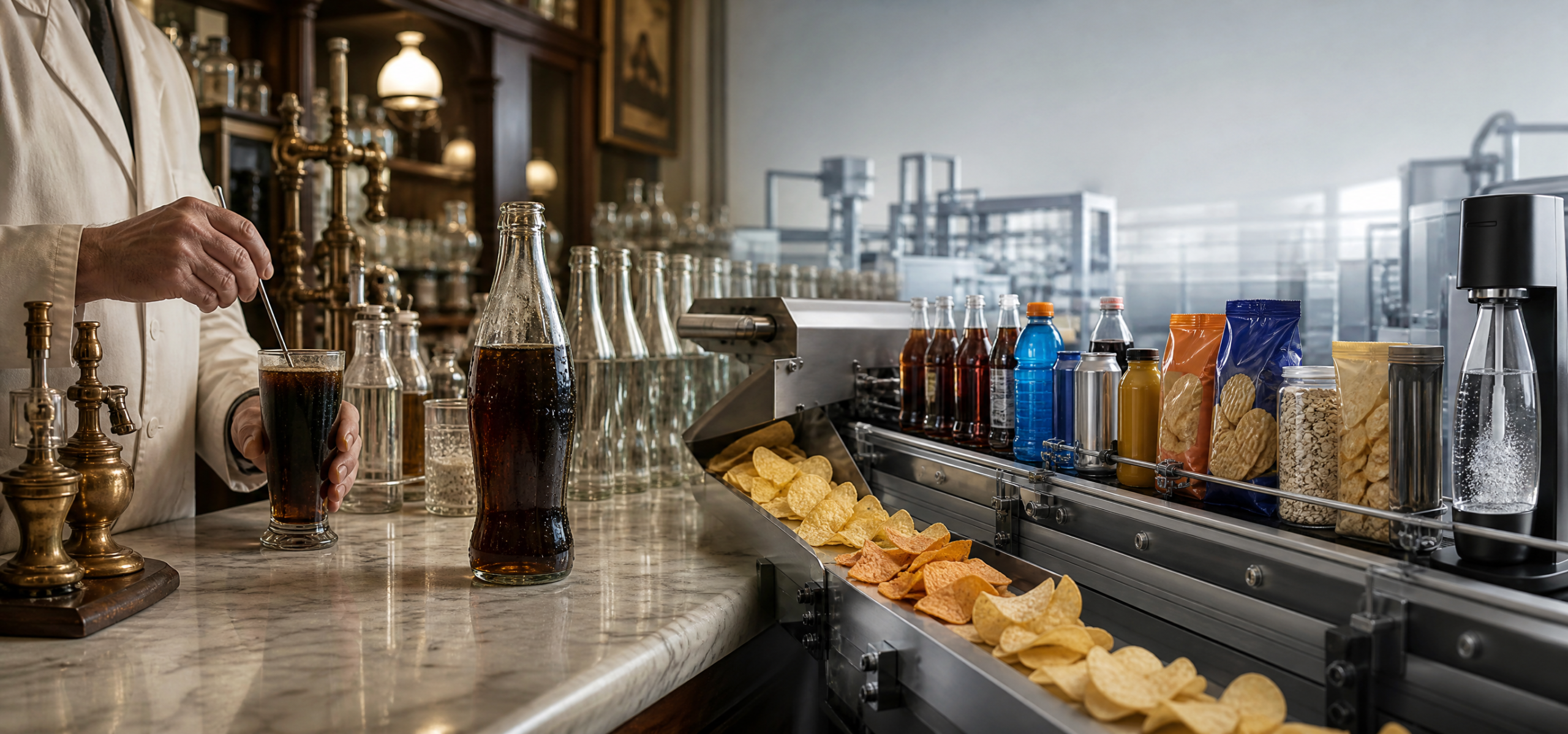
PepsiCo’s story begins with a simple idea: a pharmacist’s cola should taste good enough that customers would keep coming back. That modest ambition—Caleb D. Bradham mixing a sweet, carbonated drink for his 1890s drugstore patrons in New Bern, North Carolina—produced the Pepsi‑Cola beverage and, across the 20th century, seeded one of the world’s largest food-and-beverage companies. The contradiction at the heart of PepsiCo’s history is instructive: a single local soft drink grew into a multinational corporation whose core strength is diversity—the marriage of salty snacks and sweet beverages, large-scale manufacturing and franchised bottlers, mainstream sodas and brands positioned as healthier options.
PepsiCo is the public corporation that owns the Pepsi‑Cola brand and a wide portfolio of beverage and snack businesses. Its history matters because the company’s choices—marketing to youth, combining snacks with drinks, and reshaping its product mix in response to nutrition and regulatory pressures—helped define consumer-packaged-goods strategy in the late 20th and early 21st centuries.
Origins and founding: Brad’s Drink becomes Pepsi‑Cola
The drink that became Pepsi began in 1893 when Caleb D. Bradham, a pharmacist, created “Brad’s Drink” at his drugstore in New Bern, North Carolina. Customers bought it at the soda fountain and Bradham expanded production. In 1898 he renamed the beverage Pepsi‑Cola, advertising it as a digestive aid and a refreshing soda. The trademark and recipe formed the nucleus of the Pepsi enterprise.
The early decades were precarious. Bradham tried to scale a manufacturing and bottling business while national distribution networks and franchise systems were emerging. Pepsi‑Cola grew regionally but was vulnerable to commodity-price swings. In 1923 Bradham’s company declared bankruptcy after a period of high sugar prices and market instability; the Pepsi‑Cola name and assets passed through a series of owners in the 1920s and early 1930s before the brand reemerged under new management. Those disruptions left a lesson in Pepsi’s DNA: brand and distribution mattered more than any single founder’s ownership.
Early development: pricing, bottling and a consumer pitch
Pepsi’s most consequential early innovation was not a change in flavor but in price and packaging. During the Great Depression, Pepsi promoted a 12-ounce bottle for five cents—twice the quantity of competing colas sold for the same nickel. The “more for your money” positioning attracted cash-strapped consumers and helped Pepsi regain ground against Coca‑Cola. That move showed how marketing, packaging and price could reconfigure demand even when the product itself was similar to rivals.
Pepsi also benefited from the development of the modern bottling and franchised-distributor system. Like Coca‑Cola, Pepsi relied on independent bottlers to produce, bottle and distribute the beverage locally, while the corporate company controlled syrup production, branding and national advertising. That separation—corporate-owned concentrate and franchised bottling—remained a defining structural feature of Pepsi’s beverage operations for decades.
Frito‑Lay and the decision to become more than a soda company
The single most decisive structural turning point for PepsiCo arrived in the 1960s. Snack companies that would become Frito‑Lay traced back to entrepreneurs such as Elmer Doolin, who commercialized Fritos in the 1930s, and Herman W. Lay, who built a regional snack distribution business. Those snack businesses merged into Frito‑Lay, Inc. in 1961, creating a national snack manufacturer with significant manufacturing capabilities and a nationwide distribution footprint.
In 1965 the Pepsi‑Cola Company and Frito‑Lay merged to form PepsiCo. The merger combined a national beverage franchise with a mass-market snack manufacturer and reflected a strategic judgment: scale and complementary categories would create more stable profits and reduce dependence on a single volatile product category. After 1965 PepsiCo pursued a model that kept snack manufacturing in-house, managed beverage concentrate centrally, and relied on bottlers for beverage production and local distribution—allowing the company to pursue both manufacturing efficiency and marketing reach.
Marketing, the cola wars, and international reach
Pepsi’s identity was built around marketing that targeted youth and promoted mass consumption. In the 1960s the company positioned itself as modern and youthful with campaigns such as “The Pepsi Generation.” Over decades, Pepsi used taste tests and bold advertising to frame itself as the choice of younger consumers.
The “Pepsi Challenge,” introduced in the mid-1970s as a series of consumer blind tastings, reinforced that positioning. By inviting consumers to taste Pepsi and Coca‑Cola side by side, the campaign turned marketing claims into a testable contest. The Pepsi Challenge mattered because it shifted competitive rhetoric toward evidence and contributed to Pepsi’s market-share gains in the 1970s and early 1980s; Coca‑Cola’s 1985 “New Coke” reformulation then intensified the rivalry and alienated many customers.
Internationally, Pepsi pursued a mix of traditional market entries and unconventional deals. In the early 1970s Pepsi became one of the first Western soft-drink brands to negotiate significant access to the Soviet market; a barter arrangement in the 1970s—trading concentrate for vodka—was emblematic of the creative commercial negotiations companies undertook during the Cold War to enter closed economies. More broadly, PepsiCo expanded in Latin America, Europe and Asia through bottling partners and local distribution agreements, making its brands familiar worldwide.
Major milestones and portfolio moves
PepsiCo’s growth unfolded through a series of consequential corporate decisions, acquisitions and reorganizations. Each reshaped where the company earned its profits and how it organized itself.
- 1961: Formation of Frito‑Lay, Inc., joining the Frito Company and H.W. Lay & Company into a single national snack manufacturer.
- 1965: Merger of Pepsi‑Cola Company and Frito‑Lay to create PepsiCo, a combined snacks-and-beverages company.
- 1970s–1980s: Expansion into international markets and aggressive marketing campaigns, including the Pepsi Challenge, which intensified the cola wars with Coca‑Cola.
- 1997: Spin-off of the restaurant businesses (KFC, Pizza Hut, Taco Bell) into Tricon Global Restaurants, ending PepsiCo’s direct involvement in quick-service restaurants and refocusing the company on packaged foods and beverages.
- 1998: Acquisition of Tropicana from Seagram, adding mainstream fruit juices to PepsiCo’s beverage lineup.
- 2001: Acquisition of Quaker Oats Company, bringing the Gatorade brand and a range of cereal and grain-based products under PepsiCo’s umbrella.
- 2018: Announcement and completion of the acquisition of SodaStream, signaling an interest in at-home beverage systems and lower-packaging options.
- 2020: Acquisition of Rockstar Energy Beverages, expanding PepsiCo’s entry into the energy-drink category alongside existing brands such as Mountain Dew and Gatorade.
Each transaction added a new revenue stream and altered PepsiCo’s risk profile—juices and sports drinks helped offset declining soda consumption, snacks provided stable margins, and SodaStream and Rockstar reflected moves into growing or adjacent categories. Over time, snacks—led by Frito‑Lay brands—became a primary margin engine while beverages offered scale and a global marketing platform.
Leadership that redirected strategy: Kendall, Enrico, Nooyi and Laguarta
Individual leaders changed PepsiCo’s priorities. Donald M. Kendall, who rose through Pepsi‑Cola in the mid-20th century, was central to the 1965 merger and to building an assertive, brand-driven company culture. Roger A. Enrico, CEO in the late 1990s, presided over international expansion and portfolio shifts, including the Tropicana acquisition.
Indra Nooyi became CEO in 2006 and pushed the company to broaden its product mix toward healthier options, formalized sustainability commitments, and framed the business around a program launched in 2006 called “Performance with Purpose,” which linked nutritional reformulation, environmental targets and community programs to business performance. Her tenure emphasized product innovation and global marketing, and it recalibrated company priorities as public awareness of sugar and health issues grew.
Ramon Laguarta succeeded Nooyi as CEO in 2018. His early priorities included completing the SodaStream acquisition, expanding energy drinks, and accelerating e-commerce and sustainability initiatives—responses to changing consumer preferences and environmental scrutiny. Leadership changes mattered because they determined which categories received capital and which parts of the legacy business were allowed to shrink.
Challenges, controversies and public pushback
PepsiCo has repeatedly confronted the public and regulatory consequences of selling sugary drinks and salty snacks. From the late 20th century onward, rising scientific and public concern about obesity, diabetes and cardiovascular disease put packaged-food companies under scrutiny for portion sizes, sugar content and marketing to children. Governments and advocacy groups proposed soda taxes, advertising restrictions, and school food standards that pressured sales of core products.
Pepsi’s high-profile missteps were also media events. In 2017 a television advertisement featuring model Kendall Jenner was widely criticized for trivializing protests and co-opting imagery of social movements; Pepsi pulled the ad and apologized. The incident underscored how branding that aims to be culturally resonant can backfire if it appears inauthentic or tone-deaf.
Environmental criticism has focused on packaging waste and water use. PepsiCo responded with sustainability pledges—reducing packaging, improving recyclability, and committing to emissions reductions—but those initiatives have faced scrutiny over their sufficiency and pace.
Recent developments and the company’s modern position (2018–2023)
The most consequential recent years for PepsiCo were defined by three linked pressures: changing consumer tastes away from sugary sodas, the growth of snacks and energy drinks, and intensified attention to plastic packaging and carbon emissions. PepsiCo’s response blended acquisitions, research and development, and corporate goals.
In August 2018 PepsiCo announced it would acquire SodaStream, completing the transaction later that year. The deal gave PepsiCo a consumer-facing device for home carbonation and emphasized reducing single-use plastic by encouraging refillable bottles and concentrate systems. On April 24, 2020, PepsiCo completed its acquisition of Rockstar Energy Beverages, strengthening its position in a fast-growing segment.
The Covid-19 pandemic that year disrupted consumption patterns—on-premise sales at restaurants and movie theaters collapsed while retail and at-home consumption rose. PepsiCo’s diverse portfolio—snacks for at-home consumption and beverages sold through retail channels—proved resilient during the initial pandemic shock, even as away-from-home channels remained constrained.
Under Ramon Laguarta, PepsiCo emphasized e-commerce, direct-to-consumer experimentation, and premiumization in certain categories, while continuing to invest in reformulations and in brands viewed as less dependent on sugary soft drinks. The company also continued to set public sustainability goals, including commitments on greenhouse gas emissions and packaging, addressing regulatory risk and shifting consumer preferences.
By the early 2020s PepsiCo was clearly a company where snacks and beverages function as co-equal pillars: Frito‑Lay’s savory snacks remained a major profit engine while beverages provided high-volume revenue and marketing muscle. The legal parent remained PepsiCo, Inc., a publicly traded company headquartered in Purchase, New York, overseeing both company-owned manufacturing and a global system of bottling partners and distributors.
Legacy: what PepsiCo changed about consumer goods
PepsiCo’s lasting contribution is twofold. First, it demonstrated that combining complementary categories under one corporate roof—snacks and beverages—could create a resilient, diversified business model. The 1965 merger of Pepsi‑Cola and Frito‑Lay anticipated later industry practices of horizontal portfolio building: buying adjacent categories to smooth seasonal and cyclical downturns in any single product.
Second, Pepsi helped professionalize modern brand marketing. From early price campaigns in the Depression to the youth-oriented positioning of the late 20th century and the taste-test provocations of the Pepsi Challenge, Pepsi’s advertising taught rival marketers the power of identity and evidence-based claims. The company also showed how acquisitions (Tropicana, Quaker Oats/Gatorade) could reframe a beverage company as a broader consumer-foods player.
Not everything endured. Some soda-era campaigns became liabilities as public-health concerns changed the regulatory and cultural environment. Pepsi’s occasional marketing missteps demonstrated the cost of cultural tone-deafness in an era of rapid social awareness. Still, the core lesson—diversify brands, control manufacturing for profitable categories, and adapt marketing to new consumer priorities—has been absorbed into the industry’s playbook in part because PepsiCo pioneered aspects of it.
Conclusion: a company of reinvention and contradiction
PepsiCo’s arc—from Caleb Bradham’s soda fountain to a multinational snacks-and-beverages company—is a history of reinvention. Early lessons in pricing and distribution gave the brand the consumer foothold it needed. The 1965 merger with Frito‑Lay remade Pepsi from a cola company into a diversified food-and-beverage firm; later acquisitions such as Tropicana and Quaker Oats broadened the portfolio at moments when soda consumption faced headwinds.
In recent years PepsiCo navigated public-health scrutiny and environmental concern by buying into new categories (SodaStream, energy drinks), reformulating products, and pursuing sustainability initiatives. The central theme of PepsiCo’s evolution is pragmatic diversification: when one category faltered, the company sought growth in another, often using acquisition to accelerate the shift. That approach made PepsiCo less vulnerable to the fate of any single beverage and turned it into a durable, if occasionally controversial, presence in global food systems.












