










History of NOV
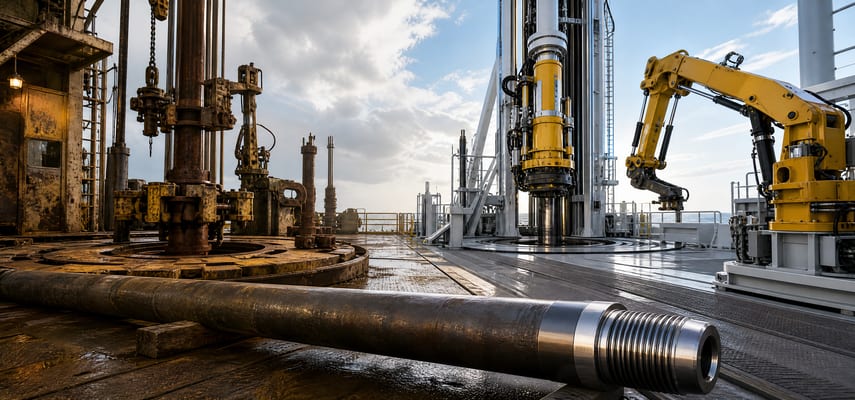
History of NOV charts how an industrial lineage built around drilling equipment—top drives, tubulars, pressure-control systems and aftermarket services—became central to modern oilfield operations. On a drilling floor at sea or on a remote desert pad, much of the motion of a turning well can be traced to NOV’s manufacturing and service network.
Quick timeline: 2005 merger; 2008 Grant Prideco acquisition; 2014–2016 oil-price collapse; 2020 pandemic shock; 2021 rebrand to NOV Inc.
Roots in manufacturing and the merger that created National Oilwell Varco (2005)
NOV’s roots extend well before the 2005 merger. The company traces an earliest predecessor to Oil City, Pennsylvania, in 1862. The lineage also included National Supply (established in 1893) and Varco (founded in 1908 in Los Angeles by Walter Abegg and Baldwin Reinhold). National‑Oilwell was formed in 1995 and the related acquisition closed in January 1996.
The modern NOV dates to a corporate union in the first decade of the 21st century. In 2005 two large oilfield suppliers—National Oilwell and Varco International—combined to form National Oilwell Varco. The new entity was built to offer a broader array of drilling equipment and services under a single corporate umbrella: from rig components and pressure-control equipment to tubulars and rig systems.
Why the merger mattered: the oil and gas boom of the early 2000s had pushed demand for drill rigs and associated capital equipment to levels that rewarded suppliers who could offer integrated packages. By joining, National Oilwell and Varco doubled down on the strategy of being a one-stop shop for operators and drilling contractors, a consolidation that reshaped supply relationships across the industry.
In the company’s early development, Armco’s National Supply and USX’s Oilwell consolidated their manufacturing and distribution operations into the National‑Oilwell partnership in April 1987. A management-led investor group acquired that partnership effective January 1, 1996 and took National‑Oilwell public on October 29, 1996; in 1997 the company expanded through purchases including Dreco, while Varco introduced top‑drive prototypes in 1982–83.
Building scale through acquisition: Grant Prideco and drill-pipe consolidation (2008)
Only a few years after the merger, the enlarged company pursued a major purchase that sharpened its control over a critical oilfield segment. In 2008 National Oilwell Varco completed the acquisition of Grant Prideco, a leading manufacturer of drill pipe and premium threaded connections. That deal significantly expanded NOV’s position in drill pipe and premium threaded connections—equipment whose performance directly affects drilling speed and reliability.
Why this mattered: drill pipe is the industry’s circulatory system; failures are costly and time-consuming. By bringing Grant Prideco’s manufacturing capability and global operations into its portfolio, NOV could offer drill pipe alongside its rig-equipment portfolio and expand its connection-technology and service offerings. The acquisition strengthened NOV’s position in the supply chain at a time when operators were pursuing longer, deeper and more complex wells.
The boom years and expansion of product breadth (late 2000s–early 2010s)
Across the late 2000s and into the early 2010s, NOV expanded both organically and through smaller bolt-on acquisitions. The company emphasized products that became ubiquitous on modern rigs: top drives that replaced rotary tables, hydraulic and mechanical pipe-handling systems that sped up tripping time, and advanced pressure-control equipment including blowout preventers (BOPs) and wellheads. It also invested in aftermarket services—repair, inspection and parts supply—that provided recurring revenue beyond the cyclical sale of new rigs.
Why this period mattered: NOV’s strategy turned it into an industrial platform. Selling a top drive was useful; selling the spare parts, inspection programs and training that keep it running for years created relationships that softened the company’s exposure to booms and busts. The breadth of product lines made NOV indispensable to many drilling contractors.
The oil-price collapse and strategic retrenchment (2014–2016)
The oil market changed abruptly beginning in mid-2014. A global oversupply and the OPEC decisions that followed drove prices down dramatically, and demand for new rigs and heavy equipment evaporated. For an equipment maker so tied to rig construction, the consequences were immediate and severe.
NOV confronted plummeting orders, extended lead times and shifting customer priorities. The company cut costs through severance, facility closures and other restructuring measures as demand fell. Those moves mirrored industry-wide retrenchment: drilling contractors stacked rigs, operators deferred projects, and suppliers had to pivot to survive.
Why this downturn mattered: the 2014–2016 cycle revealed the vulnerability of large, capital-intensive suppliers to the commodity cycle. It forced NOV to sharpen its focus on services, aftermarket revenues and operational efficiency. More importantly, NOV’s aftermarket business continued to provide spare parts, repairs, rentals, technical support, field service and rig-specific modifications alongside new equipment sales.
Shock of 2020 and acceleration of change
The year 2020 delivered a second jolt. COVID-19 restrictions sharply reduced economic activity and oil demand, driving down oil and gas prices and worldwide drilling activity. NOV reported that its 2020 revenue fell 28% amid the downturn.
NOV continued investing in new products and services during the downturn, including lower-emissions technologies. Its 2020 filings highlighted the Ideal eFrac electric fracturing fleet and the PowerBlade energy-recovery system. The twin shocks of 2014 and 2020 hardened a new corporate lesson: survival required building businesses that could make money even when rig counts were low.
Rebranding to NOV Inc. and a shift in public identity (2021)
In January 2021 the company shortened its corporate name from National Oilwell Varco to NOV Inc. The rebrand was more than cosmetic. Management framed it as an acknowledgment that the company’s technical capabilities and markets extended beyond the narrow identity of being a supplier solely to oil rigs.
Why the rebrand mattered: the name change signaled a strategic pivot. NOV sought to position itself as an industrial technology company supporting a broader set of energy activities—drilling, production, electrification and, increasingly, work that involved emissions reduction or remote-operation technology.
Leadership transitions accompanied these corporate shifts. The 2005 merger combined the companies’ senior teams: former Varco chief John F. Lauletta became chairman while National Oilwell’s Merrill A. “Pete” Miller Jr. became president and CEO, with Varco executives Joseph C. Winkler and Clay C. Williams taking the COO and CFO roles. Clay C. Williams later succeeded Miller as president and CEO in February 2014; when NOV completed the spinoff of its distribution business as NOW Inc. on May 30, Miller left to become NOW’s executive chairman and Williams added the NOV chairmanship.
Core products and why they mattered to modern drilling
NOV’s product portfolio reads like a list of the rig’s most consequential pieces. Across decades the company refined and mass-produced systems that are central to modern drilling operations:
- Top drives: electric or hydraulic units that rotate the drill string from a mast-mounted position, improving drill performance and safety by eliminating rotary tables and simplifying pipe handling.
- Blowout preventers (BOPs) and pressure-control systems: critical safety equipment designed to seal the well in emergencies; their reliability is essential for avoiding catastrophic incidents and regulatory penalties.
- Drill pipe and premium connections: tubulars engineered for deep or extended-reach wells that determine how far and how fast a rig can drill without failure.
- Pipe-handling and automated rig systems: equipment that reduces manual labor on the rig floor and shortens the time to add or remove drill pipe, thereby reducing operational costs.
- Aftermarket services: inspection, maintenance, repairs, spare parts and training—recurring businesses that stabilize revenue when capital orders fall.
Why these products mattered: improvements in each of these categories have material effects on operator economics. Faster tripping, more reliable BOPs and robust drill pipe increase drilling uptime, reduce non-productive time and lower the per-foot cost of well construction. NOV’s ability to standardize and service these products at global scale positioned it to support increasingly complex horizontal and extended-reach drilling.
Global footprint and manufacturing strategy
As of December 31, 2025, NOV owned or leased approximately 503 facilities worldwide and said it served customers in 57 countries. Its listed principal sites included manufacturing, inspection, repair and service operations in the United States, Mexico, the United Arab Emirates, Malaysia, China, Saudi Arabia, Singapore, the United Kingdom, Denmark and Brazil.
NOV’s filings describe facilities with functions including manufacturing, warehousing, inspection, repairs, service, aftermarket parts, field service and training. Its rig-service materials likewise describe a global network of repair and spare-parts centers supporting regional customers.
Why this network mattered: the distributed facilities supported manufacturing and aftermarket activities, including repairs, spare parts, field service and training.
Technology, digitalization and the low-carbon conversation
Into the 2020s, NOV emphasized automation, digital control systems and electrification. Its Max digital ecosystem supports real-time condition monitoring, remote control, data analytics and condition-based maintenance, while products such as the PowerBlade energy-recovery system and Ideal eFrac electric fracturing fleet targeted lower fuel use and emissions.
Why these moves mattered: customers were asking for lower operating costs and reduced emissions footprints. NOV marketed these technologies as ways to improve efficiency, monitor equipment remotely, reduce fuel use and limit the need for personnel near operating machinery.
Aftermarket and services as a hedge against cycles
A recurring theme in NOV’s evolution has been the deliberate enlargement of its aftermarket and services business. When orders for new rigs disappear, service revenue—inspection, parts replacement, retrofits—keeps factories humming and service engineers busy. During downturns, NOV emphasized the importance of its installed base and aftermarket business, including spare parts, repairs and technical support through a global service network.
Why this mattered: a stronger services business reduces dependency on capital cycles. It also locks in customer relationships: a company that inspects and repairs its equipment is more likely to be the one customers call when they purchase new assets.
Challenges: cycles, competition and regulatory scrutiny
No industrial giant rises without encountering resistance. NOV has faced several persistent headwinds:
- Commodity cycles: The company’s revenues have historically tracked rig counts and capital spending patterns, creating volatility that is hard to eliminate entirely.
- Intense competition: Other large suppliers and specialty manufacturers routinely vie for the same contracts, pressing prices and margins.
- Safety and regulatory pressures: Equipment like BOPs is subject to intense scrutiny after major incidents, and manufacturers must respond with robust testing, documentation and redesigns when required.
Why these challenges mattered: they shaped strategic choices—acquiring or building recurring-revenue businesses, investing in quality systems, and moving toward electrification and digital services to differentiate offerings.
Recent years: resilience, adaptation and the business outlook
Through the early 2020s NOV navigated a complex landscape: recovering oil demand after the pandemic, geopolitical shocks that affected energy markets, and the steady policy and investor pressure to reduce the carbon intensity of oil and gas operations. The company’s public statements and business emphasis reflected these forces: a need to keep manufacturing efficient, to grow services and software, and to provide equipment that helps customers lower emissions while improving drilling productivity.
Why recent developments mattered: NOV’s ability to adapt would determine whether it remained a supplier of first resort for world-class drilling fleets or became a niche supplier in an industry gradually repricing carbon and risk. Investments in electrified drives, remote monitoring and aftermarket services were pragmatic bets—ways to sell existing customers equipment they wanted while positioning for markets where emissions and automation mattered as much as drilling speed.
What NOV’s story reveals about the oilfield-supply industry
NOV’s history is less a tale of a single inventing genius than of industrial accumulation: the layering of capabilities, the steady acquisition of suppliers, and repeated cycles of expansion and contraction. That pattern is instructive.
First, scale matters for complex equipment. Manufacturers with broad portfolios can bid for turnkey projects and capture more of the project value chain. Second, recurring services are the best buffer against cyclical demand in capital goods; companies that build inspection, repair and parts businesses are more resilient. Third, macro shocks—price collapses, pandemics, geopolitical events—require firms to be operationally flexible and to maintain a portfolio of products that serve both growth-era capital demand and downturn-era maintenance work.
Conclusion
NOV did not invent the rig. But by consolidating critical systems—top drives, tubulars, pressure-control gear—and by building a global manufacturing and service network, it became central to how modern wells are drilled and maintained. Its rise demonstrates the industrial logic of scale and integration; its periodic contractions show the vulnerability of equipment makers to commodity cycles. As the energy industry changes, NOV’s story will be a test case for whether an oilfield-equipment giant can translate mechanical know-how into the technologies that operators say they now need: electrification, remote operation and lower-emissions workflows. How successfully it does so will determine whether NOV remains a linchpin of conventional drilling or morphs into a broader industrial-technology company for the energy transition.











