










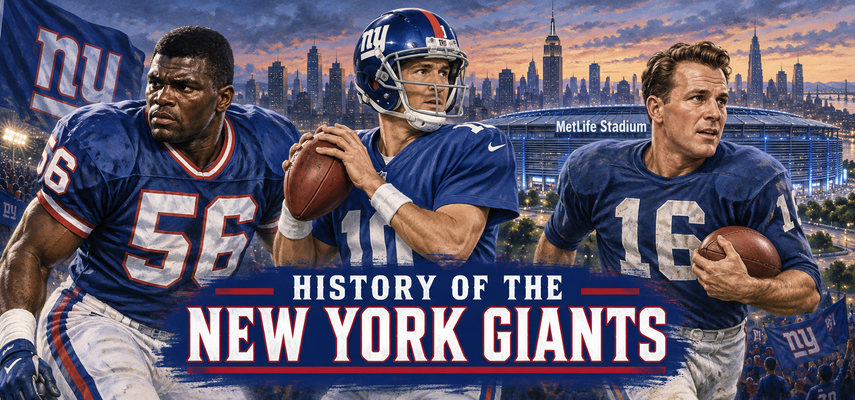

The New York Giants connect the NFL’s early struggle for recognition with its modern championship stage. Founded in 1925, the franchise won titles before television transformed the sport, then built later champions around powerful defenses and timely quarterback play. Four pre-Super Bowl NFL championships and four Super Bowl victories belong to different competitive structures within one continuous history. The Polo Grounds, Yankee Stadium and New Jersey venues each frame part of that story. This account follows the Giants through their completed 2025 season, separating their established achievements from the coaching changes and unfinished competition of the next chapter.
Franchise at a glance
| Field | Details |
|---|---|
| Founded | 1925; NFL franchise awarded August 1 |
| First season | 1925, National Football League |
| Original city and name | New York, New York — New York Giants |
| Current city and name | New York Giants; home games in East Rutherford, New Jersey |
| Previous cities and names | No franchise name change; home venues moved outside New York City |
| League and conference/division | NFL — National Football Conference East |
| Home venue | MetLife Stadium, East Rutherford; opened in 2010 |
| League championships | 4 Super Bowl titles: 1986, 1990, 2007, 2011 |
| Other recognized championships | 4 pre-Super Bowl NFL titles: 1927, 1934, 1938, 1956; 5 NFC titles |
| Historical coverage | 2025 NFL season, including playoffs completed in February 2026; later developments through October 16, 2026 |
Origins and early years
Tim Mara established the Giants in 1925, bringing an NFL franchise to the nation’s largest city while professional football still competed for attention with college football and baseball. The team’s first season was therefore an attempt to build both a competitive roster and a sustainable audience. The Polo Grounds supplied its original home, and the football team shared the Giants name with the city’s baseball club without sharing that organization’s sporting history.
The franchise’s first championship came in 1927 under coach Earl Potteiger. New York finished 11–1–1 and received the NFL title through the league standings; there was no championship game to attach to that season. This distinction matters when comparing the earliest title with later playoff victories. The Giants’ subsequent moves between stadiums, including their eventual New Jersey home, did not establish replacement franchises. Their historical record remains continuous from the 1925 beginning, through changes in playing location and successive generations of Mara family leadership.
Defining eras
1925–1946: Establishing an early NFL institution
The 1927 championship gave the young franchise an early measure of sporting legitimacy. Steve Owen later became the central coaching figure of its next period. With players such as Mel Hein and Ken Strong, the Giants reached the first scheduled NFL Championship Game in 1933, losing to Chicago. The rematch the following season produced a different outcome.
In the 1934 Sneakers Game, New York changed footwear to gain traction on the frozen Polo Grounds field and defeated the Bears 30–13. The adjustment became a memorable part of the story, but the championship also reflected a strong team under Owen. Another title followed in 1938 with a 23–17 victory over Green Bay. Hein’s work at center connected those championship teams, while Tuffy Leemans supplied another major offensive figure. Repeated later appearances in the league final established the Giants as a durable contender even when they did not add another title.
1947–1963: New York’s television-era contender
The postwar Giants gradually assembled another important generation. Frank Gifford supplied versatile offensive play, Charlie Conerly led at quarterback, and Sam Huff became a central defensive figure. Jim Lee Howell succeeded Owen as head coach, with Vince Lombardi and Tom Landry directing the offense and defense. The team moved to Yankee Stadium in 1956 and beat Chicago 47–7 in the NFL Championship Game that season.
The 1958 final brought the Giants and Baltimore Colts into an overtime contest watched by a national television audience. Baltimore won 23–17, but the game helped strengthen professional football’s cultural position. New York returned to the championship game in 1959 and again in 1961, 1962 and 1963. Y.A. Tittle’s arrival extended the competitive period. Those later appearances ended in defeats, leaving the 1956 championship as the era’s only league title despite its broader influence on the game’s growing audience.
1964–1982: Decline, changing homes and reconstruction
The earlier contender declined sharply after the 1963 season. Coaching and roster changes did not quickly restore its position, and a long absence from the postseason followed. The franchise also moved through temporary homes as it prepared to leave Yankee Stadium. Games at the Yale Bowl and Shea Stadium preceded the opening of Giants Stadium in East Rutherford in 1976.
The 1978 defeat to Philadelphia remembered as the Miracle at the Meadowlands exposed the organization’s competitive frustrations. A failed attempt to run out the clock ended with a fumble returned for a decisive Eagles touchdown. The following leadership changes included George Young’s arrival as general manager. Phil Simms entered through the 1979 draft, while Lawrence Taylor’s selection in 1981 transformed the defense. A playoff victory after that 1981 season signaled a credible return. The reconstruction joined improved personnel decisions with a stronger institutional foundation rather than depending on a single dramatic play.
1983–1990: Parcells and a championship defense
Bill Parcells became head coach in 1983 and developed the Giants around a demanding defensive identity. Taylor’s pass rushing, Harry Carson’s leadership and a powerful running game helped turn the team into a contender. The 1986 Giants finished 14–2, then defeated Denver 39–20 in Super Bowl XXI. Simms’s exceptional passing performance earned the game’s MVP, while Taylor had won the Associated Press NFL MVP for the regular season.
Four seasons later, New York produced another championship through a different postseason path. Jeff Hostetler replaced the injured Simms, and the Giants beat San Francisco in the NFC Championship Game before defeating Buffalo 20–19 in Super Bowl XXV. Ottis Anderson’s running earned the Super Bowl MVP. The final missed Buffalo field goal settled a close game, but New York’s ball control and defensive plan had created the opportunity. Parcells departed after that season, ending a coaching tenure that supplied two distinct championship teams.
1991–2011: Two more titles under Coughlin and Manning
The years after Parcells included uneven results and another Super Bowl appearance under Jim Fassel. The 2000 Giants won the NFC Championship Game 41–0 against Minnesota, then lost Super Bowl XXXV to Baltimore. Tom Coughlin arrived as head coach in 2004, the same year New York acquired Eli Manning’s draft rights. Their partnership eventually brought the franchise back to the championship level.
The 2007 team won three road playoff games before defeating previously unbeaten New England 17–14 in Super Bowl XLII. David Tyree’s helmet catch helped sustain the decisive drive, finished by Manning’s touchdown pass to Plaxico Burress. Four seasons later, a 9–7 Giants team again defeated the Patriots, this time 21–17 in Super Bowl XLVI. Manning earned MVP honors in both games. MetLife Stadium had opened in 2010, linking the second Coughlin title to a new home while the underlying franchise history remained unchanged.
2012–2025: Searching for the next durable foundation
The years after the fourth Super Bowl victory brought more frequent changes in coaching and roster direction. Coughlin’s tenure ended after the 2015 season. A playoff appearance under Ben McAdoo in 2016 did not become another sustained run, and later rebuilds struggled to recover the earlier competitive consistency. Manning’s retirement closed one of the franchise’s longest quarterback chapters.
Brian Daboll’s first season in 2022 produced a playoff berth and a road victory over Minnesota, before Philadelphia ended the run in the divisional round. The following seasons did not sustain that improvement. New York finished 3–14 in 2024 and 4–13 in 2025. Daboll’s dismissal during the latter season brought interim leadership before another permanent coaching appointment. These results belong to the completed record rather than to an assumed rebound. The long history contains several successful reconstructions, but none makes a new one automatic.
Recent history
The latest completed season is 2025, when the Giants finished 4–13 and missed the playoffs. Brian Daboll was dismissed during that season, and Mike Kafka served as interim head coach. The franchise’s championship totals remained four pre-Super Bowl NFL titles and four Super Bowl victories; its most recent postseason win still belonged to the 2022 season.
John Harbaugh was named head coach on January 20, 2026. His earlier Baltimore accomplishments belong to that separate franchise and do not become Giants team achievements through his appointment. As of October 16, 2026, the new coaching era’s first NFL season was underway, with no final record or postseason outcome assigned here. MetLife Stadium remained the home venue. The immediate historical change was the arrival of new leadership, while whether that change would produce another durable contender remained an open sporting question.
Greatest players and influential figures
Mel Hein
Hein anchored the Giants at center during the championship teams of 1934 and 1938. His work combined blocking, defensive responsibility and unusual durability in the era of two-way football. The 1938 league MVP spent his entire NFL career with New York, making his foundational contribution part of the franchise’s earliest championship period.
Frank Gifford
Gifford’s versatility helped define the Giants’ successful 1950s offense. His 1956 NFL MVP season ended with a league championship, while his receiving and rushing ability made him important beyond a single role. His later broadcasting prominence expanded his public profile, but his playing contribution belongs specifically to New York’s football history.
Lawrence Taylor
Taylor changed the defensive possibilities of the Giants after his arrival in 1981. His pass rushing and ability to disrupt an offense helped anchor two Super Bowl-winning teams. The 1986 Associated Press NFL MVP spent his entire professional playing career with New York and remains central to the franchise’s defensive identity.
Phil Simms
Simms supplied the quarterback leadership of the first Giants Super Bowl champion and earned Super Bowl XXI MVP honors. His long tenure also connected the rebuilding years with the Parcells contender. Injury kept him out of the postseason following the 1990 season, when Jeff Hostetler directed the team’s second Super Bowl run.
Michael Strahan
Strahan became the defensive link between different Giants coaching periods. His pass rushing and leadership helped take the team to Super Bowl XXXV and later to victory in Super Bowl XLII. That championship closed his playing career, while his Hall of Fame recognition reflects a broader body of work in New York.
Eli Manning
Manning directed the Giants’ championship offenses in the 2007 and 2011 seasons, earning the Super Bowl MVP both times. His durability connected those title runs with a much longer quarterback tenure. The two championships belong alongside the difficult later seasons within one career spent entirely with the Giants.
Steve Owen
Owen’s long coaching tenure helped turn the Giants into a lasting NFL institution. His teams won the 1934 and 1938 championships and repeatedly returned to the league final. His importance rests on sustained tactical and organizational development across an early period when professional football’s teams were still building durable identities.
Tom Coughlin
Coughlin coached the Giants to their third and fourth Super Bowl victories, working with Manning across twelve seasons. His teams combined disciplined preparation with the ability to win difficult postseason games away from home. Those championship peaks were achieved within an uneven wider record, making consistency and breakthrough separate parts of his tenure.
Championships and postseason milestones
The Giants have eight overall NFL championships through 2025: four before the Super Bowl and four Super Bowl victories. Their five NFC titles are conference honors, not five additional league championships. The 1927 title was determined by standings rather than a final, so its table entry has no opponent or invented game score. Super Bowl entries use the NFL season year; the games themselves occurred in the following calendar year.
On smaller screens, scroll horizontally to see all columns.
| Season/year | Competition | Opponent | Result | Defining figure(s) |
|---|---|---|---|---|
| 1927 | NFL championship — standings | Not applicable | League title; 11–1–1 season | Earl Potteiger; Steve Owen |
| 1934 | NFL Championship Game | Chicago Bears | Won 30–13 | Ken Strong; Mel Hein; Steve Owen |
| 1938 | NFL Championship Game | Green Bay Packers | Won 23–17 | Mel Hein; Tuffy Leemans; Steve Owen |
| 1956 | NFL Championship Game | Chicago Bears | Won 47–7 | Frank Gifford; Charlie Conerly; Jim Lee Howell |
| 1986 | Super Bowl XXI | Denver Broncos | Won 39–20 | Phil Simms; Lawrence Taylor; Bill Parcells |
| 1990 | Super Bowl XXV | Buffalo Bills | Won 20–19 | Ottis Anderson; Jeff Hostetler; Bill Parcells |
| 2007 | Super Bowl XLII | New England Patriots | Won 17–14 | Eli Manning; Michael Strahan; Tom Coughlin |
| 2011 | Super Bowl XLVI | New England Patriots | Won 21–17 | Eli Manning; Justin Tuck; Tom Coughlin |
Rivalries, venues and team identity
Rivalries
Philadelphia and Dallas supply repeated divisional confrontations whose significance extends beyond individual seasons. The Eagles rivalry includes the 1978 Meadowlands finish and later playoff meetings. Dallas has been another recurring measure of NFC East standing. New England occupies a different place: two Super Bowl meetings, both Giants victories, created an important championship relationship rather than an annual divisional rivalry.
Home venues and traditions
The Giants moved from the Polo Grounds to Yankee Stadium, then through temporary homes before Giants Stadium opened in 1976. MetLife Stadium replaced it in 2010 and is shared with the Jets. Keeping the New York name while playing in New Jersey reflects a metropolitan identity whose supporters extend across the region rather than a change of franchise ownership of records.
Retired numbers and team honors
The Giants formally retire numbers and maintain a separate Ring of Honor. Examples include Lawrence Taylor’s 56, Eli Manning’s 10 and Michael Strahan’s 92. No. 14 honors both Ward Cuff and Y.A. Tittle. The club’s recognitions must also be distinguished from election to the Pro Football Hall of Fame, which is a league-wide career honor.
Legacy
The Giants’ history is distinctive for the distance between its championship generations and the continuity connecting them. Early standings and championship-game titles helped stabilize an emerging league; later Super Bowl victories carried the franchise into a different sporting economy. Powerful defenses recur throughout that story, but the champions also depended on adaptable coaching and timely quarterback play. Long declines between the peaks show that institutional memory does not guarantee competitive renewal. The eight completed championships remain the central achievement, while the changing homes and successive rebuilds explain how one franchise has persisted across a century of professional football.
Where to eat in New York City
Planning a visit? Explore our best restaurants in New York City guide.












