










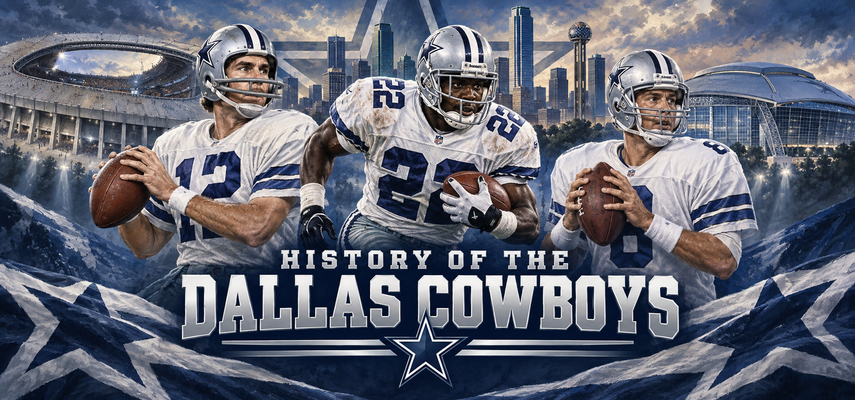

The Dallas Cowboys turned a difficult expansion beginning into one of professional football’s most recognizable identities. Tom Landry’s teams established a long competitive standard, while the later partnership of Troy Aikman, Emmitt Smith and Michael Irvin brought another championship era. Five Super Bowl victories connect those different generations without making their teams interchangeable. The star, the stadiums and the national following became part of the story, alongside ownership changes and repeated postseason disappointments. This history follows the franchise from its 1960 arrival through its completed 2025 season, with later developments identified separately from results still being decided.
Franchise at a glance
| Field | Details |
|---|---|
| Founded | 1960; NFL franchise awarded January 28 |
| First season | 1960, National Football League |
| Original city and name | Dallas, Texas — Dallas Cowboys |
| Current city and name | Dallas Cowboys; home games in Arlington, Texas |
| Previous cities and names | None; home venues moved within the Dallas–Fort Worth area |
| League and conference/division | NFL — National Football Conference East |
| Home venue | AT&T Stadium, Arlington; opened in 2009 |
| League championships | 5 Super Bowl championships: 1971, 1977, 1992, 1993, 1995 |
| Other recognized championships | 8 NFC championships; no pre-Super Bowl NFL championship |
| Historical coverage | 2025 NFL season, including playoffs completed in February 2026; later developments through October 16, 2026 |
Origins and early years
The NFL awarded Dallas an expansion franchise in January 1960, bringing the league into a growing Texas market. Clint Murchison Jr. headed ownership, Tex Schramm shaped the business and football organization, and Tom Landry became the first head coach. The new club was separate from the AFL’s Dallas Texans, who later moved to Kansas City. Sharing a city did not make the two organizations predecessors or successors of one another.
The Cowboys began at the Cotton Bowl and finished their first season 0–11–1. They entered too late to participate in that year’s college draft, an additional obstacle for an expansion roster. Rather than changing direction after the initial losses, ownership gave Landry time to develop a system and Schramm and personnel executive Gil Brandt time to assemble talent. Bob Lilly, selected in the 1961 draft, became an early foundation. The franchise’s rise would come through sustained organizational development rather than immediate success.
Defining eras
1960–1969: Building Landry’s contender
Landry’s early Cowboys improved gradually. Quarterback Don Meredith, receiver Bob Hayes and defensive tackle Bob Lilly helped turn the expansion team into a serious opponent. Dallas recorded its first winning season in 1966, finishing 10–3–1 and reaching the NFL Championship Game. Green Bay won 34–27, leaving the Cowboys close to the title without one of their own.
The following season ended with another championship defeat against the Packers, this time in the freezing conditions of the Ice Bowl. Bart Starr’s late quarterback sneak supplied the decisive score in a 21–17 game. These were NFL championship losses, not Super Bowl appearances. Dallas also lost playoff games to Cleveland at the end of the decade. Repeated contention established the organization’s strength, but the inability to finish the postseason became a defining pressure on Landry’s team. The eventual champions emerged from that experience rather than arriving as an entirely new organization.
1970–1977: Two championships establish the standard
After the AFL–NFL merger, Dallas won the NFC in the 1970 season but lost Super Bowl V to the Baltimore Colts, 16–13. Linebacker Chuck Howley earned the game’s MVP despite playing for the losing team. Roger Staubach’s emergence as the established starting quarterback then helped change the ending. The 1971 Cowboys defeated Miami 24–3 in Super Bowl VI, earning the franchise’s first overall championship.
Texas Stadium opened during that title season, giving the team its distinctive roof opening and a new home in Irving. Landry’s flexible offense and disciplined defense continued to produce contenders. A 1975 Super Bowl loss to Pittsburgh was followed by another title in the 1977 season. Dallas beat Denver 27–10 in Super Bowl XII, with defensive linemen Harvey Martin and Randy White sharing MVP honors. The championship teams connected Staubach’s improvisation with a defense capable of controlling the game.
1978–1988: Sustained contention and a difficult decline
Dallas returned to the Super Bowl in the 1978 season, losing another close championship meeting with Pittsburgh, 35–31. That result completed the franchise’s five Super Bowl appearances during the 1970s. Staubach retired after the following season, and Danny White took over at quarterback. With Tony Dorsett supplying the running game, the Cowboys continued to reach the later rounds of the postseason.
Three consecutive NFC Championship Game defeats in the 1980, 1981 and 1982 seasons showed both the team’s durability and its limits. Dwight Clark’s touchdown catch for San Francisco in the middle of that sequence became an enduring image of a rival’s breakthrough. Dallas’s streak of twenty consecutive winning seasons ended after 1985. The decline accelerated as the decade closed, and the 1988 team finished 3–13. Landry’s long tenure had established the club’s competitive identity, but its final years required a major reconstruction.
1989–1995: Rebuilding around the Triplets
Jerry Jones bought the Cowboys in 1989 and replaced Landry with Jimmy Johnson. The abrupt coaching change divided supporters, while a 1–15 first season revealed how much work remained. Dallas drafted Troy Aikman and used the Herschel Walker trade to acquire resources for a deeper roster. Emmitt Smith joined Michael Irvin as the offense’s other central figures, behind an increasingly powerful offensive line.
The transformation produced consecutive Super Bowl wins over Buffalo in the 1992 and 1993 seasons, 52–17 and 30–13. Aikman and Smith earned the respective game MVP awards. Johnson’s departure after the second title brought Barry Switzer to the sideline. The Cowboys lost the 1994 NFC Championship Game to San Francisco, then returned to beat Pittsburgh 27–17 in Super Bowl XXX after the 1995 season. Larry Brown’s interceptions earned that game’s MVP. Three titles in four seasons established a second championship generation with its own personnel and leadership.
1996–2019: New stars and unfinished postseason runs
The championship core aged, and Dallas struggled to recover the same postseason position. Aikman’s playing career ended after the 2000 season, while Smith later finished his NFL career in Arizona. Bill Parcells’s arrival as head coach in 2003 brought renewed competitiveness. Tony Romo eventually emerged as the starting quarterback, linking an undrafted beginning with a long period of productive offense.
AT&T Stadium opened in 2009, extending the franchise’s visibility while replacing Texas Stadium. Under Jason Garrett, Dallas won division titles without returning to the NFC Championship Game. The 2014 season ended in Green Bay after a disputed non-catch ruling on Dez Bryant’s fourth-down reception. Dak Prescott and Ezekiel Elliott then led a 13–3 regular season in 2016, but another divisional defeat followed. These were meaningful winning teams, yet their achievements remained separate from the Super Bowl titles that supplied the franchise’s familiar historical benchmark.
2020–2025: Division success without another breakthrough
Mike McCarthy succeeded Garrett in 2020. Prescott’s serious ankle injury disrupted that first season, before Dallas returned to sustained regular-season success. The Cowboys won twelve games in each season from 2021 through 2023. Their postseason endings were less consistent: consecutive eliminations by San Francisco were followed by a home wild-card defeat to Green Bay after the 2023 season.
A 7–10 finish in 2024 brought another coaching transition. Brian Schottenheimer became head coach in January 2025 after serving as offensive coordinator. His first team finished 7–9–1 and missed the playoffs. That completed result did not extend the earlier twelve-win sequence or end the conference-final drought. Prescott’s era had produced division championships and strong offensive seasons, but the historical distinction remained clear: Dallas’s most recent NFC championship and Super Bowl victory still belonged to the 1995 season.
Recent history
The latest completed season is 2025. Dallas finished 7–9–1 and did not qualify for the postseason in Brian Schottenheimer’s first year as head coach. The tie belongs in the record; reducing that season to seven wins and nine losses would leave an incomplete account. The Cowboys’ championship totals therefore remained five Super Bowl victories and eight NFC titles through that completed season.
As of October 16, 2026, Schottenheimer remained head coach and the 2026 NFL season was underway. This history does not assign that ongoing season a final record, playoff berth or championship. AT&T Stadium remained the team’s home in Arlington. The current chapter concerns the effort to turn another coaching and roster cycle into deeper postseason success, while the completed record continues to distinguish regular-season achievement from the championships earned by the Landry and 1990s teams.
Greatest players and influential figures
Bob Lilly
Lilly became the defensive foundation of the Cowboys’ rise after his selection in the 1961 draft. His entire NFL playing career was spent with Dallas, including the franchise’s first Super Bowl championship. His interior strength helped define the defense before the later championship generations and made him the Ring of Honor’s first member.
Roger Staubach
Staubach connected improvisational quarterback play with Landry’s structured offense. After completing his Navy service, he became the leader of two Super Bowl-winning Cowboys teams and earned Super Bowl VI MVP honors. His career established a standard for the position that later Dallas quarterbacks would inherit rather than simply repeat.
Tony Dorsett
Dorsett added exceptional speed and running production to the late-1970s Cowboys. His rookie season ended with the Super Bowl XII championship, and his later work helped sustain the transition from Staubach to Danny White. Most of his NFL rushing career belonged to Dallas, before a final season in Denver.
Troy Aikman
Aikman endured the difficult beginning of the Jones–Johnson rebuild before directing three Super Bowl-winning teams. His accuracy and decision-making complemented an exceptional running game and offensive line. The Super Bowl XXVII MVP spent his entire NFL playing career in Dallas, making his championship contribution specific to this franchise.
Emmitt Smith
Smith supplied the running foundation of the Cowboys’ three-title generation and earned Super Bowl XXVIII MVP honors. He became the NFL’s career rushing leader while playing for Dallas. His eventual career total also includes two Arizona seasons, which belong to his broader individual record rather than additional Cowboys accomplishments.
Michael Irvin
Irvin became the central receiving figure of the 1990s championship teams. His physical play and connection with Aikman helped balance Smith’s rushing threat, giving Dallas multiple ways to control a game. His entire NFL playing career was with the Cowboys, and all three of his Super Bowl victories came there.
Tom Landry
Landry coached the Cowboys from their first season through 1988, building the franchise from expansion losses into a sustained contender. His teams won two Super Bowls and established twenty consecutive winning seasons. His contribution joined tactical development with unusual institutional continuity, while the later decline remains part of the same tenure.
Jimmy Johnson
Johnson directed the rapid reconstruction that followed the 1989 ownership change. His roster building and coaching helped turn a one-win beginning into consecutive Super Bowl championships. The following title under Barry Switzer used much of that foundation, but Johnson’s own Dallas coaching championships belong specifically to the 1992 and 1993 seasons.
Championships and postseason milestones
Dallas has won five Super Bowls and no pre-Super Bowl NFL championship. Its eight NFC championships include the three Super Bowl-losing seasons of 1970, 1975 and 1978. Those conference titles are not additional overall championships. The 1966 and 1967 NFL championship defeats also remain distinct from the later Super Bowl record. The table uses NFL season years, so each listed Super Bowl was played early in the following calendar year.
On smaller screens, scroll horizontally to see all columns.
| Season/year | Competition | Opponent | Result | Defining figure(s) |
|---|---|---|---|---|
| 1971 | Super Bowl VI | Miami Dolphins | Won 24–3 | Roger Staubach; Bob Lilly; Tom Landry |
| 1977 | Super Bowl XII | Denver Broncos | Won 27–10 | Harvey Martin; Randy White; Tom Landry |
| 1992 | Super Bowl XXVII | Buffalo Bills | Won 52–17 | Troy Aikman; Michael Irvin; Jimmy Johnson |
| 1993 | Super Bowl XXVIII | Buffalo Bills | Won 30–13 | Emmitt Smith; Troy Aikman; Jimmy Johnson |
| 1995 | Super Bowl XXX | Pittsburgh Steelers | Won 27–17 | Larry Brown; Emmitt Smith; Barry Switzer |
Rivalries, venues and team identity
Rivalries
Washington became an enduring divisional opponent through repeated meetings and consequential postseason contests. Philadelphia supplies another competitive regional rivalry within the NFC East. San Francisco became a defining postseason opponent, particularly through the conference championship meetings that shaped the early 1990s. These relationships reflect different eras rather than one unchanging competitive balance.
Home venues and traditions
The Cotton Bowl housed the expansion years before Texas Stadium opened in 1971. The move to Arlington’s AT&T Stadium in 2009 created another distinct venue chapter without changing the franchise’s Dallas identity. The helmet star, Thanksgiving home games and the broad television audience connect supporters across the different stadiums and playing generations.
Retired numbers and team honors
The Cowboys use their Ring of Honor rather than formally retiring jersey numbers. Some famous numbers are issued selectively, while No. 88 has become a recurring receiving tradition. Ring membership, an informally withheld number and election to the Pro Football Hall of Fame are different honors. None should be presented as an official number retirement.
Legacy
The Cowboys’ significance rests on two championship generations and the organizational choices connecting them. Landry’s patient construction and the rapid Johnson rebuild followed different paths to the same competitive level. Their success created a demanding benchmark for later teams, whose division titles and productive seasons have not always led to comparable postseason outcomes. The franchise’s imagery and national reach amplify those expectations, but the football history remains more specific than the brand. Five Super Bowl victories anchor the completed record; the intervening struggles explain why repeating that success has proved difficult.
Where to eat in Dallas
Planning a visit? Explore our best restaurants in Dallas guide.












