










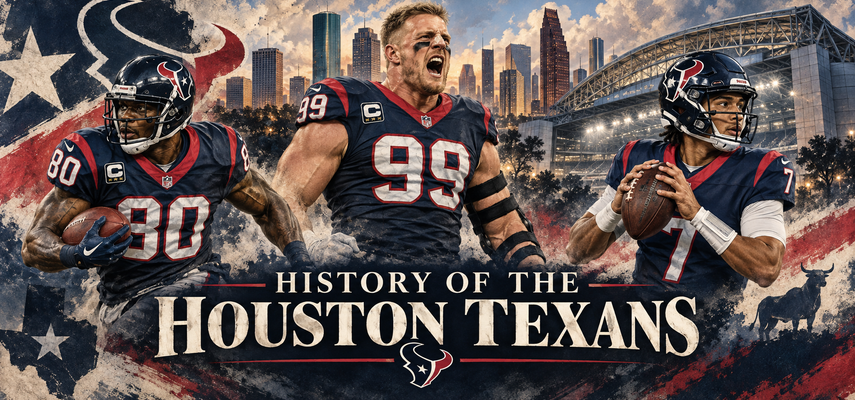

The Houston Texans brought the NFL back to a city whose football history already ran deep. Their own story began in 2002, separate from the Oilers, and developed through expansion struggles, Andre Johnson’s receiving, J.J. Watt’s defense and repeated attempts to move beyond the divisional playoffs. Gary Kubiak supplied the first postseason breakthrough; DeMeco Ryans and C.J. Stroud later gave the franchise another direction. Houston’s identity combines an enthusiastic local following with a championship pursuit still unfinished. This history follows the Texans through the completed 2025 season, distinguishing those results from developments during the ongoing 2026 campaign.
Franchise at a glance
| Field | Details |
|---|---|
| Founded | October 6, 1999; NFL expansion franchise awarded |
| First season | 2002, National Football League |
| Original city and name | Houston, Texas — Houston Texans |
| Current city and name | Houston Texans; Houston, Texas |
| Previous cities and names | None; the Houston Oilers’ history belongs to the Titans |
| League and conference/division | NFL — American Football Conference South |
| Home venue | Reliant Stadium; opened in 2002, formerly named NRG Stadium |
| League championships | 0 Super Bowl victories |
| Other recognized championships | 0 AFC championships |
| Historical coverage | 2025 NFL season, including postseason completed in February 2026; later developments through October 16, 2026 |
Origins and early years
The Oilers’ departure for Tennessee left Houston without an NFL team after the 1996 season. Businessman Bob McNair led the effort to secure a replacement, and the league awarded Houston an expansion franchise in October 1999. The Texans’ first season followed in 2002, giving the organization time to construct a roster, establish its operations and prepare a new stadium. Its records began with that expansion team rather than continuing the Oilers’ statistical history.
The name also required a historical distinction. Earlier professional teams had used Texans, including the Dallas club that became the Kansas City Chiefs. None supplied this Houston franchise with inherited championships. Dom Capers became the first head coach, and quarterback David Carr was the first overall selection in the 2002 draft. Houston’s opening regular-season game produced a 19–10 victory over Dallas, an immediate regional highlight. That debut did not eliminate the difficulties of expansion, but it demonstrated how quickly a new club could connect with supporters eager to have professional football back.
Defining eras
2002–2005: Expansion excitement meets a difficult start
Houston’s first victory created expectations that an unfinished roster could not consistently satisfy. Carr faced heavy pressure behind an offensive line still being assembled, while Capers attempted to build a competitive defense. The team had to develop young players and establish dependable depth simultaneously. Occasional victories offered encouragement without producing a winning season, exposing the distance between a successful launch and a stable football operation.
The selection of Andre Johnson in 2003 gave the offense a lasting foundation. His size, speed and reliability made him valuable even when Houston could not protect its quarterback or sustain drives. Johnson became a connection between the expansion years and the more competitive teams that followed. By the end of 2005, however, the initial coaching arrangement had reached its limit. The organization needed more than isolated talent. It needed an offensive structure capable of supporting its best players and a development process that could turn young selections into a coherent team.
2006–2010: Kubiak builds an offensive foundation
Gary Kubiak arrived in 2006 with an approach built around coordinated blocking, play-action passing and a dependable running game. Matt Schaub became the starting quarterback the following year, giving the team a different offensive direction. Johnson developed into one of the league’s leading receivers, and Houston began to produce the sustained offensive performances that its early teams had lacked. The improvement involved both headline players and a more consistent supporting structure.
Arian Foster’s emergence gave that system a particularly effective runner. His vision and receiving ability helped the Texans make defenses account for more than Johnson alone. Houston recorded its first winning season in 2009, although the playoffs remained out of reach. Defensive inconsistency continued to limit the team’s ceiling. The period established that Houston could field an accomplished offense, but it also clarified the next requirement: a defense strong enough to make those offensive gains matter over a full season and in the postseason.
2011–2013: The first playoff victories and Watt’s arrival
The 2011 draft brought J.J. Watt, while Wade Phillips took charge of a defense that improved sharply. Houston won its first AFC South title despite injuries at quarterback. T.J. Yates helped finish the regular season and led the offense in the franchise’s first playoff appearance, a 31–10 victory over Cincinnati. Baltimore ended the run in the divisional round. The achievement nevertheless changed the Texans’ standing from an expansion project into a team with genuine postseason expectations.
Houston won its division again in 2012 and defeated Cincinnati in another wild-card game before losing at New England. Watt’s exceptional defensive production earned the first of his three Associated Press Defensive Player of the Year awards. His ability to disrupt runs, pressure passers and affect throwing lanes made him the defense’s defining presence. The progress did not continue uninterrupted. A collapse in 2013 ended Kubiak’s tenure and required another organizational reset, even as Johnson and Watt remained established stars.
2014–2017: Defensive strength and quarterback uncertainty
Bill O’Brien became head coach in 2014 and worked to restore competitiveness. Watt continued to play at an extraordinary level, earning further AP defensive awards for the 2014 and 2015 seasons. DeAndre Hopkins developed into a major receiving threat, eventually carrying the offense’s leading role beyond Johnson’s Houston years. The Texans won consecutive division titles in 2015 and 2016, demonstrating that their defensive core could keep the team competitive through changes elsewhere.
The quarterback position remained unsettled. Houston’s 2015 postseason ended with a heavy defeat to Kansas City, while the following team won a wild-card game against Oakland before New England stopped its run. The franchise then drafted Deshaun Watson in 2017. His initial performances suggested a more dynamic offensive future, although a serious knee injury interrupted his rookie season. The era brought regular-season resilience and individual excellence, but Houston still had to connect those strengths to a sustained answer at the most important offensive position.
2018–2022: A dramatic opportunity gives way to rebuilding
Watson and Hopkins helped Houston win the division in 2018 and 2019. The latter team survived an overtime wild-card game against Buffalo and then built a 24–0 lead at Kansas City. The Chiefs recovered and won 51–31. That divisional defeat became one of the franchise’s clearest examples of how close an opportunity could appear before slipping away. Houston had reached the postseason repeatedly without reaching the AFC Championship Game.
Subsequent personnel changes and coaching turnover dismantled much of that contender. Hopkins was traded, O’Brien departed during the 2020 season and the team entered another rebuilding period. Watson did not play for Houston in 2021 and was traded to Cleveland in 2022. David Culley and Lovie Smith each served one season as head coach. The repeated changes made continuity difficult for younger players and supporters alike. By the end of 2022, the Texans needed a convincing direction as much as they needed a stronger roster.
2023–2025: Ryans and Stroud restore postseason expectations
DeMeco Ryans returned to Houston as head coach in 2023 after an earlier playing career with the Texans. Rookie quarterback C.J. Stroud supplied an immediate offensive foundation and earned AP Offensive Rookie of the Year honors. Houston won the AFC South and defeated Cleveland 45–14 in the wild-card round before Baltimore ended its season. The improvement connected a new coaching identity with a young quarterback rather than relying on a single veteran addition.
The Texans won another division title in 2024, defeated the Chargers in the playoffs and then lost at Kansas City. The 2025 team finished 12–5 and earned the franchise’s first road playoff victory, beating Pittsburgh 30–6. New England ended that run in the divisional round. Three consecutive postseason appearances confirmed the new era’s competitiveness, but the final barrier remained. Through the completed 2025 season, Houston had still never reached an AFC Championship Game. The distinction kept recent progress in proportion to the larger championship ambition.
Recent history
Houston finished the 2025 regular season 12–5. Its 30–6 wild-card victory at Pittsburgh was the franchise’s first road postseason win, followed by a 28–16 divisional loss at New England. Those games belonged to the 2025 NFL season even though they were played in January 2026. The completed record therefore included another playoff victory but no AFC title or Super Bowl appearance.
Ryans remained head coach as the 2026 campaign began. The stadium’s naming arrangement also changed: the venue that opened as Reliant Stadium and later carried the NRG name returned to Reliant in 2026. This was a change to the existing building, not a move to a new home. As of October 16, 2026, the current season remained underway. Its final record and postseason outcome are not assigned here, preserving the distinction between the team’s verified completed results and its continuing pursuit.
Greatest players and influential figures
Andre Johnson
Johnson gave Houston an elite offensive presence before the franchise became a regular playoff participant. His route running, physical strength and consistency made him productive through changing quarterbacks and coaching staffs. His later Hall of Fame recognition and place in the Texans’ Ring of Honor reflect that foundational contribution.
J.J. Watt
Watt transformed the defense through pressure, pursuit and an unusual ability to disrupt passes at the line of scrimmage. Three AP Defensive Player of the Year awards marked his peak in Houston. His Texans legacy includes both exceptional individual seasons and a central role in the franchise’s first sustained contender.
Arian Foster
Foster’s patient running and receiving made Kubiak’s offense more balanced and difficult to defend. He emerged from an undrafted beginning into a leading role during Houston’s first playoff years. His effectiveness helped connect the blocking scheme to a dependable ground game, easing the burden on the passing attack.
Matt Schaub
Schaub provided the most stable quarterback play of Houston’s first decade. His partnership with Johnson helped establish an accomplished passing offense, while the team developed toward its first division titles. Injuries and a difficult final period also belong to his story, which spans both the breakthrough and its limits.
DeAndre Hopkins
Hopkins developed from a young complement to Johnson into Houston’s leading receiver. His hands, contested catches and ability to work with changing quarterbacks gave the offense a dependable focal point. The division-winning teams of the later 2010s relied heavily on the opportunities he created downfield and near the sideline.
C.J. Stroud
Stroud’s rookie season changed Houston’s immediate expectations. His composure and passing accuracy helped turn a rebuilding team into a division champion and playoff winner, earning AP Offensive Rookie of the Year recognition. His early postseason success established a promising chapter whose ultimate championship outcome remained open at the cutoff.
Gary Kubiak
Kubiak gave the Texans an offensive identity and coached their first winning season, division championship and playoff victory. His emphasis on coordinated blocking, play-action and a productive running game supported Johnson, Schaub and Foster. The difficult ending to his tenure does not erase those important institutional firsts.
Bob McNair
McNair led the effort that secured Houston’s replacement NFL franchise after the Oilers departed. As founding owner, he connected the expansion bid, stadium planning and organization’s long-term development. His influence belongs principally to establishing the team and its place in the city rather than to its on-field statistical achievements.
Championships and postseason milestones
Houston’s selected postseason milestones trace playoff progress rather than championships. The franchise has no Super Bowl victory or AFC title through the completed 2025 season. Division titles and wild-card victories are valuable achievements, but neither is counted as a conference championship. Season labels below follow the NFL campaign, including games played the following January.
On smaller screens, scroll horizontally to see all columns.
| Season/year | Competition | Opponent | Result | Defining figure(s) |
|---|---|---|---|---|
| 2011 | First playoff victory; AFC wild card | Cincinnati Bengals | Won 31–10 | T.J. Yates; Arian Foster; Gary Kubiak |
| 2019 | AFC wild card | Buffalo Bills | Won 22–19, overtime | Deshaun Watson; DeAndre Hopkins |
| 2023 | AFC wild card | Cleveland Browns | Won 45–14 | C.J. Stroud; DeMeco Ryans |
| 2024 | AFC wild card | Los Angeles Chargers | Won 32–12 | C.J. Stroud; DeMeco Ryans |
| 2025 | First road playoff victory; AFC wild card | Pittsburgh Steelers | Won 30–6 | DeMeco Ryans; Houston defense |
Rivalries, venues and team identity
Rivalries
The Tennessee matchup carries an unusual historical background because the Titans continue the Oilers franchise that once played in Houston. The Texans have their own record and local identity. Indianapolis and Jacksonville provide the other regular AFC South rivalries, while Dallas offers a prominent in-state matchup whenever the schedule brings the teams together.
Home venues and traditions
Houston has played in the same retractable-roof stadium since its 2002 debut. Originally Reliant Stadium, it carried the NRG name before returning to Reliant in 2026. Tailgating, the team’s bull imagery and its navy, red and white colors distinguish the Texans’ game-day setting from the earlier Oilers’ visual identity.
Retired numbers and team honors
The Texans honor major contributors through their Ring of Honor, including Andre Johnson, J.J. Watt and founding owner Bob McNair. Ring membership recognizes service to the organization and should not be confused with an automatic formal jersey retirement. Johnson’s Hall of Fame recognition is a separate professional honor from the team’s own tribute.
Legacy
Houston’s history is a continuing effort to turn a successful NFL return into a championship organization. Johnson established an individual standard, Kubiak supplied the first playoff breakthrough and Watt gave the defense a national identity. The Ryans–Stroud era restored expectations after a difficult rebuild and added further postseason victories. Those achievements matter without being mistaken for a completed title pursuit. The Texans’ defining story remains their own: a new Houston franchise building traditions and records, with the next step beyond the divisional playoffs still to be achieved.
Where to eat in Houston
Planning a visit? Explore our best restaurants in Houston guide.












