










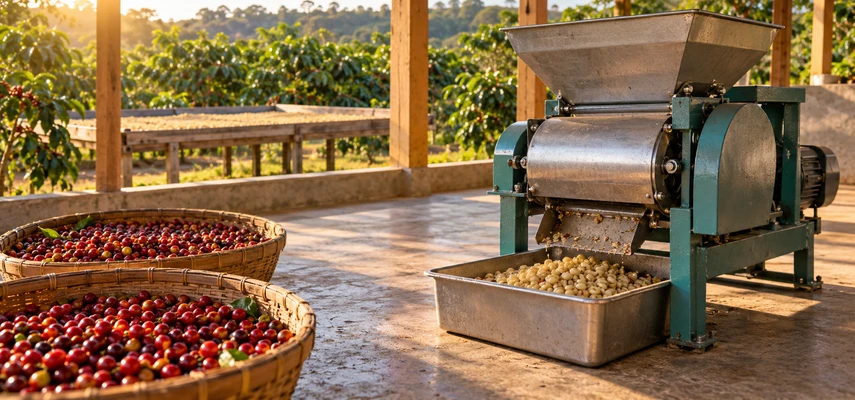

By the time you open a bag of coffee, most of its story has already happened. Someone raised the plants, harvested the fruit, separated and dried the seeds, checked their quality, and moved them toward a roaster. Your grinder gets a fairly late entrance.
Following that journey makes a coffee label much more useful. “Washed” describes something that happened before roasting. “Green coffee” is a stage of the product, not a promise about sustainability. And the roast date marks one important turning point in a much longer chain.
There isn’t a single factory-style route that every coffee follows. Farms and processing methods differ. But the main stages give you a clear way to understand how a small tropical fruit becomes the drink waiting beside your breakfast.
The journey starts with a plant
A coffee farm begins making decisions long before there are cherries to pick. Growers need suitable plants for their land, taking account of climate, disease, expected production, and the kind of coffee they can sell. Young plants may be raised in a nursery before moving to the field.
That early care matters because coffee is a perennial crop. A healthy young plant can contribute to years of harvests; poor planting material can create problems that last. Work on coffee seed and nursery quality focuses on getting that foundation right.
Then comes the ongoing work: managing soil fertility, weeds, shade where used, pests, and disease. Flowers eventually give way to fruit. You can admire the picture of a flowering coffee branch, but someone has to keep that branch healthy through weather and the growing season.
Harvest means picking fruit
Coffee beans begin as seeds inside cherries. The plant isn’t producing dry brown beans ready for a bag, however convenient that would be for everyone involved. The fruit has to be harvested and handled while its condition is still suitable for processing.
Selective picking collects ripe cherries while leaving less mature fruit for another pass. Strip picking removes fruit together, and mechanical harvesting is used where farm design and terrain make it practical. Each approach has implications for labor, speed, and the mix of fruit arriving at the mill.
The harvest stage helps set the possibilities for everything that follows. Later equipment can sort out some unwanted material, but it can’t turn every damaged or unsuitable cherry into excellent coffee. Good raw material gives the next person a better starting point.
Sorting begins before roasting
Fresh cherries may be sorted to remove leaves, twigs, damaged fruit, or other unwanted material. Some operations use water to help separate cherries by density, while others use different combinations of manual and mechanical sorting. The details depend on the processing setup.
These steps are part of post-harvest quality management, which extends from receiving fruit through later milling. A small farm, a cooperative washing station, and a larger commercial mill won’t necessarily have identical equipment or divide up the work in the same way.
What they share is a practical problem: fruit is perishable, and its seeds need to reach a stable condition without losing the qualities the producer is trying to preserve. Processing is much more than getting inconvenient skins out of the way.
Processing: three familiar paths
Natural coffee dries inside the fruit
In natural processing, the cherries dry with their fruit still around the seeds. Producers may spread them on patios or raised beds, managing the layer and turning the fruit as it dries. Later, the dried outer material is removed.
Keeping the fruit on during drying affects how the coffee develops, but it also makes care during drying especially important. “Natural” names a method; it doesn’t mean the producer simply leaves the fruit outside and hopes for the best. Nor does it automatically mean organic.
Washed coffee loses the pulp earlier
With washed processing, a depulper removes much of the outer fruit. Producers then remove the remaining sticky material around the seeds, often through fermentation and washing, before drying the coffee in its parchment covering.
Parchment is the protective layer surrounding the seed. If you see pale, papery-looking coffee drying at a washing station, you’re seeing a different stage from the green beans that reach a roaster. The words “washed” and “roasted” describe entirely different operations.
Honey processing keeps some sticky material
Honey processing removes the outer fruit but retains some mucilage, the sticky layer around the seeds, during drying. No bees are enlisted and no honey needs to be added. The name refers to the material left on the coffee.
These processing families offer a useful map, although exact practices vary. They can influence flavor without guaranteeing a particular result. A natural coffee isn’t required to taste like berries, and a washed coffee doesn’t arrive with all its flavor washed away.
Drying makes careful handling possible
Whether fruit stays on or comes off earlier, drying needs attention. The aim is to reduce moisture enough for the coffee’s next stages while avoiding uneven drying, contamination, or damage. Conditions that seem harmless in a photograph can matter a great deal over days of work.
Producers may use patios, raised beds, mechanical dryers, or a combination. They monitor and manage the process rather than relying on appearance alone. The ACIAR harvest and processing manual emphasizes clean drying areas, suitable moisture, and proper handling of parchment coffee.
Think of drying as preservation with consequences for quality. It helps prepare coffee for storage and transport, but it isn’t a way to freeze flavor forever. Once dried, coffee still needs protection from moisture and unsuitable storage conditions. The product may travel far before anyone roasts it.
Milling reveals the green coffee
After drying and any appropriate storage period, coffee moves through further preparation. Depending on the process used, hulling removes dried fruit layers or parchment. Sorting and grading can separate beans by size, density, or visible defects, using equipment, hand work, or both.
The result is green coffee, the unroasted seeds traded and shipped to roasters. “Green” here describes their state. It says nothing by itself about environmental certification, farming ethics, or whether the final cup will be good.
Not every coffee makes the same trip. A producer may also roast locally, while other coffees travel through exporters, importers, and warehouses before reaching a roastery. Samples may be assessed along the way. Each handoff needs information and care as well as a means of moving the bags.
Roasting changes the character of the seed
Open a container of green coffee and you won’t get the same aromatic greeting as a newly opened bag of roasted beans. Heat transforms the seeds, changing their color, structure, and chemistry while developing familiar coffee aromas. The roasting stage gives the product a very different character.
The roaster manages heat and time toward an intended result, then cools the beans to limit further roasting. A coffee intended for a bright filter brew may be treated differently from one designed around a heavier roasted profile. Light, medium, and dark are broad descriptions, with boundaries that differ between sellers.
Roasting involves physical changes as well. Beans expand, and roasters listen for cracking sounds during the process. Coffee science work on roasting and freshness explores the porous structure that develops and the gases released afterward. You don’t need the chemistry to appreciate how much the seed has changed.
Freshly roasted doesn’t mean finished changing
Roasted coffee continues to release gas, especially carbon dioxide, after leaving the roaster. At the same time, exposure to oxygen and other storage conditions can affect its aromas. This is why packaging and the time between roasting and brewing deserve attention.
Research on preserving freshness treats gas release and chemical changes as related but distinct parts of coffee aging. The practical lesson is less dramatic than the slogan “freshest is always best”: ask the roaster how to store the coffee and when they suggest brewing it.
There isn’t one rest period that suits every roast and brewing method. A roast date is useful information, not a countdown timer with the same deadline for every bag. Good storage helps protect the work that came before it.
Grinding and brewing finish the journey
Grinding exposes more surface for water to contact. The chosen grind needs to work with the brewer: water behaves differently in a press full of immersed grounds than in a compact espresso bed. Grind size belongs to the preparation, rather than being a universal setting labeled “good coffee.”
During brewing, water removes soluble material from the grounds. That process, extraction, brings flavor into the cup. A filter can also change how much oil and fine material reaches the drink. The basic brewing methods are different ways of managing that final meeting between coffee and water.
This last stage is where you have the most direct influence. Consistent quantities, a suitable grind, clean equipment, and water you enjoy drinking give you a more useful starting point than guessing everything afresh each morning. You don’t have to optimize every detail to notice a difference.
Read the bag as a record of decisions
Now a few ordinary label details tell a fuller story. Origin points toward the place and people behind the crop. A processing name tells you something about how fruit and seeds were handled. The roaster’s name and roast information describe another set of choices closer to your kitchen.
No single label term captures all that work. A beautifully roasted coffee still depends on its agricultural starting material, and an exceptional harvest still needs careful handling afterward. Quality builds across the journey; it doesn’t suddenly appear when someone prints a tasteful bag.
The next time you grind coffee, picture the cherries before the beans. Your cup is the last stop in a sequence of practical decisions made by people you may never meet. Understanding a few of those decisions makes the drink more interesting, and gives you better questions to ask when you find one you love.











