










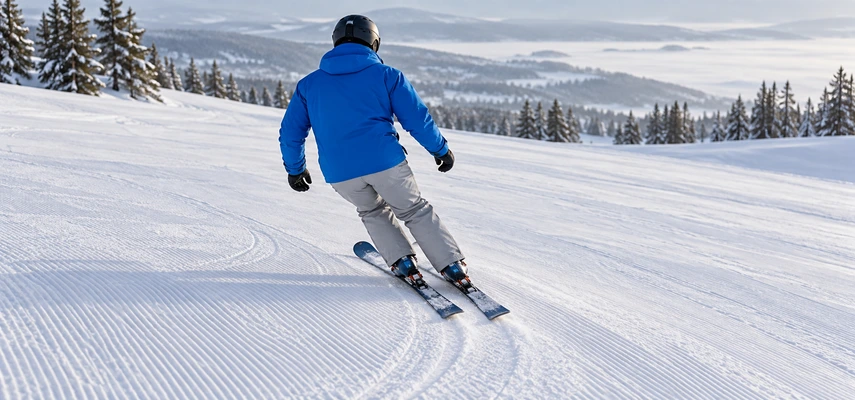

Parallel skiing can look like a simple change in arrangement: the ski tails stop pointing outward, and both skis begin traveling together. If appearance were the whole task, the instruction would be wonderfully brief. Just put them next to each other.
The real change is more useful. You learn to coordinate steering, edge release, and support so both skis can enter and shape a turn without depending on a wedge. Their relationship becomes the result of the movement rather than something you force into place.
Work with an instructor on easy terrain where your existing turns and stopping are reliable. Learning a new coordination shouldn’t require simultaneously coping with your most demanding slope. The wedge remains an available tool, not an embarrassing object you must discard by lunchtime.
Parallel describes the skis, not the whole quality of the turn
In a parallel turn, both skis point in broadly the same direction through the movement. They can remain separated by a comfortable width; parallel doesn’t mean touching.
They can also skid. A controlled brushed parallel turn is different from a clean carved turn, and both are legitimate skiing tasks. For a developing skier, the ability to shape a turn and manage speed matters more than producing the narrowest possible track.
The PSIA-AASI Eastern framework distinguishes wedge christies, basic skidded parallel turns, and more edged ski performance. That distinction prevents a common confusion: moving beyond the wedge doesn’t mean moving directly into advanced carving.
Judge progress by what the skis let you do. Can you steer them deliberately, maintain the intended path, and stop appropriately? Matching their appearance while losing those functions isn’t the goal.
Start where the old skill is comfortable
Choose open, gentle terrain selected with your instructor. You should be able to make controlled turns in both directions and stop reliably there. Leave enough attention available to notice a new movement.
Don’t move to a steeper slope because someone says speed will make parallel happen naturally. More motion may change the sensation, but it also reduces the margin for understanding and correcting the task.
REI’s parallel-turn progression begins with appropriate easy terrain and assumes established linked wedge turns. Its useful lesson is the foundation and setting, not a deadline for how many days learning should take.
Different learners may follow different progressions. An instructor can choose whether to explore matching at the end of a turn, edge release, or another supporting task. The right starting point depends on what you already do.
Keep the wedge small enough to remain mobile
An oversized wedge can make it harder to coordinate the legs and change their relationship. Your instructor may help you use a more comfortable shape while keeping speed manageable through a suitable path.
Don’t simply remove the braking effect you’re relying on and continue down the same demanding slope. If reducing the wedge makes control unreliable, simplify the terrain and task before proceeding.
Use rounded turns and the steering you already understand. The purpose is to make room for a different coordination, not to erase all existing control in pursuit of a more advanced-looking outline.
Avoid pulling the skis together with a strained upper-body movement. The change should emerge from the legs, support, and edge relationship. A quieter torso leaves those movements easier to feel and for the instructor to observe.
Understand why an inside ski may resist matching
The inside ski is toward the inside of the turn’s curve. During a wedge turn, its relationship to the snow differs from the outside ski’s. If it remains loaded and engaged on an opposing edge, it may resist being guided into a parallel relationship.
Trying to drag it sideways while it grips can create effort without a clean result. The useful question is whether it needs a change in support, a gentler edge angle, or a better steering movement—not simply more force.
Your instructor may ask you to lighten or flatten that ski enough to guide it more freely. That doesn’t necessarily mean lifting it off the snow. Keep the task and cue specific to what they observe.
Think of moving a chair whose leg is caught on a rug. Pulling harder isn’t always the best answer; first you notice what is preventing the movement. The analogy is about releasing an obstruction, not a literal mechanical model of a ski turn.
Matching often develops toward the end of a turn
Some progressions begin with the skis matching after the turn has developed, when the skier is moving farther across the slope. That can provide a manageable place to explore the relationship without demanding a fully parallel start immediately.
As coordination improves, the matching may occur earlier. The point isn’t to push it earlier regardless of the result. It should remain connected to useful steering, balance, and speed control.
The official term wedge christie describes turns in which a wedge develops into parallel skis during the turn. The timing can vary with ability, terrain, and confidence. It is a recognizable learning stage, not evidence that the skier is doing two incompatible sports.
Don’t copy a frame from someone else’s turn and assume it identifies the movement you need. An instructor can observe the whole sequence and distinguish a helpful transition from a forced shuffle that happens to end with matching skis.
Edge release makes a new turn possible
When the skis are engaged on one set of edges, those edges help resist sideways movement. To begin a turn in the other direction, the engagement must change so the skis can be guided into the new path.
Release means reducing the old edge engagement appropriately. It doesn’t mean losing all control or deliberately pointing straight downhill for a long distance. The transition belongs inside a coordinated, manageable turn.
Small movements of the feet and lower legs can change the edge relationship while the body remains supported. An instructor can choose a task that lets you feel that change safely before combining it with a more complex descent.
Avoid holding the old edges and trying to twist around them with the shoulders. That can make the new turn feel like a struggle. The useful sequence creates freedom for the skis, then guides them rather than waiting passively for gravity to select a route.
Let both legs participate
Parallel skiing isn’t one ski doing everything while the other is carried along as decoration. The legs coordinate their steering and edge changes, with support distributed appropriately for the task.
The outside ski commonly provides important support as the turn develops, but that doesn’t justify stamping on it or lifting the inside ski as a universal rule. Individual exercises may use such variations for a purpose; ordinary turning is a more coordinated activity.
A comfortable separation gives the legs room to work. Pressing the skis together can hide a lack of independence and make adjustments harder. Your anatomy and the situation matter more than an image of perfectly touching boots.
Ron LeMaster’s alignment discussion explains why body organization and support matter throughout skiing. For this stage, keep the objective simple: remain available to move while the skis work together.
Preserve the speed control you came with
Parallel skis can glide more freely than a braking wedge. That makes turn shape and controlled skidding especially important while you’re developing the new coordination.
Don’t chase a clean carved track if the immediate need is a slower, more manageable turn. A brushed path can give you the time and control needed to learn. Carving is a separate skill with its own progression.
If speed builds, return to easier terrain and ask the instructor to assess the route and ski action. Don’t solve acceleration by making a last-second movement you haven’t learned or by continuing until the slope flattens.
The NSAA responsibility code still requires control, avoidance of people ahead, and appropriate stops. Practicing a new technique doesn’t create a private exemption from the people using the same run.
Troubleshoot the pattern, not your identity
If one ski stays wedged, notice when it happens and in which direction. If the skis cross, catch, or accelerate, stop the experiment and return to a manageable task. Describe the pattern to the instructor.
Check fatigue and equipment discomfort as well as technique. A tired or painful leg can change how you support and steer. Persistent pain or numbness deserves assessment rather than a more determined attempt to match the skis.
Work on one useful change at a time. A single cue practiced repeatedly gives clearer feedback than trying to remember every parallel-skiing instruction you’ve ever heard during one turn.
Ask the instructor to identify where the difficulty begins: releasing the previous turn, guiding the skis into the next direction, or maintaining support as the turn develops. Those are different questions. If the skis match only at the end, that may be a useful stage to consolidate. If they start parallel but diverge when you become anxious, the task may need easier terrain rather than another command to squeeze them together. A short observed sequence gives more useful information than a long run judged only by its final few meters.
The transition is worthwhile when it expands your options. Both skis become easier to guide, the new turn begins without a wrestling match, and you retain control of the route. Parallel skiing then becomes something more satisfying than a corrected shape: a coordination you understand and can continue developing.












