










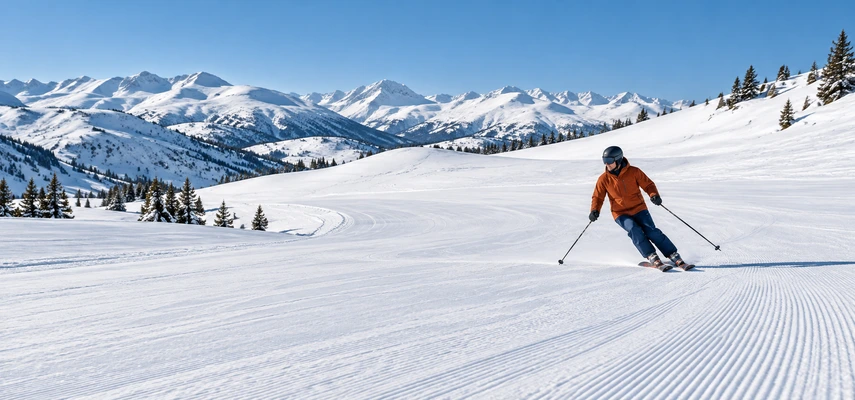

You can get down a blue run. What you’d like now is to enjoy the trip without negotiating with every turn. The difference between those two experiences is a useful place to work on your skiing.
Confidence on intermediate terrain isn’t permission to stop paying attention. It comes from having skills and decisions you can rely on: choosing an appropriate route, managing your pace, adapting when the snow changes, and recognizing when the day’s conditions ask more than you can comfortably provide.
This guide is for skiers who already turn and stop reliably on suitable intermediate slopes. If you’re preparing for your first blue, begin with a qualified instructor’s assessment and terrain choice. Here, the project is making familiar blue-run skiing more adaptable and less tiring, rather than collecting a harder trail color.
Treat blue as a category, not a promise
In North American trail markings, a blue square identifies intermediate terrain. It doesn’t promise the same experience at every resort or on every trail. The NSAA trail-signage guidance explains the relative nature of difficulty ratings within a ski area.
Even on one mountain, two blue runs may ask different questions. One could be wide and consistently groomed; another might include a narrower passage, an exposed pitch, or snow that changes through the day. The label is a starting point for inquiry, not a complete description.
Ask ski-school staff or patrol about current conditions and suitable progression. Be specific: you want a wide groomed intermediate route, for example, with no unexpected difficult exit. Check the return route as well as the attractive first section on the map.
Once you know a trail, keep reassessing it. Yesterday’s forgiving surface doesn’t reserve today’s conditions for you. A comfortable choice in morning visibility may become a poor practice venue in afternoon shadows and heavy traffic.
Build confidence from repeatable evidence
“Be confident” is a difficult instruction to execute. “Make controlled turns through this familiar section and stop in the planned place” gives you something observable.
Look for evidence that you can manage the task without a chain of rescues. Can you turn both ways at your chosen pace? Can you adjust the size of a turn when space changes? Can you stop deliberately, rather than waiting for the slope to flatten?
These questions don’t create a formal ability test. They help you describe your skiing to an instructor. Aspen Snowmass’s guide to lessons illustrates how ski schools distinguish levels through what participants can do and the terrain they can manage.
Keep a modest record after skiing: which run, what conditions, and what became more reliable. “I linked controlled turns on the lower pitch in soft groomed snow” is more useful than “I conquered blues.” It also reminds you that success has context, which makes your next decision more informed.
Use turn shape before adding speed
An intermediate plateau sometimes looks like skiing the same route faster without gaining more choices. That can feel like progress until the route becomes crowded, firm, or unfamiliar.
Work instead on making the path you intend. A rounded turn gives you a way to change direction through the arc rather than relying only on a sharp braking finish. The appropriate blend of steering and edging depends on snow, terrain, and the pace you choose.
REI’s parallel-turn instruction places practice on terrain where the skier is comfortable making a change. That’s a useful principle even after parallel turns are established: a skill is easier to examine when the slope isn’t consuming all your attention.
Avoid turning this into a demand for perfect carved tracks. Controlled skidded turns are useful skiing. The important question is whether the ski performance suits the task, not whether the tracks would impress someone studying them from a chairlift.
If pace keeps increasing despite your intended shape, ask an instructor to observe. You may be beginning late, rushing the turn, losing support, or choosing too much pitch. More determination doesn’t identify which problem you have.
Change one part of the challenge
Suppose you feel comfortable on one broad groomed blue. A sensible next experience might be another run with similar pitch and snow, rather than a narrow unfamiliar blue in flat light after lunch when your legs are tired.
You cannot control every variable on a mountain. Still, you can avoid deliberately increasing several at once. Ask which new route offers a modest change, and go with a qualified instructor if you need help judging it.
The same idea works within practice. Try a particular adjustment on an easy familiar section before asking it to survive the most demanding part of your day. If it works there, transfer it gradually with feedback.
This isn’t a ladder you must climb at every outing. Some days are better for consolidating what you already know. A useful day might end with more dependable turns on the same terrain, which is progress even if the trail map remains unimpressed.
Read the snow and the space ahead
Intermediate confidence includes noticing changes early enough to do something about them. Look beyond the immediate ski tips and keep updating the picture of the route ahead, including other people.
If a section looks shiny, scraped, deeply tracked, or hard to see, don’t assume it will behave like the snow under your feet. Approach within control and choose whether the route remains suitable. Visual clues are imperfect, so leave room for uncertainty.
Likewise, an open patch can close as other skiers move through it. Your intended turn doesn’t establish ownership. People downhill or ahead have priority under the NSAA responsibility code, and you must be able to stop or avoid them.
Choose visible stopping places that don’t obstruct traffic. Before starting again, look uphill and avoid others. These habits reduce the number of hurried decisions you have to make once moving, which is a very practical contribution to feeling organized.
Give your body room to respond
An anxious skier may become rigid or settle behind the feet. That can make directing the skis harder, which supplies fresh material for anxiety. The way out is usually a smaller task and useful movement feedback, rather than a stern instruction to relax.
Ask an instructor whether your position leaves the legs able to steer and adapt. A cue about the ankles might help one skier; another may need better timing between turns. There is no single body-position command that fixes every uncertain intermediate.
Pay attention to breathing and tension as information about the task. If you are bracing through every turn, choose easier terrain and reset. You don’t need to prove courage by repeating a sequence that you cannot currently manage.
Boot discomfort, fatigue, cold, or poor visibility can also change how you move. Solve the actual problem where possible. A boot-fit concern belongs with a qualified fitter, while exhausted legs may simply deserve a break.
Make a lesson specific
Tell the instructor what happens, not only what level you call yourself. “I can link parallel turns on this groomed blue, but I accelerate on the steeper middle section” gives them a useful problem to assess.
You might ask for help maintaining a chosen pace, making rounder turns, or adapting to modest variations in snow. Let the instructor select terrain and exercises appropriate to your movements and the day’s conditions.
After feedback, describe the difference you noticed. Did the adjustment make the turn easier to start? Did it help in both directions? Did it remain useful when you shifted attention back to the route? Those answers help turn a lesson cue into something you understand.
Before finishing, ask what to practice independently and what should wait for supervision. A demonstration intended to develop an instructor’s skill isn’t automatically your homework for the next crowded run.
Ski with people who respect the plan
A companion can make a new route more comfortable by agreeing on suitable terrain and sensible meeting places. They can also make it harder by disappearing over a rollover after announcing that it’s “basically easy.” Ask for concrete information instead.
Set the pace and route according to the skier who needs the most consideration. Don’t follow a faster person so closely that their line replaces your judgment. Keep enough space and attention to respond independently.
If the group wants different terrain, separate with a clear meeting arrangement rather than turning your afternoon into a reluctant qualification exam. Enjoyment is a reasonable goal for a ski day.
Know what a better run feels like
More confident blue-run skiing may feel quieter: fewer surprise accelerations, fewer last-second corrections, and more attention available for the mountain around you. It doesn’t have to feel faster.
Finish while you still have enough control and attention for the return route. Big Sky’s on-mountain safety guidance reinforces matching decisions to ability and conditions; that remains useful whether you’re on your second intermediate outing or your twentieth.
Choose appropriate terrain, make one skill more reliable, and notice what the snow actually asks of you. Confidence then has something solid underneath it: a growing collection of situations you’ve handled deliberately, with enough judgment to recognize the ones that should wait.












