










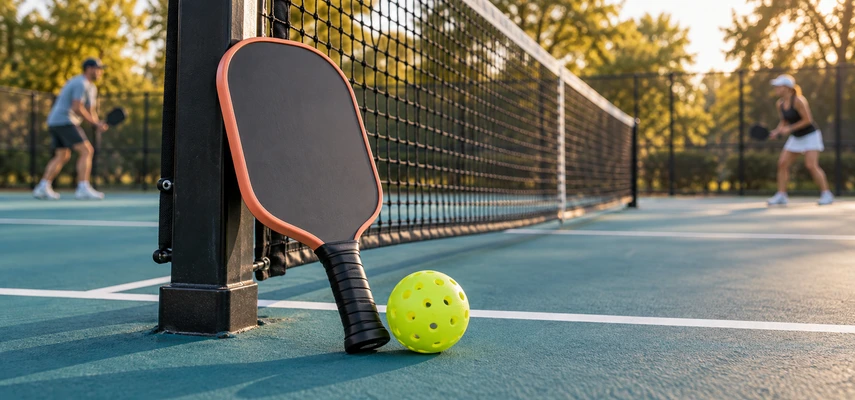

A good pickleball player can make you nervous by hitting the ball very gently. There you are, paddle ready, waiting for something impressive, and your opponent sends over a little floating shot that barely clears the net. Suddenly you’re reaching forward, lifting the ball awkwardly, and offering them the easy put-away you were hoping to hit yourself.
The equipment looks like it belongs at a backyard barbecue. The decisions can feel like chess with sneakers.
That’s the attraction: pickleball gives beginners a manageable way into a racket sport, then keeps revealing more beneath the surface. You can enjoy your first cooperative rally without understanding advanced tactics. Later, the same court becomes a fascinating argument about space, timing, patience, and when to stop being patient.
A paddle, a ball, and a surprisingly interesting court
Pickleball is played by two people in singles or four in doubles. Players use solid-faced paddles to hit a hollow, perforated plastic ball across a net, trying to make a legal return that the opposition cannot answer. It borrows familiar ingredients from tennis, badminton, and table tennis, but the recipe produces its own game.
The regulation court is 20 feet wide and 44 feet long for both singles and doubles. The net is 36 inches high at the sidelines and 34 inches at the center. A seven-foot-deep non-volley zone stretches across each side beside the net. Everyone calls it the kitchen, which makes otherwise serious court conversations sound faintly domestic. These dimensions appear in USA Pickleball’s introduction to the sport.
Compared with tennis, the playing rectangle is smaller, the implement has no strings, and the ball is plastic rather than felt-covered rubber. You don’t need a tennis-style overhead serve to begin. Nor do you need a table-tennis background: the ball bounces on a court you move around, rather than a table you stand behind.
Doubles shares the coverage between partners and adds the pleasure—and occasional confusion—of deciding who takes the ball in the middle. Singles leaves one player responsible for the whole width. The court stays the same size; the amount of help changes considerably.
Follow one rally
Imagine you’re serving in a friendly doubles game. Your first job is to send the ball diagonally into the opposite service court, beyond the kitchen. A serve that lands on the kitchen line is a fault. A fault is a rule violation that ends the rally.
There are two serving methods. A volley serve contacts the released ball before it bounces and has specific upward-swing, waist-height, and paddle-position requirements. A drop serve contacts the ball after a permitted drop and bounce; those three swing restrictions don’t apply. Both still have placement and foot-position rules. Unlike tennis, standard pickleball doesn’t give you a routine second attempt after a missed serve. USA Pickleball’s rules summary explains the distinctions.
The receiver lets your serve bounce and returns it. Your team must also let that return bounce before hitting it. Now the opening bounce requirement is satisfied, and either side can play a ball after a bounce or volley it—hit it before it bounces—subject to the kitchen restrictions.
Why those first two bounces matter
The two-bounce rule applies to the serve and its return, not to every shot for the rest of the rally. It also doesn’t mean letting the ball bounce twice on your side before answering it.
Its tactical effect is enormous. If you rush toward the net immediately after serving, a deep return can land behind you while you’re still required to let it bounce. Your enthusiasm has become a positioning problem.
The receiving side, meanwhile, can use the return to begin moving forward. That helps explain why serving in pickleball doesn’t automatically confer the commanding advantage a beginner might expect from watching tennis. The rule creates a contest over reaching a useful position, rather than simply following a big serve toward the net.
After the opening exchange, players rally until someone fails to make a legal return. For standard standing play, allowing a second bounce on your side loses the rally; official wheelchair and adaptive provisions can permit an extra bounce. The 2026 USA Pickleball Official Rulebook covers those variations.
The kitchen isn’t a forbidden room
You can stand in the kitchen. You can enter it to play a ball after it bounces. The restriction is on volleying while touching the zone, including its boundary lines, and on related momentum faults.
Suppose you volley from behind the kitchen line, then your follow-through carries you forward onto it. That’s a fault even if your shot has already ended the rally. Hitting the ball from a legal position doesn’t grant permission to fall into an illegal one afterward. If you’ve been standing in the zone, you must re-establish both feet completely outside it before volleying.
This buffer prevents players from simply camping beside the net and smashing everything downward. It leaves room for low, soft exchanges that would be much harder to sustain if an opponent could volley from inches away.
Think of it as a rule that changes the geometry of opportunity. Your opponent may be near the net, but they can’t erase every short ball by stepping closer and hitting it out of the air. That gives a carefully placed soft shot somewhere useful to go.
Why the soft shots matter
Pickleball has its own vocabulary, but four common shots explain much of what you’ll see.
A drive is a firmer shot intended to travel with pace. A volley is defined by when you hit it—before the bounce—rather than by how hard you swing. A dink is a soft shot played after a bounce near the kitchen, aimed into the opposing kitchen. A drop is a softer shot, often played from farther back, intended to descend into that same area.
The distinction between a dink and a drop matters because distance changes the task. Guiding the ball a short way across the net isn’t the same problem as sending it there from near the baseline. Both can make the opponent contact the ball low, but they arrive from different situations. USA Pickleball’s dink guide introduces the close-range version.
Low contact changes your options
Picture a ball arriving below the top of the net. To get it over, your opponent must give it some upward direction. Hit too hard without enough control and it may sail long; lift it too high and the next player may attack.
A ball arriving comfortably above net height offers more room to hit forward and downward. That’s why an unassuming soft shot can be more troublesome than a fast ball sent straight to a waiting paddle. The soft shot is trying to limit the reply, not win a speed contest.
None of this makes power obsolete. A drive can pressure an opponent, and an attackable high ball may deserve a decisive response. The developing skill is recognizing what the ball permits. Patience has a purpose: create a better opportunity before accelerating.
Scoring without the first-day headache
In traditional side-out scoring, only the serving side scores points. Games commonly go to 11, with a two-point winning margin. Winning a rally while receiving doesn’t add to your score; it moves your team closer to gaining the serve.
In doubles, both partners ordinarily get a serving turn before a side out transfers service to the opposition. The exception is the opening service sequence: the starting team gets only one server. That’s why a traditional doubles game starts with the call 0–0–2: serving score, receiving score, server number.
You don’t need to memorize the whole rotation before a supervised first game. Ask an experienced partner to call the score and explain where to stand. The important first distinction is between winning a rally and earning a point. USA Pickleball’s side-out scoring guide walks through the sequence.
Rally-scoring formats also exist, awarding points to the side winning the rally. Confirm the format before playing rather than assuming every club, league, and tournament uses identical procedures.
A backyard invention that outgrew the backyard
Pickleball began on Bainbridge Island, Washington, in 1965. Joel Pritchard, Bill Bell, and Barney McCallum developed the game using improvised equipment, including paddles and a perforated plastic ball, on a badminton court. Its origins are refreshingly practical: people wanted something enjoyable to play.
The name has acquired competing stories. USA Pickleball’s account credits Joan Pritchard with a reference to rowing’s “pickle boat,” rather than naming the sport after the family dog. The naming debate deserves its own exploration; you don’t need to settle it to return a serve.
What began as family recreation developed into organized clubs, tournaments, equipment businesses, and professional competition. That broad journey is documented in USA Pickleball’s history. Today’s recreational game and elite competition occupy the same sporting family without requiring the same commitments. You can enjoy a public-court game without adopting a professional training schedule.
What you need—and what you can borrow
For a first session, arrange a court, a suitable ball, and a paddle for each player. Borrowing a paddle is a sensible way to discover what feels comfortable before buying. Look for a handle you can hold securely and equipment in sound condition; advanced construction terminology can wait.
Wear court shoes suited to lateral movement and check that the surface is dry, clear, and usable. Bring water, allow time to warm up, and increase playing time gradually. A small court still asks you to stop, change direction, and respond quickly. Accessible doesn’t mean effortless or risk-free.
USA Pickleball’s safety guidance recommends appropriate footwear and protective eyewear. Choose eye protection designed for sport rather than assuming ordinary glasses provide equivalent protection. Take heat and fatigue seriously, coordinate with your partner, and don’t chase a ball into another active court. Medical concerns or persistent pain deserve qualified healthcare advice.
Your first good reason to come back
Find a beginner session through a community center, recreation department, or local club. Ask whether equipment is supplied, how court rotations work, and whether instruction is available. A welcoming group matched to your experience matters more initially than an impressive paddle.
Start with cooperative exchanges. Try to give your partner a playable ball, notice whether it has bounced, and learn the kitchen boundary. Agree who takes middle balls, make honest line calls, and stop play when a stray ball creates a hazard. These habits help everyone share a compact space.
Then enjoy the first rally that feels less like survival and more like a conversation. One ball goes over, another comes back, and you discover you have enough time to choose. That’s where pickleball begins to reveal itself: simple equipment, a few unusual constraints, and an endlessly interesting question about what to send back next.









