










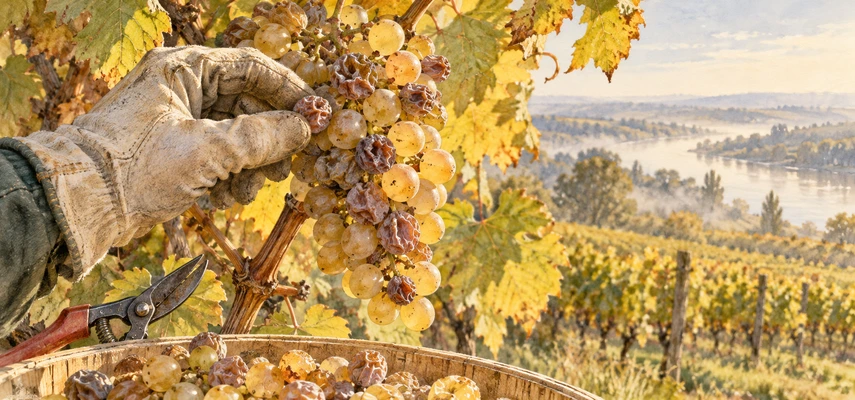

Bordeaux white and sweet wines ask growers to make two very different appointments with the same grapes. For a fresh dry white, the aim is healthy fruit with lively acidity. For Sauternes, growers wait for an extraordinary transformation: ripe grapes lose water under the influence of noble rot. One vineyard wants its harvest safely indoors while another is still watching the autumn weather.
The grapes overlap, but the timing, risks, labour and finished wines diverge. This lesson covers Entre-deux-Mers, Graves, Pessac-Léognan, Sauternes and Barsac in the WSET Level 3 specification. Questions and written exercises are original independent study material, not official WSET assessments.
Bordeaux white and sweet wines begin with three grapes
Sauvignon Blanc brings pronounced citrus, grassy or herbal aromas and relatively high acidity. It can supply the lift in a dry blend or counterbalance a sweet wine’s richness. Earlier harvesting helps preserve freshness, although picking before flavour ripeness can leave an excessively green wine. Site, crop and season influence the useful picking window. The Bordeaux wine council’s profile connects Sauvignon with both dry and sweet styles.
Sémillon contributes body and texture, often with less assertive youthful aromas than Sauvignon. Dry wines can develop waxy, nutty or honeyed complexity with suitable maturation and ageing. Sémillon is especially important in botrytised sweet wines because it is susceptible to noble rot and can give rich, concentrated juice. The regional Sémillon profile describes its role in dry blends as well as sweet wines. Susceptibility is useful only when the vineyard gets the right conditions; destructive rot remains a risk.
Muscadelle adds floral, grapey or musky perfume, commonly as a small blending component. Its name doesn’t make it Muscat. The variety can contribute to both dry and sweet blends, but its disease sensitivity makes vineyard care important. The Muscadelle profile describes its aromatic contribution and vulnerability. None of these roles supplies a universal recipe: producers can make markedly different wines by changing proportions and decisions.
Locate the styles before comparing them
Bordeaux’s maritime climate moderates temperature, but rainfall and humidity bring disease pressure. Dry whites benefit from a ripening period that develops flavour without losing too much acidity. Excessive heat can make that balance harder to retain. Sweet-wine growers need enough ripeness first, then weather that permits noble rot and drying rather than prolonged wet decay.
| Origin | Location and useful style expectation |
|---|---|
| Entre-deux-Mers | Between the Dordogne and Garonne, with rolling clay-limestone country. Its classic dry whites are fresh, citrus-led blends, usually intended for relatively early drinking. |
| Graves | South of Bordeaux on the Garonne’s left-bank side. Gravel, sand and clay vary between sites; dry whites range from straightforward fruit-led wines to richer oak-influenced examples. |
| Pessac-Léognan | The northern Graves area around Bordeaux’s southern and south-western outskirts. Its dry whites can combine freshness, concentration, barrel influence and development potential. |
| Sauternes | Farther south near the Garonne and Ciron. Gravelly rises and local autumn conditions support selective production of concentrated noble-rot sweet wines. |
| Barsac | Within the wider Sauternes area, with important limestone-based sites. Its sweet wines can combine richness and freshness; eligible producers may use Barsac or Sauternes. |
The Pessac-Léognan appellation council describes both dry whites and reds. This lesson concentrates on its whites; the name doesn’t designate a white-only appellation. Graves also makes red wines. Conversely, a dry white made by a Sauternes estate doesn’t automatically qualify for the Sauternes appellation.
Keep the syllabus and current labels separate: Entre-deux-Mers is traditionally taught through its dry whites, but the appellation also recognised reds from 2023. The Bordeaux wine council’s current appellation account records the change. Don’t repeat “white only” as a current legal rule. Geographical Entre-deux-Mers has long produced reds under other Bordeaux designations as well.
Fresh dry whites: protecting what is already in the fruit
For a fruit-led Entre-deux-Mers, the production chain aims to preserve aroma and acidity. Growers manage crop and canopy so healthy grapes reach flavour ripeness. In humid weather, airflow and disease monitoring matter. In heat, some shade can protect fruit. A decision that helps one vintage can be excessive in another.
Harvest timing balances acidity, sugar and aroma. Bringing grapes in promptly and protecting juice from unwanted oxidation helps retain fresh character. Gentle pressing, suitable clarification and temperature-controlled fermentation can produce a clean, aromatic wine. Stainless steel offers temperature control without adding oak flavours. Fermenting dry converts most grape sugar into alcohol; the wine doesn’t become sweet simply because the grapes were ripe.
Malolactic conversion is often prevented when the aim is crisp acidity. It isn’t a compulsory step in every white wine, and suppressing it requires appropriate cellar control. Keeping a wine briefly on fine lees can add texture without introducing the same flavours as new oak. The winemaker still needs to monitor lees condition and microbial stability.
Shorter tank maturation and earlier release reduce barrel expenditure and the cost of holding stock. Larger production volumes can spread fixed costs across more bottles. That helps explain accessible prices, although an individual producer may pursue a more ambitious style. “Affordable” describes a commercial position, not a fault in the glass.
Richer dry whites: oak, lees and balance
Graves and especially Pessac-Léognan provide important examples of more elaborate dry-white production. Sauvignon can keep a blend fresh while Sémillon supplies breadth. Fruit concentration must support whatever the cellar adds. New oak laid over thin fruit tends to announce the barrel more clearly than the wine.
Fermentation in barrel can integrate oak influence with the developing wine. Subsequent maturation on lees may build texture; bâtonnage redistributes those lees and can increase their interaction with the wine. It also adds labour and changes oxygen exposure. Stirring isn’t an automatic instruction to keep going until the wine tastes expensive.
Barrel size, age and toast affect flavour impact. Newer, smaller barrels usually provide more oak influence than older, larger vessels, all else equal. A portion of tank-fermented wine can preserve a sharper fruit expression in the final blend. Malolactic conversion may be limited or avoided to retain acidity; a creamy texture alone doesn’t prove that it occurred.
The Château Olivier white-wine account illustrates that blends and sensory profiles vary by wine and vintage. Treat an estate example as evidence of a possible approach, not a regulation for the whole appellation. Better dry whites can gain nutty or honeyed complexity in bottle, provided fruit and acidity remain balanced. Age doesn’t rescue a wine lacking those foundations.
Sauternes and Barsac: useful rot requires useful weather
Botrytis cinerea can act as noble rot on ripe grapes under suitable conditions. Humidity encourages its development; drier, sunnier periods allow water loss from affected berries. Sugar and other components become concentrated, and the fungus also changes the fruit’s chemistry and aroma. Honey, dried apricot, marmalade or saffron-like notes can appear in the resulting wines. It isn’t merely a sweeter version of fresh grape juice.
The cool Ciron and warmer Garonne contribute to autumn mist conditions locally. The Sauternes and Barsac growers’ account connects morning humidity, fine weather and selective picking. Mist alone isn’t the answer. If damp conditions persist, destructive rot can spread and the crop may become unsuitable. Château Suduiraut’s explanation makes this weather-dependent risk explicit.
Botrytis doesn’t progress evenly across a vineyard, a bunch or even adjacent berries. Pickers therefore return in successive passes, called tries, selecting suitably affected fruit. Waiting increases labour and exposure to weather; it also leaves less juice when berries have lost water. In an unfavourable year, excellent selection may mean making very little wine. Quality control doesn’t guarantee a profitable harvest.
Barsac is a distinct appellation rather than a lower classification tier. Eligible Barsac wine may instead carry Sauternes; the reverse doesn’t allow every Sauternes producer to claim Barsac. The classified-growth council’s geographical account explains the relationship and contrasting soils. Barsac’s freshness is a useful stylistic tendency, not a guarantee that every Barsac is lighter than every Sauternes.
Concentrated juice still needs careful fermentation
Shrivelled fruit supplies little, viscous juice and needs careful pressing. High sugar creates difficult conditions for yeast. Fermentation proceeds slowly and may stop with substantial residual sugar as alcohol and other stresses limit yeast activity. Producers monitor the desired balance and can stop fermentation using cooling and sulfur dioxide, followed by appropriate clarification and microbial control. No spirit addition is required: Sauternes isn’t a fortified wine.
Residual sugar makes stability particularly important. Living yeast plus fermentable sugar can restart fermentation in bottle. Filtration and sound hygiene help manage the risk, alongside other suitable controls. The AWRI’s packaging guidance explains why bottling is a technical control point, not just a change of container.
Barrel fermentation or maturation can add complexity and expense, but neither creates noble rot. Blending different parcels, picking passes or varieties helps balance richness, acidity, aroma and oak. A very sweet wine needs enough freshness and flavour intensity to avoid a heavy, tiring impression. In tasting, assess sweetness and acidity separately before deciding whether they work together.
Quality, classifications and the cost of waiting
The 1855 sweet-wine classification has three levels: Premier Cru Supérieur, Premier Cru and Deuxième Cru. Château d’Yquem occupies the first category. This is separate from the five red-wine tiers. The Bordeaux wine council’s classification guide sets out the distinction. A classification is useful label information; it doesn’t replace tasting the bottle or turn every wine from an estate into classified Sauternes.
For dry whites, expensive land, careful vineyard work, lower saleable yields, barrels and cellar time can raise costs. For botrytised wines, repeated hand picking and severe selection add labour while dehydration reduces juice volume. The weather risk is commercially significant too: costs accumulate before the grower knows how much suitable fruit will remain.
Transport, storage, applicable import charges and trade margins influence retail prices in both styles. Demand and estate reputation can add premiums beyond production costs, while limited demand can constrain prices despite costly production. An explanation of price therefore needs both sides: what the wine costs to make and what buyers are willing to pay.
Compare a fresh dry white and a noble-rot sweet wine by following the same chain: site and season, harvest decision, juice composition, fermentation, maturation, then the glass. You’ll explain far more than a list of aromas can. The same grape is capable of different jobs; the grower’s decisions determine which one it gets.
Knowledge check: 10 original questions
Choose one answer per question. These questions are independent educational practice.
1. What is Sauvignon Blanc’s most useful contribution to many Sauternes blends?
2. Why do growers revisit a Sauternes vineyard during harvest?
3. Which conditions most favour useful noble rot on ripe grapes?
4. Which statement best describes Muscadelle?
5. Why might a producer prevent malolactic conversion in a dry Bordeaux white?
6. Which statement about Barsac is correct?
7. What is the principal microbial concern when bottling a sweet wine?
8. Which interpretation of Entre-deux-Mers is appropriate today?
9. What explains low juice yields in noble-rot production?
10. Why doesn’t a creamy dry white prove that malolactic conversion occurred?
Answers and explanations
1. B — Balance in a sweet blend. Sauvignon’s acidity can keep a sweet, concentrated wine feeling fresh. It doesn’t prevent botrytis or remove residual sugar. The question asks about sensory balance, not a mandatory blend recipe.
2. D — Uneven development. Different berries reach useful concentration at different times. Successive selective passes allow pickers to collect suitable fruit while leaving other grapes to develop, increasing labour and weather exposure.
3. A — A weather sequence. Humidity supports infection, while dry conditions permit concentration through water loss. Persistent wetness can encourage destructive rot. The presence of the fungus alone doesn’t establish that the outcome will be desirable.
4. C — An aromatic component. Muscadelle can supply floral, musky or grapey perfume in dry and sweet Bordeaux blends. Its similar name doesn’t make it Muscat, and disease susceptibility remains a vineyard concern.
5. B — Preserving acidity. Malolactic conversion changes sharper malic acid into softer lactic acid. Preventing it can help retain a crisp style. It doesn’t sterilise the wine, alter grape identity or establish appellation eligibility.
6. A — A geographical choice. Qualifying Barsac producers can choose the broader Sauternes designation. That relationship doesn’t give every Sauternes vineyard the right to use Barsac, and it has no connection with a classification ladder.
7. C — Fermentation risk. Fermentable sugar provides substrate for surviving yeast. Appropriate microbial control, hygiene and packaging practices are therefore important. Cooling a wine earlier in production doesn’t by itself prove bottle stability.
8. D — Updated appellation knowledge. Entre-deux-Mers remains important for classic dry-white study. The current appellation also recognises reds from 2023, so older white-only descriptions need context. The region and the appellation are distinct concepts.
9. B — Concentration and selection. Dehydration leaves less juice per quantity of fruit. Rejecting unsuitable berries further reduces saleable volume. Those effects help explain costs without pretending that expensive production automatically secures high market demand.
10. C — Multiple routes to texture. Sémillon’s contribution, lees contact and maturation choices can build breadth or creaminess. Malolactic conversion is one possible influence, but texture alone isn’t sufficient evidence that it occurred.
Written exercise 1: explain the harvest cost
Question — 5 marks: Explain why harvesting grapes for a noble-rot sweet Bordeaux can be more costly per bottle than harvesting healthy grapes for a fresh dry white.
Indicative marking points: Award one mark each for uneven development; repeated vineyard visits; skilled selective hand labour; dehydration reducing juice; and rejected fruit or weather losses reducing saleable volume.
Model answer: Useful noble rot develops unevenly, so the whole crop cannot simply be gathered at one moment. Pickers revisit the vineyard, adding time and travel through the rows. Selecting suitable berries by hand requires careful labour. Water loss leaves less juice in the accepted grapes. Rejected berries and crop lost while waiting further reduce the number of bottles over which vineyard costs are spread.
Why it earns credit: The five points explain separate operational and volume effects. Merely saying the grapes are “special” or “more concentrated” would not account for all the extra costs.
Written exercise 2: design a fresh dry style
Question — 5 marks: Suggest five decisions that could help a producer make a fresh, fruit-led dry Entre-deux-Mers white, explaining each decision’s purpose.
Indicative marking points: Award one mark each for harvest preserving acidity with flavour ripeness; protection from unwanted oxidation; temperature-controlled fermentation; limiting new oak; and preventing malolactic conversion to retain acidity.
Model answer: Pick when flavour is ripe but acidity remains lively. Protect juice from unwanted oxidation to preserve fresh aromas. Control fermentation temperature to support a clean aromatic result. Use stainless steel or little new oak so wood doesn’t obscure fruit. Prevent malolactic conversion when retaining sharper acidity is part of the style. The combination aims at freshness rather than maximum richness.
Why it earns credit: Each decision is paired with an outcome. Alternatives can earn credit when correctly explained and suited to the brief; these are original educational marking suggestions, not an official WSET scheme.
One-page revision summary
| Topic | Causal connection to remember |
|---|---|
| Sauvignon Blanc | Acidity and citrus or herbal aroma help refresh both dry and sweet blends. |
| Sémillon | Body, texture and noble-rot susceptibility support dry blends and concentrated sweet wines. |
| Muscadelle | A small aromatic contribution can add floral perfume; it isn’t Muscat. |
| Entre-deux-Mers | Classic fresh dry whites come from between the rivers. Reds are also recognised under current rules. |
| Graves and Pessac-Léognan | Dry whites can gain complexity through blending, oak and lees; neither origin is white-only. |
| Noble rot | Ripe fruit needs suitable humidity followed by drying conditions. Persistent wetness risks destructive rot. |
| Sauternes and Barsac | Successive selective passes and dehydration reduce volume and increase labour. Eligible Barsac can be labelled Sauternes. |
| Fermentation and stability | Concentrated juice challenges yeast. Residual sugar requires appropriate microbial control; no fortification is required. |
| Classification | The 1855 sweet system has three levels, separate from the five red tiers. |
| Quality and price | Balance sweetness with acidity and flavour. Explain prices through production costs, distribution and market demand. |












