










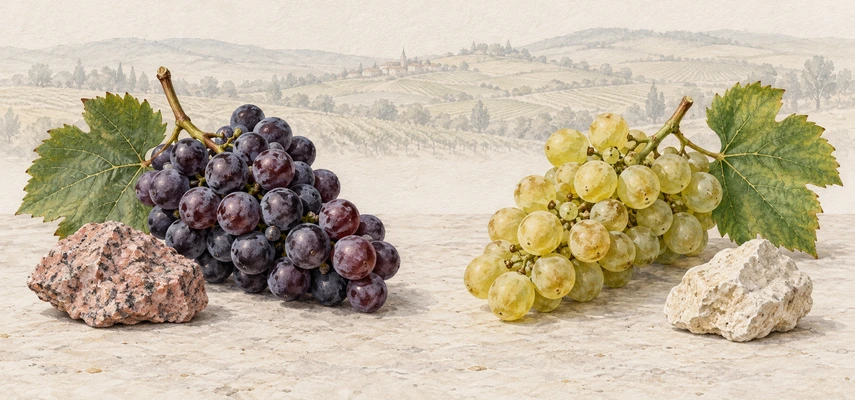

Southern Burgundy and Beaujolais can look like the quieter pages after the Côte d’Or’s famous names. That misses the interesting part. Here are Chardonnay wines shaped by warmer slopes, Pinot Noir villages with their own identities, and Gamay reds that range from a fresh harvest celebration to structured wines worth keeping.
Three grapes and several distinct districts share the journey south. This lesson follows the WSET Level 3 specification through the Côte Chalonnaise, Mâconnais and key Beaujolais appellations, connecting growing conditions and production choices with style, quality and price. Its practice questions and marking suggestions are original independent material, not official WSET assessments.
Southern Burgundy and Beaujolais on the map
Travel south from the Côte de Beaune and you reach the Côte Chalonnaise, west of Chalon-sur-Saône. Farther south, around Mâcon, the Mâconnais becomes increasingly important for Chardonnay. Beaujolais extends from south of Mâcon towards Lyon, with hills west of the Saône plain. Gamay dominates its reds, while a small white-wine sector uses Chardonnay.
The Côte Chalonnaise has a continental setting broadly comparable with the Côte d’Or, but a more broken pattern of hills and exposures. The Mâconnais generally receives warmer southern influences, helping Chardonnay reach ripe fruit flavours. Beaujolais also benefits from warmth, with altitude and exposure modifying individual sites. Southward latitude is useful orientation, not a command that every wine must be fuller or lower in acidity.
Frost, hail and fungal disease remain hazards. High or exposed sites can ripen differently from sheltered lower slopes. A warm season may produce generous fruit but require attention to acidity, drought stress and sunburn. The Bourgogne wine board’s climate account describes the increasing southern influence without removing local variation.
Côte Chalonnaise: four village names and a wider designation
Limestone and clay-rich soils, varied slopes and different exposures create a mosaic of growing conditions. Growers manage crop and canopy to ripen healthy fruit, balancing light and airflow against excessive exposure in hot weather. Early-budding Chardonnay and Pinot Noir can both suffer spring frost. Lower saleable yields and difficult hillside work increase the cost carried by each bottle.
| Designation | What to locate and expect |
|---|---|
| Bourgogne Côte Chalonnaise | A geographical denomination within regional Bourgogne, covering eligible sites in the district. Pinot Noir reds and Chardonnay whites can offer fresh, fruit-led introductions to the area. |
| Rully | In the northern Côte Chalonnaise. Both Chardonnay whites and Pinot Noir reds matter, with whites especially prominent; freshness can coexist with oak and lees influence. |
| Mercurey | Farther south in sheltered hills. Mainly Pinot Noir, often with ripe berry fruit and firm structure; Chardonnay whites also exist. |
| Givry | South of Mercurey, around hillside villages. Mainly Pinot Noir, with fragrant fruit and potentially substantial young tannin; a smaller white production uses Chardonnay. |
| Montagny | In the southern part of the district. A white-only Chardonnay appellation, offering citrus or stone-fruit character with freshness and possible maturation complexity. |
The official profiles of Rully, Mercurey, Givry and Montagny distinguish their colours and sites. All four have Premier Cru sites. The designation describes particular vineyard origins, not an annual ranking of producers.
Pinot Noir fermentation with skins extracts colour and tannin. Destemming, whole-bunch use, cap management and maceration time influence style; aggressive extraction can’t turn poor fruit into balanced wine. Malolactic conversion and oak maturation commonly help shape the final red. For Chardonnay, pressing, fermentation vessel, malolactic conversion and lees contact provide a different set of choices. Neither barrel use nor Premier Cru wording guarantees that the result will be balanced.
Mâconnais: Chardonnay becomes the main conversation
The Mâconnais has rolling hills, limestone outcrops and clay-limestone sites, with geological variation between villages. Warmth can support ripe peach or other stone-fruit character in Chardonnay. Suitable slopes and water supply still matter: a very warm site may need earlier picking to preserve balance, while a cooler exposure may retain freshness through a hot season.
| Designation | Origin and style connection |
|---|---|
| Mâcon | A regional appellation covering whites as well as reds and rosés. Chardonnay is central to the whites, while Gamay is important for the red sector. |
| Mâcon-Villages | A white-wine designation for qualifying Chardonnay from defined villages. Often fresh and ripe-fruited, it commonly offers an accessible price and relatively early release. |
| Pouilly-Fuissé | Southern Mâconnais around Fuissé, Solutré-Pouilly, Vergisson and Chaintré. Chardonnay can combine ripe fruit, concentration and freshness, with oak influence depending on the producer. |
| Saint-Véran | Sites around the southern Mâconnais, including areas bordering Pouilly-Fuissé. Dry white Chardonnay can show ripe fruit and rounded texture supported by acidity. |
The Mâcon account and Mâcon-Villages account separate the broader name from the white designation. Mâcon followed by an individual village name supplies another geographical detail; it isn’t the same wording as Mâcon-Villages.
Pouilly-Fuissé isn’t Pouilly-Fumé, the Sauvignon Blanc wine from the Loire. It also isn’t a Grand Cru. The current Pouilly-Fuissé sheet records Premier Cru recognition from 2020. Older claims that the entire Mâconnais has no Premier Cru wines are out of date. Saint-Véran remains a distinct appellation, not a second label automatically applied to every Pouilly-Fuissé parcel.
Co-operatives are important in the district, pooling facilities and enabling growers to share expensive equipment. Individual domaines and merchant businesses also make wine. Larger tanks, controlled fermentation and earlier bottling can preserve fruit and spread costs. More ambitious wines may use barrel fermentation, lees and longer maturation. Drouhin’s Pouilly-Fuissé account illustrates a tank-and-barrel approach; its proportions are a producer example, not a regional legal recipe.
Beaujolais: give Gamay a chance to be more than Nouveau
Gamay buds and ripens early, helping it mature within the season but exposing young growth to frost. It can be vigorous and productive, so crop control and site suitability matter. It generally supplies fresh acidity, red cherry or raspberry fruit and relatively modest tannin. More concentrated wines can have considerably more structure than that shorthand suggests.
Northern Beaujolais contains many granite-based hillsides, alongside other rocks and soils. Weathered granite can form sandy, well-drained soils that restrain vigour where fertility and water supply are limited. Southern Beaujolais has more clay-limestone areas, though neither half has a single uniform geology. Don’t attribute every difference in fruit flavour to one rock: exposure, crop and cellar choices also contribute.
Beaujolais is the broad appellation. Beaujolais Villages focuses on designated northern hill sites and often offers more concentration, while the ten crus identify individual appellations. The official Beaujolais Villages account describes the varied soils and styles. “Villages” doesn’t mean that every vineyard surrounding any village qualifies. White wines exist under the broader designations, but the famous crus are red Gamay contexts.
| Cru | Site and style reference |
|---|---|
| Brouilly | Around the lower slopes and surrounding country of Mont Brouilly. Varied soils support fruit-driven wines, often enjoyable young; it is separate from Côte de Brouilly. |
| Fleurie | Northern hills around Fleurie, with extensive pink granite. Floral perfume and a fine texture are useful tendencies, without excluding concentration or structure. |
| Morgon | Around Villié-Morgon, including the Côte du Py. Granite and weathered volcanic or schist-like materials contribute varied sites; fuller, structured wines can develop well. |
| Moulin-à-Vent | Near Romanèche-Thorins and Chénas, named for a windmill rather than a commune. Firm structure and ageing potential distinguish many examples. |
The regional profiles of Brouilly, Fleurie, Morgon and Moulin-à-Vent show the range. These aren’t four successive quality ranks. They’re origins, each with producer and vintage variation. The other six crus are Chénas, Chiroubles, Côte de Brouilly, Juliénas, Régnié and Saint-Amour.
Semi-carbonic fermentation: two processes in one vat
Beaujolais frequently uses whole bunches. In semi-carbonic maceration, grapes at the bottom of the vat break under the weight above. Yeast ferments the released juice, producing carbon dioxide. The increasingly oxygen-poor environment allows intracellular fermentation inside intact berries higher in the vat. Yeast fermentation in juice and this internal berry process coexist; the entire crop isn’t fermenting only inside unbroken grapes.
Carbonic maceration instead begins by deliberately providing a carbon-dioxide-rich environment for intact fruit. The AWRI’s technical account explains the intracellular process. In either case, pressing and ordinary yeast fermentation complete the transformation of sugar to alcohol. Carbon dioxide in the vat doesn’t mean the finished wine must be sparkling.
The Beaujolais council’s vinification guide follows the practical sequence. Shorter maceration can favour an aromatic, supple, early-drinking style. Longer skin contact and different cap management can produce more structure. Some producers destem fruit and use more conventional red-wine fermentation, especially for wines intended to mature. Barrel, large-vessel or tank ageing choices further diversify the results.
Banana or confectionery aromas can occur, but they aren’t compulsory Gamay flavours or proof of quality. Nor does the technique eliminate the need for sound fruit, hygiene and fermentation control. A structured Morgon and a light Nouveau may share grape and region while following different production goals.
Nouveau, maturity and the cost of a wine’s intended style
Nouveau describes an early-release style, not a separate appellation. Beaujolais and Beaujolais Villages can produce it; the crus aren’t labelled Nouveau. Release falls on the third Thursday of November, as explained in the regional council’s current account. Short maturation supports immediate fruit and lowers stock-holding costs. The objective is youthful drinking, not a competition to develop the most tertiary aromas.
A cru intended for development may involve stricter selection, more skin contact and longer maturation. That can raise labour, vessel and storage costs, but it doesn’t mean every cru requires new oak. Likewise, an excellent fresh Mâcon-Villages doesn’t need a barrel programme to justify its existence. Style and quality are related questions, not synonyms for weight and expense.
Land and grape prices, yields and vineyard labour affect production costs across all three districts. Co-operative facilities or efficient larger-scale production can spread some fixed costs. Transport, storage, applicable taxes and trade margins help determine shelf prices; demand and reputation can add premiums. Quicker release reduces financing time, though time-sensitive distribution may add logistical pressure for Nouveau.
Judge each wine’s balance, intensity, complexity and length in its own style. A young fruity Gamay can be very successful without needing a decade in bottle. A concentrated Chardonnay needs freshness to balance its breadth. The useful Level 3 answer explains how the producer arrived at that result, then separates what it costs to make from what the market will pay.
Knowledge check: 10 original questions
Choose one answer per question. These are original educational questions.
1. Which Côte Chalonnaise appellation is white-only Chardonnay?
2. What distinguishes Mâcon-Villages from the broader Mâcon designation?
3. Which statement about Pouilly-Fuissé is accurate?
4. What starts the carbon-dioxide supply in semi-carbonic maceration?
5. Why does a carbon-dioxide-rich vat not necessarily produce sparkling wine?
6. Which comparison is sound?
7. What does Nouveau mean in this context?
8. Why can co-operative production support accessible prices?
9. Which statement about the Beaujolais crus is correct?
10. What is the strongest explanation for managing Gamay crop levels?
Answers and explanations
1. B — Montagny’s colour. Montagny produces Chardonnay whites. Rully makes both colours, while Mercurey and Givry are mainly red with white production too. Remembering the dominant colour isn’t the same as identifying a white-only appellation.
2. D — Label specificity. Mâcon-Villages identifies qualifying white Chardonnay wine. The broader Mâcon designation also includes red and rosé production. A named village after Mâcon adds another geographical distinction, so complete wording matters.
3. A — Chardonnay and an updated hierarchy. Pouilly-Fuissé belongs to the Mâconnais and has recognised Premier Cru sites. It is distinct from Loire Pouilly-Fumé. Premier Cru recognition doesn’t make every Pouilly-Fuissé a classified-site wine.
4. C — Juice fermentation supplies gas. Grapes crushed by the weight above release juice, which yeast ferments. That creates carbon dioxide and allows intact berries to undergo intracellular fermentation. Both processes coexist within the vat.
5. B — Method versus finished style. A carbon-dioxide-rich maceration environment encourages an internal berry process. It doesn’t require gas to remain dissolved under pressure in the final bottle. Beaujolais made this way is normally still wine.
6. A — Qualified style expectations. The appellations offer useful stylistic reference points, but sites, vintages and producer choices vary. The names don’t identify yeast strains, guarantee oak flavour or make every wine Nouveau.
7. C — Early release. Nouveau describes a production and release style within eligible appellations. It isn’t a new appellation or a top cru tier. Short maturation aims to preserve immediate youthful fruit rather than develop long-ageing complexity.
8. D — Shared fixed costs. Members can use pooled pressing, fermentation and cellar equipment rather than each financing everything separately. Sharing facilities doesn’t remove vineyard work, standardise all fruit or abolish vintage effects.
9. B — Distinct origins. The crus are separate appellations, not an annually renewed producer ranking. Several can make structured, ageworthy Gamay. The four named in the question illustrate important contrasts without forming a quality ladder themselves.
10. C — Crop and site capacity. Productive vines still need enough resources and a suitable growing season to ripen the crop. Management aims for appropriate balance; the lowest possible yield isn’t automatically the best result and doesn’t remove other hazards.
Written exercise 1: explain semi-carbonic maceration
Question — 5 marks: Explain five steps or mechanisms involved in making a red wine using semi-carbonic maceration.
Indicative marking points: Award one mark each for whole bunches entering the vat; lower grapes breaking and releasing juice; yeast fermentation producing carbon dioxide; intracellular fermentation in intact berries in the oxygen-poor environment; and pressing followed by yeast completion of fermentation.
Model answer: Whole bunches fill the vat. The weight breaks some lower grapes, releasing juice. Yeast ferments that juice and produces carbon dioxide. The resulting oxygen-poor environment allows intact berries above to undergo intracellular fermentation. The fruit is then pressed, and ordinary yeast fermentation completes the conversion of remaining sugar to alcohol. The timing and extraction choices influence how supple or structured the final wine becomes.
Why it earns credit: Each point explains a separate stage or process. It doesn’t incorrectly claim that all alcohol is made inside unbroken berries or that the bottled wine must sparkle.
Written exercise 2: compare two Chardonnay production plans
Question — 5 marks: A fresh Mâcon-Villages is tank-matured and released early; an ambitious Pouilly-Fuissé uses barrels and longer lees maturation. Explain five possible style or cost differences.
Indicative marking points: Award one mark each for neutral tanks preserving fruit without wood flavour; barrels adding oak influence; lees affecting texture; barrel purchase/handling costs; and longer maturation increasing storage or stock-financing costs.
Model answer: Neutral tanks preserve a direct fruit expression without adding oak flavour. Barrel use can add toast or spice, depending on age and size. Longer fine-lees contact may build texture. Barrels cost money to purchase and handle, increasing production expenditure. Longer maturation also uses cellar space and delays income from the stock. These differences explain production goals and costs without proving that the richer wine is automatically better balanced.
Why it earns credit: Five distinct effects connect specific decisions with style or expense. Actual results depend on fruit and how the techniques are used. These are indicative educational points, not an official WSET marking scheme.
One-page revision summary
| Topic | Explanation to retain |
|---|---|
| Geography | Côte Chalonnaise, Mâconnais and Beaujolais follow one another southwards, with local hills and exposure modifying the general warmth trend. |
| Côte Chalonnaise | Rully makes both colours; Mercurey and Givry are mainly red; Montagny is white-only Chardonnay. Regional Bourgogne Côte Chalonnaise is a different designation. |
| Mâconnais | Chardonnay dominates the white sector. Mâcon is broader than white Mâcon-Villages; Pouilly-Fuissé and Saint-Véran are distinct origins. |
| Updated classification | Pouilly-Fuissé has Premier Cru sites recognised from 2020. It isn’t Pouilly-Fumé or a Grand Cru. |
| Gamay | Early development, vigour and fruit health require management. Fresh fruit and modest tannin don’t rule out concentrated, structured wines. |
| Beaujolais origins | Broad Beaujolais, northern Beaujolais Villages and ten crus identify different geographical scopes. |
| Four key crus | Brouilly often emphasises fruit; Fleurie fragrance; Morgon and Moulin-à-Vent can be more structured. These are tendencies, not guarantees. |
| Semi-carbonic | Yeast fermentation of released juice generates gas while intact berries undergo intracellular fermentation. Yeast completes fermentation after pressing. |
| Nouveau | Early-release style, third Thursday of November, from eligible Beaujolais or Villages wines rather than the crus. |
| Quality and price | Match assessment to intended style. Explain cost through grapes, labour, facilities, maturation, transport and margins, then add demand. |











