










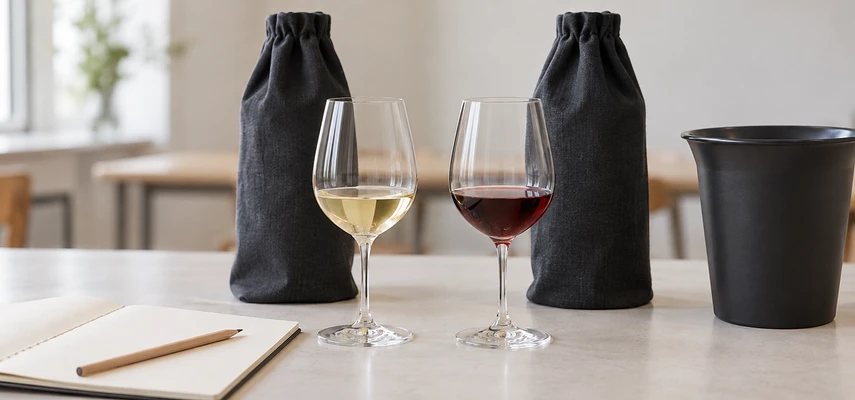

WSET Level 3 blind tasting practice works best when it produces a complete description and a defensible conclusion. The covered bottle removes label clues so you can concentrate on the wine. It doesn’t turn the exercise into a competition to name a grape, village or producer before anyone else.
This independent practice lesson combines the method in #44 with the quality reasoning in #45. It uses original fictional wine profiles and exercises, not copied examination samples or official marking keys. The assigned WSET specification is the reference for the examination format; consult the official SAT for its terminology alongside these original prompts.
Know the task before starting the clock
The tasting examination uses one white still wine and one red still wine in 30 minutes. The white carries 20 marks, the red 21 marks, giving 41 marks combined. The tasting pass requirement is 55% combined, rather than a separate 55% requirement for each wine. The theory components have their own separate pass requirements.
However, those figures don’t make a home tasting objectively self-marking. An actual wine needs a sensory reference and an appropriate marking judgement. Here, written scenarios let you practise reasoning from supplied facts. Real samples let you practise observation, which requires comparison and calibration with an approved educator to evaluate reliably.
The WSET exam-preparation overview confirms that the task is describing two still wines and drawing conclusions about quality and readiness. Exact origin isn’t the goal. If you recognise a familiar style, continue describing what is actually present rather than writing the note you expect that style to deserve.
Set up a small, controlled practice session
Ask a partner or educator to select sound white and red still wines, conceal the labels and keep the identities recorded separately. Use clean, comparable glasses and modest pours. Include water, a spittoon, a white background and a quiet place to write. Serve each sample appropriately; identical temperature isn’t required for two different colours and styles.
Before the tasting, remove strong fragrances and lingering flavours. WSET’s palate-preparation advice explains how competing smells and tastes affect perception. Avoid turning practice into drinking: spit, use small samples and take breaks between sessions. The useful outcome is a clearer note, not two finished glasses.
Later, retain the first note before discussing the wines or revealing labels. Otherwise, an attractive story about the producer can rewrite your memory of what you noticed. A practice log should show your original decision, the reference feedback, the reason for the difference and a specific action to try next time.
An original 30-minute rehearsal plan
Use the first two minutes to label your notes, check the glasses and scan the prompts. Spend minutes 2–13 on the white and minutes 13–25 on the red. Reserve minutes 25–30 for checking omissions, making the conclusions explicit and ensuring that the palate descriptions are actually written. This is a suggested study allocation, not a rule imposed by WSET.
Within each wine, move from appearance to nose and palate, then conclusions. Return briefly to uncertain features, but don’t spend half the session searching for one elusive aroma. Meanwhile, avoid neglecting the second sample because the first felt more familiar. Completeness across both wines is a more productive aim than an elaborate paragraph about one.
After the timer stops, draw a line under the timed work. Any extra observations belong in a separate practice section. That distinction tells you whether the difficulty was sensory recognition, recall of the framework or time management. Without it, an improved untimed note can disguise a repeated problem completing the actual exercise.
Original note prompts: write, then decide
These prompts are an original study aid, not a reproduction or substitute for the official tasting sheet. For each wine, make room for the following observations and consult the official terminology when choosing levels.
| Area of your note | Original prompts for the learner |
|---|---|
| Looking | Is it clear? How deep is the colour, what hue is visible, and is there anything else relevant? |
| Smelling | Does it seem sound? How expressive is it? Which specific scents can you support, and how developed does it seem? |
| Tasting structure | Assess sugar, salivation, drying grip where relevant, warmth and overall weight independently. |
| Tasting flavour | State flavour strength, name the characteristics actually present and follow what remains after spitting. |
| Judging quality | Which features support the chosen level, and what limits a stronger conclusion? |
| Judging readiness | Is it enjoyable now, and is there a convincing case for beneficial further development? |
Select one supported level where the task calls for one. Don’t hedge across several levels because you hope the correct answer lies somewhere in the range. The WSET tasting-exam tips also warn against missing categories, incomplete readiness and leaving palate flavours unwritten. Use those reminders when auditing the finished note.
Worked white-wine example: fresh detail and early readiness
Imagine a clear, pale lemon white. It is clean, with medium(+) aroma intensity, showing green apple, lemon, lime, pear and blossom. Its nose seems youthful. On the palate it is dry, with high acidity, medium alcohol, light body and medium(+) flavour intensity. Apple, citrus and floral flavours persist for a medium(+) finish.
A plausible original conclusion is good quality: the distinct fruit supports the high acidity, flavour has useful definition and persistence, and the wine is clean. Its fairly straightforward, youthful character limits the case for a stronger conclusion in this scenario. It is ready to drink now, with no convincing evidence supplied for beneficial further ageing.
From there, examine the chain of reasoning. High acidity doesn’t automatically make the wine excellent, and the absence of oak doesn’t make it inferior. The note supports a positive judgement through defined fruit, balance and persistence, then acknowledges limited complexity. The readiness recommendation concerns enjoying its current freshness rather than waiting for an unspecified transformation.
However, this model follows supplied facts. It isn’t a universal note for any grape, nor a guarantee that an actual sample described similarly will receive that exact quality assessment. If an educator judges the real wine differently, compare concentration, finish and complexity before arguing about the conclusion word alone.
Worked red-wine example: concentration with further potential
Imagine a clear, medium ruby red. It is clean, with pronounced aromas of black cherry, blackberry, blackcurrant, violet and vanilla, and a youthful nose. The palate is dry, with medium(+) acidity, high fine-grained tannin, high alcohol, full body and pronounced flavour intensity. Defined black fruit and spice persist through a long finish.
A plausible original conclusion is very good quality. Intense, distinct flavour and a long finish are positive evidence; the fruit supports the substantial structure rather than disappearing beneath it. Floral and spice detail add interest to the fruit. Further maturity could add complexity, while the current observations don’t require a claim that the wine is already outstanding.
It can be enjoyed now and has potential for ageing in this scenario. The tannin is fine, with enough fruit for present balance, while concentration, acidity and proportionate structure support a case for further development. This is conditional on suitable storage. It isn’t a promise that high alcohol or tannin alone guarantees future improvement.
By contrast with guessing identities, comparing the two examples shows how different styles can succeed. The white’s freshness can be its successful intended expression; the red’s concentration can support a different development path. A quality conclusion shouldn’t become a reward for being darker, heavier or more expensive. The evidence has to fit the sample in front of you.
Three original practical exercises
First, practise structural calibration with two educator-selected whites that differ clearly in acidity or residual sugar. Write the structural observations independently before discussing aroma. Then explain which sensation you used. This helps reveal whether a ripe-fruit smell has been mistaken for sugar, or whether salivation has been confused with a drying sensation.
After the structural comparison, practise finish and body separation with two contrasting reds. Record overall weight, flavour strength and flavour persistence as three separate judgements. After spitting, identify what remains rather than timing every sensation. A lingering grip can coexist with a short fruit finish; a lighter wine can carry precise flavour for longer than expected.
Later, run the timed two-wine rehearsal using unfamiliar samples and the schedule above. Keep the identities concealed until the first notes and conclusions are complete. Afterwards, ask an educator which observations were accurate, which fell within a reasonable tolerance and which need recalibration. A revealed label is useful context, but it isn’t sensory feedback by itself.
Review errors without inventing a home exam score
After the session, use a simple review log with four columns: your observation, educator feedback, likely reason and next action. For example, repeatedly overestimating acidity may call for paired reference samples. Repeatedly omitting readiness may call for a timed completion routine. These are different problems, so “taste more wine” isn’t a sufficiently specific remedy for both.
The WSET School London practice page demonstrates the value of sample-specific keys and model answers. This article doesn’t copy those materials. Use authorised practice resources for the actual samples involved, and ask an approved educator how to interpret borderline structural judgements and alternative accurate descriptors.
Finally, distinguish a completion check from a sensory accuracy check. You can verify that every category contains an answer and that your conclusion has supporting sentences. You can’t verify that the wine truly had high acidity merely because you wrote it confidently. Appropriate feedback and repeated, focused comparison are what make the practice increasingly reliable.
Knowledge check: Blind tasting practice
1. What is the main aim of this blind-tasting practice?
2. What is the tasting examination’s time allowance?
3. Which combination describes the tasting samples?
4. How are the tasting marks combined under the assigned specification?
5. Which statement correctly describes the tasting pass requirement?
6. What should happen before revealing labels during practice?
7. Which is a completion check rather than proof of sensory accuracy?
8. What should you record for palate flavours?
9. Which claim about the fictional red model is justified?
10. What makes feedback most useful?
Answers and explanations
1. C — Describe and assess. Removing labels helps focus attention on the wine. An exact identity guess isn’t a substitute for the analytical task.
2. B — Thirty minutes. The two-wine tasting has a thirty-minute allowance. The suggested division within that period is an original practice plan.
3. D — Two still wines. The specification calls for one white and one red still wine. Sparkling and fortified study doesn’t change that tasting format.
4. A — Forty-one combined marks. The assigned specification allocates twenty to the white and twenty-one to the red. These are examination figures, not invented home sensory scores.
5. C — A combined tasting result. The fifty-five-percent tasting requirement applies across the two wines combined. Separate theory requirements still apply.
6. B — Preserve the original judgement. Recording first prevents label knowledge from rewriting your observations. It gives feedback a useful point of comparison.
7. D — An answer can be complete yet wrong. Checking all categories catches omissions. Sensory accuracy still needs the wine and appropriate reference feedback.
8. A — Write the actual flavours. An explicit palate description supplies assessable information. Leaving it implicit doesn’t communicate the observed characteristics.
9. C — A supported conditional forecast. The scenario supplies fruit and appropriate structure together. Neither tannin alone nor an arbitrary exact date follows from those facts.
10. B — Match the remedy to the problem. A sensory calibration issue needs a different response from repeated omissions or weak reasoning. Specific feedback directs useful practice.
Written exercise 1: Audit the white model’s conclusion (5 marks)
Using the supplied fictional white, explain five points supporting its quality or readiness conclusion. Do not guess a grape or add features absent from the scenario.
Model answer: Clear fruit supports a positive intensity judgement. That fruit balances the high acidity rather than being overwhelmed. Recognisable flavour lasts beyond the initial sip, supporting useful length. Fairly straightforward youthful character limits the claim to exceptional complexity. The current fresh, balanced expression supports drinking now, while the supplied evidence doesn’t establish beneficial further ageing.
Why it earns credit: Award one practice mark each for (1) intensity, (2) explained balance, (3) flavour length, (4) a complexity limitation and (5) readiness supported by the scenario. This evaluates reasoning from supplied facts, not actual sensory performance or an official key.
Written exercise 2: Design a targeted follow-up session (5 marks)
A learner repeatedly confuses fruit aroma with sweetness, times alcohol warmth as finish, and leaves the second wine’s conclusion incomplete. Design five useful actions for the next practice session.
Model answer: Use educator-selected dry and sweeter reference samples to calibrate actual sugar perception independently of fruit aroma. After spitting, name the flavours that persist rather than timing warmth alone. Set a checkpoint to move from the first wine to the second within the thirty-minute rehearsal. Reserve the final minutes to complete both conclusions and check omissions. Compare the retained independent notes with educator feedback, recording the specific correction and next action.
Why it earns credit: Award one practice mark each for (1) sweetness calibration, (2) flavour-focused finish, (3) a transition checkpoint, (4) a conclusion review and (5) feedback linked to the original note. These are learning-process credits rather than a sensory examination score.
One-page revision summary
| Practice element | Action | What it checks |
|---|---|---|
| Format | One white still wine, one red still wine, 30 minutes | Familiarity with the assigned examination task |
| Assessment context | White 20, red 21, combined 41; 55% combined tasting pass | Correct distinction from separate theory requirements |
| Set-up | Sound samples, concealed labels, clean glasses, water and spittoon | Fair sensory conditions |
| First note | Write before discussion or label reveal | Independent observation |
| White model | Fresh fruit, acidity, definition and useful persistence | Quality and early-readiness reasoning |
| Red model | Concentration, supported structure and long flavour | Conditional further-potential reasoning |
| Calibration exercise | Compare selected structural references | Sugar, acid, tannin and warmth distinctions |
| Finish exercise | Separate weight, flavour strength and persistence | Independence of body, intensity and length |
| Timed rehearsal | Suggested 2-minute set-up, 11-minute white, 12-minute red, 5-minute review | Completion under pressure |
| Review log | Original observation, feedback, reason, next action | Targeted improvement |
| Completion versus accuracy | Filled categories versus correct sensory judgements | Limits of unsupported self-scoring |
Repeat the same type of targeted exercise before increasing the number of wines. A corrected, well-understood observation is more useful than a larger collection of unexamined guesses.












