










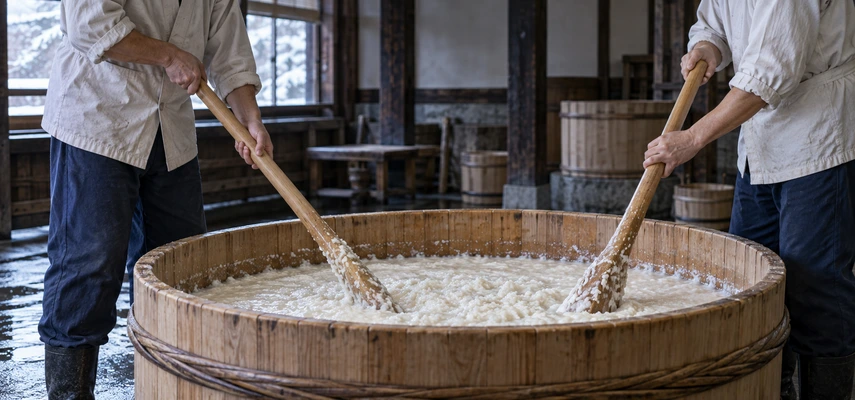

What makes a starter traditional: the wooden tools, the time it takes, or the way acidity develops? For kimoto, yamahai and mizu-moto, the most useful starting distinction is microbial. These traditional sake starters use lactic acid bacteria to establish acidity rather than relying on the direct prepared-acid approach of conventional sokujō. They still require skillful management of a changing environment.
The three methods appear together in the WSET Level 3 specification, but they aren’t interchangeable. Kimoto includes distinctive physical working of the starter material; yamahai omits that particular work; mizu-moto begins through an acidic-water preparation. Understanding how each reaches a suitable environment is more useful than calling them all rustic.
Traditional sake starters manage microbial change
A starter must support a useful yeast population for the main mash while limiting unwanted organisms. Lactic acid bacteria help alter the environment by producing lactic acid. As acidity, nutrients and other conditions change, different organisms find the medium more or less favorable. The process is managed development, not a promise that every microbe present is desirable.
The NRIB explanation of kimoto and yamahai contrasts bacterial acid formation with direct acid use in sokujō. Both routes create acidity, but their histories differ. That difference can affect the chemical environment in which yeast develops, even if a measurement at one later moment happens to look similar.
Therefore, don’t define a traditional starter merely as one with no lactic acid. Lactic acid is central to the explanation. What differs is how it gets there. The accurate contrast is between acid generated through the starter’s microbial development and prepared acid deliberately added in the conventional modern approach.
Kimoto includes yamaoroshi
Kimoto is associated with yamaoroshi, the traditional working and breaking down of the rice-and-kōji mixture using paddles. This labor helps physically distribute and soften the material within starter preparation. It is not pressing finished sake from its lees, nor is it a separate form of alcoholic fermentation carried out by human muscle.
The physical treatment and the microbial development occur within a controlled temperature course. Kōji enzymes act on rice components, lactic acid bacteria contribute acidity, and yeast later becomes established as the useful fermenting population. The timing and condition of the material matter because each stage changes the environment inherited by the next.
For example, working the mixture changes its physical state and distribution. Temperature management influences both enzyme action and microbial activity. Those are different mechanisms, even though they contribute to the same developing starter. A strong explanation names the particular function rather than claiming the paddles somehow manufacture the final sake’s savory taste directly.
A familiar succession is a model, not a script
Traditional explanations often describe early microbes followed by lactic acid bacteria and eventual dominance of the desired sake yeast. In some kimoto systems, nitrate-reducing bacteria and the temporary presence of nitrite form part of the early selective environment. Acidity, sugar and temperature then contribute to further selection as the starter develops.
However, real brewery communities vary. A primary study of kimoto development examines bacterial and chemical changes rather than assuming an identical sequence in every batch. Use microbial succession as a framework for understanding environmental change, not a compulsory cast list that every brewery must reproduce exactly.
That qualification improves precision. If a particular organism is absent or behaves differently, the brewer still needs a suitable outcome. The relevant learning question is which conditions favor the useful population and constrain competitors. Remembering a diagram without that mechanism leaves you unable to explain why the sequence matters.
Yamahai removes a task, not the need for control
Yamahai abbreviates a name referring to the abolition of yamaoroshi. The particular grinding or working associated with kimoto is omitted. The method still relies on enzyme action and lactic acid bacteria as part of developing a suitable starter. It is not simply kimoto with all management removed.
The omitted physical task means the brewer uses a different handling approach to obtain useful breakdown and development of the material. Prepared rice, kōji activity, temperature and time remain important. Consequently, describing yamahai as “do nothing and wait” misses both the biochemical work and the human decisions that guide it.
Nor does the omission guarantee that yamahai is faster or slower than every kimoto example. Specific schedules depend on brewery practice and material development. Compare the defining process difference first. Use claims about duration only when a source and context support them, rather than turning one producer’s timetable into a universal rule.
Mizu-moto begins with acidic water
Mizu-moto, also written mizumoto, uses a distinct preliminary route to acidification. Raw rice and water support lactic acid fermentation that creates acidic water called soyashimizu. That prepared acidic liquid is then used with steamed rice and kōji in subsequent starter development. The separate water-preparation stage is the point that distinguishes the explanation from kimoto and yamahai.
A 2025 primary study of mizumoto documents microbial and chemical shifts through those stages. Its observed sequence shows how an initial lactic-acid environment helps constrain unwanted organisms before the later fermentation develops. The study’s particular schedule and measurements describe the system examined, not a mandatory recipe for every brewery.
Related historical and modern accounts also use the term bodai-moto. Do not assume every named revival or producer method is identical in every operation. For this syllabus comparison, explain the mizu-moto principle clearly: an acidic-water preparation precedes its use in the later rice-and-kōji system. That is more informative than merely naming a temple or repeating an origin legend.
Temperature helps select the next stage
Temperature affects enzymes and microorganisms differently. Managing it changes the pace of breakdown and the conditions favoring particular populations. A warming or cooling decision therefore belongs within the microbial explanation, not as an optional technical detail appended after the history.
Likewise, sugar concentration and acidity change through the process. A useful environment for an early stage may not remain the desired environment later. The brewer observes the developing material and guides its transition. Traditional methods require attention precisely because the medium is changing rather than remaining a fixed mixture of ingredients.
This does not imply that every starter must be entirely spontaneous. Breweries can use selected yeast within traditional starter approaches. The source of lactic acidity and the source of the eventual yeast are separate questions. “Bacterial acid development” is not automatically a claim that no cultivated yeast can be introduced.
Process differences can influence style without fixing it
Different starter histories can affect the nitrogen compounds, acids and other material available to yeast. These differences may contribute to fermentation behavior and the final sake’s texture or flavor. Some kimoto and yamahai sakes are associated with pronounced acidity, savory character or a full palate, but those are supported tendencies rather than necessary definitions.
The NRIB and JSS guide places starter choices within the wider production system. Rice polishing, kōji, yeast, main fermentation and finishing can reinforce or moderate a tendency. A kimoto daiginjō and a fuller less-polished kimoto need not produce the same experience simply because they share a starter family.
Conversely, richness does not prove a traditional starter. A sake made through a different method can show overlapping sensory features. In blind tasting, such features support a hypothesis only when considered together and with appropriate uncertainty. One savory note is not a laboratory certificate of starter identity.
Compare with sokujō without repeating the whole lesson
In conventional sokujō, prepared lactic acid supplies the early acidity directly. Kimoto and yamahai develop that acidity through lactic acid bacteria within their starter process. Mizu-moto does so through the initial acidic-water stage. All three comparisons concern the route and history of acidification, not a division between acidic and acid-free sake.
The practical contrast also includes management needs. Direct acid addition avoids waiting for the same bacterial acidification sequence; traditional routes manage that sequence as part of preparation. Neither category guarantees quality. The brewer must achieve a suitable yeast population and then guide the main fermentation toward its intended result.
Work a causal answer from method to consequence
Suppose an examination asks why kimoto can differ from sokujō. Begin with the origin and development of acidity. Explain that the microbial and enzymatic history changes the starter medium over time. Then connect that medium to yeast development and possible flavor contribution, while acknowledging the role of later production decisions.
If the question asks the difference between kimoto and yamahai, begin with yamaoroshi rather than reciting that both can taste rich. If it asks mizu-moto, identify soyashimizu and its preparation. The name being compared determines the relevant mechanism. Repeating the same generic natural-versus-modern answer three times would miss those differences.
For practical calibration, include a kimoto or yamahai junmai and a kimoto or yamahai daiginjo or junmai daiginjo. Describe the samples blind, then reveal the confirmed starter and grade. Ask how aromatic delicacy can coexist with a traditional starter. These contrasting examples help separate the starter mechanism from a compulsory rich or rustic flavor stereotype.
Traditional starters are easier to understand beside the added-acid approaches and the later main-mash process. Test the sensory limits of the comparison in blind production-technique practice.
One-page revision summary
Kimoto includes yamaoroshi; yamahai omits that work while retaining bacterial acid development. Mizu-moto establishes acidic soyashimizu before later starter use. In each case, temperature, enzymes and changing microbial conditions help establish useful yeast. Compare the actual routes to acidity, then qualify any sensory implication. Traditional is a process context, not an automatic guarantee of one taste or superior quality.
Written practice: original TFE exercises
These suggested marks and indicative points are independent teaching guidance, not official WSET marking schemes.
Exercise 1: 5 suggested marks
Explain the defining process difference between kimoto and yamahai, and one important feature they share. Mapping: Unit 1 LO1.
Indicative marking points:
- Kimoto includes yamaoroshi.
- Yamaoroshi physically works and breaks down starter material.
- Yamahai omits that particular operation.
- Both rely on lactic acid bacteria to develop acidity in the conventional comparison.
- Both still require management to establish useful yeast for later fermentation.
Model answer: Kimoto includes yamaoroshi, the physical working and breaking down of the rice-and-kōji mixture. Yamahai omits that particular task. Both conventionally rely on lactic acid bacteria to establish acidity and still need temperature, enzyme and microbial management to develop a useful yeast population for the main mash.
Why it works: The answer identifies the physical difference without confusing it with their shared route to acidification and starter purpose.
Common mistake: Saying yamahai omits lactic acid bacteria or requires no active management.
Exercise 2: 5 suggested marks
Explain how mizu-moto establishes an acidic environment and why that does not guarantee one finished flavor. Mapping: Unit 1 LO1 and LO2.
Indicative marking points:
- An initial raw-rice and water preparation supports lactic acid bacteria.
- They produce acidic water called soyashimizu.
- That acidic water is used in subsequent rice-and-kōji starter development.
- Acidification helps manage microbial conditions for later yeast fermentation.
- Later ingredients and production choices still influence the final sensory result.
Model answer: Mizu-moto begins by developing lactic acidity in a raw-rice and water preparation, producing soyashimizu. This acidic water enters subsequent starter development with steamed rice and kōji, helping establish a selective environment for fermentation. The route can influence the medium, but yeast, rice preparation, main fermentation and finishing still shape the sake, preventing a guaranteed single flavor.
Why it works: It gives the distinctive preliminary stage, traces its function and qualifies the later sensory consequence.
Common mistake: Describing mizu-moto as simply another name for aged sake or assuming acidity alone identifies the finished flavor.
Knowledge check: 10 original practice questions
Independent TFE questions, not official WSET examination items. Choose one answer per question; explanations follow separately.
1. What do all three prescribed traditional approaches ultimately need to support?
2. What is a useful purpose of temperature management during starter development?
3. Which sensory claim is defensible?
4. Which operation is associated with kimoto?
5. What is omitted in the defining yamahai comparison?
6. Why is microbial succession better treated as a framework than an identical script?
7. Which statement about selected yeast and traditional starters is accurate?
8. What is soyashimizu?
9. Which is the best answer focus when comparing kimoto with yamahai?
10. What distinguishes conventional traditional starter acidification from sokujō?
Answers and explanations
1. D — Useful yeast for subsequent alcoholic fermentation.. Despite different routes to starter development, the later fermentation still needs suitable yeast and conditions. Mapping: Unit 1 LO1 Range 4; LO2 Range 4.
2. C — To influence enzyme activity and microbial development through the stages.. Different stages and organisms respond differently to the temperature course. Mapping: Unit 1 LO1 Range 4; LO2 Range 4.
3. A — Starter history can contribute to style, but later production choices can modify the result.. The full system produces the finished sake, so starter tendencies cannot be treated as universal signatures. Mapping: Unit 1 LO1 Range 4; LO2 Range 4.
4. D — Yamaoroshi working of the starter material.. Yamaoroshi is a physical operation within starter preparation, not a finishing process. Mapping: Unit 1 LO1 Range 4; LO2 Range 4.
5. A — The yamaoroshi operation.. Yamahai removes the particular physical task while retaining managed biological and chemical development. Mapping: Unit 1 LO1 Range 4; LO2 Range 4.
6. B — Brewery communities and conditions vary while the process still needs a suitable outcome.. The mechanism concerns changing selective conditions; exact populations need not repeat a single diagram. Mapping: Unit 1 LO1 Range 4; LO2 Range 4.
7. D — Selected yeast can be used; acid origin and yeast source are separate questions.. Bacterial acid development does not automatically imply a completely uninoculated yeast fermentation. Mapping: Unit 1 LO1 Range 4; LO2 Range 4.
8. C — Acidic water prepared through lactic fermentation in a mizu-moto approach.. The acidic-water preparation is central to distinguishing mizu-moto from the other starter routes. Mapping: Unit 1 LO1 Range 4; LO2 Range 4.
9. B — The yamaoroshi difference and their shared bacterial acid development.. The question’s defining process distinction should lead the explanation, with sensory implications qualified. Mapping: Unit 1 LO1 Range 4; LO2 Range 4.
10. B — Traditional methods develop acidity through lactic acid bacteria rather than direct prepared-acid addition.. The relevant distinction is the source and development of acidity, not the presence versus absence of acid. Mapping: Unit 1 LO1 Range 4; LO2 Range 4.












